Recent Articles

Forced and natural dynamics of a clamped flexible fiber in wall turbulence

Giulio Foggi Rota, Morie Koseki, Riya Agrawal, Stefano Olivieri, and Marco Edoardo Rosti

Phys. Rev. Fluids 9, L012601 (2024) - Published 12 January, 2024

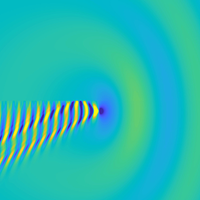
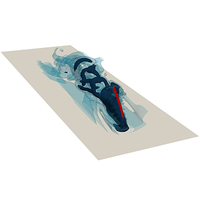
In turbulent flows, slender flexible bodies exhibit complex motions such as the swaying of seagrass or the oscillations of a pylon in the wind. Here we characterize the dynamical behavior of a clamped flexible fiber immersed in wall turbulence over a wide range of natural frequencies by DNS. Only two flapping states are possible: one where the fiber oscillates at the characteristic frequency of the largest turbulent eddies and another where the natural structural response dominates. We observe for the first time that in the turbulence dominated regime the fiber always sways at a frequency proportional to the largest scale of the flow, regardless of its structural parameters.

Marangoni vortex rings in miscible spreading

Anurag Pant and Baburaj. A Puthenveettil

Phys. Rev. Fluids 9, L012701 (2024) - Published 11 January, 2024

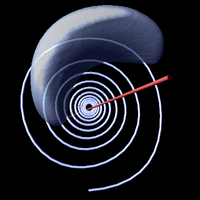
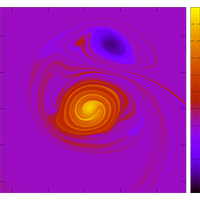
This work investigates the dynamics of a unique, radially expanding vortex ring in a water layer when a miscible, volatile drop of ethanol spreads as a film on the air-water interface. The study unravels the link between the dynamics at the interface and the generation of vorticity in the water layer below it. A novel scaling is proposed for the radius and velocity of such vortex rings, where they are shown to be dependent on time as well as the properties of the drop and the substrate.

Air-cushioning below an impacting wave-structured disk: Free-surface deformation and slamming load

Yee Li (Ellis) Fan, Utkarsh Jain, and Devaraj van der Meer

Phys. Rev. Fluids 9, 010501 (2024) - Published 10 January, 2024

A radially symmetric sinusoidal wave structure is imprinted on an impacting circular disk to modulate the way the disk forces the free water surface. The experiments support the argument that the surface elevation around the disk edge prior to impact is an instability of the Kelvin-Helmholtz type, as the free surface resonates when the forcing wavelength on the disk is close to the most unstable wavelength predicted by theory. Besides, our wave-structured disk is also found to promote gradual inertial wetting of the impacting surface to effectively retain the entrapped air pocket (as shown in the figure), which, in turn, mitigates the peak impact force.

Molecular diffusion of mass and energy predicted by ab initio potential energy surfaces for air components at high temperatures

Paolo Valentini, Maninder S. Grover, and Nicholas J. Bisek

Phys. Rev. Fluids 9, 013401 (2024) - Published 9 January, 2024

The accurate characterization of molecular transport properties is essential for high-fidelity simulations of reactive, hypersonic flows. The correct prediction of energy and mass diffusion in the laminar, high-temperature, multicomponent boundary layer of a hyper-velocity flow has profound implications for the accurate modeling of gas-surface interactions and thermal loads on the aeroshell. In this work, molecular transport is investigated by solely using ab initio potential energy surfaces. Our approach removes the empiricism associated with simplified molecular interactions models used in previous studies and is applicable to arbitrary gas mixtures.

Adjoint-based machine learning for active flow control

Xuemin Liu and Jonathan F. MacArt

Phys. Rev. Fluids 9, 013901 (2024) - Published 9 January, 2024

We develop neural-network active flow controllers through a deep learning PDE augmentation method (DPM). In two-dimensional, incompressible, confined cylinder flow with Re = 100, we compare drag-reduction performance and optimization cost of adjoint-based controllers and deep reinforcement learning (DRL)-based controllers. The DRL-based controller demands 4,229 times the model complexity of the DPM-based one. The DPM-based controller is 4.85 times more effective and 63.2 times less computationally intensive to train than the DRL-based counterpart. In laminar compressible flows, successful extrapolation of the controller to out-of-sample flows demonstrates the robustness of the learning approach.

Front tracking simulation of droplet displacement on solid surfaces by soluble surfactant-driven flows

Xinglong Shang, Zhengyuan Luo, Bofeng Bai, Long He, and Guoqing Hu

Phys. Rev. Fluids 9, 014002 (2024) - Published 9 January, 2024

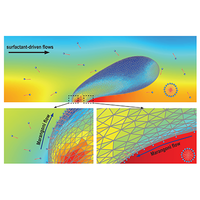
Comprehensive numerical investigations of droplet displacement in soluble surfactant driven flows using the front-tracking method are presented. Surfactant transport in the bulk and at interfaces shapes droplet displacement and determines the transition conditions between steady-state sliding and detachment. Detachment is highly dependent on surfactant replenishment at interfaces, especially at receding contact lines where the nonuniform concentration induced Marangoni flow impedes movement. The critical effective capillary number can be used as a criterion to evaluate the ability of the surfactant to detach the droplet, giving a unique logarithmic relationship with detachment time.

Irregular dependence on Stokes number, and nonergodic transport, of heavy inertial particles in steady laminar flows

Anu V. S. Nath, Anubhab Roy, S. Ravichandran, and Rama Govindarajan

Phys. Rev. Fluids 9, 014302 (2024) - Published 9 January, 2024

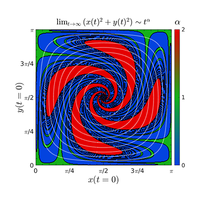
The dispersion of heavy inertial particles in a cellular flow made of Taylor-Green vortices is found to display non-ergodicity and sensitive dependence on initial particle location. Even more surprising is the sensitive and non-monotonic dependence on Stokes number. The large time dispersion of particles can be ballistic (red), diffusive (green) or trapped (blue), depending on where they have started in the flow. Diffusive particles show chaotic dynamics. Here the mutually exclusive group of initial particle locations form a non-ergodic set (as in the figure), unlike a turbulent flow, which is known to be ergodic.

Gravity current escape from a topographic depression

Edward W. G. Skevington and Andrew J. Hogg

Phys. Rev. Fluids 9, 014802 (2024) - Published 9 January, 2024

Density-driven flows climb out of topographic depressions if they are sufficiently energetic. We investigate the inertial dynamics of these unsteady flows theoretically as fluid climbs from a lower to an upper plateau and then simultaneously propagates away from and drains back into the depression. The volume of fluid that escapes the confinement diminishes with a power-law dependence upon time; the draining flow becomes self-similar, and the self-similarity is of the second kind, featuring an exponent which is a function of the frontal Froude number. The volume continues to decrease even when viscous processes are non-negligible and ultimately none of the fluid escapes from the depression.

Pulsation mechanism of a Taylor cone under a single pulse voltage

Jin-bo Cheng, Qi-you Liu, Li-jun Yang, Jun-xue Ren, Hai-bin Tang, Qing-fei Fu, and Luo Xie

Phys. Rev. Fluids 9, 013701 (2024) - Published 8 January, 2024

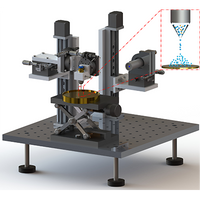
Using a needle-plate electro-atomization experimental device, and applying a single pulse disturbance voltage signal, the response of the Taylor cone to a disturbance signal was explored. At the experimental level, the coupling relationship between polarization charge relaxation time and the oscillation period of the Taylor cone was uncovered, revealing the oscillation mechanism of the Taylor cone under this voltage disturbance.

Wave motions due to a point source pulsating and advancing at forward speed parallel to a semi-infinite ice sheet

Z. F. Li, G. X. Wu, and Y. Y. Shi

Phys. Rev. Fluids 9, 014801 (2024) - Published 5 January, 2024

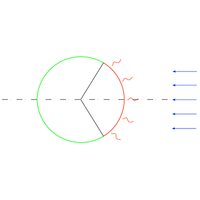
In the Arctic region, with the reduction of ice extent and thickness, a shipping route may become possible. We theoretically derive the wave motions induced by a point source pulsating and advancing at the marginal ice zone. It is found that when a ship navigates along the edge of an ice sheet, the free surface wave pattern has two V-shaped components. The outer V-wave is very similar to the common free surface wave without the ice sheet, while the inner V-wave is mainly due to the reflection of the outer V-wave by the ice sheet.

Colloidal diffusiophoresis in crossed electrolyte gradients: Experimental demonstration of an “action-at-a-distance” effect predicted by the Nernst-Planck equations

Ian Williams, Patrick B. Warren, Richard P. Sear, and Joseph L. Keddie

Phys. Rev. Fluids 9, 014201 (2024) - Published 4 January, 2024

We have conducted experiments which show that when two sources of different salts dissolving in water overlap, colloidal particles suspended anywhere in the solution move due to an action-at-a-distance force. As soon as the salts from the pair of sources overlap, an electric field appears practically instantaneously throughout the solution. The electric field exerts a force on any charged colloidal particles, causing them to move at speeds of order 0.1 micrometer/s. This new way of moving particles suspended in water could be used, for example, to remove them from solution, thereby purifying the water.

Attraction of neutrally buoyant deformable particles towards a vortex

Yutaro Fujiki, Hideto Awai, Yutaro Motoori, and Susumu Goto

Phys. Rev. Fluids 9, 014301 (2024) - Published 4 January, 2024

Deformable elastic particles can accumulate around a vortex center even if the particle is neutrally buoyant. The angle between the deformed particle and the pathline plays important roles in this accumulation process. In this paper, we propose a simple model to explain this interesting accumulation phenomenon.

Self-diffusiophoresis with bulk reaction

Rodolfo Brandão, Gunnar G. Peng, David Saintillan, and Ehud Yariv

Phys. Rev. Fluids 9, 014001 (2024) - Published 3 January, 2024

Catalytic motors, which self-propel in a liquid due to an inhomogeneous surface reaction, constitute an important illustration of active matter in a non-biological context. Prevailing models of the associated self-diffusiophoretic transport assume a chemical reaction at the boundary of the swimmer. We here address the more realistic scenario where that reaction is balanced by a homogeneous reaction in the bulk. The associated diffusive transport of solute, described by two Damköhler numbers, exhibits a boundary-layer topology which is not encountered in the prevailing models.

Asymmetric Kelvin-Helmholtz instabilities in stratified shear flows

Adam J. K. Yang, Mary-Louise Timmermans, and Gregory A. Lawrence

Phys. Rev. Fluids 9, 014501 (2024) - Published 2 January, 2024

This study elucidates the regime of fluid instabilities that can arise in a stratified shear flow when density and velocity interfaces are not aligned - a common occurrence in various geophysical flows. Through a combination of linear stability analysis and direct numerical simulations, we unveil a hybrid mode characterized by features of both Kelvin-Helmholtz and Holmboe instabilities. By quantifying the crucial role of asymmetry, our findings contribute to a refined understanding of the dynamics and mixing in these stratified shear flows.

Dynamic wetting experiments with nitrogen in a quasi-capillary tube

Domenico Fiorini, Alessia Simonini, Johan Steelant, David Seveno, and Miguel Alfonso Mendez

Phys. Rev. Fluids 8, 124004 (2023) - Published 28 December, 2023

We perform experiments with liquid nitrogen’s gas-liquid interface oscillations in a U-shaped quartz tube and investigate the wetting dynamics in inertia-dominated conditions. The experiments reveal a linear relationship between dynamic contact angle evolution and Capillary number in advancing conditions while the contact angle remains near equilibrium in receding conditions. An equivalent contact angle, derived from a model, shows the overall independence of the capillary pressure from the actual contact angle evolution. Theoretical analysis indicates viscous forces dominate in small tubes, while gravity and inertial forces govern larger tube oscillations.

Unsteady granular chute flows at high inertial numbers

Satyabrata Patro, Anurag Tripathi, Sumit Kumar, and Anubhav Majumdar

Phys. Rev. Fluids 8, 124303 (2023) - Published 26 December, 2023

High speed granular flows flowing over inclined surfaces are studied using discrete element method and continuum simulations. Significant slip velocity at the base and strong oscillations in the layer height are observed. The popular inertial-number-based JFP rheological model fails to capture the transient flow dynamics at high inertial numbers. Accounting for the layer dilatancy effect and the presence of normal stress difference is essential to accurately predict the average flow behavior. A modified rheological model recently proposed by the authors, accounting for all these effects describes the evolution of the high-speed granular flow very well for both low as well as high inertial numbers.

Freezing of sessile droplet and frost halo formation

Sivanandan Kavuri, George Karapetsas, Chander Shekhar Sharma, and Kirti Chandra Sahu

Phys. Rev. Fluids 8, 124003 (2023) - Published 22 December, 2023

Freezing droplets are ubiquitous in many practical applications, like in aircraft and wind turbine icing, spray technologies, food and pharmaceutical engineering, and natural phenomena such as raindrop formation. In the context of sessile droplets, the freezing process unveils fascinating physics, featuring a frost halo on the substrate, the evolution of the liquid-ice interface, and the formation of a cusp-like morphology at the tip of the droplet. Our study explores the novel theoretical aspects of frost halo formation, revealing its intricate link to the inherent evaporation process during the initial freezing phases.

Hydrodynamic interactions change the buckling threshold of parallel flexible sheets in shear flow

Hugo Perrin, Heng Li, and Lorenzo Botto

Phys. Rev. Fluids 8, 124103 (2023) - Published 22 December, 2023

Viscous-flow induced buckling modifies the morphology of sheet-like particles suspended in liquids. Experiments reveal that a pair of sheets can bend at a shear rate ten times lower than the buckling threshold defined for a single sheet. Using simulations and modeling, we demonstrate that this softening is due to hydrodynamic interactions. Our study suggests that the morphology of sheet-like particles in suspensions and the resulting rheology is not a purely material property, but also depends on particle concentration and microstructure.

Numerical comparison of two-dimensional Navier-Stokes flows on the whole plane and the periodic domain

Koji Ohkitani

Phys. Rev. Fluids 8, 124607 (2023) - Published 22 December, 2023

A direct numerical comparison is made of two-dimensional Navier-Stokes flows between two different boundary conditions, namely the whole plane and a periodic domain. We study their differences after adjusting the Reynolds number. The norms generally decay faster on the periodic domain than on the whole space. In the case of a simple vortex merger the difference is appreciable, whereas the difference is small in the case of turbulence. This gives support to studying finite-energy turbulence under periodic boundary conditions.

A priori screening of data-enabled turbulence models

Peng E. S. Chen, Yuanwei Bin, Xiang I. A. Yang, Yipeng Shi, Mahdi Abkar, and George I. Park

Phys. Rev. Fluids 8, 124606 (2023) - Published 21 December, 2023
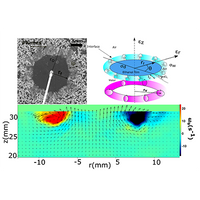
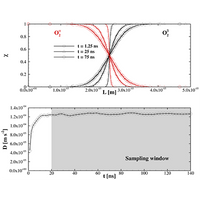
A posteriori validation and verification of black box machine learned turbulence models is time consuming and is not always fruitful. We discuss a theoretical framework that allows a priori screening of machine-learned models that are based on feed-forward neural networks. It requires no knowledge of the weights and bias and only knowledge of the activation function. The method tells one whether a machine learned model preserves basic calibrations like the law of the wall.

Sign In to Your Journals Account

Filter

Recent Issues

Vol. 11, Iss. 10
October 2026
Vol. 11, Iss. 9
September 2026
Vol. 11, Iss. 8
August 2026
Vol. 11, Iss. 7
July 2026
Category
Article Type
Section

Filter

Article Lookup

Enter a citation