Recent Articles

Flow of a shear-thinning fluid in a rectangular duct

Ilya Barmak, Davide Picchi, Alexander Gelfgat, and Neima Brauner

Phys. Rev. Fluids 9, 023303 (2024) - Published 13 February, 2024

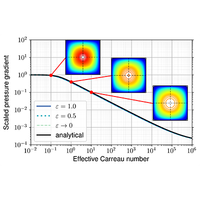
A rigorous numerical solution for steady laminar flows of shear-thinning fluids in rectangular ducts is presented for the first time. We derive universal scaling laws for the effective viscosity that depends on the dimensionless rheological parameters and the effective channel size that is a function of the aspect ratio of the duct. These allow us to generalize the classical formula for the friction factor of Newtonian flows (12/Re) to Carreau fluids flowing in rectangular ducts of any aspect ratio, where the Reynolds number is based on the effective channel size and the effective viscosity.

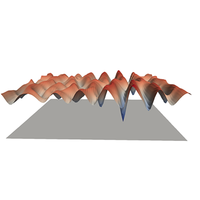
Thermal boundary layers in turbulent Rayleigh-Bénard convection with rough and smooth plates: A one-to-one comparison

Ronald du Puits

Phys. Rev. Fluids 9, 023501 (2024) - Published 13 February, 2024

Roughness at a surface hotter or colder than its environment may significantly enhance the convective heat transfer coefficient. This enhancement results from modification of the near-wall flow field. Our work demonstrates how roughness elements deform the temperature field compared to a smooth surface, and, under which conditions the heat transfer coefficient is enhanced.

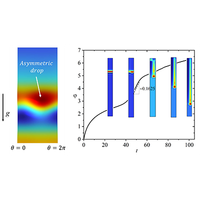
Stability of traveling waves of a thermoviscous liquid film down the outer surface of a cylinder

Garima Singh and Naveen Tiwari

Phys. Rev. Fluids 9, 024002 (2024) - Published 13 February, 2024

The stability of a traveling wave on the outside of a heated solid vertical cylinder is considered. The axisymmetric traveling wave becomes unstable and leads to the formation of asymmetric droplets over the cylinder. Eigenvalue analysis indicates that at smaller wavenumbers, the gravity mode exists, and a thermocapillary mode also exists but at larger wavenumbers. Patterns generated using nonlinear analysis show that the selected mode is governed by the geometric confinement in the azimuthal direction. Interesting nonlinear patterns are obtained due to an interesting interplay between the gravity mode and thermocapillary mode.

Turbulent power theory in heavy-ion plasma of a Jovian magnetosphere

Vitaliy Kaminker

Phys. Rev. Fluids 9, 024602 (2024) - Published 13 February, 2024

Turbulent power is introduced in to Jupiter’s magnetosphere near the cen- trifugal equator of the plasma disc. Turbulent fluctuations are generated within the plasma fluid. Turbulent energy then travels out of the plasma disc via shear Alfvén waves, dissipating out of the system along the way.

Shear-triggered coalescence

Alireza Mashayekhi, Coralie Vazquez, Hongying Zhao, Michael Gattrell, James F. Gilchrist, and John M. Frostad

Phys. Rev. Fluids 9, 023602 (2024) - Published 8 February, 2024

In prior work, it was observed that some bitumen droplets coalesced faster when colliding in shear than colliding head-on. Inspired by this observation, we aimed to reproduce the same behavior in a simpler system composed of pure oil, water, and surfactants/particles. Using a cantilevered-capillary force apparatus we observed this phenomenon for droplets stabilized by cellulose nanocrystals and coined the term “shear-triggered coalescence” to describe it.

Instability and rupture of sheared viscous liquid nanofilms

Vira Dhaliwal, Christian Pedersen, Kheireddin Kadri, Guillaume Miquelard-Garnier, Cyrille Sollogoub, Jorge Peixinho, Thomas Salez, and Andreas Carlson

Phys. Rev. Fluids 9, 024201 (2024) - Published 8 February, 2024

Liquid nanofilms are subject to rupture due to intermolecular forces triggered by surface perturbations arising from thermal fluctuations. When a shear stress is imposed at the free surface it becomes stable in the direction of shear, but perturbations can still grow in the perpendicular direction to the shear.

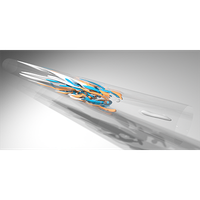
Turbulent puffs in transitional pulsatile pipe flow at moderate pulsation amplitudes

Daniel Morón and Marc Avila

Phys. Rev. Fluids 9, 024601 (2024) - Published 8 February, 2024

Pulsatile pipe flow, or the flow in a pipe with a mean and one or more harmonic bulk velocity components, is a benchmark to study unsteady driven flows in industrial and biological applications. We study the transitional regime of pulsatile pipe flow at moderate-to-high amplitudes and intermediate pulsation frequencies. We show that, as in steady driven pipe flow, the first long-lived turbulent structures are localized. We combine direct numerical simulations, causal analysis and turbulence modeling to describe the behavior of these turbulent patches in pulsatile pipe flow, and to determine the physical mechanisms by which they survive the pulsation.

Laser-induced thermocapillary flows on a flowing soap film

Yu Zhao and Haitao Xu

Phys. Rev. Fluids 9, L022001 (2024) - Published 8 February, 2024

We propose a focused laser heating method to study wave properties of flowing soap films. The laser-induced thermocapillary flows lead to symmetric disturbances in film thickness. The shock waves originating from the propagating symmetric elastic waves, which have remained elusive despite considerable experimental efforts, are thus stimulated on flowing soap films with low surfactant concentrations, or appreciable elasticities. Interestingly, on soap films with high surfactant concentrations, or vanishingly small elasticities, the laser-induced disturbances in film thickness remain unchanged and flow with the film without propagating, creating “laser-engraving” on free liquid films.

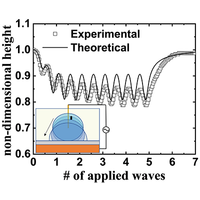
Electrowetting dynamics of sessile droplets in a viscous medium

Juan S. Marin Quintero, Butunath Majhy, and Prashant R. Waghmare

Phys. Rev. Fluids 9, 024001 (2024) - Published 7 February, 2024

This work analyzes the transient wetting dynamics of droplets in viscous media with appropriate governing parameters and examines the drop’s transient response immediately after the actuation, the drop’s retraction and resultant dynamics, and the effect of multiple wave actuation on the droplet transition.

Reversal of the transverse force on a spherical bubble rising close to a vertical wall at moderate-to-high Reynolds numbers

Pengyu Shi

Phys. Rev. Fluids 9, 023601 (2024) - Published 6 February, 2024

Bubbles rising near a vertical wall are known to bounce repeatedly when the Reynolds number (Re) exceeds about 65. This behavior contradicts potential flow theory, which suggests a consistently attractive transverse force. In this study, we demonstrate through numerical simulations that below a critical Re-dependent separation, the transverse force decreases with decreasing separation, potentially reversing from attractive to repulsive. We believe this reversal is responsible for the bouncing motion observed in freely near-wall rising bubbles.

Electroosmotic mixing of viscoplastic fluids in a microchannel

Sumit Kumar Mehta and Pranab Kumar Mondal

Phys. Rev. Fluids 9, 023301 (2024) - Published 5 February, 2024

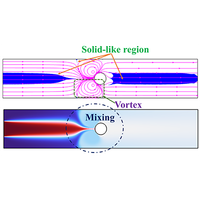
This work finds that the yield stress (YS) of electrically actuated viscoplastic fluids significantly influences mixing and aggregation phenomena. When shear force is applied below the YS limit, these fluids exhibit solid-like behavior due to their viscoplasticity. This is commonly observed in biological fluids like blood used in applications where rapid mixing is crucial. The local modulation of electrical forcing is achievable due to the ionic interaction between the solid and liquid phases. This leads to the observation of distinct flow structures, found to be influenced by the YS. Additionally, the likelihood of constituent particles aggregating is strongly correlated with YS.

Editorial: The 2023 François Naftali Frenkiel Award for Fluid Mechanics

Eric Lauga and Beverley McKeon

Phys. Rev. Fluids 9, 010001 (2024) - Published 31 January, 2024

Autothermotaxis of volatile drops

Pallav Kant, Mathieu Souzy, Nayoung Kim, Devaraj van der Meer, and Detlef Lohse

Phys. Rev. Fluids 9, L012001 (2024) - Published 31 January, 2024

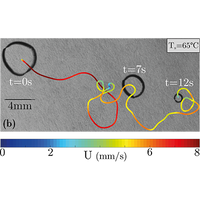
We present an extraordinary phenomenon that emerges from seemingly simple ingredients: a volatile droplet deposited on a highly wetting and heat-conducting warm substrate. Contrary to prevailing intuition that the deposited droplet would spread more and evaporate faster, we find that the droplet instead undergoes contraction and in addition it spontaneously and erratically moves, for substrate temperatures well below the boiling point of the liquid. We term this remarkable phenomenon “Autothermotaxis” and show that it originates from the thermal Marangoni flow in the droplet which undergoes an instability. The thermal Marangoni flow is also the reason for the contraction of the droplet.

Unifying length-scale-based rheology of dense suspensions

Zhuan Ge, Teng Man, Herbert E. Huppert, Kimberly M. Hill, and Sergio Andres Galindo-Torres

Phys. Rev. Fluids 9, L012302 (2024) - Published 30 January, 2024

Suspensions, comprising particles and fluid, play a crucial role across diverse domains, including in nature, such as submarine landslides, biological systems such as blood flows, as well as industrial materials like concrete. The rheology of these materials is a combination of both fluid and solid properties. This study introduces a dimensionless number derived from the ratio between characteristic length scales, offering a unified perspective on the rheology of dense suspensions across a spectrum from conditions where fluid-like effects dominate to regimes influenced by inertial forces. The derivation contained herein is strict, offering significant physical insight into these systems.

Elastic instability in a family of rectilinear viscoelastic channel flows devoid of centerline symmetry

Shailendra Kumar Yadav, Ganesh Subramanian, and V. Shankar

Phys. Rev. Fluids 9, 013301 (2024) - Published 29 January, 2024

The recently discovered elastic center-mode instability in plane-Poiseuille flow is shown to be present even in base flows devoid of centerline symmetry. This is illustrated using the Couette-Poiseuille family of asymmetric velocity profiles, wherein the instability is present when the maximum of the base flow is present within the channel domain. The predicted instability is potentially relevant to viscoelastic flows in the Taylor-Dean, shallow-cavity, and slider-bearing configurations.

Modal and nonmodal stability analysis of turbulent stratified channel flows

Donato Variale, Enza Parente, Jean Christophe Robinet, and Stefania Cherubini

Phys. Rev. Fluids 9, 013904 (2024) - Published 29 January, 2024

This work aims at studying the modal and nonmodal stability of stably stratified turbulent channel flow, assessing the influence of stratification at fixed friction Reynolds number. When increasing the stratification, the energy gain for streamwise-independent perturbations increases by two orders of magnitude, and the spanwise wavenumber for which the energy gain peaks reaches values comparable to those reported in the direct numerical simulations. Moreover, for nonzero values of the streamwise and spanwise wavenumbers, α and β, the energy gain curve has two peaks, one for shorter target times and α>β, leading to a center-channel temperature peak, and another for α<β at larger target times.

Sound waves, diffusive transport, and wall slip in nanoconfined compressible fluids

Hannes Holey, Peter Gumbsch, and Lars Pastewka

Phys. Rev. Fluids 9, 014203 (2024) - Published 29 January, 2024

In this work we compare long wavelength fluctuations in nanoconfined simple fluids from molecular dynamics simulations with continuum descriptions. Quasi-two-dimensional descriptions of these confined fluids give rise to attenuation behavior of hydrodynamic fluctuations distinct from the bulk. Interactions with the walls introduce additional dissipation and can be related to wall slip and an anomalous dispersion relation for sound.

Study of the wall pressure variations on the stall inception of a thick cambered profile at high Reynolds number

Caroline Braud, Bérengère Podvin, and Julien Deparday

Phys. Rev. Fluids 9, 014605 (2024) - Published 26 January, 2024

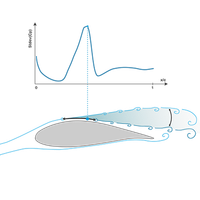
Understanding the flow physics near stall at high chord-based Reynolds numbers (> 106) remains a challenge for both experimental and numerical approaches. Generally statistical bi-dimensionality of the flow is assumed a priori. In the present study, the wall pressure at two chords provides a description of the flow evolution with the angle of incidence. Our results indicate that flow separation at high Reynolds numbers is an inherently local, three-dimensional and unsteady process that occurs in a continuous manner. However, as it can be represented with mainly two proper orthogonal decomposition modes, our results also suggest that a low-order approach may offer a viable modeling route.

Hydrodynamic bound states of rotating microcylinders in a confining geometry

Hanliang Guo, Yi Man, and Hai Zhu

Phys. Rev. Fluids 9, 014102 (2024) - Published 25 January, 2024

Locomotion is a combination of translation and rotation. With suitable boundary conditions, rotation can induce translation. The induced translations are more intriguing when multiple objects are rotating together. In this paper, we study theoretically the hydrodynamic bound states of two active cylinders rotating inside cylindrical confinement filled with viscous fluid. We find that the active cylinder pair can fall into four distinct non-trivial hydrodynamic bound states depending on their initial positions. Our findings may be helpful in understanding bacterial flagella rotating within a confining geometry.

Vortex-induced vibration of a flexible pipe under oscillatory sheared flow

Xuepeng Fu, Shixiao Fu, Mengmeng Zhang, Haojie Ren, Bing Zhao, and Yuwang Xu

Phys. Rev. Fluids 9, 014604 (2024) - Published 25 January, 2024

An experimental apparatus for studying vortex-induced vibration (VIV) of a flexible pipe was designed and constructed in an ocean basin. A VIV test of a tensioned flexible pipe in oscillatory sheared flow (OSF) was performed based on this rotation rig. One end of the test pipe is fixed, and one end is forced to oscillate harmonically with various amplitudes and periods. The results show that VIV under OSF exhibits amplitude modulation and hysteresis phenomena. A critical Keulegan-Carpenter (KC) number is proposed to describe the occurrence of modulated VIV under OSF. The experimental results provide benchmark data for future VIV prediction research.

Sign In to Your Journals Account

Filter

Recent Issues

Vol. 11, Iss. 10
October 2026
Vol. 11, Iss. 9
September 2026
Vol. 11, Iss. 8
August 2026
Vol. 11, Iss. 7
July 2026
Category
Article Type
Section

Filter

Article Lookup

Enter a citation