Recent Articles

Experiments on the unsteady massive separation over an aerofoil

S. Mohamed Aniffa and Alakesh Ch. Mandal

Phys. Rev. Fluids 8, 123901 (2023) - Published 7 December, 2023

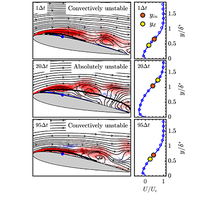
Instantaneous flow fields over a NACA 0012 aerofoil at the stall and post-stall angles of attack have been measured using the time-resolved particle image velocimetry technique. The time sequence of the measured data reveals that the massive separation over the upper surface of the aerofoil is intermittent in nature. This intermittent massive separation is due to the interchange of instability, that is, from a convective to an absolute instability and from an absolute to a convective instability. A physical mechanism for this intermittent massive separation has also been proposed.

Exploring regular and turbulent flow states in active nematic channel flow via Exact Coherent Structures and their invariant manifolds

Caleb G. Wagner, Rumayel H. Pallock, Jae Sung Park, Michael M. Norton, and Piyush Grover

Phys. Rev. Fluids 8, 124401 (2023) - Published 7 December, 2023

Active fluids operating at negligible Reynolds numbers can exhibit spontaneous coherent motion, dynamical vortex patterns, and mesoscale turbulence. We employ tools from nonlinear dynamical systems theory to uncover the global phase space of two-dimensional active nematic channel flow. We compute several Exact Coherent Structures (ECSs), which are exact solutions of the physical dynamics with distinct and regular spatiotemporal structure; examples include unstable equilibria, periodic orbits, and traveling waves. We provide numerical evidence to show that this collection of ECSs and their invariant manifolds act as an organizing template for the complicated spatiotemporal motion of the active fluid.

Viscous free-surface cusps: Local solution

J. Eggers

Phys. Rev. Fluids 8, 124001 (2023) - Published 6 December, 2023

In the image, the free surface between a liquid and air is deformed into a sharp cusp by the rapid rotation of the cylinder on the left. We show that such a structure is a generic feature of viscous flow, and study its properties. This is important, since air can enter the fluid through the cusp’s tip, and thus become entrained into the interior of the fluid.

Study of the vortex structure in compressible wall-bounded turbulence

Tianyi Bai, Cheng Cheng, Kevin P. Griffin, Xinliang Li, and Lin Fu

Phys. Rev. Fluids 8, 124603 (2023) - Published 6 December, 2023

Compressible turbulent channel flows exhibit a multitude of vortex structures dispersed throughout the boundary layer. Although the structural similarity between compressible and incompressible flows has been well established, most of these observations are concluded through merely visualizations of instantaneous fields. We dissect the statistical features of vortices in compressible channel flows comprehensively and show a quantitative consistency with incompressible flows by applying semi-local scaling. This work fills a gap in our knowledge about vortex structures in compressible channel flows and first applies Morkovin’s hypothesis to statistics of instantaneous vortex features.

Estimates of mode-1 internal tide harmonic generation in the global ocean

Scott Wunsch and F. Joseph Marcellino

Phys. Rev. Fluids 8, 124801 (2023) - Published 6 December, 2023

Internal waves play an important role in the dynamics of the ocean. When propagating in vertically varying stratification, they generate harmonic modes through a nonlinear effect. In this work, measured ocean stratification profiles are analyzed to estimate the propensity of oceanic internal tides to exhibit this effect. As seen in the figure, nonlinear harmonic generation could plausibly occur in the Equatorial Indo-Pacific, but not elsewhere, in the global ocean.

Investigation of the influence of the dimensionless centrifugal work number on spanwise rotating channel low-speed compressible flow

Junxin Che, Ruquan You, Fei Zeng, Haiwang Li, Wenbin Chen, and Zhi Tao

Phys. Rev. Fluids 8, L121401 (2023) - Published 6 December, 2023

We introduce a novel dimensionless parameter, termed the centrifugal work number, which is derived from the rotational energy equation. This parameter quantifies the ratio of centrifugal force work to gas enthalpy in the flow within rotating channels. Large eddy simulation was employed to validate the influence of this parameter on rotating channel flow. The flow similarity theory considering the fluid compression characteristics inside the rotating channel has been established.

Interaction between trefoil knotted flame and vortex

Yunde Su (苏运德) and Yue Yang (杨越)

Phys. Rev. Fluids 8, 123201 (2023) - Published 5 December, 2023

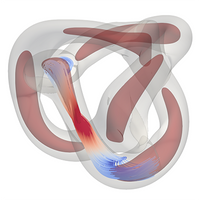
We present a novel three-dimensional configuration for the numerical study of the flame-vortex interaction. The premixed flame is initially located within a vortex tube with the same trefoil knotted centerline, and it propagates outward and interacts with the knotted vortex tube. This configuration allows the study of flame extinction, flame-flame interaction, and suppression of the vortex reconnection. Using direct numerical simulations, we show that the asymmetric flame propagation along the vortex axis generates helicity, and the baroclinic effect arising from the misalignment between the local density gradient and nonlocal pressure gradient flattens the vortex/flame tubes.

Subcritical transition to turbulence triggered by a magnetic dynamo

F. Daniel, L. Petitdemange, and C. Gissinger

Phys. Rev. Fluids 8, 123701 (2023) - Published 5 December, 2023

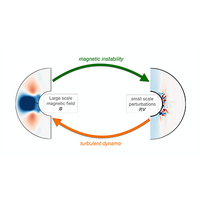
The numerical simulations reported here show that the significant slowdown of many stars can be understood as a subcritical transition to turbulence. It is sustained by a nonlinear mechanism involving the emergence of a strong magnetic field in the radiative region of stars. This turbulence provides a new source of angular momentum transport that persists at very low differential shear, arbitrarily far from any hydrodynamic instability. This scenario is captured by a simple nonlinear model that provides a general description of the transition to turbulence in astrophysical flows, as long as it involves competition between a large-scale magnetic field and a small-scale magnetic instability.

Integral relation in zero-pressure-gradient boundary layer flows

Tie Wei and Joseph Klewicki

Phys. Rev. Fluids 8, 124601 (2023) - Published 5 December, 2023

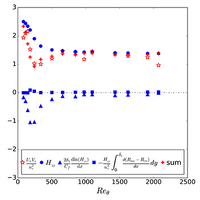
A precise relationship between the boundary layer edge velocity components, Ue and Ve, and the friction velocity, uτ, is derived from the integral of the continuity and momentum equations for flow over a flat plate. This relationship is validated using experimental and numerical data across a wide range of Reynolds numbers. At higher Reynolds numbers, the integral relation can be approximated as UeVe/uτ2≈H12, where H12 represents the shape factor.

Wall shear stress and wall heat flux in a supersonic turbulent boundary layer subjected to concave surface curvature

Fulin Tong (童福林), Junyi Duan (段俊亦), Xiangxin Ji (纪相鑫), Siwei Dong (董思卫), Xianxu Yuan (袁先旭), and Xinliang Li (李新亮)

Phys. Rev. Fluids 8, 124602 (2023) - Published 5 December, 2023

Compressible turbulent boundary layers over concave surface curvature are of major interest in the design of high-speed aircraft and propulsion systems. In this work, we investigate the effect of longitudinal concave surface curvature on the statistical and structural properties of the fluctuating wall shear stress and wall heat flux, including probability density function, space-time correlations, and frequency spectra. We also quantitatively demonstrate that the significantly energized outer large-scale structures make an increasingly important contribution to the mean wall shear stress and wall heat flux generation.

Effects of atmospheric stratification and jet position on the properties of early aircraft contrails

Pierre Saulgeot, Vincent Brion, Nicolas Bonne, Emmanuel Dormy, and Laurent Jacquin

Phys. Rev. Fluids 8, 114702 (2023) - Published 30 November, 2023

We are interested in the dilution of exhaust gases in aircraft wakes due to the combined effect of wake, mixing, and atmospheric stratification. The aim is to predict the properties of early contrails as a function of the aircraft’s main properties and the state of the atmosphere. Two-dimensional simulations of a passive scalar field representing jets under the action of wake vortices are carried out in a framework that allows a wide parametric study of aircraft and atmospheric parameters. The figure shows the evolution of vortex position (dashed lines) and ice mass (solid colors) for a B777 with a relative humidity of 140% and two atmospheric stratification conditions.

Compression-driven viscous fingering in a radial Hele-Shaw cell

Callum Cuttle, Liam C. Morrow, and Christopher W. MacMinn

Phys. Rev. Fluids 8, 113904 (2023) - Published 29 November, 2023

The viscous-fingering instability that emerges when gas is injected into a liquid-filled Hele-Shaw cell is a paradigm of pattern formation that has been extensively studied. Here, we examine a previously neglected aspect of the problem: The compressibility of the injected gas. We use experiments, numerical simulations, and an axisymmetric model to show that gas compression controls the time-dependent injection rate and systematically delays the onset of viscous fingering at high capillary number. We quantify the importance of gas compression with a single dimensionless compressibility number.

Shape-induced pairing of spheroidal squirmers

Ruben Poehnl and William E. Uspal

Phys. Rev. Fluids 8, 113103 (2023) - Published 27 November, 2023

We consider the conditions needed to obtain stable bound states of two spheroidal squirmers. We find that the particles must have oblate shape and non-axisymmetric distribution of surface slip in order to obtain immotile “head-to-head” pairs of identical particles. For motile “head-to-tail” pairs, the particles cannot be identical, and must satisfy certain conditions involving their self-propulsion velocities, stresslets, and shape. Overall, our results demonstrate that introducing heterogeneity in shape and interfacial actuation opens new possibilities for realizing self-organization in systems of interfacially driven microswimmers.

Linear stability of thermocapillary flow in a droplet attached to a hot or cold substrate

Lukas Babor and Hendrik C. Kuhlmann

Phys. Rev. Fluids 8, 114003 (2023) - Published 27 November, 2023

Thermocapillary flow in droplets attached to a heated or cooled wall can undergo various hydrodynamic instabilities. In this work, we explain these instabilities by means of linear stability analysis and present their dependence on the contact angle, Prandtl number, and the heating or cooling mode of operation.

Convection rolls and three-dimensional particle dynamics in merging solute streams

Robben E. Migacz, Guillaume Durey, and Jesse T. Ault

Phys. Rev. Fluids 8, 114201 (2023) - Published 27 November, 2023

Microparticles migrate in gradients of solute concentration through a process known as diffusiophoresis. Several classic works have examined the phenomenon in two dimensions in microfluidic devices where streams of distinct solute concentration meet. We expand on such works by considering, experimentally, numerically, and theoretically, the dynamics of fluid, solute, and particles in three dimensions. We find that diffusioosmotic flow along walls of nonzero surface charge, which yields structures we call “convection rolls,” can be significant to the dynamics.

Rayleigh-number dependence of the critical vibration frequency in vibrating thermal turbulence

Ze-Lin Huang, Xi-Li Guo, Jian-Zhao Wu, Bo-Fu Wang, Kai Leong Chong, and Quan Zhou

Phys. Rev. Fluids 8, 113501 (2023) - Published 21 November, 2023

Vibration has the ability to control the convective heat transport depending on the relative direction of vibration to the gravitation. We show that horizontal vibration (perpendicular to gravitation) enhances heat transport while vertical vibration (parallel to gravitation) suppresses heat transport. The observed heat transport enhancement or suppression is indicated by the critical vibration frequency. We theoretically and numerically reveal the scaling law between the critical vibration frequency and the Rayleigh number.

Mushroom vortex street

Meng Shi and Sigurdur T. Thoroddsen

Phys. Rev. Fluids 8, 110512 (2023) - Published 20 November, 2023

Global stability of 180∘-bend pipe flow with mesh adaptivity

Daniele Massaro, Valerio Lupi, Adam Peplinski, and Philipp Schlatter

Phys. Rev. Fluids 8, 113903 (2023) - Published 20 November, 2023

We explore the global stability of flow in a U-bend (180∘-bend) and compare the results with those in an elbow (90∘-bend) and toroidal pipes. These findings may have relevance for piping systems as well as bends in blood vessels. We identify a Hopf bifurcation at Reb=2528, which is consistent with the elbow flow but significantly lower than the torus, suggesting different underlying transition mechanisms in developing and periodic geometries. In our numerical approach, we utilize a novel method that employs adaptive meshes individually designed for the base flow, direct and adjoint disturbances, optimized for both efficiency and accuracy.

Effect of temperature-dependent viscosity on pressure drop in axisymmetric channel flows

Marcel M. Louis, Evgeniy Boyko, and Howard A. Stone

Phys. Rev. Fluids 8, 114101 (2023) - Published 20 November, 2023

Viscosity gradients induced by heating are ubiquitous in three-dimensional printing, oil extraction, heat exchangers, and other applications where viscous flows and temperature fields are coupled. We investigate the influence of wall heating conditions on the pressure drop-flow rate relationship in narrow pipe flows and determine the asymptotic behavior of the pressure drop in both low and high-Peclet number limits.

Shape of a frictional fluid finger

Eirik G. Flekkøy, Bjørnar Sandnes, and Knut Jørgen Måløy

Phys. Rev. Fluids 8, 114302 (2023) - Published 20 November, 2023

Compared with Saffman-Taylor fingers, which result from long-range viscous forces, ‘frictional fingers’ are a distinct hydrodynamic phenomenon that is entirely governed by short range forces. Here we develop a theory that describes the shape of a single frictional finger as a function of the ratio between effective surface tension and friction. The width and shape of the finger are those that minimize the power needed to form them as a balance is established between fluid pressure, capillary, and frictional forces.

Sign In to Your Journals Account

Filter

Recent Issues

Vol. 11, Iss. 10
October 2026
Vol. 11, Iss. 9
September 2026
Vol. 11, Iss. 8
August 2026
Vol. 11, Iss. 7
July 2026
Category
Article Type
Section

Filter

Article Lookup

Enter a citation