Recent Articles

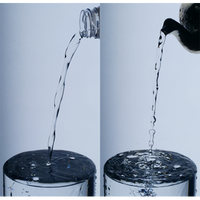
Amplitude of water pouring sound

Mouad Boudina, Joonoh Kim, and Ho-Young Kim

Phys. Rev. Fluids 8, L122002 (2023) - Published 21 December, 2023

The familiar pouring sound we all hear when preparing tea or coffee has been a rare topic of study so far, despite its importance in several applications. We experimentally find that the sound amplitude increases with the jet corrugation, indicating that thin jets are louder than thick ones for the same given height. When pouring from a high distance, the jet breaks up into impacting drops, and the amplitude increases with the jet length and diameter. Results show that the jet corrugation relates to the volume of entrained air, hence the pouring sound can enter as a practical method to measure water aeration rates.

Prebifurcation enhancement of imbibition-drainage hysteresis cycles

Ido Lavi, Lauren Rose, Ramon Planet, Jaume Casademunt, Stéphane Santucci, and Jordi Ortín

Phys. Rev. Fluids 8, 124002 (2023) - Published 20 December, 2023

When flowing through disordered media, fluid-fluid interfaces are subjected to sharp capillary jumps that shape displacements at large scales. The intricacies of this phenomenon are hard to decipher due to the inherent stiffness and non-locality of the problem. Here we use an “imperfect” Hele-Shaw cell to elucidate the response to a single topographical defect as a function of the imposed flow rate, keeping to stable Saffman-Taylor conditions. Through imbibition-drainage experiments and numerical integration of a robust two-dimensional model we showcase the profound impact of the proximity to the fingering instability.

Oscillatory flows in compliant conduits at arbitrary Womersley number

Shrihari D. Pande, Xiaojia Wang, and Ivan C. Christov

Phys. Rev. Fluids 8, 124102 (2023) - Published 20 December, 2023

Oscillatory flows in deformable tubes have been of intense interest since Womersley’s work in the 1950s. The solutions for the pressure, flow rate, and wave propagation along the tube are a cornerstone of biofluid mechanics. However, it is assumed that the hydrodynamic pressure can only cause infinitesimal wall deformations; the cross-sectional area cannot change. Yet, oscillatory flows do deform conduits to such an extent that a nonlinear pressure gradient develops. We derive and benchmark a reduced-order model (a single, complex-valued partial differential equation for the pressure) that captures two-way coupling between flow and deformation, without restrictions on the oscillation frequency.

Dependence of scalar mixing on initial conditions in turbulent channel flow

Milind Singh, Emmanuel Germaine, Laurent Mydlarski, and Luca Cortelezzi

Phys. Rev. Fluids 8, 124605 (2023) - Published 19 December, 2023

Scalar-field initial conditions can have a strong effect on the evolution(s) of scalar fields and the rate at which mixing occurs. The effects of the scalar field initial conditions are studied by analyzing the evolution of three scalar fields with interfaces oriented normal to the streamwise, wall-normal, and transverse directions. When the interface is aligned normal to the mean velocity vector, higher rates of production and destruction of the scalar dissipation, as well as strong advection and stretching of the interface by the mean flow are observed. It is therefore recommended that scalar interfaces be aligned normal to the mean velocity vector to promote mixing within internal flows.

Controlling the dewetting morphologies of thin liquid films by switchable substrates

S. Zitz, A. Scagliarini, and J. Harting

Phys. Rev. Fluids 8, L122001 (2023) - Published 19 December, 2023

Wetting of surfaces holds a crucial interest for diverse technological and societal areas, from nanotechnology to contagion dynamics. We propose the usage of substrates with time-varying wettability as a novel tool to solve a critical problem, namely the control of dewetting morphologies. A new numerical method, able to handle unprecedented system sizes in this context, is employed. We unveil the existence of a droplet-to-rivulet transition determined by the substrate adaptation rate. Our work paves an avenue for the application of simulations to study the complex dynamics of thin liquid films over switchable and adaptive substrates.

Negatively buoyant vortices in the Boussinesq-Euler equations

G. G. Rooney

Phys. Rev. Fluids 8, 123802 (2023) - Published 15 December, 2023

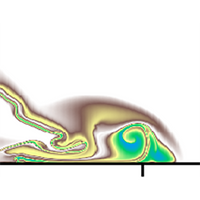
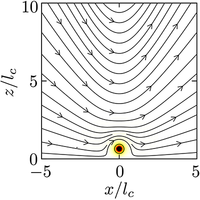
This work investigates an idealized model of a finite-volume, cylindrical gravity current, placing it in a context with non-buoyant dipoles and atmospheric ‘modons’. In cross-section, the current presents as a semicircular vortex of dense fluid in an unstratified background. In the frame traveling with the current, the flow is in a steady-state, achieved by a balanced generation of baroclinic vorticity. Numerical experiments demonstrate how the steadiness of a single vortex depends upon this balance, and show that vortex interactions have similarities to those of solitary waves.

Floating wind farm experiments through scaling for wake characterization, power extraction, and turbine dynamics

Juliaan Bossuyt, Ondřej Ferčák, Zein Sadek, Charles Meneveau, Dennice F. Gayme, and Raúl Bayoán Cal

Phys. Rev. Fluids 8, 120501 (2023) - Published 14 December, 2023

A novel scaling methodology is presented for unique wind and water tunnel experiments of floating offshore wind farms. Geometric similarity of the floater design is leveraged to improve the hydraulic response and relax Froude scaling. Turbine motion, power, and wake measurements reveal intricate coupled dynamic interactions between wave topology, wake evolution, turbine response, and wind farm power output.

Point torque representations of ciliary flows

Siluvai Antony Selvan, Peter W. Duck, Draga Pihler-Puzović, and Douglas R. Brumley

Phys. Rev. Fluids 8, 123103 (2023) - Published 12 December, 2023

The beating of cilia and flagella has fascinated biologists and physicists alike for decades. Previous mathematical models designed to capture the corresponding flow fields are typically either highly simplified and do not resolve all lengths scales or are computationally demanding and cannot be easily generalized to larger arrays of cilia. This paper develops an alternative method which uses point torques to represent the cilia and captures the near- and far-field characteristics in an efficient and accurate manner. These singularity solutions can be used to accurately calculate the collective flows and transport properties of larger ciliary arrays.

From nearly homogeneous to core-peaking suspensions: Insight in suspension pipe flows using MRI and DNS

Willian Hogendoorn, Wim-Paul Breugem, David Frank, Martin Bruschewski, Sven Grundmann, and Christian Poelma

Phys. Rev. Fluids 8, 124302 (2023) - Published 12 December, 2023

Semi-dilute to dense particle-laden inertial pipe flows are studied using magnetic resonance imaging in conjunction with direct numerical simulations. In general, both methods show an excellent agreement for both the time-averaged velocity and concentration profiles. Different flow regimes are identified based on the experimental and numerical data. For higher solid volume fractions a core-peaking concentration distribution is found that explains the observed drag decrease relative to the drag expected for a uniform concentration distribution.

Mean streaming and the onset of turbulence in the reciprocating flow in a double bifurcation airway model: Insights for high-frequency ventilation

Chinthaka Jacob, David G. Tingay, and Justin S. Leontini

Phys. Rev. Fluids 8, 123102 (2023) - Published 11 December, 2023

This paper reports on a reciprocating flow through a double bifurcation geometry to quantify the potential gas transport in flows similar to those in the human airway during high-frequency ventilation. The roles of nonlinear mean streaming and turbulent diffusion are investigated in appropriate clinical conditions and their dependence on both the upstream and downstream conditions are manifested. We report turbulent bursts occur in the first three generations of the airway when the instantaneous flow velocity exceeds a critical value. Results highlight the importance of considering a model geometry with appropriate complexity for physiological flows.

Premixed flame stability under shear-enhanced diffusion: Effect of the flow direction

Joel Daou and Prabakaran Rajamanickam

Phys. Rev. Fluids 8, 123202 (2023) - Published 11 December, 2023

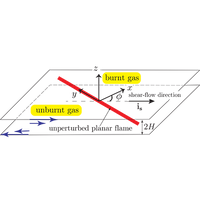
In the presence of shear-enhanced diffusion (Taylor dispersion), flame propagation is effectively anisotropic. The paper clarifies the influence of the direction of a shear flow relative to the direction of propagation on the diffusional-thermal instabilities of premixed flames. Interestingly, the cellular flame instability can now be encountered in mixtures with Lewis numbers larger than one.

Numerical investigation of quasistatic magnetoconvection with an imposed horizontal magnetic field

Michael A. Calkins, Talal AlRefae, Angel Hernandez, Ming Yan, and Stefano Maffei

Phys. Rev. Fluids 8, 123501 (2023) - Published 11 December, 2023

Buoyancy-driven flow of an electrically conducting fluid occurs in planets, stars and industrial applications. Here we use simulations of Rayleigh-Bénard convection with an imposed horizontal magnetic field and stress-free mechanical boundary conditions as a simplified model for understanding such systems. As the buoyancy forcing and magnetic field strength are increased we find a sequence of bifurcations, ranging from steady two-dimensional convection cells to three-dimensional anisotropic convective turbulence. Large scale mean flows become dominant as the parameters are made more extreme.

Biglobal analysis of baroclinic instability in a current-undercurrent oceanic system

Xianliang Chen, Jianping Gan, and James C. McWilliams

Phys. Rev. Fluids 8, 123801 (2023) - Published 11 December, 2023

We study the dynamics of a mesoscale current-undercurrent system motivated from the multilayer circulations in the Western North Pacific, attempting to further understand the dynamic origin of the Luzon Undercurrent. We adopt the so-called biglobal analysis, which can deal with realistic basic flows of continuously nonuniform vertical shear and strong horizontal variation. The high vertical shear between the upper and lower currents, and that near the vertical boundaries give rise to two branches of unstable modes of distinct dynamical features. The interplay between baroclinic and barotropic instabilities, as well as the coupling ageostrophic and viscous/diffusive motions are revealed.

Dissolution regimes of a horizontal channel in a gravity field

Wei Guo, Ran Hu, Chen-Xing Zhou, Zhibing Yang, and Yi-Feng Chen

Phys. Rev. Fluids 8, 123902 (2023) - Published 11 December, 2023

We fabricate a soluble microfluidic channel within a micro-PIV-based imaging system to explore the pore-scale dissolution dynamics in a gravity field. We find that the evolution of eddies induced by buoyancy-driven convection within the flow-dissolution system governs the dissolution rate and the dissolution regimes. This research enhances our comprehension of the interplay between buoyancy-driven convection and forced convection in etching the solid surface.

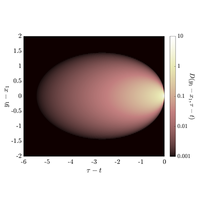
Systematic approach for modeling a nonlocal eddy diffusivity

Jessie Liu, Hannah H. Williams, and Ali Mani

Phys. Rev. Fluids 8, 124501 (2023) - Published 11 December, 2023

Prior studies have shown that the eddy diffusivities governing mean passive scalar transport can be nonlocal in space and time. However, nonlocal eddy diffusivities are often cost prohibitive to compute and difficult to implement in reduced-order models. This work proposes a systematic and cost-effective approach for quantifying and modeling nonlocal eddy diffusivities.

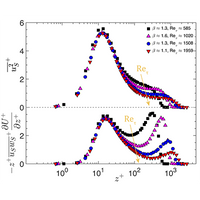
Reynolds-number effects on the outer region of adverse-pressure-gradient turbulent boundary layers

Rahul Deshpande, Aron van den Bogaard, Ricardo Vinuesa, Luka Lindić, and Ivan Marusic

Phys. Rev. Fluids 8, 124604 (2023) - Published 11 December, 2023

Reynolds number (Re) effects are studied in the outer region of moderate adverse-pressure-gradient (APG) turbulent boundary layers (TBLs). This study finds that the small scale (viscous) energy in an APG TBL at near-equilibrium conditions reduces with increasing friction Re. The origin of this trend is traced back to the production of turbulent kinetic energy in an APG TBL, the small scale contribution to which is also found to decrease with Re in the outer region. The results emphasize that new scaling arguments and spatial-resolution corrections should be tested rigorously across a broad range of Re, particularly for pressure gradient TBLs.

Tensor network reduced order models for wall-bounded flows

Martin Kiffner and Dieter Jaksch

Phys. Rev. Fluids 8, 124101 (2023) - Published 8 December, 2023

We introduce a quantum inspired and widely applicable tensor network-based framework for developing reduced order models describing wall-bounded fluid flows. For the examples of the lid-driven and doubly-driven cavities, we find that our method only uses a small fraction of the number of variables parameterizing the solution compared to direct numerical simulation and can improve its runtime by an order of magnitude on comparable hardware. Our work provides a novel path towards efficient high-precision simulations of the Navier-Stokes equation at high Reynolds numbers.

Size of heterogeneous deformations in sheared granular flows

Parisa Shekari, Benjy Marks, and Pierre Rognon

Phys. Rev. Fluids 8, 124301 (2023) - Published 8 December, 2023

Granular flows exhibit kinematic patterns reminiscent of turbulence. In discrete element method simulations, we measure the characteristic size of these patterns and relate it to the size of a representative element volume (REV). We find that this size increases and diverges close to jamming. Such large REVs may be the root cause of nonlocal behaviors and finite size effects observed at the continuum level.

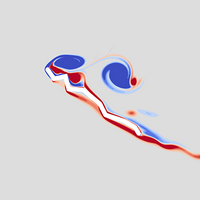
Dynamic lift enhancement mechanism of dragonfly wing model by vortex-corrugation interaction

Yusuke Fujita and Makoto Iima

Phys. Rev. Fluids 8, 123101 (2023) - Published 7 December, 2023

Dragonfly wings, with their unique corrugated structure, may achieve superior aerodynamic performance in specific flight conditions, although these conditions are not yet fully understood. This led us to investigate the vortex dynamics and lift generation as a corrugated wing transitions from a stationary state to translational motion. The results reveal that suppression of secondary vortices generated on the wing significantly improves the overall performance of corrugated wings. This advances our understanding of flight dynamics and can also contribute to applications in engineering and biomimicry.

Towards a constitutive relation for emulsions exhibiting a yield stress

H. V. M Kibbelaar, A. Deblais, G. Briand, Y. Hendrix, A. Gaillard, K. P. Velikov, M. M. Denn, and D. Bonn

Phys. Rev. Fluids 8, 123301 (2023) - Published 7 December, 2023

Many materials encountered around us in daily life are yield stress materials, which behave solid-like for small applied stresses, but start to flow when the applied stress exceeds a threshold. The shear viscosity of these materials is relatively well understood. However, this is far from a complete and satisfactory description of the mechanical response, and most flows are more complicated. A coherent picture for general flows is still lacking.

Sign In to Your Journals Account

Filter

Recent Issues

Vol. 11, Iss. 10
October 2026
Vol. 11, Iss. 9
September 2026
Vol. 11, Iss. 8
August 2026
Vol. 11, Iss. 7
July 2026
Category
Article Type
Section

Filter

Article Lookup

Enter a citation