Recent Articles

Hidden in plain sight: How evaporation impacts the pendant drop method

Pim J. Dekker, Christian Diddens, Marjolein N. van der Linden, and Detlef Lohse

Phys. Rev. Fluids 11, 094901 (2026) - Published 3 September, 2026

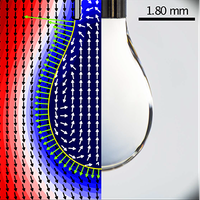
Surface tension is frequently measured with the pendant drop method, while the ambient humidity is usually an afterthought. With carefully calibrated experiments and detailed numerical simulations, we show that evaporative cooling lowers the drop temperature by up to 9.5 K which in turn raises the measured surface tension by more than 1 mN/m. Evaporation-driven and Marangoni-induced flows additionally deform the drop, but only marginally. A passive humidity control removes these artifacts entirely and reveals the shallow minimum in the surface tension of aqueous 1,2-hexanediol mixtures.

Effect of localized surface roughness on laminar separation bubbles

Nianhua Liu and Serhiy Yarusevych

Phys. Rev. Fluids 11, 093901 (2026) - Published 1 September, 2026

Lifting surfaces operating at aerodynamically low Reynolds numbers often have laminar separation bubbles (LSBs) whose characteristics can significantly affect performance. We investigate the effect of localized surface roughness, which might form due to manufacturing, local contamination, damage or icing, on LSBs. We find that the localized roughness eliminates downstream laminar separation and modifies the LSB topology and dynamics over a substantial spanwise region extending well beyond the roughness itself. The associated effect on aerodynamic performance is considerably greater than would be expected based solely on the relative spanwise extent of the localized roughness.

Experimental study on the free surface of liquid metal film flow under the influence of gas jet impingement

Lin-Ling Li (李临玲), Juan-Cheng Yang (阳倦成), and Ming-Jiu Ni (倪明玖)

Phys. Rev. Fluids 11, 094801 (2026) - Published 1 September, 2026

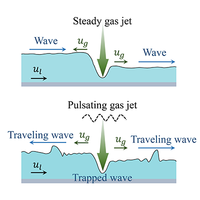
Compared with a static liquid film, gas jet impingement on a flowing liquid metal film produces a shallower cavity and a strongly asymmetric profile through upstream liquid accumulation. Counter-current coupling upstream and co-current coupling downstream cause the wave-amplitude response to jet momentum to weaken upstream but strengthen downstream as the liquid Reynolds number increases. Under pulsating jets, an attenuation coefficient correlates wave amplitude with jet momentum and characterizes a pronounced spatial asymmetry in momentum transfer. These findings clarify how gas jets influence the liquid metal film flow and provide a reference for the design of liquid metal divertors.

Arrested development of the Rayleigh-Taylor instability in the cabbeling regime

Marek Stastna and Andrew P. Grace

Phys. Rev. Fluids 11, 084505 (2026) - Published 31 August, 2026

This article presents a simple to implement algorithm for detecting strong cabbeling in stratified fluids with a nonlinear equation of state. The algorithm is used to identify the manner in which the arrested development of the Rayleigh-Taylor instability occurs in the strongly cabbeling regime.

Scalar and momentum transfer in a low-Reynolds-number channel flow after a rough-to-smooth step change

Sedat Tardu and Benjamin Arrondeau

Phys. Rev. Fluids 11, 084611 (2026) - Published 31 August, 2026

Large staggered roughness elements in the entrance region of a subcritical channel flow generate intense turbulent eddies that gradually break down as the flow progresses into the downstream smooth channel (SC) of the configuration studied here. This flow combines several sources of complexity: surface roughness, a rough-to-smooth step change and relaminarization. The characteristics of the turbulence decay along the SC centerline agree reasonably well with those of homogeneous isotropic turbulence. Owing to the slow rate of relaminarization, the Nusselt number averaged over large streamwise distances in the SC remains close to that of an equivalent fully developed turbulent channel flow.

Interactions and reconnections of four-dimensional quantum vortices

H. A. J. Middleton-Spencer, B. McCanna, D. Proment, and H. M. Price

Phys. Rev. Fluids 11, 084701 (2026) - Published 31 August, 2026

Vortex reconnections are fundamental to quantum fluids. They are reconnections of quantum vortices defined by a topological change and irreversible energy transfer given by universal scaling laws, leading to quantum turbulence. We generalize this mechanism by studying reconnections of extra-dimensional quantum vortices. We find a new range of vortex interactions depending on their initial orientation – a four-dimensional generalization to the known three-dimensional case; vortex interactions with no reconnections; and a new class reconnection that keeps the same scaling law with no energy transfer, suggesting a form of reversible reconnection not allowed in three-dimensional systems.

Impact of the formation angle on the drag of bio-inspired ∨ formations

Prasoon Suchandra and Shabnam Raayai-Ardakani

Phys. Rev. Fluids 11, 084702 (2026) - Published 31 August, 2026

We study flow past V-formations of cylinders, inspired by migratory birds’ flight, examining how formation angle affects the drag of both individuals and the group. Using particle image velocimetry in a water tunnel, we evaluate the impact of changing angles on complex wake-wake/wake-body interactions, quantifying mean and fluctuating quantities, and analyzing vortex dynamics. We find that members with streamwise overlap experience major reductions in the drag force compared to a solo cylinder. Our study establishes a baseline for probing flow past groups of complex bodies (like drones) and demonstrates how optimizing formations can achieve desired performance goals, such as minimum drag.

Numerical investigation of shock wave interactions with flexible fiber granular curtains

Peng Wang, Jiawei Han, Kun Xue, and Yu Guo

Phys. Rev. Fluids 11, 084302 (2026) - Published 28 August, 2026

We present a numerical study of shock-induced dispersal in dense, flexible fiber curtains using a coupled discrete element method–computational fluid dynamics (DEM–CFD) approach. The fiber curtains exhibit distinct particle dynamics compared to spherical particle curtains. Increasing the fiber aspect ratio and reducing flexibility enhance geometric interlocking and prolong clustering, thereby increasing resistance to shock propagation. Finally, we modify a scaling law using an effective fiber aspect ratio to predict the temporal evolution of curtain expansion, accounting for fiber elongation and significant bending deformation.

Regime maps for sloshing in horizontal cylindrical tanks under vertical acceleration

Francisco Monteiro, Tommaso De Maria, Samuel Ahizi, Ramon Abarca, Giuseppe C. A. Caridi, and Miguel A. Mendez

Phys. Rev. Fluids 11, 084804 (2026) - Published 28 August, 2026

Vertical accelerations can amplify small free-surface disturbances into strongly nonlinear sloshing through parametric resonance, yet the resulting regimes remain poorly characterized in horizontal cylindrical tanks. While the classical Mathieu equation predicts the onset of parametric instability, here, high-speed experiments, combined with data-driven modal analysis and classification, reveal nonlinear responses that develop beyond the instability threshold. The resulting dimensionless regime maps organize stable, longitudinal, breaking, and mixed-mode dynamics across different fill levels, exposing the rich flow phenomenology surrounding the primary parametric-instability region.

Turbulence structures of supersonic boundary layers in a bent pipe

Huifeng Chen (陈慧锋), Yixin Yang (杨揖心), Mingbo Sun (孙明波), Hongbo Wang (汪洪波), Dapeng Xiong (熊大鹏), Changhai Liang (梁昌海), Wenxiao Long (龙文骁), and Wenming Li (李文明)

Phys. Rev. Fluids 11, 083401 (2026) - Published 27 August, 2026

This paper uses direct numerical simulations to systematically investigate supersonic flows in a bent pipe with a developing turbulent boundary layer and a core flow region. The results reveals that boundary layers experience intricate flow patterns at different azimuthal angles: secondary flows that drives the streaks move from the lower to the upper side; separation triggered by the combined effects of the adverse pressure gradient and flow deceleration on the upper wall; and the increase of the Görtler instability on the lower wall inducing the clustering and uplift of low-momentum fluids, the presence of Görtler-like vortices, and the baroclinic effect of turbulent transport processes.

Generative AI for subgrid turbulence in large-eddy simulations: A priori analysis

Yu Cheng and Tianle Liu

Phys. Rev. Fluids 11, 084610 (2026) - Published 26 August, 2026

Turbulent transport in large-eddy simulations relies on subgrid-scale (SGS) closures, yet conventional models typically assume that SGS stresses are uniquely determined by the resolved flow. We introduce a conditional diffusion model that learns the conditional distribution of SGS stresses from high-resolution atmospheric boundary layer simulations. By representing conditional variability rather than a single deterministic mapping, the proposed framework accurately reproduces SGS stress statistics, generalizes across unseen stability regimes and grid resolutions, and provides a new probabilistic framework for SGS turbulence modeling.

Metal-pad-roll instability theory for small-scale models of reduction cells

Pranav Hegde, Wietze Herreman, Jorge César Brändle de Motta, Romain Canu, Marie-Charlotte Renoult, and Gerrit Maik Horstmann

Phys. Rev. Fluids 11, 084803 (2026) - Published 26 August, 2026

Metal-pad-roll instabilities limit the safe and efficient operation of aluminum reduction cells, yet laboratory-scale models fall outside the assumptions of most existing theories. We develop an analytical stability theory for small rectangular two-layer cells that captures finite-depth, viscous, and capillary effects, including a parameter-free description of interfacial-wave damping. Validated against direct numerical simulations and experiments, the theory provides quantitative benchmarks for designing and interpreting small-scale MHD experiments and multiphase simulations.

Controlled drop generation via ligament extraction from a static or vibrating liquid bath

Johnathan Hoggarth, Daniel M. Harris, John W. M. Bush, and Bauyrzhan K. Primkulov

Phys. Rev. Fluids 11, L082001 (2026) - Published 26 August, 2026

We introduce a simple droplet generation technique that rapidly stretches a liquid ligament on both quiescent and vibrating baths. By systematically varying the stretching distance and the radius of the cylindrical probe used to form the ligament, we map the parameter space in which the ligament pinches off and collapses into a single droplet. The resulting droplet size follows the volume-conservation scaling R∼a2/3L1/3 , with excellent reproducibility (radius variation below 5%).

Polymer diffusive instability of viscoelastic Poiseuille flow between slippery walls

Bin Zhang, Yuke Li, Hongna Zhang, Guiren Wang, Rong Liu, Shaowei Wang, and Zijing Ding

Phys. Rev. Fluids 11, 083905 (2026) - Published 24 August, 2026

Polymer diffusive instability (PDI) provides a unique route to instability in viscoelastic flows at vanishing Reynolds numbers, yet how realistic wall conditions modify its behavior remains unclear. Here, we show that wall slip regulates PDI in viscoelastic Poiseuille flows by altering the dominant instability pathway. Increasing slip weakens the near-wall PDI-1 mechanism and favors a shear-driven PDI-2 regime. Combining linear stability analysis and direct numerical simulations, we reveal the energy-transfer processes underlying this slip-induced transition and provide new insight into controlling polymer-flow instabilities.

Continuum granular flow model with restitution-derived viscoelastic damping

Bodhinanda Chandra, Sachith Dunatunga, and Ken Kamrin

Phys. Rev. Fluids 11, 084301 (2026) - Published 24 August, 2026

Granular materials dissipate energy through frictional rearrangement and dissipative collisions, yet these mechanisms are often entangled or partially neglected in continuum models. We develop a unified viscoelastic–viscoplastic framework that links the coefficient of restitution e directly to continuum viscosities while preserving the established μ(I) rheology during plastic flow. Implemented within the material point method, the model reproduces the steady-state Bagnold solution, wave propagation, impact, dynamic reposing behavior, and vibration-induced pattern formation. These results emphasize that restitution must be embedded correctly to capture granular flow dynamics accurately.

Time-varying coherence of an attached-eddy wall imprint

Chulan Hu and Xuebo Li

Phys. Rev. Fluids 11, 084609 (2026) - Published 24 August, 2026

Wall-attached motions leave an intermittent footprint on the near-wall flow, but conventional coherence analyses reveal only its time-averaged behavior. Using synchronized two-point hot-wire measurements in a high-Reynolds-number turbulent boundary layer, we develop a wavelet-based framework that resolves this wall imprint in time and scale while recovering established mean coherence scaling. The results show that the characteristic persistence scale grows with wall distance even as coherence at that scale weakens, and that strongly wall-imprinted events exhibit systematic wall-normal changes in scale-local energy transfer and energy distribution.

Projection-based solver for viscoelastic Stokes flow using Fast Fourier Transforms

Georg Rempfer, Mae Nesenberend, Chengkai Zhu, Bart Stam, Debabrata Panja, and Joost de Graaf

Phys. Rev. Fluids 11, 084901 (2026) - Published 24 August, 2026

Numerical studies of viscoelastic Stokes flow often regularize the stress singularities predicted by the Oldroyd-B model, obscuring their underlying structure. We introduce an efficient FFT-based projection solver for incompressible flow and validate it in the classical four-roll mill. By analyzing the polymeric stress directly in Fourier space, we quantify its power-law scaling with resolution and determine the critical Weissenberg number for steady-state convergence without adding artificial stress diffusion.

Projection method for mean resolvent analysis of periodic flows

A. Bongarzone, C. Content, D. Sipp, and C. Leclercq

Phys. Rev. Fluids 11, 083903 (2026) - Published 17 August, 2026

Resolvent analysis is a cornerstone tool for predicting how flows respond to external forcing, but for unsteady flows the choice of linear operator is not obvious. The common mean-flow resolvent, linearized about the time-averaged flow, can misidentify the dominant receptivity mechanisms, whereas the statistically optimal mean resolvent correctly captures physically relevant phenomena such as the vortex pairing in jets presented here. This work introduces a projection method that enables mean resolvent analysis at low computational cost without resorting to adjoint equations about the unsteady attractor, thereby opening a path toward more complex flows.

Hydrodynamic dispersion and diffusivity contrast govern the stability of a reaction front in porous media

Gourab Chakraborty, Vinod Narayanan, and Uddipta Ghosh

Phys. Rev. Fluids 11, 083904 (2026) - Published 17 August, 2026

Reactive fronts in porous media are often destabilized by concentration dependent viscosity of the constituent fluids, leading to viscous fingering. These processes are known to be strongly influenced by hydrodynamic dispersion, originating from incomplete mixing at the pore scale. Yet, their impact and the resulting instabilities remain poorly understood. This study combines transient and quasi-steady-state linear stability analysis to reveal how hydrodynamic dispersion and diffusivity contrasts govern the growth and onset of instabilities, providing new physical insights, with potential applications in contaminant remediation, enhanced oil recovery, and carbon sequestration.

Universal scaling in free laminar jet: A self-consistent theory for its transitional evolution

Binjian Ma, Xiaoyu He, Yuexuan Mao, Zixuan Wang, Yonggang Zhu, Huizhu Yang, and Xiaozhou He

Phys. Rev. Fluids 11, 084101 (2026) - Published 17 August, 2026
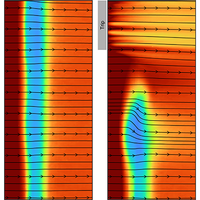
Classical similarity theory describes the far field of a laminar jet, but not how a finite Poiseuille inlet loses its memory and reaches that state. We develop a self-consistent two-mode analytical model that predicts this pre-asymptotic evolution without empirical fitting. The theory uncovers a universal Reynolds-scaled centerline decay and shows that the transition length grows linearly with Reynolds number, while reproducing full velocity profiles for both round and slot jets in close agreement with Navier–Stokes simulations.

Sign In to Your Journals Account

Filter

Recent Issues

Vol. 11, Iss. 10
October 2026
Vol. 11, Iss. 9
September 2026
Vol. 11, Iss. 8
August 2026
Vol. 11, Iss. 7
July 2026
Category
Article Type
Section

Filter

Article Lookup

Enter a citation