Recent Articles

Analyzing the transport process of reacting solute in a wind-affected two-layered laminar open channel flow

Gourab Saha and Kajal Kumar Mondal

Phys. Rev. Fluids 11, 084501 (2026) - Published 10 August, 2026

Reactive solute transport in open-channel flows is central to understanding contaminant migration in rivers, wetlands, and engineered waterways, but the combined influence of wind-induced shear, porous-bed resistance, and wall absorption has remained unresolved. This study introduces a generalized dispersion model that captures the coupled transient effects of those three influences through analytical transport coefficients and concentration distributions, validated by Brownian dynamics simulations. The findings reveal how wind direction governs pollutant dispersion, retention, and removal, and provides a predictive framework for layered environmental flows.

Exploring two-dimensional turbulent properties in anisotropic and disordered Fourier space: Insights into inverse cascades and universal superdiffusion from randomly sampled triadic interaction

Francesco Carbone and Sergio Servidio

Phys. Rev. Fluids 11, 084603 (2026) - Published 10 August, 2026

In this work, we analyze two-dimensional turbulence in a Galerkin-truncated system with pseudo-logarithmic and random mode selection in Fourier space. The results confirm the presence of the double energy cascade (k−5/3 and k−3) and show how anisotropy influences the organization of vorticity without altering universal scaling laws. Finally, particle pair dispersion follows Richardson superdiffusion (ℓ2(t)∼t3), demonstrating that preserved spectral interactions sustain turbulent transport.

Stabilities in the attachment of a particle to a pendant droplet

Wanqiu Zhang, Fei Zhang, and Xinping Zhou

Phys. Rev. Fluids 11, 084001 (2026) - Published 7 August, 2026

Capillary attachment is a fundamental phenomenon in microengineering, yet the lack of comprehensive theories makes it difficult to predict a pendant drop’s particle-lifting capability. We investigate the critical roles of stability in this process, specifically addressing how to maximize lifting capacity. Our work establishes the theoretical framework required to successfully lift particles in practical applications.

Orientation dynamics of gyrotactic microswimmers in turbulent flows

Suraj Kumar Nayak, Vishwanath Shukla, and Akshay Bhatnagar

Phys. Rev. Fluids 11, 084602 (2026) - Published 4 August, 2026

Direct numerical simulations reveal the orientation and transport of spherical, spheroidal, and rod-like gyrotactic microswimmers in three-dimensional turbulence. Strongly gyrotactic swimmers preferentially align with the vertical, while weakly gyrotactic swimmers are nearly isotropic. Rod-like swimmers are more strongly affected by fluid shear and align with the principal strain direction. Orientation correlations depend on the gyrotactic response time, and all shapes transition from ballistic to diffusive transport. A reduced two-dimensional model for spherical swimmers reproduces the key statistics.

Enucleated incompressible red blood cells in shear flow: Theoretical analysis of shape instabilities

Avraham Moriel, Howard A. Stone, and Simon Mendez

Phys. Rev. Fluids 11, 083601 (2026) - Published 3 August, 2026

The ability of red blood cells to deform under shear flow is critical to cardiovascular function, yet capturing their complex fluid-structure interactions remains challenging. We extend a perturbative approach to capture cellular enucleation, and probe the emergence of shape instabilities under shear flow. This method isolates how a cell’s initial orientation, membrane mechanics, and viscosity contrast drive morphological instabilities, such as stomatocytes and trilobes. Ultimately, this framework provides a baseline for understanding how disorders like sickle cell disease and malaria compromise cells dynamics.

Superresolution reconstruction of nonlinear evolution of multimode Rayleigh–Taylor mixing

Cheng-Quan Fu, Zongqiang Ma, Yang Song, Cunbo Zhang, Sijia Lyu, Chenyue Xie, Anmin He, Nan-Sheng Liu, and Pei Wang

Phys. Rev. Fluids 11, 083901 (2026) - Published 3 August, 2026

Rayleigh-Taylor mixing is important in natural phenomena and engineering applications, but limited spatial resolution in practical experiments and simulations constrains studies of this mixing process. Resolution-limited fields preserve only large-scale features such as mean profiles and mixing widths, but fail to resolve small-scale structures, resulting in lower fluctuation variance and higher apparent mixedness. Convolutional neural network (CNN) based superresolution reconstructs multiscale flow fields and recovers mixedness evolution, with robust generalization across unseen phases and flow parameters.

Mapping surface height dynamics to subsurface flow physics in free-surface turbulent flow using a shallow recurrent decoder

Kristoffer S. Moen, Jørgen R. Aarnes, Simen Å. Ellingsen, and J. Nathan Kutz

Phys. Rev. Fluids 11, 084601 (2026) - Published 3 August, 2026

The turbulent flow beneath a water surface is difficult to measure directly, yet it governs important processes such as mixing and air–water gas exchange. We show that the SHallow REcurrent Decoder (SHRED), a lightweight recurrent neural network, can reconstruct subsurface turbulent flow fields using only three sparse measurements of the surface height. The method performs well on both numerical simulations and laboratory experiments, highlighting its potential for future remote sensing of rivers and other free-surface flows.

End-pinching and inertial-capillary reopening in viscoplastic liquid ligaments at low Ohnesorge number

Shu Yang, Fahim Tanfeez Mahmood, and C. Ricardo Constante-Amores

Phys. Rev. Fluids 11, 073303 (2026) - Published 30 July, 2026

We study how viscoplastic filaments retract and break. Unlike Newtonian liquids, viscoplastic fluids can resist motion through a yield stress. We identify two mechanisms that can prevent droplet detachment from its edge depending on the shear-dependence: shear thickening reopens due to generation of vorticity near the neck, whereas strong shear-thinning allows capillary pressure to reopen it due to curvature changes. Remarkably, this latter mechanism also arises in the Newtonian limit as the viscosity approaches zero, demonstrating that an almost inviscid filament need not undergo classical end pinching, contrary to the prevailing picture in the literature.

Smectic bubbles in strong external electric fields

Torsten Trittel, Christoph Klopp, Caterina Tosarelli, Emmanuelle Lacaze, and Ralf Stannarius

Phys. Rev. Fluids 11, 073606 (2026) - Published 30 July, 2026

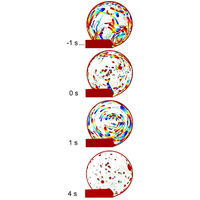
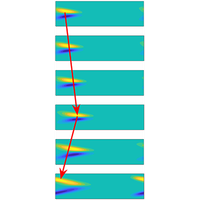
In this work smectic bubbles with millimeter diameters, but only nanometer film thicknesses, are exposed in microgravity experiments to high electric fields to study field effects on film inclusions. The observed motion of islands and droplets in the film plane can be considered as a quasi-two-dimensional analogue of electrospraying. Different mobilities of anions and cations of the ionic dopants make the effect polarity dependent. The image shows the motion of islands (color coded blue to brown) when a high electric field at the anode (brown bar) is switched off at time t=0.

Droplet-induced stretch effects on lean premixed hydrogen-air flame front

Maria Rosaria Acquaviva and Ivan Langella

Phys. Rev. Fluids 11, 073201 (2026) - Published 29 July, 2026

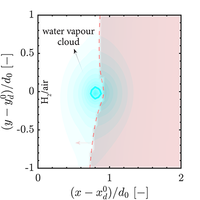
Water injection is a promising technology for mitigating pollutant emissions from hydrogen combustion. However, the high reactivity and diffusivity of hydrogen flames make droplet–flame interactions particularly intricate. Using two-dimensional detailed-chemistry simulations, we show that a single droplet locally modifies the flame displacement speed and heat release rate, while altering flame stretch through droplet-induced curvature. We also propose a phenomenological model to predict the local flame displacement and velocity during the droplet-flame interaction.

Two-stage dispersion mechanism of clean spherical bubbles rising in a chain

Satoi Suzuki and Toshiyuki Sanada

Phys. Rev. Fluids 11, 073604 (2026) - Published 29 July, 2026

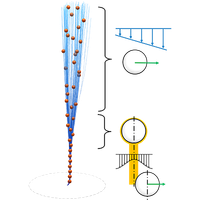
Why do clean spherical bubbles spread laterally even after they leave each other’s wakes? Experiments and reduced-order modeling reveal that bubble chains disperse through two successive mechanisms: wake-induced lift initiates lateral dispersion, while a bubble-induced upward flow drives the second stage. The findings reveal how pairwise wake interactions give rise to collective bubble dynamics.

Origin of the sound produced by a detaching bubble

Vincent Gourmandie, Jeanne Chauris, Remi Fechter, Valentin Leroy, Caroline Derec, and Juliette Pierre

Phys. Rev. Fluids 11, 073605 (2026) - Published 29 July, 2026

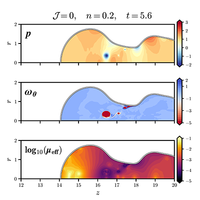
The sound produced by a detaching bubble is known to arise from its volumetric oscillations, but the factors driving the oscillation amplitude has remained an open question. We perform experiments using two bubble-generation methods, and observe that both the shape and amplitude of the pressure signal depend strongly on the bubble formation mechanisms. Using a large set of experimental data, we identify that the oscillation amplitude is mainly controlled by the initial growth velocity of the bubble. Furthermore, we propose a simple model that captures the onset of the acoustic signal as a consequence of the bubble pinch-off dynamics.

Caustics of finitely dense inertial particles

C. Rajarshi and Rama Govindarajan

Phys. Rev. Fluids 11, 074304 (2026) - Published 29 July, 2026

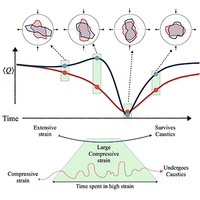
We study collisions of small inertial particles suspended in a background flow. These particles may be inert plankton in the ocean or water droplets in clouds. Previous studies have shown that such collisions or caustics require particles to pass through regions of high strain in the flow. Our work finds that the type of strain is crucial, not just its magnitude. Regions of large compressive strain trigger caustics, whereas particles survive caustics despite encountering large strain if they come from extensional strain. Extending the study of caustics to finitely dense particles, we show that the level of strain required for caustics increases with decreasing particle density.

Data-driven augmentation of a turbulence model in three dimensional separated flows

Chenyu Wu, Shaoguang Zhang, and Yufei Zhang

Phys. Rev. Fluids 11, 074607 (2026) - Published 29 July, 2026

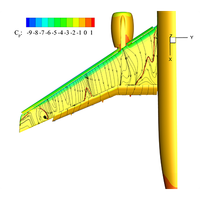
We introduce a sequential approach to augment the shear stress transport-conditioned (SST-CND) model, which was originally trained on 2D flows, in 3D scenarios. 3D field inversion is first performed to obtain the distribution of the augmentation term. Then, features that are nonzero only in 3D scenarios are selected to build the expression using symbolic regression. The resultant SST-CND3D model preserves the original model’s capabilities in 2D flows, while showing significant improvement in 3D complex cases, including a real-world high-lift device.

Drag regimes of acoustic liners in a turbulent channel flow without acoustic excitation

Paul Kraemer, Olivier Léon, Fabien Méry, and Estelle Piot

Phys. Rev. Fluids 11, 074608 (2026) - Published 29 July, 2026

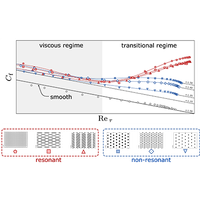
Acoustic liners are widely used for noise reduction in aero-engines, but the physical mechanisms governing their aerodynamic drag remain insufficiently documented. Based on pressure-drop measurements in a turbulent channel over a wide range of Reynolds numbers, this study identifies distinct drag regimes and reveals two markedly different behaviors within the transitional regime. In particular, large drag increases are shown to be associated with the onset of aeroacoustic resonance at the liner resonance frequency, while the relative importance of liner geometry is captured through a frontal-solidity-based parameter.

Erratum: Inertia-gravity wave dissipation and form drag. I. Finite depth effects [Phys. Rev. Fluids 11, 054804 (2026)]

Daniel Abdulah and Wanying Kang

Phys. Rev. Fluids 11, 079901 (2026) - Published 29 July, 2026

Imbibition dynamics of an extremely viscous fluid

Claudiu Patrascu, Victoria-Elena Plopeanu, and Ioana Rasuceanu

Phys. Rev. Fluids 11, L072001 (2026) - Published 29 July, 2026

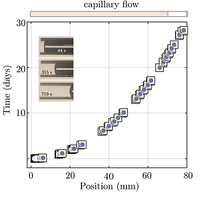
We embark on a 30-day journey following the flow of a high-viscosity liquid through a capillary tube to assess how existing theoretical models, which also account for the dynamic nature of the contact angle, perform in long-term imbibition processes. The journey reveals the persistent and diffusive nature of imbibition processes for liquids with extreme values of viscosity.

Time-varying wind-turbine wakes at high Reynolds numbers

Nathaniel J. Wei, Adina Y. Fleisher, John W. Kurelek, and Marcus N. Hultmark

Phys. Rev. Fluids 11, 070501 (2026) - Published 28 July, 2026

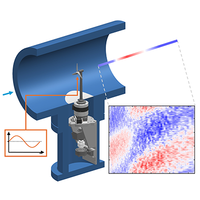
A wind-turbine wake in a pressurized-air wind tunnel was forced via slow periodic oscillations in the turbine rotation rate. Flow measurements identified traveling waves in the wake, which could be controlled by independently varying the turbine thrust and tip-speed ratio. The results demonstrate the importance of advection for the modeling and control of wind-turbine wakes, even at nominally quasi-steady time scales.

Flow instability in Stokes layer of Carreau fluids

Mengqi Zhang, Dongdong Wan, and Huanshu Tan

Phys. Rev. Fluids 11, 073902 (2026) - Published 28 July, 2026

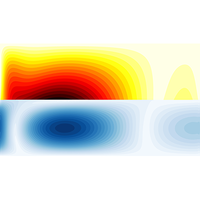
Shear-thinning is ubiquitous in biological and industrial fluids, yet its influence on the instability of time-periodic shear flows remains poorly understood. Using Floquet stability analysis of the Stokes layer in Carreau fluids, we show that shear-thinning can either suppress or promote instability depending on the characteristic fluid response time. The study further identifies a phase-dependent energy-transfer mechanism governing instability in a time-periodic shear flow, which has not been revealed in the literature, providing a dynamic counterpart to the classical energy-production mechanism in steady shear flows.

Theory and simulation of elastoinertial rectification of oscillatory flows in two-dimensional deformable rectangular channels

Uday M. Rade, Shrihari D. Pande, and Ivan C. Christov

Phys. Rev. Fluids 11, 074102 (2026) - Published 28 July, 2026

Oscillatory flows in compliant channels are common to a number of soft-hydraulic problems, from physiological transport to microfluidics. Recently, elastoinertial rectification was shown to lead to streaming in these systems. We develop this theory for a two-dimensional (2D) channel with a confined, nearly incompressible elastic layer as its wall and validate the predictions against detailed Lagrangian–Eulerian fluid–structure interaction simulations. Surprisingly, the nearly incompressible 2D layer introduces new physics: resonance-like amplification of streaming at specific Womersley numbers. Our results offer design principles for optimizing flow rectification in soft microsystems.

Sign In to Your Journals Account

Filter

Recent Issues

Vol. 11, Iss. 10
October 2026
Vol. 11, Iss. 9
September 2026
Vol. 11, Iss. 8
August 2026
Vol. 11, Iss. 7
July 2026
Category
Article Type
Section

Filter

Article Lookup

Enter a citation