Recent Articles

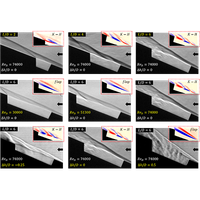
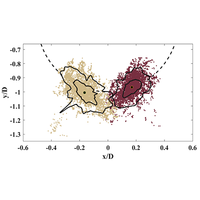
Effect of centerline separation on a vortex dominated wake

Rhylan A. Huss and Farrukh S. Alvi

Phys. Rev. Fluids 11, 074702 (2026) - Published 28 July, 2026

A previously undocumented Reynolds-number-dependent transition is identified in the wake of a rounded-edge slanted afterbody, from a centerline-separated to a novel centerline-attached vortex state. The transition produces a pronounced drag reduction through the collapse of the centerline recirculation region as the upstream boundary layer becomes turbulent. These findings explore experimental evidence linking laminar separation bubble dynamics, shear-layer instability, and wake-state transitions in this canonical bluff-body geometry.

Statistical field theory for a passive vector model with spatially linear advection

Lukas Bentkamp and Michael Wilczek

Phys. Rev. Fluids 11, 074606 (2026) - Published 23 July, 2026

The comprehensive statistics of a turbulent flow field can in principle be captured by Hopf’s functional approach; however, the resulting functional equations have remained largely intractable. We here study a simplified passive vector model, whose Hopf equation is solved exactly by an ensemble of Gaussian fields. Based on both theory and simulations, we find that the model displays a fluctuating energy flux from large to small scales. The resulting intermittency at the small scales can be understood as arising from a probabilistic mixture of Gaussian sub-ensembles.

Deformation and instability of sessile soap bubbles in an electric field

Hongsik Kim and Sunghwan Jung

Phys. Rev. Fluids 11, 074003 (2026) - Published 22 July, 2026

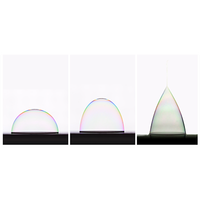
Put a soap bubble in an electric field and it stretches into a taller, smooth dome. Turn the field up and, past a critical point, the top sharpens into a pointed cone that fires off a thin jet. Imaging the bubble from the side, we follow this whole sequence in one experiment and find two things. Bubbles of different sizes deform along the same curve once the field is rescaled by bubble size and surface tension, so one balance between electric and capillary forces sets the shape. And the cone is far sharper than Taylor’s classic value, because it is selected while the film is still rushing toward the jet rather than resting in equilibrium.

Role of diffusion in mixing inkjet printed droplets

Yatin Darbar, Ahmed Said Ismail, Thomas C. Sykes, David Harbottle, Harvey M. Thompson, and Mark C. T. Wilson

Phys. Rev. Fluids 11, 073603 (2026) - Published 21 July, 2026

Droplet mixing is vital in many practical applications, yet the underlying physical mechanisms remain poorly understood. This work uses carefully validated numerical simulations to investigate the mixing dynamics of inkjet printed droplets. Our results show that impact-driven flows contribute only weakly to mixing, while molecular diffusion governs homogenization over a timescale of seconds. We perform studies to understand how droplet size, spacing, volume ratio, and substrate wettability influence mixing, producing methods to estimate mixing times for droplet-based manufacturing processes.

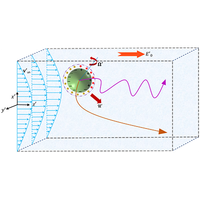
Wake dynamics and force responses of isolated and tandem rotating spheres at moderate Reynolds numbers

Suresh Behara

Phys. Rev. Fluids 11, 074101 (2026) - Published 21 July, 2026

Rotating bluff bodies are widely used to control wake instabilities and fluid forces, but the role of wake–body interactions in multi-body configurations remains less understood. Direct simulations of isolated and tandem transversely rotating spheres show that rotation can suppress classical shedding and reorganize the wake into double-threaded vortical structures. However, tandem interactions can overturn this stabilizing effect, sustaining unsteady wakes and strongly modulating drag and lift.

Scalings and simulation requirements in two-phase flows

Luis H. Hatashita, Pranav Nathan, and Suhas S. Jain

Phys. Rev. Fluids 11, 074303 (2026) - Published 20 July, 2026

High-fidelity simulations have become indispensable for uncovering the physics of turbulent two-phase flows, yet quantitative guidelines for the grid and time-step requirements needed to accurately resolve interface dynamics have been lacking. We derive scaling laws that predict these computational requirements as functions of Reynolds, Weber, and Capillary numbers; identify distinct inertia- and viscous-dominated regimes; and introduce a new dimensionless parameter that unifies their classification. The resulting framework provides practical a priori resolution criteria and computational cost estimates for predictive interface-resolved simulations.

Cascade of mesostrophy in turbulence with reduced vortex stretching

Wouter J. T. Bos

Phys. Rev. Fluids 11, 074605 (2026) - Published 17 July, 2026

Invariants, such as energy or enstrophy, are central to turbulence theory. Some systems behave in a sub-space between two well-known limits where invariants are known. Here, we demonstrate that invariants can also be defined for these intermediate cases. Knowledge of the invariants enables the development of simple models for the multiscale dynamics of such systems.

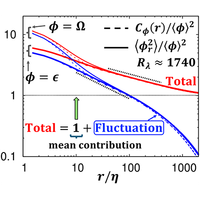
Statistics of energy dissipation rate and enstrophy in high-resolution direct numerical simulation of turbulence in a periodic box

Naoya Okamoto, Takashi Ishihara, Mitsuo Yokokawa, and Yukio Kaneda

Phys. Rev. Fluids 11, 074603 (2026) - Published 16 July, 2026

Using direct numerical simulations of incompressible turbulence at Taylor-scale Reynolds numbers Rλ up to about 1740, we examine spectra, two-point correlations, and second-order local-average moments of the energy dissipation rate ϵ and enstrophy Ω. Correlations and local-average moments exhibit larger scaling exponents for fluctuating fields than for total fields over nearby but distinct ranges. In both statistics, squared-mean contributions are nonnegligible relative to fluctuating contributions. Thus, total- and fluctuation-field exponents need not coincide over these ranges. Results suggest Rλ ≈ 1740 remains insufficient to reach the asymptotic regime assumed in intermittency theories.

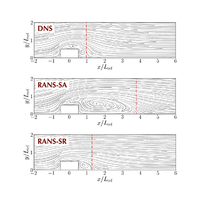
Improving the Spalart-Allmaras turbulence model for separated flows using field inversion and symbolic regression

Paul Bataillie, Maxime Casanova, and Pedro Stefanin Volpiani

Phys. Rev. Fluids 11, 074604 (2026) - Published 16 July, 2026

Data assimilation and symbolic regression are used to formulate an analytical correction to the Spalart-Allmaras model, addressing local deficiencies in its production term. The correction improves separated-flow predictions while preserving the performance of the baseline model for wall-attached flows. Tests on multiple two-dimensional flow cases confirm the applicability of the correction across diverse configurations.

Criticality of the viscous to inertial transition near jamming in non-Brownian suspensions

Nishanth Murugan, Donald Koch, and Sarah Hormozi

Phys. Rev. Fluids 11, 074302 (2026) - Published 15 July, 2026

Dense non-Brownian suspensions undergo a rheological transition with increasing shear rate, from a Newtonian scaling where stress grows linearly, to a Bagnoldian scaling where it grows quadratically. For suspensions devoid of frictional contacts due to electrostatic repulsive forces keeping the particles apart, our discrete element simulations reveal the shear rate marking the onset of the inertial regime to exhibit a critical behavior as the suspension approaches jamming. Our results show this criticality to be tied to a diverging microstructural length scale, larger than any individual particle, that governs the emergence of inertial effects within the suspension.

Axisymmetric cavities in hypersonic flow

Soumya R. Nanda, Talluri Vamsi Krishna, Jacob Cohen, and S. K. Karthick

Phys. Rev. Fluids 11, 073401 (2026) - Published 14 July, 2026

Using qualitative flow diagnostics and quantitative pressure measurements, this study investigates hypersonic flow over a cone-mounted axisymmetric cavity to assess the influence of Reynolds number, aspect ratio, and excess rear-face height. A distinct mode-shifting behavior from flapping-dominated to Kelvin-Helmholtz-dominated oscillations is identified at the highest aspect ratio, owing to a possible turbulent transition of the shear layer with a change in Reynolds number, which is found to be absent in the two-dimensional cavity configuration. The excess rear-face-height cases also demonstrate the ability to alter the dominant instability mechanism and resonance characteristics.

Electrophoretic motion of nonuniformly charged particles suspended in arbitrary background flows: An exact reduced-order approach

Rajnandan Borthakur and Uddipta Ghosh

Phys. Rev. Fluids 11, 073702 (2026) - Published 14 July, 2026

Electrophoresis is often used in combination with external flows for enhanced particle separation. However, the resulting motion when particles have nonuniform surface charge remains poorly understood. This dynamic problem is solved here using an efficient and exact reduced order model. It reveals the diverse set of trajectories emerging from the coupling between the particle’s rotation and its uneven surface charge with potential applications in medical diagnosis and analytical chemistry.

Bursting of a laminar separation bubble subject to periodic forcing on a pitching airfoil

Connor Toppings, Theodoros Michelis, Marios Kotsonis, and Serhiy Yarusevych

Phys. Rev. Fluids 11, 073901 (2026) - Published 14 July, 2026

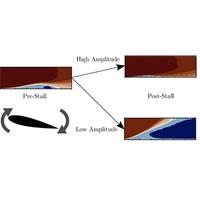
Low Reynolds number airfoils may stall abruptly due to laminar separation bubble bursting. Periodic boundary layer forcing can promote transition through the excitation of natural instabilities, and thereby delay or prevent stall. In this study, forcing is provided by a plasma actuator and the influence of varying forcing amplitude on the bursting transient is examined using particle-image velocimetry and surface pressure measurements. Increasing the forcing amplitude delays and increases the variance in the bursting start time. However, the dynamics of the bursting process are largely insensitive to forcing amplitude. For higher forcing amplitudes, bursting is entirely prevented.

Conversions between kinetic and surface energy in periodically forced multiphase turbulence

J. Vahé and F. Thiesset

Phys. Rev. Fluids 11, 074002 (2026) - Published 14 July, 2026

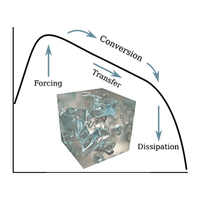
In multiphase turbulent flows, kinetic and interfacial energies usually coexist in a subtle balance, but their mutual conversion often goes unnoticed in statistically steady regimes. Our work introduces a controlled, time-periodic forcing to break this steadiness, thereby revealing the dynamic cycle of energy injection, conversion, and dissipation. By extending the k−ϵ model to include surface energy and nonequilibrium effects, and by linearizing the system, we uncover the intricate time scales that govern the coupling between these processes.

How elasticity affects bubble pinch-off

Coen I. Verschuur, Alexandros T. Oratis, Vatsal Sanjay, and Jacco H. Snoeijer

Phys. Rev. Fluids 11, 073302 (2026) - Published 13 July, 2026

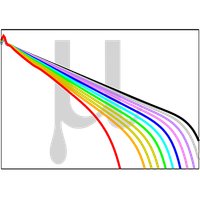
The pinch-off of drops and bubbles from a needle are classic examples of hydrodynamic singularities, in which a fluid body splits into two. While even small amounts of polymers strongly delay drop breakup by forming long liquid threads, recent experiments show that bubble pinch-off remains largely unaffected. In this article we demonstrate that polymer stretching cannot compete with the violent inertial collapse governing bubble pinch-off. Only for sufficiently high polymer concentrations and small needle sizes can viscoelastic effects delay breakup, resulting in the formation of air cavities.

Singular jets in free-falling droplets

M. Kharbedia, H. Franca, H. K. Schubert, D. J. Engels, M. Jalaal, and O. O. Versolato

Phys. Rev. Fluids 11, 073602 (2026) - Published 13 July, 2026

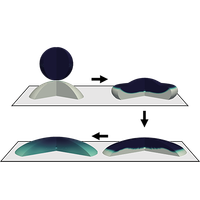
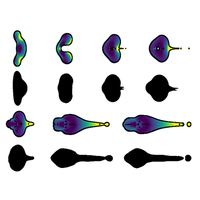
We experimentally and numerically investigate nanosecond laser-induced jetting dynamics of a free-falling micro-sized liquid tin droplet. Following laser impact, the droplet rapidly expands and retracts, leading to the formation of a high-speed axial jet. A specific combination of laser-induced pressure and its angular distribution on the droplet surface drives cavity formation, ultimately giving rise to a singular jet. We reveal the underlying mechanism and construct a phase diagram explaining jet emergence as the result of a subtle interplay between droplet curvature during retraction and radial flow.

Bouncing under AC electric field and Coulombic attraction suggest charge transfer between biopolymer microcapsules

Nishant Nair, Clément de Loubens, Romain Lhermerout, Benjamin Cross, and Hugues Bodiguel

Phys. Rev. Fluids 11, 073701 (2026) - Published 13 July, 2026

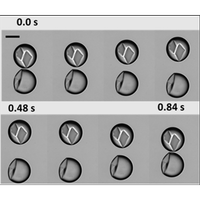
Charge transfer between particles is believed to strongly influence the mechanical properties of many suspensions, yet it remains difficult to observe directly. We demonstrate that biopolymer microcapsules exhibit a unique bouncing dynamics under an alternating electric field that is consistent with repeated charge transfer during contact. These findings identify Coulombic interactions as the origin of the attractive forces responsible for the fragile gel behavior and yield stress previously observed in suspensions of these microcapsules.

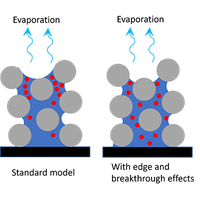
Impact of saturation edge and breakthrough effects on colloid distribution during slow drying in a thin porous medium

Marc Prat, Pierluigi Arnelli, Michel Quintard, and Joel Pauchet

Phys. Rev. Fluids 11, 074301 (2026) - Published 13 July, 2026

Controlling the distribution of colloidal particles during drying of a thin porous medium is of importance for various technological applications. The liquid phase distribution during drying in a thin system is strongly affected by two effects, referred to as the edge and breakthrough effects. The impact on the colloid distribution during drying of both effects is studied. Simulations indicate markedly more uniform colloid spatial distributions as the result of both effects compared to predictions based on the standard model ignoring these effects.

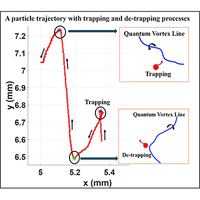
Interaction between small particles and quantum vortex lines in superfluid He II thermal counterflow

Karuna Pathirannehelage Pasan Sanjeeva and Yoshiyuki Tsuji

Phys. Rev. Fluids 11, 074602 (2026) - Published 13 July, 2026

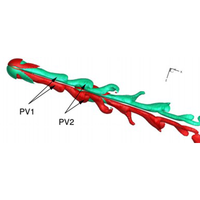
Particle-vortex interactions in quantum turbulence are essential for interpreting the results from particle-laden experiments in superfluid He II thermal counterflow. In this experimental investigation, we extracted and analyzed trapping and de-trapping processes of small particles on quantum vortex lines. Our results show an asymmetry between the two processes, indicating that they are governed by distinct physical mechanisms, and suggest that they exhibit self-similar features across small time lags. These results deepen our understanding of trapping and de-trapping processes of particles, and the dynamics of particle motion in turbulent thermal counterflow under two-fluid interactions.

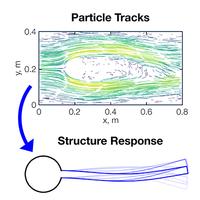
Neural inference of fluid-structure interactions from sparse off-body measurements

Rui Tang, Ke Zhou, Jifu Tan, and Samuel J. Grauer

Phys. Rev. Fluids 11, 074901 (2026) - Published 13 July, 2026
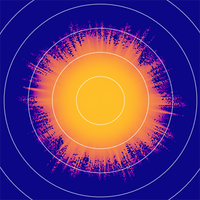
Experimental studies of fluid–structure interactions (FSI) rarely capture dense, simultaneous measurements of both the fluid and solid phases, which limits analysis of the coupled dynamics. We present a physics-informed data assimilation framework that reconstructs both the flow and structure from sparse, off-body particle tracks, i.e., without requiring a constitutive model or direct observations of the structure. The method accurately recovers coupled dynamics in 2D and 3D benchmarks, allowing for quantitative measurements of FSI from limited data.

Sign In to Your Journals Account

Filter

Recent Issues

Vol. 11, Iss. 10
October 2026
Vol. 11, Iss. 9
September 2026
Vol. 11, Iss. 8
August 2026
Vol. 11, Iss. 7
July 2026
Category
Article Type
Section

Filter

Article Lookup

Enter a citation