Recent Articles

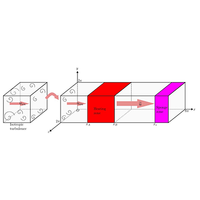
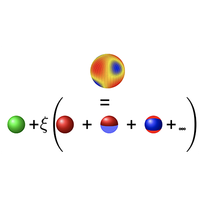
Effective viscosity of a suspension of hot particles

Osher Arbib and Naomi Oppenheimer

Phys. Rev. Fluids 10, 013301 (2025) - Published 23 January, 2025

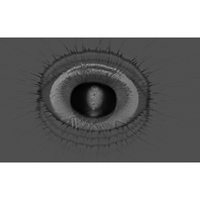
When particles suspended in a fluid are heated, their localized temperature modifies the fluid’s viscosity in nontrivial ways. Einstein famously showed that adding particles to a fluid increases its viscosity. This work demonstrates that heating these particles can cause the viscosity to increase, decrease, or remain unchanged, depending on the temperature gradient. Moreover, an uneven heat distribution on the particles gives rise to surprising effects — making the fluid’s behavior directionally dependent and inducing what is known as odd viscosity. These findings open new avenues for controlling fluid flow.

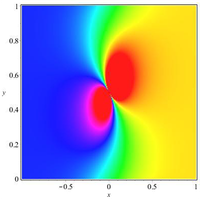
Motion of a point dipole in a strip

A. I. Bulycheva, K. M. Kulik, and V. V. Yanovsky

Phys. Rev. Fluids 10, 014703 (2025) - Published 23 January, 2025

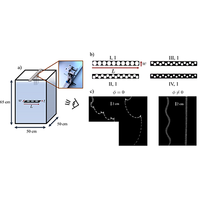
Localized vortices play a major role in complex flows. Their interaction with the boundaries of the medium determines the complex structure of many flows. The finite dimensions of the vortex cores lead to nonintegrability for a small number of such vortices, complicating the flow analysis. To understand interactions and motions in limited areas, we use limiting point vortices, which can be described within the framework of Hamiltonian particle mechanics. The considered example of the motion of a point dipole vortex in a channel demonstrates both integrability and the possibility of a complete classification of all possible motions and flows accompanying its motion in the channel.

Erratum: Slender phoretic loops and knots [Phys. Rev. Fluids 9, 054201 (2024)]

Panayiota Katsamba, Matthew D. Butler, Lyndon Koens, and Thomas D. Montenegro-Johnson

Phys. Rev. Fluids 10, 019901 (2025) - Published 23 January, 2025

Drop impact dynamics on hierarchically textured lubricant-infused surfaces

Biruk Teka Gidreta, Michelle Huang, Dan Daniel, and Solomon Adera

Phys. Rev. Fluids 10, 013604 (2025) - Published 21 January, 2025

This work investigates drop impact dynamics on state-of-the-art lubricant-infused micro/nanotextured surfaces. The results of this study show the presence of an optimal lubricant layer thickness (≈3-5 𝜇m) that maximizes drop breakup and splashing. Moreover, our experiments show that drop splashing can be suppressed by increasing lubricant viscosity. Lastly, the density mismatch between the drop and the lubricant oil has also been shown to amplify the breakup of the radially expanding liquid rim into tiny droplets. The insights gained from this work provide new avenues to suppress and/or amplify drop breakup during high-velocity impact.

Tumbling elimination induced by permeability: An experimental approach

J. Sánchez-Rodríguez and F. Gallaire

Phys. Rev. Fluids 10, 013904 (2025) - Published 21 January, 2025

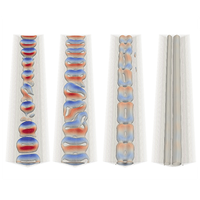
Archetypal falling behaviors of impervious objects are classified into four modes: fluttering, tumbling, steady descent, and chaotic motion. We present in this paper an experimental result of stability induced by porosity and permeability. We discover that by drilling different porosity patterns, we can avoid tumbling and chaotic behavior in plates that, due to their inertia and Reynolds values, should tumble while falling according to the regime diagram of impervious plates. Instead, the majority of the plates flutter and a few even descend steadily.

Linear model for secondary motions in stratified flows

Abdelhalim Abdeldayem, Thijs Bon, Raúl Bayoán Cal, and Johan Meyers

Phys. Rev. Fluids 10, 014605 (2025) - Published 21 January, 2025

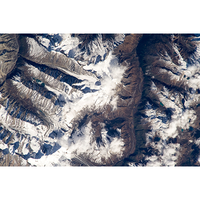
The valley-mountain arrangement excites secondary vortices when interacting with the atmospheric boundary layer. In this paper we develop an analytical model to predict these secondary vortices in the case of thermal stratification. The model was compared to recent direct numerical simulations available in the literature which studied secondary motions in channel flow for a wide range of Reynolds and Richardson numbers. The model showed robust performance for the range of cases considered, showing error less than 5% for the temperature and below 20% for velocity in most cases.

Transition time of a bouncing drop

Yahua Liu, Seyed Ali Hosseini, Cong Liu, Milo Feinberg, Benedikt Dorschner, Zuankai Wang, and Ilya Karlin

Phys. Rev. Fluids 10, 013602 (2025) - Published 16 January, 2025

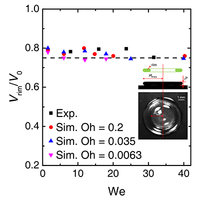
Drops impacting superhydrophobic surfaces have a rim-lamella structure at maximum spreading. The volume ratio of these two components is shown to be Weber-independent and related to a new Weber-independent characteristic time, the transition time. Volume ratios from experiments and simulations at different Ohnesorge numbers are shown.

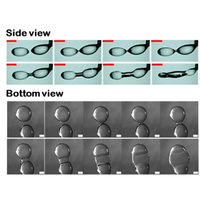
Anisotropic growth dynamics of liquid bridge during droplet coalescence under acoustic levitation

Hongyue Chen, Xianyu Nong, Bokun Zhao, Wenxuan Zhong, Kangqi Liu, Zhen Chen, and Duyang Zang

Phys. Rev. Fluids 10, 013603 (2025) - Published 16 January, 2025

Coalescence of droplets is connected to fascinating interfacial fluid dynamics that is of great importance in a variety of natural and engineering systems. We here explore the growth dynamics of liquid bridges during droplet coalescence under acoustic levitation. We show that the early-time evolution of the liquid bridge follows a scaling law d∼t5 in the inertial regime, with different prefactors for horizontal and vertical growth. We also highlight the interplay between acoustic radiation pressure and Laplace pressures. A new dimensionless parameter, the Acoustic-Capillary Dynamics Number, is introduced to enhance our understanding of liquid bridge dynamics in acoustic fields.

Continuous data assimilation closure for modeling statistically steady turbulence in large-eddy simulation

Sagy R. Ephrati, Arnout Franken, Erwin Luesink, Paolo Cifani, and Bernard J. Geurts

Phys. Rev. Fluids 10, 013801 (2025) - Published 16 January, 2025

We use a continuous data assimilation approach to obtain low-cost stand-alone computational models for fluid flows. A nudging method is used to enforce global flow statistics, yielding a data-driven stochastic model that obtains accurate flow representations at coarse grids at severely reduced computational costs. This is demonstrated for the two-dimensional Navier-Stokes equations and the quasi-geostrophic equations.

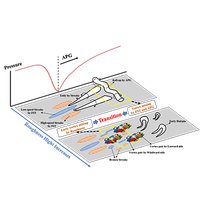
Interaction of freestream turbulence and surface roughness in separation-induced transition

Haocheng Wu, Yang Xiang, Gaohua Li, and Zifei Yin

Phys. Rev. Fluids 10, 013903 (2025) - Published 16 January, 2025

This study explores how distributed surface roughness influences separation-induced transition on a flat plate, under the influence of freestream turbulence and adverse pressure gradients. Using direct numerical simulations, the interactions between freestream perturbations and vortices generated by roughness elements are investigated. Results reveal that low roughness accelerates instability development without dominating the transition process, while higher roughness causes a more intensified vortex mixing process and directly results in transition to turbulence.

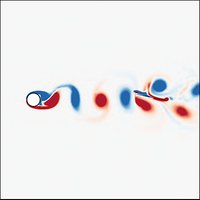
Wake interference effects on flapping dynamics of elastic inverted foil

Aarshana R. Parekh and Rajeev K. Jaiman

Phys. Rev. Fluids 10, 014702 (2025) - Published 16 January, 2025

This study examines how the unsteady wake from an upstream stationary cylinder impacts the flapping response of an elastic inverted foil. Through high-fidelity simulations, we identify a critical nondimensional bending rigidity above which wake interference effects result in distinct flapping dynamics governed by stiffness and mass ratio. Additionally, we propose a nondimensional parameter that captures the interplay between inertia and elasticity, offering insights into fluid-structure interactions with implications for renewable energy harvesting systems.

Lack of self-similarity in transverse velocity increments and circulation statistics in two-dimensional turbulence

Nicolás P. Müller and Giorgio Krstulovic

Phys. Rev. Fluids 10, L012601 (2025) - Published 16 January, 2025

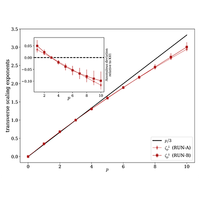
This numerical study on two-dimensional (2D) turbulence reveals that transverse structure functions in the inverse energy cascade display anomalous scaling properties, differing from the self-similar behavior of longitudinal ones. Using direct numerical simulations of incompressible Navier-Stokes equations, this study shows a link between the scaling exponents of transverse structure functions and velocity circulation moments. These findings provide new insights into the dynamics of 2D turbulence, with implications for understanding geophysical flows.

Self-organization in a stably stratified, valley-shaped enclosure heated from below

Patrick J. Stofanak, Cheng-Nian Xiao, and Inanc Senocak

Phys. Rev. Fluids 10, 014402 (2025) - Published 13 January, 2025

Heating a stratified fluid in a valley-shaped container triggers a self-organizing flow. Starting from a quiescent state, any infinitesimal disturbance leads the flow through a transient three-dimensional phase before settling into a two-dimensional steady state. This complex pathway arises from the dominance of viscous dissipation over buoyant production. The orderly transition between 3D and 2D, supported by linear theory, sets our findings apart from transient chaos. While the final pattern is not predicted by linear theory, several stages align well with it. Our example offers new insights into self-organization in fluid systems with geophysical and astrophysical implications.

Impact of intergranular bonds on morphology transition of two-phase fluid-induced deformation

Feihu Ke, Chung-Yee Kwok, and Kang Duan

Phys. Rev. Fluids 10, 013902 (2025) - Published 10 January, 2025

We conduct experimental and theoretical investigations into the previously unexplored effects of intergranular bonds within cohesive granular skeletons on multiphase flow dynamics. We illuminate that fluid forces can become large enough to surpass bond strength, leading to bond breakage and fracture initiation as capillary numbers increase. A first-ever phase diagram of five distinct fluid-fluid-grain displacement morphologies is established under varying flow and cohesion conditions. Through dimensional analysis, we propose a fracturing number Nf* = 1 as a theoretical threshold to characterize the onset of fluid-induced fracturing in cohesive media.

Influence of stratified shear instabilities on particle sedimentation in three-dimensional simulations with application to marine carbon dioxide removal

Adam J. K. Yang, Mary-Louise Timmermans, Jason Olsthoorn, and Alexis K. Kaminski

Phys. Rev. Fluids 10, 014501 (2025) - Published 10 January, 2025

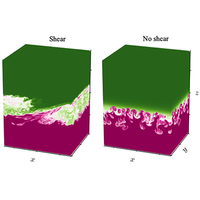
Stratified flow instabilities play a critical role in particle sedimentation in marine environments, influencing the efficacy of marine carbon dioxide removal strategies. Using direct numerical simulations, we reveal how these instabilities enhance or inhibit settling across flow regimes. Our findings highlight the dynamic interplay between turbulence, stratification, and particle dynamics, providing new insights into optimizing carbon removal techniques.

Artificial-neural-network-based subgrid-scale models in the strain-rate eigenframe for large-eddy simulation of compressible turbulent channel flow

Xingsi Ren, Dehao Xu, Jianchun Wang, and Shiyi Chen

Phys. Rev. Fluids 10, 014603 (2025) - Published 10 January, 2025

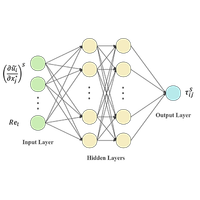
Artificial-neural-network-based (ANN-based) subgrid-scale (SGS) models for turbulent channel flow often suffer from instability and poor generalization. Here, we propose an ANN-SGS model based on the strain-rate eigenframe and apply it to large eddy simulations of compressible turbulent channel flow. Our results indicate that the newly proposed model can predict flow statistics more accurately than traditional SGS models, and it also exhibits generalization capability for both Reynolds and Mach numbers.

Countergradient diffusion of turbulent heat flux in turbulent Rayleigh flow

Motonori Nakamura and Fujihiro Hamba

Phys. Rev. Fluids 10, 014604 (2025) - Published 10 January, 2025

Motivated by countergradient diffusion phenomenon in the turbulent premixed flame, we discuss the effects of heat release on turbulence. We devised and implemented a direct numerical simulation of the turbulent Rayleigh flow generated by isotropic turbulence flowing into the Rayleigh flow. We show that countergradient diffusion of the turbulent heat flux occurs in the turbulent Rayleigh flow, and we discuss its mechanism based on the transport equations of the turbulent statistical quantities. It is shown that the released heat amplifies the density-internal energy correlation and contributes countergradient diffusion through the pressure gradient effect.

Reducing foam friction with self-slippery liquid-infused porous surfaces

Alexis Commereuc, Emmanuelle Rio, and François Boulogne

Phys. Rev. Fluids 10, L011601 (2025) - Published 10 January, 2025

Mitigating energy consumption in fluid transportation is crucial for industrial processes. Our research addresses this by investigating the reduction of friction in liquid foams on Slippery Liquid-Infused Porous Surfaces (SLIPS). These surfaces have asperities filled with oil, significantly reducing friction compared to smooth surfaces. While oil is unsuitable due to its anti-foaming properties, we propose a unique approach using self-SLIPS, introducing the idea that the foam liquid can serve as a lubricant. Our findings demonstrate that these passive surfaces can achieve a 25% reduction in foam friction, promising significant advancements in energy-efficient fluid transport.

Hydrodynamic instabilities of propagating interfaces under Darcy's law

Joel Daou and Prabakaran Rajamanickam

Phys. Rev. Fluids 10, 013201 (2025) - Published 9 January, 2025

The hydrodynamic instabilities of propagating interfaces in Hele-Shaw channels or porous media under the influence of an imposed flow and gravity are investigated within the framework of Darcy’s law. The stability analysis pertains to an interface between two fluids with different densities, viscosities, and permeabilities, which can be susceptible to Darrieus-Landau, Saffman-Taylor, and Rayleigh-Taylor instabilities. An explicit dispersion relation is derived.

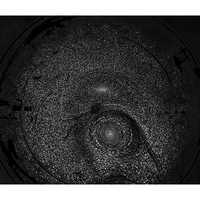
Laboratory model for barotropic vortices drifting towards a planetary pole

Djihane Benzeggouta, Benjamin Favier, and Michael Le Bars

Phys. Rev. Fluids 10, 014701 (2025) - Published 9 January, 2025
Inspired by recent observations of stable cyclone patterns on the North and the South poles of Jupiter, we present observations of monopolar barotropic cyclones in a model experiment for atmospheric polar flows. We show, both experimentally and with idealized quasi-geostrophic simulations, that starting from an initial vortex, there are two evolution regimes depending on vortex strength relative to the local beta-effect across its surface: a Rossby wave emission dominated regime and a strong vortex regime. In the latter regime, the generated cyclone drifts in a northwest direction. We show that the “beta gyre” induced “beta drift” mechanism locally applies in our experimental polar plane.

Sign In to Your Journals Account

Filter

Recent Issues

Vol. 11, Iss. 10
October 2026
Vol. 11, Iss. 9
September 2026
Vol. 11, Iss. 8
August 2026
Vol. 11, Iss. 7
July 2026
Category
Article Type
Section

Filter

Article Lookup

Enter a citation