Recent Articles

Nonequilibrium wall model for large eddy simulations of complex flows exhibiting turbulent smooth body separation

Rahul Agrawal, Sanjeeb T. Bose, and Parviz Moin

Phys. Rev. Fluids 9, 124603 (2024) - Published 20 December, 2024

We propose a nonequilibrium wall model for improving the predictions of flow separation in complex, turbulent boundary layers. Improved predictability of smooth body separation at multiple Reynolds and Mach numbers in flows over the NASA/Boeing speed bump and the Bachalo-Johnson bumps is demonstrated at resolutions where the equilibrium model fails to separate. Scaling arguments, followed by a posteriori verification suggest a weaker scaling of the required resolutions to capture flow separation using the proposed model compared to standard equilibrium closures.

Unification theory of instabilities of visco-diffusive swirling flows

Oleg N. Kirillov and Innocent Mutabazi

Phys. Rev. Fluids 9, 124802 (2024) - Published 20 December, 2024

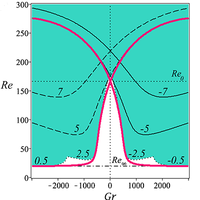
By employing local geometrical optics stability analysis adapted to visco-diffusive flows, we derive novel explicit instability criteria for isothermal and non-isothermal swirling flows, induced by the combination of rotation and shear in orthogonal directions and ubiquitous in various natural phenomena, such as tornadoes and tropical cyclones. Our advance stems from an observation overlooked in previous research: the neutral stability curves in these problems possess an envelope, which we have analytically determined using the connection between envelopes and polynomial discriminants. Our analytical results offer a general theory of instabilities across a wide range of swirling flows.

Lagrangian versus Eulerian view on the mean drift and streaming flows in orbital sloshing

A. Bongarzone and F. Gallaire

Phys. Rev. Fluids 9, 124803 (2024) - Published 20 December, 2024

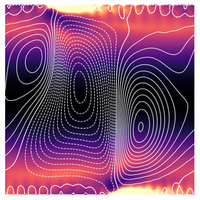
Orbital sloshing, a common technique in fluid mixing for processes like cell cultivation and fermentation, generates complex wave dynamics at the interface and a hidden Lagrangian mean flow in the fluid bulk. Distinguishing between the Eulerian viscous streaming and Stokes drift contributions to the overall Lagrangian motion has remained challenging, particularly in highly viscous fluids. This study presents a weakly nonlinear analysis, revealing that Stokes drift and Eulerian viscous corrections can be equally important in the mean flow generation, offering new insights into orbital sloshing wave dynamics beyond traditional inviscid models.

Simplified mathematical model for erosion and deposition in a porous medium

Amy María Sims, Sai Kunnatha, Emeka Peter Mazi, Priyanka Joseph, Kulsum Saber, Daniel Hwang, and Pejman Sanaei

Phys. Rev. Fluids 9, 124306 (2024) - Published 19 December, 2024

We develop a two-dimensional mathematical model that investigates the processes of erosion and deposition in an elastic porous medium. To simplify, we assume homogeneity and nondimensionalize the parameters, including Darcy velocity, particle concentration, and shear stress before reducing the continuum model via asymptotic analysis by exploiting its small aspect ratio. Our results illustrate the evolution of the medium under a prescribed constant flux of particles, wherein we draw conclusions on how total volume changes based on varying coefficients that dictate the tendency of particles to adhere to or be eroded from the walls of the medium at varying values of shear stress.

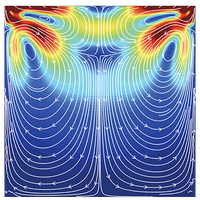
Ruelle-Takens-Newhouse and degenerate period-doubling routes to chaos in a wavy-channel flow under mixed convection

Mohammad Hossein Doranehgard, Iman Borazjani, Nader Karimi, and Larry K. B. Li

Phys. Rev. Fluids 9, 124403 (2024) - Published 19 December, 2024

Wavy channels are widely used to enhance heat transfer in various applications, but their nonlinear dynamics under mixed convection remain poorly understood. Our numerical study reveals that mixed convection fundamentally alters the routes to chaos in wavy-channel flows: symmetric channels show both the Ruelle-Takens-Newhouse and degenerate period-doubling routes, asymmetric channels show only the latter route, and semi-wavy channels show no routes to chaos. The Pomeau-Manneville intermittency route, previously observed in isothermal conditions, is notably absent. These insights into the nonlinear dynamics of wavy-channel flows provide crucial guidance for optimizing heat transfer devices.

Theoretical and experimental investigation of the shapes formed by floating droplets excited with Faraday waves

L. Mazereeuw

Phys. Rev. Fluids 9, 124404 (2024) - Published 19 December, 2024

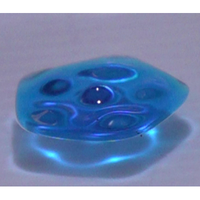
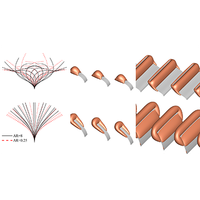
When the Faraday instability is induced in floating droplets in a viscous bath, a wave radiation pressure is exerted on the droplet boundary, causing it to evolve until a new equilibrium shape is reached. Different shapes are obtained by varying the forcing amplitude and frequency, though the system is highly hysteretic. We develop a theoretical model for the time evolution of the droplet boundary through the separation of timescales, with a strong agreement between the predicted equilibrium profiles and experimental observations.

Transition route to elastic and elasto-inertial turbulence in polymer channel flows

M. Beneitez, J. Page, Y. Dubief, and R. R. Kerswell

Phys. Rev. Fluids 9, 123302 (2024) - Published 18 December, 2024

In this work we show that the polymer diffusive instability is able to trigger viscoelastic turbulence with and without inertia through a secondary linear instability providing a generic supercritical route to viscoelastic turbulence. The reported secondary instability resembles center or wall modes, establishing connections with previous results in the literature.

Motion and deformation of a bubble in a Hele-Shaw cell

K. Wu, D. J. Booth, I. M. Griffiths, P. D. Howell, J. K. Nunes, and H. A. Stone

Phys. Rev. Fluids 9, 123603 (2024) - Published 18 December, 2024

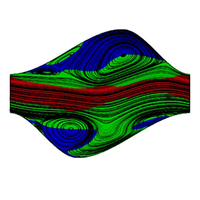
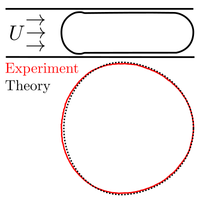
We theoretically and experimentally study the propagation of approximately circular pancake-shaped bubbles in a Hele-Shaw cell under a uniform background flow at low Reynolds number. Bubble motion and deformation are determined by an interplay between the Hele-Shaw viscous pressure, the pressure drop due to the thin films surrounding the bubble, and the capillary pressure due to the in-plane curvature of the bubble boundary. Numerical, asymptotic and experimental results indicate that, with all other parameters constant, the in-plane aspect ratio of the bubble varies nonmonotonically with its size. The model is also extended for buoyancy-driven bubbles in inclined or vertical channels.

Experimental investigation of the exit dynamics of a horizontal circular cylinder out of water and silicone oil

Intesaaf Ashraf, Lionel Vincent, Romain Falla, Vincent E. Terrapon, Benoit Scheid, and Stéphane Dorbolo

Phys. Rev. Fluids 9, 124005 (2024) - Published 18 December, 2024

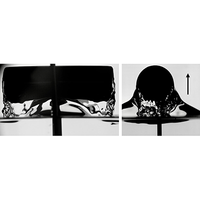
A dolphin leaping out of the water. A piece of bread pulled from Swiss fondue. A car emerging from a bath of anti-corrosion fluid. More somberly, a missile launched from below sea level. The question is: how much liquid is carried along? We study the entrainment around a horizontal cylinder and observe that, whether in water or in oil (50 times more viscous than water), higher speeds result in greater liquid entrainment. By tracking the thickness of the liquid film at the top of the cylinder, we measure the drainage process down to a few microns. Remarkably, shortly after crossing the interface (typically within 1 second), the drainage becomes independent of the withdrawal speed.

Engelund bedload transport formula for sparsely vegetated channels

Yihan Qu, Zhiheng Ye, Qingwei Lin, and Limo Tang

Phys. Rev. Fluids 9, 124502 (2024) - Published 18 December, 2024

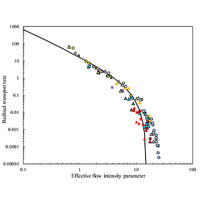
Bedload transport in vegetated channels, especially sparsely vegetated channels, is highly complex. As flow intensity varies, bedload transport can be divided into two stages: local and global bedload transport. In this study, the Engelund formula, which is typically used for bedload transport in bare beds, has been extended to calculate the bedload transport rate in sparsely vegetated channels. The results show that the bedload formula based on bed shear stress is more appropriate for medium and high bedload transport rates (global bedload transport), while the bedload formula based on grain shear stress is more suitable for weak bedload transport rates (local bedload transport).

Global stability analysis of falling jets with surfactants

Hu Sun, Qiyou Liu, Dingwei Zhang, Bingqiang Ji, Lijun Yang, and Qingfei Fu

Phys. Rev. Fluids 9, 124004 (2024) - Published 17 December, 2024

Liquid jets with insoluble surfactants undergo thinning and acceleration due to gravitational stretching. The evolution of the jet’s basic flow and surface perturbations is influenced by a combination of inertia, surface tension, viscosity, gravity, and Marangoni stress. Global stability analysis results show that the Marangoni effects caused by the surfactants promote thinning of the basic flow and inhibit the growth of perturbations. Gravity, on the other hand, not only suppresses the perturbation development but also increases the optimal forcing frequency in forced falling jets.

Numerical study of the oscillatory boundary layer over wall-mounted flexible filaments

Yu-Hang Xiong, An-Kang Gao, Xi-Yun Lu, and Shaohua Chen

Phys. Rev. Fluids 9, 124101 (2024) - Published 16 December, 2024

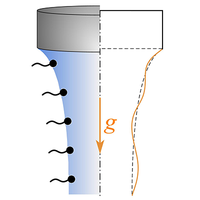
This study explores the flow-structure interaction between the oscillatory boundary layer flow and an array of wall-mounted flexible filaments using a penalty-immersed boundary method. The key finding is that the presence of filaments lifts the boundary layer by the average filament height. A partial slip boundary condition with a complex-valued slip length is introduced to quantify the velocity-velocity gradient relation. It indicates the slip length reaches a stable value at the upper edge of the filaments. This study provides insight into modeling the effective boundary condition of the filament-attached wall.

Heat transport and flow structures in inclined circular enclosures

Snehal Sunil Patil, V. R. Krishna Priya, and Rajaram Lakkaraju

Phys. Rev. Fluids 9, 124305 (2024) - Published 16 December, 2024

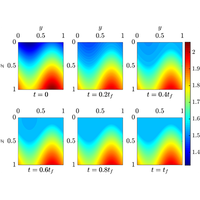
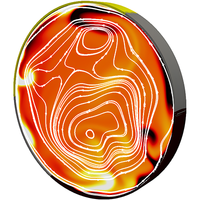
Long-term seasonal weather variations can arise from a misalignment between sunlight and the direction of a planet’s gravitational pull, though plausible reasons are yet unclear. Inspired by such events, we have carried out numerical simulations and unmasked large-scale circulations and their reversals in canonical convection. At optimal orientations, the large-scale motions and core mixing events work against each other to achieve maximum heat transport. Our research findings have potential implications for climate studies and the development of thermal control strategies for device applications.

Revisiting amplitude modulation in non-canonical wall-turbulence through high-Reynolds number experimental data

Mitchell Lozier, Ivan Marusic, and Rahul Deshpande

Phys. Rev. Fluids 9, 124602 (2024) - Published 16 December, 2024

We revisit the amplitude modulation phenomena, as defined by Mathis et al. (J Fluid Mech. 628, 311-337; 2009), in the context of non-canonical wall-turbulence. A unique set of published, high-Reynolds number turbulent boundary layer datasets, from the same experimental facility are considered. It is found that nonlinear interactions, across the turbulence scale hierarchy, may become significant with the introduction of various non-canonical perturbations, in contrast to previous observations for canonical flows. The implications of these findings on the interpretation of amplitude modulation effects, and near-wall flow prediction models, for non-canonical wall-turbulence are discussed.

Semianalytical model of optothermal fluidics in a confinement

Tetsuro Tsuji, Shun Saito, and Satoshi Taguchi

Phys. Rev. Fluids 9, 124202 (2024) - Published 13 December, 2024

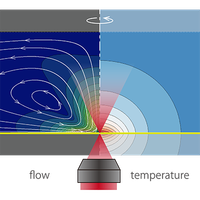
Elaborating micro- and nanoscale heat using lasers is an emerging experimental technique to induce fluid flows and to control nanomaterial motions; this paper provides a theoretical tool to explore them. When focused lasers are irradiated to microfluidic systems, we can heat up, selectively and locally, fluids, channels, and/or such as thin-metal films. This localized heat generates various thermally-induced transport of fluids and dispersed objects. Considering that flow computation requires a decent amount of training cost, the easy-access instant analytical tool developed here is helpful for researchers without a fluid-mechanics background to explore complex phenomena in their own fields.

Heat transfer in a near-critical fluid saturated porous medium: Piston effect and viscous slowing down

Didier Lasseux, Bernard Zappoli, Samuel Marre, and Yves Garrabos

Phys. Rev. Fluids 9, 124402 (2024) - Published 13 December, 2024

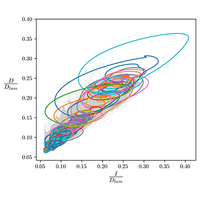
Coupled heat and momentum transfer in a porous medium saturated by a near (super) critical fluid is shown to take place under three different regimes depending on the distance to the critical point (CP). Far enough from the CP, transfer is governed by the classical piston effect (PE). While nearing the CP, the PE is hindered by a pressure gradient that builds up in the bulk of the medium. Exceedingly close to the CP, viscous effects are present in the whole domain, including the boundary layer close to the heated boundary, so that the PE is faded away and heat transfer takes place in a diffusive regime.

Dynamically relevant recurrent flows obtained via a nonlinear recurrence function from two-dimensional turbulence

Edward M. Redfern, Andrei L. Lazer, and Dan Lucas

Phys. Rev. Fluids 9, 124401 (2024) - Published 12 December, 2024

When searching for recurrence in turbulent flows a well-known issue is an inability of simple distance measures to identify solutions exhibiting high dissipation bursting behaviour. By constructing novel recurrence functions based on the nonlinearity of the governing equations, recurrent flows (unstable periodic and relative periodic orbits) are now able to be computed which cover the full range of turbulent dynamics. This has enabled much improved reconstructions of the flow statistics and indicated simple heuristic weightings of the individual solutions.

Flows, self-organization, and transport in living cells

Michael J. Shelley

Phys. Rev. Fluids 9, 120501 (2024) - Published 11 December, 2024

The movement and placement of cellular components is crucial for the proper development of egg cells and embryos. These transport processes take place within the fluidic interior of the cell and can yield surprisingly complex fluid-structure interactions. Fortunately, advances in mathematical modeling, multiscale coarse-graining, and the large-scale simulation of fluid-structure interactions have all helped in the understanding of this fundamental cellular biology. This paper discusses how simulations of immersed mobile structures and load-bearing biopolymers within cells helped show how the mitotic spindle finds its proper place inside an embryo approaching its very first cell division. Also discussed is the role played by coarse-grained porous medium models, stability analyses, and large-scale fluid-structure simulation, in revealing the self-organized processes that may underlie large-scale transport flows in developing egg cells.

Pathways from nucleation to raindrops

F. Poydenot and B. Andreotti

Phys. Rev. Fluids 9, 123602 (2024) - Published 9 December, 2024

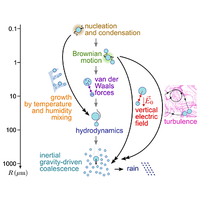
How does rain initiate from cloud droplets? Drops above 100 μm have large enough inertia to fall, allowing them to grow by capturing smaller droplets during descent. However, rain formation needs to overcome a gap of very low collision rate for droplet sizes between 3-30 μm, where this mechanism is inefficient. We investigate four pathways to rain: the coalescence pathway; the mixing pathway driven by the creation of supersaturated conditions from mixing of cloud and drop-free air; the electrostatic pathway arising from these attractive forces; and the turbulence pathway. Rainfall begins when the drop size distribution broadens enough for a few droplets to create efficient collisions.

Adjoint-based full-order and reduced-order approaches for gust mitigation

Bolun Xu, Mingjun Wei, and John T. Hrynuk

Phys. Rev. Fluids 9, 123901 (2024) - Published 9 December, 2024
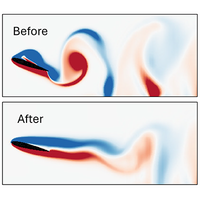
Adjoint-based approaches were developed for full-order and reduced-order models to mitigate a streamwise or transverse gust and maintain the lift performance of a heaving-pitching wing. Simultaneous optimization of multiple parameters in flow control becomes feasible by solving both the physical model and its adjoint model. With a head-on streamwise gust, adjoint-based optimization suggests reducing the wing oscillation to maintain the original lift force; with a transverse gust, besides the reduced oscillation, the optimal wing motion shows an overall pitching-down motion towards the gust to balance out the additional lift generated by the gust.

Sign In to Your Journals Account

Filter

Recent Issues

Vol. 11, Iss. 10
October 2026
Vol. 11, Iss. 9
September 2026
Vol. 11, Iss. 8
August 2026
Vol. 11, Iss. 7
July 2026
Category
Article Type
Section

Filter

Article Lookup

Enter a citation