Recent Articles

Hydrodynamic density-functional theory for the moving contact-line problem reveals fluid structure and emergence of a spatially distinct pattern

Andreas Nold, Benjamin D. Goddard, David N. Sibley, and Serafim Kalliadasis

Phys. Rev. Fluids 9, 124003 (2024) - Published 9 December, 2024

The almost 60-year-old moving contact line problem has generated and driven an abundance of research. A variety of models have been proposed to alleviate the singularity at the three-phase conjunction. However, by design they are phenomenological and fall short of identifying the nanoscale effects that determine the fluid structure and compete to resolve the singularity. Here we put forward an inherently multiscale continuum model founded on first principles that bridges the micro- to the macroscale while retaining all fundamental microscopic information. It unravels the underlying physics of moving contact lines showing that it is much more intricate than previous models suggest.

Influence of freestream turbulence and porosity on porous disk-generated wakes

M. Bourhis and O. R. H. Buxton

Phys. Rev. Fluids 9, 124501 (2024) - Published 9 December, 2024

This paper uncovers how freestream turbulence (FST) affects the wakes of porous discs with varying porosities, often used as wind turbines surrogates in wind tunnel studies. Low-porosity disks behave similarly to solid bodies in terms of entrainment behavior and scaling laws. FST reduces both wake growth and entrainment rates in the far wake, with turbulence intensity and length scale playing distinct roles. Intriguingly, as porosity increases, these “solid body” FST effects gradually diminish and are reversed above a critical porosity. This study also sheds light on the influence of disc porosity and FST on the presence of equilibrium and nonequilibrium turbulence in the wakes.

Axisymmetric internal wave tunneling

S. Boury, B. R. Sutherland, S. Joubaud, T. Peacock, and P. Odier

Phys. Rev. Fluids 9, 124801 (2024) - Published 9 December, 2024

Though internal waves cannot propagate vertically through weakly stratified fluid, if the depth of the weak stratification is sufficiently shallow, these waves can partially transmit through it. This paper quantitatively extends previous results on Cartesian internal wave tunneling to the case of axisymmetric wave fields and proposes a simple three-layer model. We show that there exists a smooth transition between the fully propagating and the tunneling regimes. We further reflect on the challenges set by the measurement of internal wave mode amplitudes in confined domains, and we discuss an innovative method to measure said amplitudes in this experimental and numerical context.

Dry granular collapse into a liquid: Role of viscous dissipation on granular flow regimes and associated waves

Alexis Bougouin, Sylvain Viroulet, Laurent Lacaze, Olivier Roche, and Raphaël Paris

Phys. Rev. Fluids 9, 124302 (2024) - Published 6 December, 2024

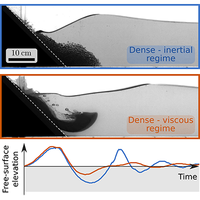
During the generation of free-surface waves in landslide-tsunami modeling, the importance of grain-fluid interaction is still not well identified. To clarify this, the present study examines experimentally the role of viscous dissipation on the dynamics of dry granular masses collapsing into a liquid pool, by varying both the grain size and liquid viscosity. The experiments reveal a richness in granular collapse regimes, from dilute- and dense-inertial to dense-viscous regimes, that significantly influence the entire wave train, while having limited impact on the leading and largest wave.

Tail length influences swimming speed of helical swimmers in granular media

Rogelio Valdés, Elsa de la Calleja, Roberto Zenit, and Francisco A. Godínez

Phys. Rev. Fluids 9, 124303 (2024) - Published 6 December, 2024

We experimentally investigate the effects of helical tail length on the swimming efficiency of artificial robots in granular matter. Using magnetically driven swimmers, we found that longer tails boost forward velocity, challenging the traditional behavior observed in Newtonian fluids. We reveal the crucial role of head size in these dynamics through a modified Resistive Force Theory model. Our results demonstrate the intricate relationship between head drag and tail morphology, showing long-range effects linked to force chain formation and buckling. This important discovery broadens our understanding of locomotion in granular systems, an area where current theories are limited.

Granular flows over normally vibrated inclined bases

Prasad Sonar, Ashish Bhateja, and Ishan Sharma

Phys. Rev. Fluids 9, 124304 (2024) - Published 6 December, 2024

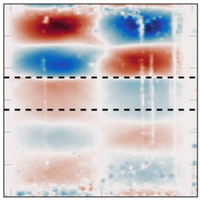
We investigate granular flows over an inclined, normally vibrated rigid base using the discrete element method, systematically varying the inclination angle (θ), vibration frequency (f), and amplitude (A). Our findings demonstrate that vibrated bases can amplify the mass flow rate (Q) by 25–100 times compared to fixed bases depending upon the choice of parameters and, further, it is possible to find conditions that maintain Q nearly constant. Finally, Q is characterized by a dimensionless parameter S, also known as the shaking strength, which represents the ratio of vibrational to gravitational energies.

Effects of wall groove misalignment on viscoplastic flow dynamics in superhydrophobic channels

A. Joulaei, H. Rahmani, and S. M. Taghavi

Phys. Rev. Fluids 9, 123301 (2024) - Published 4 December, 2024

In viscoplastic Poiseuille flows over superhydrophobic surfaces, misalignment between lower and upper grooves alters flow characteristics. Adjusting groove misalignment along with key dimensionless parameters—offset number, Bingham number, slip number, groove periodicity, and slip area fraction—affects velocity distributions, plug morphology, and yielded/unyielded zones. Misalignment intensifies velocity and strain rate deviations, leading to plug deformation, asymmetry, and potential breakage. Four distinct regimes of center plug morphology emerge, highlighting the complex interplay between misalignment and viscoplastic flow behavior.

Combined parabolic and elliptic velocity profile-based low-dimensional model in falling film

Arghya Samanta

Phys. Rev. Fluids 9, 124002 (2024) - Published 4 December, 2024

Based on the assumption of a combined parabolic and elliptic velocity profile, the simplified second-order depth-averaged equations are derived. As the parameter A relating to the eccentricity of the ellipse increases, new results adequately capture available findings. However, A = 2.23219 provides a relatively more accurate result. Maximum amplitude and speed of the steady-state traveling wave increase with rising values of A. The backflow phenomenon occurs in the capillary regime. Interestingly, the combined velocity profile detects the point of inflection in the capillary region at A = 2.23219, but it disappears at higher values of A, signaling a strong influence of the elliptic part.

Flows over backward-facing steps with different spanwise widths

Ke Zheng, Heri Setiawan, Jimmy Philip, Junghoon Lee, and Jason P. Monty

Phys. Rev. Fluids 9, 124601 (2024) - Published 4 December, 2024

The effect of spanwise aspect ratio (AR) on flow characteristics over backward-facing steps with extended streamwise length and external corners is investigated experimentally. For intermediate AR, a unique wake pattern is observed, where there is no separation bubble, and the flow after reattachment ejects from, rather than impinging on, the central plane bottom floor, leading to intensified fluctuations and a broader region of high turbulence. This flow feature may be attributed to strong interactions of separated flows from all open edges with possible contributions from corner vortices that develop alongside the step. We also discuss the influence of these corner vortices for varying AR.

Self-exploring automated experiments for discovery, optimization, and control of unsteady vortex-dominated flow phenomena

Karen Mulleners

Phys. Rev. Fluids 9, 124701 (2024) - Published 4 December, 2024

This paper discusses the transformative potential of self-exploring automated experiments for the discovery, optimization, and control of unsteady vortex-dominated flow phenomena. By minimizing experimentalists’ input in the actual performance of fluid experiments, the potential for scientific discovery is maximized.

Predictability of isotropic turbulence by massive ensemble forecasting

Alberto Vela-Martín

Phys. Rev. Fluids 9, L122601 (2024) - Published 4 December, 2024

Turbulent flows are difficult to predict due to chaos, which amplifies any uncertainty in the initial conditions. The way this uncertainty grows and propagates is key to understanding the emergence of complexity in turbulence and to assessing the reliability of turbulence forecasts. In this Letter, a novel approach based on massive ensembles of simulations reveals that uncertainty propagates in isotropic turbulence following a simple law that depends only on the average properties of the flow. This result opens avenues to improve current forecasting techniques by efficiently and accurately modeling uncertainty propagation.

Particle-in-liquid compound drops impact on solid wall: Spreading and retraction

Rui Wang and Chun-Yu Zhang

Phys. Rev. Fluids 9, 123601 (2024) - Published 3 December, 2024

When a particle-laden droplet impacts a flat surface, the presence of the particles inhibits its maximum spreading and reduces the rebound time.

Self-similar and universal dynamics in drainage of mobile soap films

Antoine Monier, François-Xavier Gauci, Cyrille Claudet, Franck Celestini, Christophe Brouzet, and Christophe Raufaste

Phys. Rev. Fluids 9, 124001 (2024) - Published 3 December, 2024

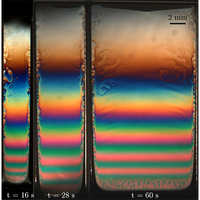
We experimentally investigated the drainage of vertical rectangular soap films as they thin under gravity. Drainage dynamics were measured by tracking isothickness interference fringes. We showed that the downward motion of these fringes is self-similar with a power-law time evolution, or equivalently, that the thickness profiles exhibit space-time separation. By combining our data with previous studies, we collapsed all profiles onto a single curve, demonstrating the universality of this phenomenon. These findings are important for studying liquid foams and marginal regeneration instability.

Shock-induced instability of dual-layer dilute gas-particle mixture

Yifeng He, Baoqing Meng, Baolin Tian, and Yue Yang

Phys. Rev. Fluids 9, 124301 (2024) - Published 3 December, 2024

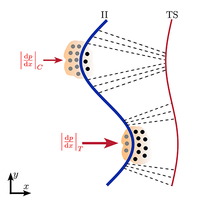
We report the mechanism and modeling for the two-dimensional shock-induced instability of a dual-layer gas-particle mixture. In the mixture, the instability is triggered by the pressure perturbation near the perturbed interface instead of the baroclinic vorticity. The velocity difference of gas induced by the pressure perturbation drives the particle interface to grow via drag coupling effects. Inspired by this interfacial instability mechanism, we estimate the growth of the particle interface in the linear stage.

Interface-induced turbulence in viscous binary fluid mixtures

Nadia Bihari Padhan, Dario Vincenzi, and Rahul Pandit

Phys. Rev. Fluids 9, L122401 (2024) - Published 3 December, 2024

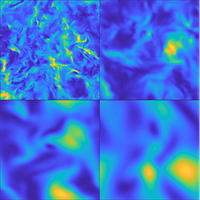
We uncover interface-induced turbulence, a striking nonequilibrium statistically steady state with spatiotemporal chaos, emerging from interfacial fluctuations in low-Reynolds-number binary-fluid mixtures. Using direct numerical simulations of the Cahn-Hilliard-Navier-Stokes equations, we reveal a power-law energy spectrum indicative of turbulence without a conventional inertial cascade.

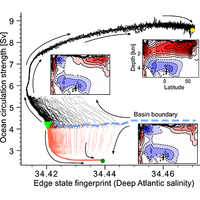
Melancholia states of the Atlantic Meridional Overturning Circulation

Johannes Lohmann and Valerio Lucarini

Phys. Rev. Fluids 9, 123801 (2024) - Published 2 December, 2024

A dynamically unstable state of the Atlantic ocean circulation in a global ocean model is constructed via an edge tracking algorithm. Such an unstable state is relevant as it mediates the potential future tipping point of the meridional overturning circulation from its present-day state to a collapsed state as a result of climate change. We identify the physical characteristics of the unstable state, which gives insights into the physical mechanisms necessary to induce a collapse, as well as potential fingerprints and early-warning signals of the tipping point.

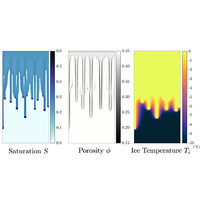
Pattern formation of freezing infiltration in porous media

Nathan D. Jones, Adrian Moure, and Xiaojing Fu

Phys. Rev. Fluids 9, 123802 (2024) - Published 2 December, 2024

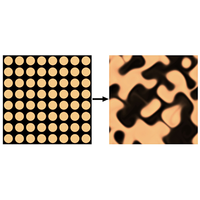
Gravity-driven flow of water into unsaturated porous media can form preferential pathways due to the gravity fingering instability. Here, we consider this process in a subfreezing porous medium using numerical simulations. We find that the macroscopic infiltration rate can be well predicted by the freezing Damköhler number. In contrast to the classical instability, the introduction of freezing in this problem gives rise to a new flow regime in which secondary flow pathways form in between the initial channels. This secondary instability homogenizes the otherwise channelized flow field and decreases the effective infiltration velocity.

Dynamics of two-dimensional water flow in angstrom-scale mono and hybrid channels

Chengzhen Sun, Qiyuan Wang, Mehdi Neek-Amal, Runfeng Zhou, and Bofeng Bai

Phys. Rev. Fluids 9, 124201 (2024) - Published 2 December, 2024

In angstrom-scale channels, where water forms a two-dimensional (2D) monolayer, interlayer shear force decreases, making traditional viscosity definitions unsuitable. Our findings demonstrate that in channels below 1 nm, water flow does not follow conventional viscosity-driven principles; instead, friction between water molecules and channel walls governs flow behavior. We extend the Hagen-Poiseuille equation by excluding viscosity and emphasizing friction, providing a more accurate model for flow in ultra-narrow 2D spaces. This approach improves understanding of water flow in angstrom-scale channels, with applications in desalination and energy conversion.

Contrasting flow dynamics between stationary and moving clapping bodies

Suyog V. Mahulkar and Jaywant H. Arakeri

Phys. Rev. Fluids 9, 114702 (2024) - Published 27 November, 2024

Flow dynamics of pulse-jetting aquatic animals are often studied with apparatus kept stationary. This paper examines whether the stationary configuration captures the mechanics of the swimming animal. A clapping body, simulating a pulse-jet animal, is tested in freely propelled (dynamic) and forward motion constrained (stationary) conditions. Significant differences are observed in body motion and wake structure: clapping motion is nearly twice as fast in dynamic cases, while mean thrust coefficient and vortex circulation are higher in stationary cases, varying with body depth but which remain constant in dynamic cases. Care is needed in extrapolating data from stationary to swimming bodies.

Rayleigh-Taylor unstable flames: The effect of two-mode coupling

Mingxuan Liu (刘明轩) and Elizabeth P. Hicks

Phys. Rev. Fluids 9, 113203 (2024) - Published 26 November, 2024

We explore how adding a reaction to a Rayleigh-Taylor unstable interface affects the way that two short wavelength modes couple to generate longer wavelength modes. Using simulations, we identify five distinct flame growth solution types. Depending on the greatest common divisor of the wavenumbers of the two modes, the flame may stall, develop coherent pulsations, or even become a metastable traveling wave. We also compare our results with two-mode coupling in ablative and classical Rayleigh-Taylor and show that all three systems may follow the same mode coupling dynamics.

Sign In to Your Journals Account

Filter

Recent Issues

Vol. 11, Iss. 10
October 2026
Vol. 11, Iss. 9
September 2026
Vol. 11, Iss. 8
August 2026
Vol. 11, Iss. 7
July 2026
Category
Article Type
Section

Filter

Article Lookup

Enter a citation