Recent Articles

Stochastic identities for random isotropic fields

A. S. Il'yn, A. V. Kopyev, V. A. Sirota, and K. P. Zybin

Phys. Rev. Fluids 10, L022602 (2025) - Published 12 February, 2025

The article presents a new result on statistical properties of isotropic tensor fields. It turns out that for the components of such fields there exists a set of nontrivial identities. Deviations from these identities allow us to make conclusions about the spatial configuration of turbulent flows.

Mesoscopic hydrodynamic model for spreading, sliding, and coarsening compound drops

Jan Diekmann and Uwe Thiele

Phys. Rev. Fluids 10, 024002 (2025) - Published 10 February, 2025

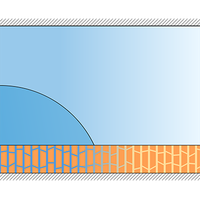
We consider the dynamics of compound drops that are formed by two immiscible, partially wetting liquids within a mesoscopic hydrodynamic description based on a gradient dynamics approach in full-curvature and long-wave variants. After discussing existing models we establish conditions between macroscopic and mesoscopic descriptions that ensure consistent Neumann and Young laws. As examples, we then numerically study spreading and sliding compound drops on horizontal and inclined substrates, respectively, as well as coarsening drop ensembles.

Active control of an overexpanded jet using plasma-based actuators

Anirudh Lakshmi Narasimha Prasad and S. Unnikrishnan

Phys. Rev. Fluids 10, 024602 (2025) - Published 10 February, 2025

Supersonic over-expanded jets, common during high-speed military aircraft takeoff, generate intense noise, posing health risks to personnel. This study tests a plasma actuator-based small perturbation control mechanism to reduce noise. Results show that optimal forcing conditions can achieve over 2.5dB noise reduction with minimal thrust loss. The study also explores the mechanisms behind noise reduction and examines the impact of control on jet flow features, providing insights into its effectiveness.

Expressing turbulent kinetic energy as coarse-grained enstrophy or strain deformations

Damiano Capocci

Phys. Rev. Fluids 10, L022601 (2025) - Published 10 February, 2025

In turbulent flows, the fluid element is deformed by chaotic motion due to the formation of sharp velocity gradients, yet an exact relationship between these deformations and kinetic energy remains elusive. In the context of incompressible and homogeneous turbulence, this work derives an exact identity connecting velocity gradient norms across the scales to kinetic energy, offering a novel decomposition in terms of strain-rate deformations and vortical motion. The formulation also leads to an exact real-space representation of the kinetic energy spectrum, providing new insights into the Kolmogorov constant and spectral scaling in hydrodynamic turbulence theory and beyond.

Experiments on buoyancy-driven instability ahead of a dissolution front in a porous rock

Sam Clarke, Jon Harrington, Simon Norris, and Andy Woods

Phys. Rev. Fluids 10, 024001 (2025) - Published 6 February, 2025

New experiments show the Rayleigh-Taylor instability in a partially soluble porous medium. An initially buoyant fluid invades from the top. As the fluid dissolves some of the solid material, it becomes dense relative to the underlying formation fluid. This leads to growth of Rayleigh-Taylor fingers at the fluid-fluid interface. We present a new theory to model the nonlinear growth of these fingers, as well as a novel technique to track dissolution fronts.

Friction-induced bubble edge curvature in flowing two-dimensional confined foams

Christophe Raufaste, Lauren Rose, Stéphane Santucci, and Benjamin Dollet

Phys. Rev. Fluids 10, 023301 (2025) - Published 5 February, 2025

Liquid foams are widely used in industrial processes, yet the interplay between foam structure and flow properties remains a topic of active research. This study investigates how friction forces and confinement in quasi-two-dimensional foams influence bubble shapes during flow, revealing anisotropic deformations and curvature of the films correlated to their orientation. Using experiments and a viscous froth-based model, we demonstrate a robust link between bubble curvature, anisotropy, and flow properties, providing new insights into the dynamics of foam flows under confinement.

Rise and fall of a multicomponent droplet in a surrounding fluid: Simulation study of a bumpy path

Mirantsoa Aimé Rasolofomanana, Romain Le Tellier, and Hervé Henry

Phys. Rev. Fluids 10, 023601 (2025) - Published 5 February, 2025

The buoyancy driven motion of a droplet that loses a component through diffusion in a fluid is studied numerically. The interplay of diffusion and advection is shown to have unexpected effects that cannot be explained in the fast or slow diffusion limit.

Path of a pair of deformable bubbles rising initially in line and close to a vertical wall

Haochen Huang (黄澔辰), Pengyu Shi, Nina Elkina, Henrik Schulz, and Jie Zhang (张杰)

Phys. Rev. Fluids 10, 023602 (2025) - Published 5 February, 2025

We simulate the dynamics of a pair of three-dimensional deformable bubbles rising initially in-line and close to a vertical wall in an otherwise quiescent liquid. Our findings reveal that the wall-induced asymmetry significantly alters the evolution of the bubble paths and wakes, with horizontal separation occurring in either the wall-normal plane or the wall-parallel plane, depending on the competition between irrotational and vortical effects. We also analyze the influence of initial angular deviations, demonstrating how the final geometry of the bubble pair helps us understand inhomogeneous near-wall bubble distributions.

Pattern formation in coiling of falling viscous threads: Revisiting the geometric model

Will Sze, Eusebius J. Doedel, Ida Karimfazli, and Behrooz Yousefzadeh

Phys. Rev. Fluids 10, 023901 (2025) - Published 5 February, 2025

A flowing viscous thread in contact with a moving platform forms intricate patterns. The shape of these patterns depends on the fall height and the platform’s speed. At moderate fall heights, these patterns can be reproduced using a model based on the no-slip condition and the curvature of the thread at the contact point. We re-examine these patterns experimentally and revisit the model computationally. We discover new patterns in both cases, highlighting the presence of greater complexity within the phenomenon than known previously.

Revisiting the linear forcing of turbulence in two-phase flows

Victor Boniou, Stéphane Jay, Guillaume Vinay, and Jean-Lou Pierson

Phys. Rev. Fluids 10, 024301 (2025) - Published 5 February, 2025

Maintaining realistic turbulence in numerical simulations is a key element for studying complex flows. This is typically achieved by forcing turbulence through the synthetic injection of energy at prescribed wavenumbers. The task gets challenging in two-phase flows, where turbulence is closely coupled with interface dynamics. In this work, we revisit the linear forcing method proposed by Lundgren and extend its application to turbulent emulsions and droplet-laden turbulence. We propose a general linear forcing that incorporates two-phase flow contributions and enables a priori control of the turbulent characteristics.

Diminishing effect of a pressure gradient on large-scale rolls of plane Couette flow: A singular value analysis

Toni Dokoza, Joao Vinicius Hennings de Lara, and Martin Oberlack

Phys. Rev. Fluids 10, 024601 (2025) - Published 5 February, 2025

This study investigates the transition from Couette flow to Poiseuille flow, focusing on the disappearance of single-circle coherent structures and their link to pressure gradients. By combining direct numerical simulation (DNS) data with resolvent and structured singular value analysis, the work identifies critical layers as key to the wall-normal positioning of structures and highlights the influence of pressure gradients on their size and shape. The findings demonstrate that structured singular value analysis aligns well with DNS results, offering a cost-effective and deeper theoretical understanding of flow dynamics.

Spectral characteristic of a scalar-dissipation-rate-based turbulent burning velocity

Sajjad Mohammadnejad and Sina Kheirkhah

Phys. Rev. Fluids 10, 023201 (2025) - Published 3 February, 2025

How fast do turbulent premixed flames burn? This experimental investigation utilizes both active and passive turbulence generators to produce a wide range of turbulent flow characteristics for studying the scalar dissipation rate (the image), which is related to the burning velocity of premixed flames. Then, the spectral characteristics of the background turbulence, scalar dissipation rate, and the related burning velocity are presented, discussed, and compared. This study discusses the important role of large-scale turbulence in enhancing the burning velocity of turbulent premixed methane-air and hydrogen-enriched methane-air flames.

Vibrational modes of a thin sheet in a pressurized chamber

Oz Oshri

Phys. Rev. Fluids 10, 013905 (2025) - Published 31 January, 2025

The intricate dynamics between thin sheets and compressible fluids plays a pivotal role in microelectromechanical systems and microfluidic switches, where precise control of fluid dynamics and structural movement is essential. In this study we present an analytical model that integrates the elasticity of thin sheets with the hydrodynamics of compressible fluids to investigate how material properties and compression influence the system’s vibrational modes.

Helical locomotion in dilute suspensions

Albane Théry, Andres Zambrano, Eric Lauga, and Roberto Zenit

Phys. Rev. Fluids 10, 013101 (2025) - Published 29 January, 2025

Microorganisms often navigate in heterogeneous complex fluids, such as mucus or soil. The heterogeneity affects swimming in surprising ways. In this work we use experiments and mathematical modeling to understand the effect of suspended particles on the efficiency of helical propulsion. Strikingly, we find that suspensions can significantly enhance propulsion.

Effects of bulk and wall chemical reactions on hydrodynamic dispersion of a solute in a couple stress fluid

Radha S, Swarup Barik, and Nanda Poddar

Phys. Rev. Fluids 10, 014502 (2025) - Published 29 January, 2025

Chemical reactions significantly affect the solute dynamics in the couple stress fluid flow. Using multiscale homogenization, our findings highlight how combined bulk and wall chemical reactions significantly reduce the solute concentration for all values of the couple stress parameter in flows between parallel plates. Bulk and wall chemical reactions consume the solute across the channel, and at the boundaries, these reactions override the effects of couple stress, ensuring precise control over concentration profiles. Crucially, the couple stress effect remains impactful for all reaction conditions, opening new frontiers in advanced fluid system design.

Gradient dynamics model for drops of volatile liquid on a porous substrate

Simon Hartmann and Uwe Thiele

Phys. Rev. Fluids 10, 014003 (2025) - Published 27 January, 2025

The article presents a mesoscopic hydrodynamic model for a spreading drop of volatile partially wetting liquid on a solid porous substrate. The model describes the coupled dynamics of the the three-phase system in terms of the drop height profile, the vertically averaged saturation profile in the porous layer and the vertically averaged vapor density above the substrate. Our approach is based on the gradient dynamics framework widely used for modeling thin liquid films. After developing the model, we discuss a selection of theoretical and numerical results, e.g., the resulting sorption isotherm or a simulation of coupled spreading, imbibition, and evaporation dynamics.

Reconfiguration and dynamics of clamped fibers under finite-amplitude surface gravity waves

Giulio Foggi Rota, Alessandro Chiarini, and Marco Edoardo Rosti

Phys. Rev. Fluids 10, 014301 (2025) - Published 27 January, 2025

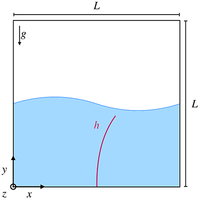
We simulate the dynamics of a flexible stem submerged under a surface gravity wave. Varying the rigidity of the stem, we explore its motion in the drag-dominated regime with realistic air and water properties. A stiffer stem maintains on average a straight configuration and exhibits streamwise oscillations in phase-opposition with the wave, moving symmetrically with respect to the vertical direction. Conversely, a more compliant stem reconfigures under the influence of the Stokes drift, bending forward and breaking the symmetry, and exhibits oscillations that are more coherent with the surrounding flow field. Resonance is observed at the transition between the two regimes.

Evaporation of thin droplets of colloidal suspensions in shallow cavities

Li-Hsuan Chang and Satish Kumar

Phys. Rev. Fluids 10, 014002 (2025) - Published 24 January, 2025

We focus on how cavity shape, evaporation rate, and thermal Marangoni flow affect particle deposition when the contact line is free to move. A lubrication- theory-based model is developed to derive evolution equations for the droplet height and vertically averaged particle concentration. Our model shows that a pressure maximum appears at the droplet edge as the evaporation rate or thermal Marangoni flows increase, or as the cavity depth decreases. The resulting inward flow causes the contact line to depin, which leads to an increase in the uniformity of particle deposition but also to the occurrence of a pinch point (a sharp local minimum of particle number density) near the droplet edge.

Editorial: The 2024 François Naftali Frenkiel Award for Fluid Mechanics

Eric Lauga and Beverley McKeon

Phys. Rev. Fluids 10, 010001 (2025) - Published 23 January, 2025

Sign In to Your Journals Account

Filter

Recent Issues

Vol. 11, Iss. 10
October 2026
Vol. 11, Iss. 9
September 2026
Vol. 11, Iss. 8
August 2026
Vol. 11, Iss. 7
July 2026
Category
Article Type
Section

Filter

Article Lookup

Enter a citation