Recent Articles

Linearized propulsion theory of flapping airfoils revisited

R. Fernandez-Feria

Phys. Rev. Fluids 1, 084502 (2016) - Published 27 December, 2016

A new calculation of the thrust forces and the efficiency of an airfoil undergoing small heaving and pitching motions is presented.

Hemodynamic forces in a model left ventricle

Federico Domenichini and Gianni Pedrizzetti

Phys. Rev. Fluids 1, 083201 (2016) - Published 23 December, 2016

Modification of the forces due to abnormal motions of the wall are analyzed in a model left ventricle, showing that loss of temporal synchrony is more relevant than loss of spatial uniformity. A relatively simple integral model is then introduced, it is able to capture the main properties of the global hemodynamic force balance.

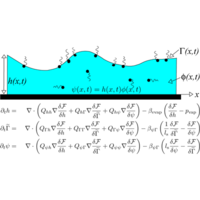
Gradient dynamics models for liquid films with soluble surfactant

Uwe Thiele, Andrew J. Archer, and Len M. Pismen

Phys. Rev. Fluids 1, 083903 (2016) - Published 23 December, 2016

A general three-field gradient dynamics model for the dynamics of liquid films covered by soluble surfactant is developed. Extending or amending the underlying energy functional results in a variety of thermodynamically consistent dynamical models.

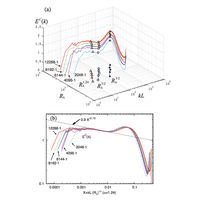
Energy spectrum in high-resolution direct numerical simulations of turbulence

Takashi Ishihara, Koji Morishita, Mitsuo Yokokawa, Atsuya Uno, and Yukio Kaneda

Phys. Rev. Fluids 1, 082403(R) (2016) - Published 22 December, 2016

Direct numerical simulations with 12,2883 grid points up to Rλ=2300 finds small systematic differences from Kolmogorov’s k-5/3 scaling of the inertial range of the energy spectrum.

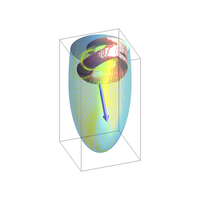
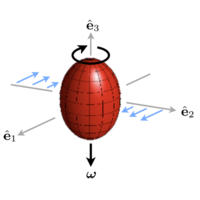
Angular velocity of a spheroid log rolling in a simple shear at small Reynolds number

J. Meibohm, F. Candelier, T. Rosén, J. Einarsson, F. Lundell, and B. Mehlig

Phys. Rev. Fluids 1, 084203 (2016) - Published 22 December, 2016

Singular perturbation theory calculations of the effect of fluid inertia on the angular velocity of a small spheroid in a shear flow show how weak fluid inertia reduces the angular velocity in an unbounded shear, and how this reduction depends upon the shape of the spheroid.

Saturation of the response to stochastic forcing in two-dimensional backward-facing step flow: A self-consistent approximation

Vladislav Mantič-Lugo and François Gallaire

Phys. Rev. Fluids 1, 083602 (2016) - Published 21 December, 2016

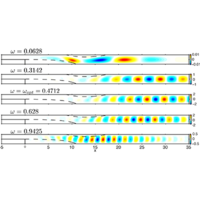
Noise amplifier flows, such as the flow above a backward facing step, are characterized by a large amplification to external stochastic perturbations. These perturbations, however, quickly loose their randomness: the response to inlet white noise undergoes a selective process promoting a response structure with an approximately single frequency active in the whole domain.

Linear models for sound from supersonic reacting mixing layers

P. Shivakanth Chary and Arnab Samanta

Phys. Rev. Fluids 1, 083801 (2016) - Published 21 December, 2016

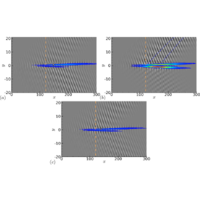
A turbulent spread rate within a linear modeling framework is used to compute the aerodynamic sound from supersonic mixing layers with heat release. The focus is on radiation from outer-mode-dominated mixing layers, which show different characteristics when compared to the classical Kelvin-Helmholtz mode based radiated sound.

Announcement: Changes to the Table of Contents of Physical Review Fluids

Phys. Rev. Fluids 1, 080001 (2016) - Published 20 December, 2016

Analysis of the clustering of inertial particles in turbulent flows

Mahdi Esmaily-Moghadam and Ali Mani

Phys. Rev. Fluids 1, 084202 (2016) - Published 20 December, 2016

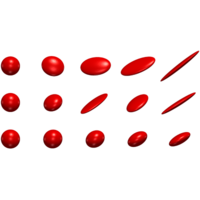
Clouds of inertial particles released in a turbulent flow experience deformation. By analytical characterizing of this deformation, a relationship is provided for the clustering of inertial particles that is applicable to a wide range of Stokes numbers.

Instantaneous insulation in a micro-slab: A mechanism for flow generation in a rarefied gas

A. Manela and L. Pogorelyuk

Phys. Rev. Fluids 1, 084102 (2016) - Published 19 December, 2016

A comprehensive analytical and numerical analyses of the flow generated in a thin slab by instantaneous thermal insulation of the walls is presented.

Interplay between viscosity and elasticity in freely expanding liquid sheets

Srishti Arora, Christian Ligoure, and Laurence Ramos

Phys. Rev. Fluids 1, 083302 (2016) - Published 16 December, 2016

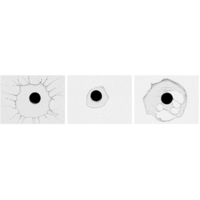
Experiments are conducted to investigate the interplay between surface tension effect, viscous dissipation, and elasticity in the free expansion of fluid sheets of viscous liquid and viscoelastic gels, produced thanks to the impact of a drop on a small solid target.

Numerical simulation of the deterministic vector separation of particles flowing over slanted open cavities

Eric S. G. Shaqfeh, Jorge A. Bernate, and Mengfei Yang

Phys. Rev. Fluids 1, 084101 (2016) - Published 15 December, 2016

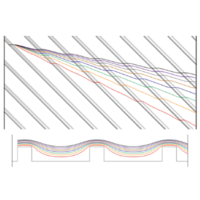
Numerical simulations elucidate the motion of rigid and deformable capsules in vector chromatography microfluidic devices.

Small scale dynamics of isotropic viscoelastic turbulence

M. Quan Nguyen, Alexandre Delache, Serge Simoëns, Wouter J. T. Bos, and Mamoud El Hajem

Phys. Rev. Fluids 1, 083301 (2016) - Published 14 December, 2016

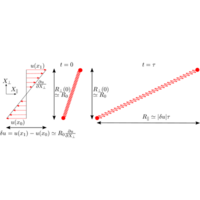
Energy transfer in viscoelastic homogeneous isotropic turbulence is investigated based on direct numerical simulations using the FENE-P model.

Long-range interactions, wobbles, and phase defects in chains of model cilia

Douglas R. Brumley, Nicolas Bruot, Jurij Kotar, Raymond E. Goldstein, Pietro Cicuta, and Marco Polin

Phys. Rev. Fluids 1, 081201(R) (2016) - Published 13 December, 2016

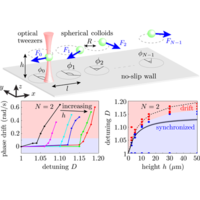
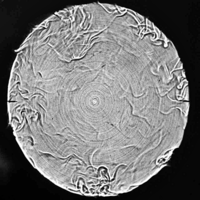
An experimental and numerical study of the consequences of varying the strength of hydrodynamic coupling between model cilia finds traveling waves, steady chevrons, and periodic phase defects.

Aerodynamic Leidenfrost effect

Anaïs Gauthier, James C. Bird, Christophe Clanet, and David Quéré

Phys. Rev. Fluids 1, 084002 (2016) - Published 13 December, 2016

Any liquid deposited on a solid moving quickly enough can remain in levitation above the surface. An analysis shows how the air flowing below and around the liquid sets the thickness of the air gap between the drop and the solid, and creates an aerodynamic force that gives control over the drop movement.

Nonmixing layers

Pierre Gaillard, Vincent Giovangigli, and Lionel Matuszewski

Phys. Rev. Fluids 1, 084001 (2016) - Published 12 December, 2016

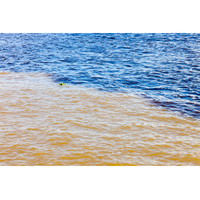
The impact of nonideal diffusion on the structure of supercritical cryogenic binary mixing layers is investigated. Nonideal diffusion has a dramatic impact near chemical thermodynamic stability limits where the components become quasi-immiscible and ultimately form a nonmixing layer.

Drying dynamics of a charged colloidal dispersion in a confined drop

Charles Loussert, Anne Bouchaudy, and Jean-Baptiste Salmon

Phys. Rev. Fluids 1, 084201 (2016) - Published 12 December, 2016

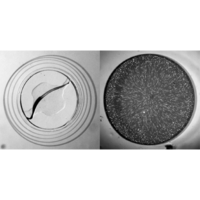
Raman and fluorescence imaging are used to investigate the drying of a confined drop of a charged colloidal dispersion. The experiments provide estimates of the collective diffusion coefficient of the dispersion, and they evidence both drying-induced buoyancy flows at low concentrations and homogeneous drying of a gel at higher concentrations.

Boundary layer fluctuations and their effects on mean and variance temperature profiles in turbulent Rayleigh-Bénard convection

Yin Wang, Xiaozhou He, and Penger Tong

Phys. Rev. Fluids 1, 082301(R) (2016) - Published 9 December, 2016

A theoretical model with a common set of parameters is presented to quantitatively describe the mean and variance temperature profiles in turbulent Rayleigh-Benard convection. This model is thoroughly tested in a specially designed quasi-two-dimensional convection cell, and the experimental results agree well with the theoretical predictions.

Semiflexible particles in isotropic turbulence

Aamir Ali, Emmanuel Lance Christopher VI Medillo Plan, Samriddhi Sankar Ray, and Dario Vincenzi

Phys. Rev. Fluids 1, 082402(R) (2016) - Published 9 December, 2016

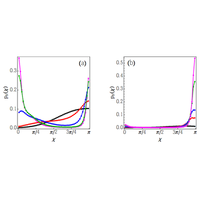
The bending dynamics of trimers depends strongly on whether the flow is laminar or turbulent and, in the latter case, is sensitive to the flow dimension. Trimers are found to be mainly fully extended in 3D turbulence and either fully extended or fully folded in 2D turbulence.

Generalized Chapman-Enskog continuum breakdown parameters for chemically reacting flows

Krishnan Swaminathan-Gopalan, Sharanya Subramaniam, and Kelly A. Stephani

Phys. Rev. Fluids 1, 083402 (2016) - Published 9 December, 2016

A new set of continuum breakdown parameters, rigorously derived from Generalized Chapman-Enskog theory, to capture regions of strong thermal and chemical nonequilibrium for high speed, chemically reacting flows is presented. Detailed analysis shows that chemical reactions can indirectly contribute to continuum breakdown via strong diffusion fluxes.

Sign In to Your Journals Account

Filter

Recent Issues

Vol. 11, Iss. 11
November 2026
Vol. 11, Iss. 10
October 2026
Vol. 11, Iss. 9
September 2026
Vol. 11, Iss. 8
August 2026
Category
Article Type
Section

Filter

Article Lookup

Enter a citation