Recent Articles

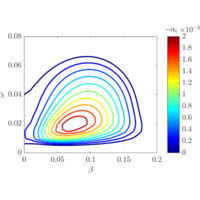
Convection-driven kinematic dynamos at low Rossby and magnetic Prandtl numbers

Michael A. Calkins, Louie Long, David Nieves, Keith Julien, and Steven M. Tobias

Phys. Rev. Fluids 1, 083701 (2016) - Published 8 December, 2016

An elegant study shows the existence of low-Rossby-number, low-magnetic-Prandtl-number kinematic dynamos driven by turbulent rotating convection.

Scaling properties of the mean wall-normal velocity in zero-pressure-gradient boundary layers

Tie Wei and Joseph Klewicki

Phys. Rev. Fluids 1, 082401(R) (2016) - Published 7 December, 2016

The mean velocity normal to the wall in a laminar and in a turbulent boundary layer with zero pressure gradient is investigated in experiments and in numerical simulations. Unlike the mean streamwise velocity and the turbulent shear stress, the mean wall-normal velocity is found to scale with its maximum and the boundary layer thickness.

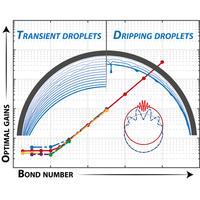
Rayleigh-Taylor instability under curved substrates: An optimal transient growth analysis

Gioele Balestra, P.-T. Brun, and François Gallaire

Phys. Rev. Fluids 1, 083902 (2016) - Published 7 December, 2016

The stability of thin viscous films coated on the inside of a horizontal cylindrical substrate is investigated by means of an optimal transient growth analysis. Despite the asymptotic stability of the system, the large algebraic growth of interfacial disturbances can result in dripping droplets.

Transition due to streamwise streaks in a supersonic flat plate boundary layer

Pedro Paredes, Meelan M. Choudhari, and Fei Li

Phys. Rev. Fluids 1, 083601 (2016) - Published 6 December, 2016

A possible bypass transition scenario in a Mach 3 flat plate boundary layer is proposed and investigated numerically.

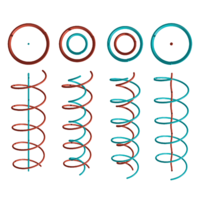
Leapfrogging Kelvin waves

N. Hietala, R. Hänninen, H. Salman, and C. F. Barenghi

Phys. Rev. Fluids 1, 084501 (2016) - Published 5 December, 2016

Two coaxial helical vortices undergo recurrent motion without reconnecting, resembling the leapfrogging of two vortex rings.

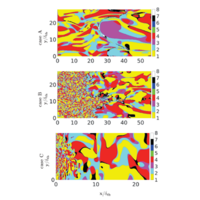
Flow topologies in different regimes of premixed turbulent combustion: A direct numerical simulation analysis

Daniel H. Wacks, Nilanjan Chakraborty, Markus Klein, Paul G. Arias, and Hong G. Im

Phys. Rev. Fluids 1, 083401 (2016) - Published 2 December, 2016

The flow topology distributions in different regimes of premixed turbulent combustion are investigated using DNS data of statistically planar turbulent H2-air premixed flames with equivalence ratio ϕ=0.7.

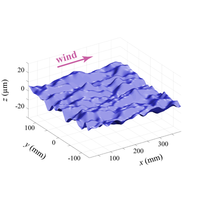
Viscosity effects in wind wave generation

A. Paquier, F. Moisy, and M. Rabaud

Phys. Rev. Fluids 1, 083901 (2016) - Published 1 December, 2016

Optical measurements with micrometer vertical resolution are performed to study the very first surface deformations produced by a turbulent wind over a viscous liquid. Varying the liquid viscosity over three decades provides new insight into surface deformations for wind velocity below the onset of wave amplification.

Shear-induced interfacial assembly of Janus particles

Hossein Rezvantalab, Kevin W. Connington, and Shahab Shojaei-Zadeh

Phys. Rev. Fluids 1, 074205 (2016) - Published 30 November, 2016

Numerical simulations demonstrate that shearing a cluster of randomly oriented Janus spheres adsorbed at the interface between two immiscible fluids drives their assembly into ordered chains due to the formation of capillary dipoles and the resulting interparticle capillary-induced interactions.

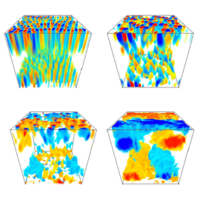
Two-dimensionalization of the flow driven by a slowly rotating impeller in a rapidly rotating fluid

Nathanaël Machicoane, Frédéric Moisy, and Pierre-Philippe Cortet

Phys. Rev. Fluids 1, 073701 (2016) - Published 29 November, 2016

The two-dimensionalization of the flow produced by a rotating impeller in a rapidly rotating frame is investigated experimentally. It is shown to proceed via the emergence of wakes of inertial waves traveling with the impeller blades as a consequence of a barotropic instability of the large-scale flow.

Spontaneous Wenzel to Cassie dewetting transition on structured surfaces

Bo Zhang, Xuemei Chen, Jure Dobnikar, Zuankai Wang, and Xianren Zhang

Phys. Rev. Fluids 1, 073904 (2016) - Published 29 November, 2016

Experiments and lattice Boltzmann simulations demonstrate that, in contrast with currently accepted opinions, the Cassie state for sufficiently large droplets condensing onto patterned hydrophobic surfaces, is stable, while the Wenzel state is metastable or unstable.

Dynamics of a thin film flowing down a heated wall with finite thermal diffusivity

Michael C. Dallaston, Dmitri Tseluiko, and Serafim Kalliadasis

Phys. Rev. Fluids 1, 073903 (2016) - Published 28 November, 2016

A theoretical investigation examines the effect of finite substrate thermal diffusivity on the stability of a thin liquid film flowing downward due to gravity.

Continuous time random walks for the evolution of Lagrangian velocities

Marco Dentz, Peter K. Kang, Alessandro Comolli, Tanguy Le Borgne, and Daniel R. Lester

Phys. Rev. Fluids 1, 074004 (2016) - Published 23 November, 2016

A continuous-time random walk approach is developed that quantifies the evolution of isochrone and equidistant Lagrangian velocities in steady heterogeneous flows. It is based on the Eulerian velocity distribution and predicts particle transport for arbitrary stationary and nonstationary initial conditions.

Investigation of airfoil leading edge separation control with nanosecond plasma actuator

J. G. Zheng, Y. D. Cui, Z. J. Zhao, J. Li, and B. C. Khoo

Phys. Rev. Fluids 1, 073501 (2016) - Published 22 November, 2016

A thorough combined numerical and experimental investigation of nanosecond dielectric barrier discharge actuation provides a description of the dynamics of the flow actuation process and elucidates the associated flow control mechanisms.

Role of body stiffness in undulatory swimming: Insights from robotic and computational models

Eric D. Tytell, Megan C. Leftwich, Chia-Yu Hsu, Boyce E. Griffith, Avis H. Cohen, Alexander J. Smits, Christina Hamlet, and Lisa J. Fauci

Phys. Rev. Fluids 1, 073202 (2016) - Published 21 November, 2016

Experiments and computational lamprey models address the question: How does flexibility affect swimming performance? Can we tune the passive material properties of a swimming body to improve performance?

Low Mach number fluctuating hydrodynamics for electrolytes

Jean-Philippe Péraud, Andy Nonaka, Anuj Chaudhri, John B. Bell, Aleksandar Donev, and Alejandro L. Garcia

Phys. Rev. Fluids 1, 074103 (2016) - Published 18 November, 2016

A numerical scheme for studying electrolyte solutions in the presence of thermally induced fluctuations is presented and analyzed. The inclusion of fluctuations consistent with fluctuation-dissipation balance is important for modeling small-scale electrokinetic transport phenomena and instabilities.

Sedimentation from particle-bearing plumes in a stratified ambient

Bruce R. Sutherland and Youn Sub (Dominic) Hong

Phys. Rev. Fluids 1, 074302 (2016) - Published 18 November, 2016

To understand better the spread of ash from volcanic eruptions penetrating into the stratosphere, laboratory experiments are performed using a recently developed light attenuation technique to measure the deposit of sediments from a particle-bearing plume rising in stratified fluid. The results are used to calibrate an adaptation of a plume model that accounts for particle settling and re-entrainment.

Effect of viscosity ratio on the shear-driven failure of liquid-infused surfaces

Ying Liu, Jason S. Wexler, Clarissa Schönecker, and Howard A. Stone

Phys. Rev. Fluids 1, 074003 (2016) - Published 17 November, 2016

Liquid-infused surfaces are being studied for possible applications in surface protection, functionalization, and drag reduction. Researchers investigate the shear-driven failure of these surfaces under a broad range of ratios of the viscosity of the external fluid to that of the lubricant, and they compare mathematical models and experimental results.

Effective slip boundary conditions for sinusoidally corrugated surfaces

Lin Guo, Shiyi Chen, and Mark O. Robbins

Phys. Rev. Fluids 1, 074102 (2016) - Published 17 November, 2016

Molecular dynamics simulations are used to investigate fluid structure near walls with different types of roughness. Slip depends on both large-scale changes in slope and atomic-scale corrugations that are modulated by local curvature.

Optimal disturbances in the near-wall region of turbulent channel flows

Euiyoung Kim, Haecheon Choi, and John Kim

Phys. Rev. Fluids 1, 074403 (2016) - Published 17 November, 2016

The transient growth of optimal disturbances constrained to the near-wall region (y+≤40) demonstrates that the ubiquitously observed near-wall turbulence structures are indeed related to linear optimal disturbance in the region where linear approximation is valid.

Mechanisms of anomalous dispersion in flow through heterogeneous porous media

Alina Tyukhova, Marco Dentz, Wolfgang Kinzelbach, and Matthias Willmann

Phys. Rev. Fluids 1, 074002 (2016) - Published 16 November, 2016
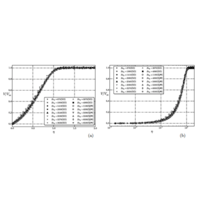
Anomalous dispersion in heterogeneous porous media is linked to the medium properties in terms of hydraulic conductivity. Spacetime particle transitions follow a continuous time random walk, which quantifies the dominant role of low-conductivity regions. An explicit map between the conductivity and transition time distributions is derived.

Sign In to Your Journals Account

Filter

Recent Issues

Vol. 11, Iss. 11
November 2026
Vol. 11, Iss. 10
October 2026
Vol. 11, Iss. 9
September 2026
Vol. 11, Iss. 8
August 2026
Category
Article Type
Section

Filter

Article Lookup

Enter a citation