Recent Articles

Statistical behavior of turbulent kinetic energy transport in boundary layer flashback of hydrogen-rich premixed combustion

Umair Ahmed, Abhishek L. Pillai, Nilanjan Chakraborty, and Ryoichi Kurose

Phys. Rev. Fluids 4, 103201 (2019) - Published 4 October, 2019

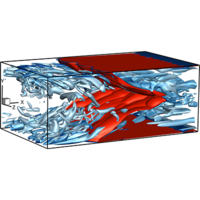
Statistical behavior of turbulent kinetic energy (TKE) transport in boundary layer flashback of hydrogen-rich premixed combustion is analyzed for the first time. Flame alters the structure of the turbulent boundary layer, which is evident from the changes in the budget of the TKE transport equation.

Energy cascades in active-grid-generated turbulent flows

D. O. Mora, E. Muñiz Pladellorens, P. Riera Turró, M. Lagauzere, and M. Obligado

Phys. Rev. Fluids 4, 104601 (2019) - Published 4 October, 2019

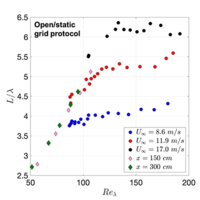
An experimental study on active-grid-generated turbulence finds that different operating protocols can produce different energy cascades. Also, independently of the protocol, the turbulence dissipation constant can be modeled from the zero crossings of velocity fluctuations.

Numerical analysis of electroconvection in cross-flow with unipolar charge injection

Yifei Guan and Igor Novosselov

Phys. Rev. Fluids 4, 103701 (2019) - Published 1 October, 2019

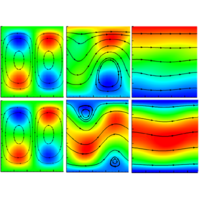
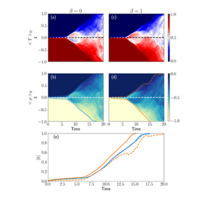
Electrohydrodynamic convection between parallel electrodes with unipolar injection is investigated numerically. A parameter Y, defined as the ratio of the local electric force to the viscous force, characterizes the stability of the flow system.

Bubble merger in initial Richtmyer-Meshkov instability on inverse-chevron interface

Xu Guo, Zhigang Zhai, Ting Si, and Xisheng Luo

Phys. Rev. Fluids 4, 092001(R) (2019) - Published 30 September, 2019

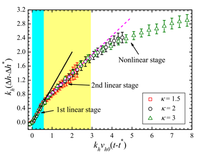
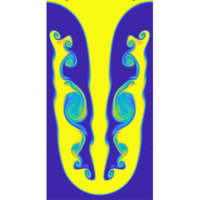
Inverse-chevron interfaces with various initial amplitudes and wavelengths are used in shock tube experiments to study bubble competition in the Richtmyer-Meshkov instability. We find that width growth of the large interface is enhanced and that of the small interface is more affected and inhibited.

Stability of viscous fingering in lifted Hele-Shaw cells with a hole

Sachin D. Kanhurkar, Vardhan Patankar, Tanveer ul Islam, Prasanna S. Gandhi, and Amitabh Bhattacharya

Phys. Rev. Fluids 4, 094003 (2019) - Published 30 September, 2019

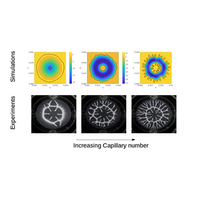
Theory, simulations, and experiments are used to study liquid-air interfacial instability of lifted Hele Shaw cells (LHSCs) with a hole in the center. The stability map provides a design framework for using multihole LHSCs to generate stable meshlike patterns in the liquid film.

Diffused-interface Rayleigh-Taylor instability with a nonlinear equation of state

Jason Olsthoorn, Edmund W. Tedford, and Gregory A. Lawrence

Phys. Rev. Fluids 4, 094501 (2019) - Published 30 September, 2019

An investigation of the impact of a nonlinear equation of state on the evolution of the Rayleigh-Taylor instability is presented. The nonlinear density relation introduces asymmetry in the growing plumes about the density interface, preferentially generating kinetic energy in the lower layer.

Effects of isothermal stratification strength on vorticity dynamics for single-mode compressible Rayleigh-Taylor instability

Scott A. Wieland, Peter E. Hamlington, Scott J. Reckinger, and Daniel Livescu

Phys. Rev. Fluids 4, 093905 (2019) - Published 26 September, 2019

The effects of initial stratification on single-mode Rayleigh-Taylor instability are examined using fully compressible wavelet-based direct numerical simulations. Such instabilities are widespread and are found in inertial confinement fusion, supernova ignition fronts, x-ray bursts, and geophysics.

Fully resolved simulations of a stationary finite-sized particle in wall turbulence over a rough bed

Xing Li, S. Balachandar, Hyungoo Lee, and Bofeng Bai

Phys. Rev. Fluids 4, 094302 (2019) - Published 26 September, 2019

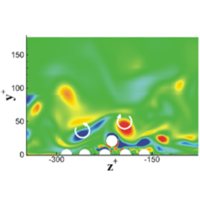
Direct numerical simulations are used to investigate forces on a stationary finite-sized particle in wall turbulence over a rough bed of hemispherical particles. Results show that lift is the main contributor of wall-normal force and can be well predicted with proper application of existing models.

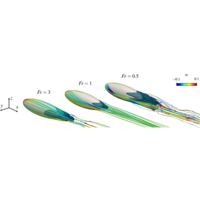
Stratified flow past a prolate spheroid

Jose L. Ortiz-Tarin, K. C. Chongsiripinyo, and S. Sarkar

Phys. Rev. Fluids 4, 094803 (2019) - Published 25 September, 2019

Simulation of density-stratified flow past an elongated body reveals substantial differences with respect to a sphere in flow separation, the near wake and internal waves. As stratification increases (Fr decreases), the fluid experiences vertical/sideways deflection and the separated region changes.

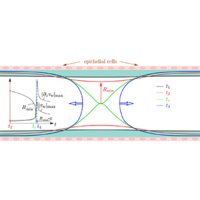
Liquid plug formation in an airway closure model

F. Romanò, H. Fujioka, M. Muradoglu, and J. B. Grotberg

Phys. Rev. Fluids 4, 093103 (2019) - Published 24 September, 2019

A numerical study finds that bifrontal plug growth leading to the closure of a human lung airway induces high stress levels on the wall, which is the location of airway epithelial cells. Postcoalescence wall stresses can be from 300% to 600% greater than precoalescence values.

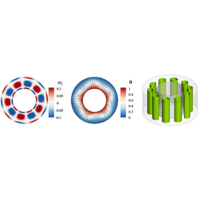
Thermoelectric convection in a dielectric liquid inside a cylindrical annulus with a solid-body rotation

Changwoo Kang, Antoine Meyer, Harunori N. Yoshikawa, and Innocent Mutabazi

Phys. Rev. Fluids 4, 093502 (2019) - Published 24 September, 2019

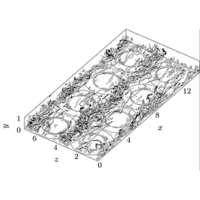
We study thermoelectric convection in a cylindrical annulus of dielectric liquid under rotation and a fixed temperature gradient. Convection onset is delayed and stationary helical vortices become oscillatory columnar vortices for a rotation rate above a value dependent on the radius ratio.

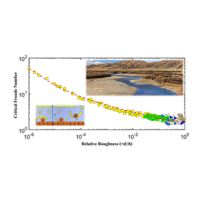
Cospectral budget model describes incipient sediment motion in turbulent flows

Shuolin Li and Gabriel Katul

Phys. Rev. Fluids 4, 093801 (2019) - Published 24 September, 2019

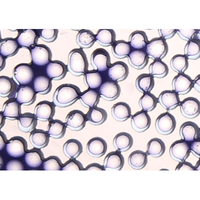
Incipient motion of sediment particles is analyzed using a relation between a densimetric Froude number (Fr) and 6 decades of relative roughness (N). The universal character of the Fr-N relation was recovered from the vertical velocity energy spectrum using a cospectral budget model.

Connectivity enhancement due to film flow in porous media

Marcel Moura, Eirik Grude Flekkøy, Knut Jørgen Måløy, Gerhard Schäfer, and Renaud Toussaint

Phys. Rev. Fluids 4, 094102 (2019) - Published 24 September, 2019

An experimental investigation shows that thin liquid films can interconnect different parts of a porous network (like wet soils or rocks) and effectively enhance the overall connectivity of the system. The effect is large enough to allow for the drainage of fluid clusters that otherwise would be entirely trapped in the matrix.

Large-amplitude oscillations of foils for efficient propulsion

Daniel Floryan, Tyler Van Buren, and Alexander J. Smits

Phys. Rev. Fluids 4, 093102 (2019) - Published 20 September, 2019

Theory and experiments explain why an inertial swimmer can swim more efficiently by flapping its tail slowly with a large amplitude than by doing so quickly with a small amplitude. The importance of drag is revealed as well as a fundamental tradeoff between thrust and efficiency.

Flow-radiation coupling in CO2 hypersonic wakes using reduced-order non-Boltzmann models

Amal Sahai, Christopher O. Johnston, Bruno Lopez, and Marco Panesi

Phys. Rev. Fluids 4, 093401 (2019) - Published 20 September, 2019

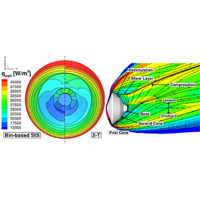
This work presents a unified physics-based reduced-order simulation framework for describing non-Boltzmann thermochemistry and radiative heating for hypersonic flows. The new approach is used to analyze afterbody flow dynamics and concomitant carbon dioxide IR radiation for the Mars 2020 mission.

Weakly nonlinear analysis of long-wave Marangoni convection in a liquid layer covered by insoluble surfactant

Alexander B. Mikishev and Alexander A. Nepomnyashchy

Phys. Rev. Fluids 4, 094002 (2019) - Published 19 September, 2019

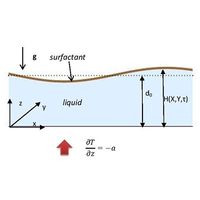
The long-wave oscillatory Marangoni instability in a heated liquid layer covered by insoluble surfactant is considered. It is shown that with the growth of the elasticity number the selected wave pattern is changed from the traveling waves to counterpropagating waves and then again to traveling waves.

Compressibility effects of supersonic Batchelor vortices

Toshihiko Hiejima

Phys. Rev. Fluids 4, 093903 (2019) - Published 16 September, 2019

Compressibility effects mean that fluctuation growth related to turbulence is suppressed as Mach number increases. An investigation that clarifies compressibility effects of the Batchelor vortex is presented. The findings indicate that entropy fluctuation in the vortex is strongly related to intrinsic compressibility.

Turbulent drag reduction by rotating rings and wall-distributed actuation

Paolo Olivucci, Pierre Ricco, and Sohrab Khosh Aghdam

Phys. Rev. Fluids 4, 093904 (2019) - Published 16 September, 2019

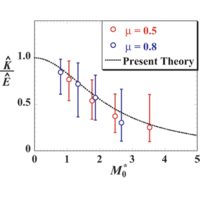
We use direct numerical simulations of turbulent channel flows to model skin-friction drag reduction with wall rotating rings combined with hydrophobic surfaces or opposition control. We find rotating rings reduce drag 20%. Combining with opposition control adds 7.4% and hydrophobic surfaces 6.5%.

Wave generation through the interaction of a mode-2 internal solitary wave and a broad, isolated ridge

David Deepwell, Marek Stastna, Magda Carr, and Peter A. Davies

Phys. Rev. Fluids 4, 094802 (2019) - Published 16 September, 2019

An investigation of a mode-2 internal solitary wave passing over a broad ridge finds that it is gradually adjusted into multiple waves of different form. The leading wave remains intact but is reduced in amplitude and energy. Incident amplitude, speed, and ridge height determine the strength of the resultant waves.

Pair dispersion in inhomogeneous turbulent thermal convection

Olivier Liot, David Martin-Calle, Amélie Gay, Julien Salort, Francesca Chillà, and Mickaël Bourgoin

Phys. Rev. Fluids 4, 094603 (2019) - Published 13 September, 2019

An experimental study of the pair separation of particles in turbulent thermal convection reveals the dramatic impact of the inhomogeneous large-scale flow on pair dispersion, without affecting the small-scale turbulent statistics. The Richardson-Obukhov regime is also revisited.

Sign In to Your Journals Account

Filter

Recent Issues

Vol. 11, Iss. 10
October 2026
Vol. 11, Iss. 9
September 2026
Vol. 11, Iss. 8
August 2026
Vol. 11, Iss. 7
July 2026
Category
Article Type
Section

Filter

Article Lookup

Enter a citation