Recent Articles

Reframing droplet coalescence: Identifying the distinctive dynamics of nanofilm evolution

Jhoan Toro-Mendoza, Oscar Paredes-Altuve, Miguel A. Velasquez, and Dimiter N. Petsev

Phys. Rev. Fluids 4, 093604 (2019) - Published 12 September, 2019

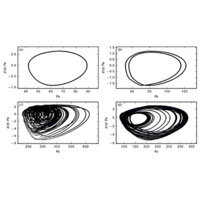
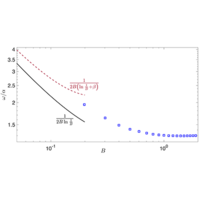
A new analysis reveals distinctive features of the modeled evolution of the fluid nanofilm formed between two coalescing droplets: an attractor-type phase space, a non-Fickean behavior of the growing film, and a complexity measure larger than that expected for fractional Brownian motion.

Trailing-edge noise from the scattering of spanwise-coherent structures

Alex Sano, Leandra I. Abreu, André V. G. Cavalieri, and William R. Wolf

Phys. Rev. Fluids 4, 094602 (2019) - Published 12 September, 2019

Using signal processing of a large-eddy simulation based on flow-acoustic correlations and spectral proper orthogonal decomposition, we identify regions and mechanisms effective at generating sound in a turbulent flow around a NACA 0012 airfoil with zero angle of attack and Mach number of 0.115.

Collective diffusivity in a sheared viscous emulsion: Effects of viscosity ratio

Abhilash Reddy Malipeddi and Kausik Sarkar

Phys. Rev. Fluids 4, 093603 (2019) - Published 11 September, 2019

Shear-induced gradient diffusivity in an emulsion of viscous drops is determined from direct numerical simulations of the system using a dynamic structure factor approach. A nonmonotonic variation of the gradient diffusivity with viscosity ratio and capillary number is observed.

Internal waves in a shear background current: Transition from solitary-wave regime to dispersive-wave regime

Chengzhu Xu and Marek Stastna

Phys. Rev. Fluids 4, 094801 (2019) - Published 11 September, 2019

For a given stratification, the presence of a shear background current may significantly alter the wave form of internal waves. Depending on the direction and strength of background shear, it could prevent the formation of solitary waves but enable the formation of a dispersive wave train.

Transition to time-dependent flow in highly viscous horizontal convection

Lennart Ramme and Ulrich Hansen

Phys. Rev. Fluids 4, 093501 (2019) - Published 10 September, 2019

It is shown that horizontal convection at an infinite Prandtl number will become time-dependent at sufficiently high Rayleigh numbers. The point of the transition is dependent on the heating configuration, and the scaling laws of heat flux and circulation strength are subsequently changed.

Stochastic model for filtration by porous materials

Filippo Miele, Pietro de Anna, and Marco Dentz

Phys. Rev. Fluids 4, 094101 (2019) - Published 10 September, 2019

Transport and filtration of colloids through permeable materials is controlled by the underlying heterogeneous structure of the host medium. A stochastic model is proposed that takes into account pore-scale heterogeneity, which controls the macroscopic deposition.

Extensional rheology of a dilute particle-laden viscoelastic solution

Anika Jain, Jonas Einarsson, and Eric S. G. Shaqfeh

Phys. Rev. Fluids 4, 091301(R) (2019) - Published 9 September, 2019

Numerical simulations of viscoelastic flow around an isolated particle find that, while the particle contribution to bulk elongational viscosity of a suspension increases at small strains, at larger strains the particle is shielded by stretched polymers, leading to a decrease in relative viscosity.

Experimental study of coherent structures of finite-size particles in thermocapillary liquid bridges

Masakazu Gotoda, Aro Toyama, Misa Ishimura, Tomoaki Sano, Mizuki Suzuki, Toshihiro Kaneko, and Ichiro Ueno

Phys. Rev. Fluids 4, 094301 (2019) - Published 9 September, 2019

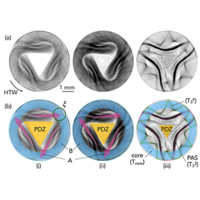
We experimentally investigate the formation of coherent structures by finite-size particles in thermocapillary liquid bridges. Special attention is paid to particle accumulation structures in which suspended particles gather to form a solid-like-structure in the rotating frame of reference.

Reducing the skin-friction drag of a turbulent boundary-layer flow with low-amplitude wall-normal blowing within a Bayesian optimization framework

O. A. Mahfoze, A. Moody, A. Wynn, R. D. Whalley, and S. Laizet

Phys. Rev. Fluids 4, 094601 (2019) - Published 9 September, 2019

A Bayesian optimization framework is developed to optimize low-amplitude wall-normal blowing control of a turbulent boundary-layer flow in order to generate net energy savings.

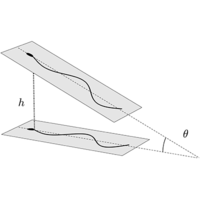
Pairwise hydrodynamic interactions of synchronized spermatozoa

Benjamin J. Walker, Kenta Ishimoto, and Eamonn A. Gaffney

Phys. Rev. Fluids 4, 093101 (2019) - Published 6 September, 2019

Simulations of synchronized spermatozoa reveal stable pairwise swimming, with swimmers speeding up as they approach each other from above. However, swimming side-by-side proves unstable, highlighting anisotropy in planar-beating flagellates that is not captured by simple singularity representations.

Controlled gliding and perching through deep-reinforcement-learning

Guido Novati, L. Mahadevan, and Petros Koumoutsakos

Phys. Rev. Fluids 4, 093902 (2019) - Published 6 September, 2019

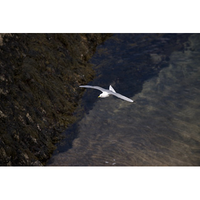
Gliding is an energetically efficient mode of transportation. It is shown that reinforcement learning identifies gliding strategies with minimum energy expenditure and fastest time of arrival, with better performance than model-based optimal control, while being robust to perturbations.

Stochastic receptivity analysis of boundary layer flow

Wei Ran, Armin Zare, M. J. Philipp Hack, and Mihailo R. Jovanović

Phys. Rev. Fluids 4, 093901 (2019) - Published 5 September, 2019

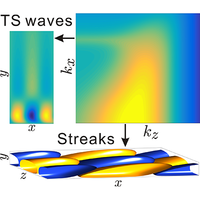
The receptivity of pretransitional boundary layers is analyzed using the steady-state covariance of the stochastically forced linearized Navier-Stokes equations. Prevailing length scales captured by both locally parallel and global analyses provide insight into perturbation growth mechanisms.

Dynamics of contracting filaments

Christopher R. Anthony, Pritish M. Kamat, Michael T. Harris, and Osman A. Basaran

Phys. Rev. Fluids 4, 093601 (2019) - Published 3 September, 2019

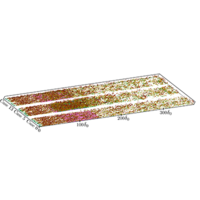
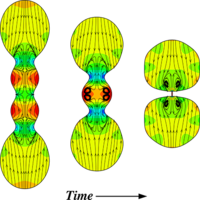
With multiscale simulations we study contracting filaments of aspect ratios O(1)-O(1000) and Ohnesorge numbers 0.0001-10. Breakup modes of inviscid, intermediately viscous, and highly viscous filaments are clarified, highlighting the key role of capillary wave interactions in the intermediate case.

Speed of rolling droplets

Ehud Yariv and Ory Schnitzer

Phys. Rev. Fluids 4, 093602 (2019) - Published 3 September, 2019

An asymptotic analysis of a two-dimensional nonwetting drop rolling down an inclined plane at small Bond numbers shows, contrary to previous studies, that the leading-order contribution to the dissipation comes from the overlap region between the drop scale and the small neighborhood of the drop’s flat-spot.

Oscillatory pattern selection by spatial heat release modulation in multistable Marangoni convection

Alexander A. Nepomnyashchy and Ilya B. Simanovskii

Phys. Rev. Fluids 4, 094001 (2019) - Published 3 September, 2019

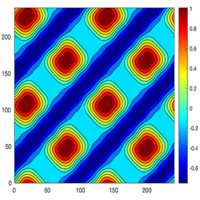
We study the action of spatial heat release modulation on wave patterns. In the case of multistability, the spatial modulation can be used for the creation of a pattern with a definite structure. The violation of the reflection symmetry of the pattern can lead to a quasiperiodic temporal evolution.

Leidenfrost drop dynamics: Exciting dormant modes

Jesse E. Bergen, Bailey C. Basso, and Joshua B. Bostwick

Phys. Rev. Fluids 4, 083603 (2019) - Published 30 August, 2019

Leidenfrost drops on curved substrates exhibit complex shape-change dynamics, which include polygonal modes, star modes, and a dominant large amplitude n=2 mode. Remarkably, two distinct modes are observed to coexist in stable synchronized resonance with harmonically related frequencies.

Pattern formation in oil-in-water emulsions exposed to a salt gradient

Ying Liu, Bhargav Rallabandi, Lailai Zhu, Ankur Gupta, and Howard A. Stone

Phys. Rev. Fluids 4, 084307 (2019) - Published 30 August, 2019

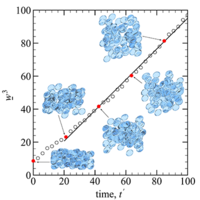
We study experimentally an oil-in-water emulsion exposed to salt concentration gradients. Numerical and analytical studies elucidate the vertical and azimuthal flow instabilities caused by competing effects of the dissolved salt and the suspended oil droplets on the density of the medium.

Multiphase buoyant plumes with soluble drops or bubbles

Shigan Chu and Andrea Prosperetti

Phys. Rev. Fluids 4, 084306 (2019) - Published 29 August, 2019

The loss of buoyancy because of dissolution is mitigated or enhanced by changes in ambient liquid density. A scaling analysis identifies three parameters: dissolution rate vs plume rise time, the effect of dissolved material on liquid density, and the drop or bubble rise velocity vs the plume velocity.

Modulation instability and rogue waves for shear flows with a free surface

Q. Pan, R. H. J. Grimshaw, and K. W. Chow

Phys. Rev. Fluids 4, 084803 (2019) - Published 29 August, 2019

The effect of shear currents on rogue waves on a free surface is modeled by the nonlinear Schrödinger equation. Curvature of velocity profiles (or vorticity gradient) and the relative motion of the wave packet and shear current play critical roles, through enhanced growth rates of disturbances.

Stability analysis of electroconvection with a solid-liquid interface via the lattice Boltzmann method

Kang Luo, Jian Wu, Alberto T. Pérez, Hong-Liang Yi, and He-Ping Tan

Phys. Rev. Fluids 4, 083702 (2019) - Published 28 August, 2019
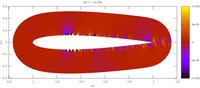
Electroconvection in dielectric liquid is extended from single phase to solid-liquid interaction. Stability criteria and bifurcation are numerically predicted by the lattice Boltzmann method. Effects of interface position, permittivity and mobility ratios, and electric conductivity are considered.

Sign In to Your Journals Account

Filter

Recent Issues

Vol. 11, Iss. 10
October 2026
Vol. 11, Iss. 9
September 2026
Vol. 11, Iss. 8
August 2026
Vol. 11, Iss. 7
July 2026
Category
Article Type
Section

Filter

Article Lookup

Enter a citation