Recent Articles

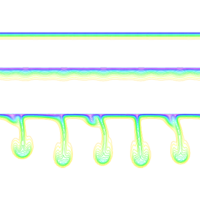
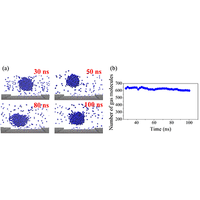
Effects of nanostructured substrates on the dynamic behavior of nanobubbles

Chenliang Li, A-Man Zhang, Shi-Ping Wang, and Pu Cui

Phys. Rev. Fluids 4, 103603 (2019) - Published 15 October, 2019

The nanotrench structure can obviously enhance the stability of bulk nanobubbles and control the formation and positions of surface nanobubbles. The hydrophilic deformed graphene domains prevent interaction between two neighboring surface nanobubbles.

Experimental study on behaviors of low-Stokes number particles in weakly chaotic structures induced by thermocapillary effect within a closed system with a free surface

Takeru Oba, Aro Toyama, Takuma Hori, and Ichiro Ueno

Phys. Rev. Fluids 4, 104002 (2019) - Published 15 October, 2019

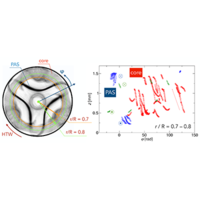
Experiments show that low-Stokes-number particles in a thermocapillary-induced convection within a closed geometry with a free surface form several types of coherent structures.

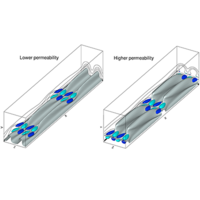
Saddle-node bifurcations of traveling waves in the asymptotic suction boundary layer flow

H. Wedin and S. Cherubini

Phys. Rev. Fluids 4, 104401 (2019) - Published 15 October, 2019

Finite-amplitude traveling wave solutions in the asymptotic suction boundary layer are computed for different wall permeabilities. The permeability has negligible effect on the Reynolds number at which they emerge, but it affects their shape and amplitude and the turbulent flow velocity profile.

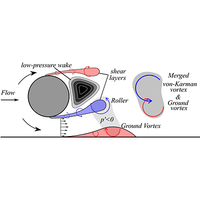
Asymmetric wake of a horizontal cylinder in close proximity to a solid boundary for Reynolds numbers in the subcritical turbulence regime

Pablo Ouro, Valentine Muhawenimana, and Catherine A. M. E. Wilson

Phys. Rev. Fluids 4, 104604 (2019) - Published 15 October, 2019

Large Eddy Simulation and experiments show that the wake of horizontal cylinders in proximity to a solid boundary is asymmetric. The cylinder’s bottom shear layer transitions to rollers, generating negative pressure, which induces a ground vortex to lift-off and interact with the von-Karman street.

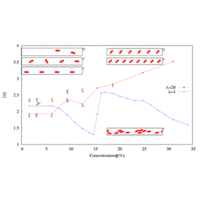
Rheology of a confined vesicle suspension

Abdessamad Nait-Ouhra, Alexander Farutin, Hamid Ez-Zahraouy, Abdelilah Benyoussef, and Chaouqi Misbah

Phys. Rev. Fluids 4, 103602 (2019) - Published 14 October, 2019

The effect of an off-center stable steady state of a vesicle (a model of red blood cells) in a bounded shear flow is investigated numerically. It is found that this new solution (off-center) strongly alters the rheological properties of dilute as well as concentrated vesicle suspensions.

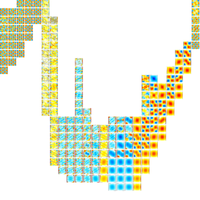
Modal reduction of a parametrically forced confined viscous flow

Jason Yalim, Bruno D. Welfert, and Juan M. Lopez

Phys. Rev. Fluids 4, 103903 (2019) - Published 14 October, 2019

A model for estimating the onset of parametric instability in a stably stratified two-dimensional confined viscous flow is presented. The model uses a superposition of modal responses to independent Mathieu equations and is calibrated using a small number of numerical Floquet results.

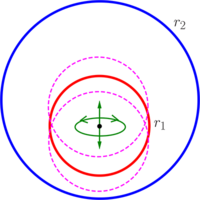
Chiral transfer of angular momentum

H. K. Moffatt and V. A. Vladimirov

Phys. Rev. Fluids 4, 104102 (2019) - Published 14 October, 2019

For a sphere moving in a viscous liquid inside a second sphere, it is shown theoretically that chirality (the lack of reflectional symmetry) is necessary to produce a mean torque from oscillatory displacements and rotations, both with zero means.

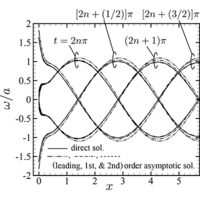
Sound waves propagating in a slightly rarefied gas over a smooth solid boundary

Masanari Hattori and Shigeru Takata

Phys. Rev. Fluids 4, 103401 (2019) - Published 11 October, 2019

A fluid-dynamic-type system for acoustic phenomena in the slip-flow regime is obtained with an asymptotic analysis of the linearized Boltzmann equation. The system permits a comprehensive understanding of the phenomena. The occurrence of various non-Navier-Stokes effects is clarified.

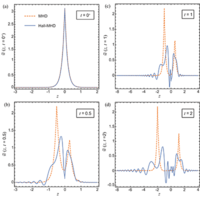
Impulse-driven Richtmyer-Meshkov instability in Hall-magnetohydrodynamics

Naijian Shen, D. I. Pullin, Vincent Wheatley, and Ravi Samtaney

Phys. Rev. Fluids 4, 103902 (2019) - Published 11 October, 2019

With the Hall-magnetohydrodynamics model for conducting fluids we study the stability of an impulsively accelerated, perturbed density interface, separating two fluids immersed in a background magnetic field. The presence of the magnetic field is found to suppress the Richtmyer-Meshkov instability.

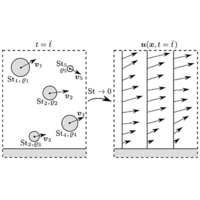
Reconstructing the fluid flow by tracking of large particles

Francesco Romanò

Phys. Rev. Fluids 4, 104301 (2019) - Published 11 October, 2019

The tracking of a few large density-mismatched particles is used to efficiently􏰁 and accurately reconstruct the background 􏰀fluid fl􏰀ow. Approximating the particulate phase space and taking the limit of vanishing Stokes number (St), we reconstruct three paradigmatic 􏰀flows.

Hydrodynamics and rheology of a vesicle doublet suspension

Bryan Quaife, Shravan Veerapaneni, and Y.-N. Young

Phys. Rev. Fluids 4, 103601 (2019) - Published 10 October, 2019

Effects of membrane-membrane adhesion on vesicle hydrodynamics are studied theoretically (using lubrication theory) and numerically (using time-adaptive boundary integral simulations). Novel vesicle dynamics are quantified to help design future microfluidic experiments to probe membrane adhesion.

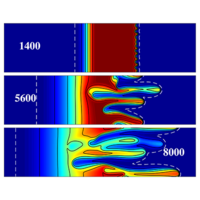
Influence of Langmuir adsorption and viscous fingering on transport of finite size samples in porous media

Chinar Rana, Satyajit Pramanik, Michel Martin, A. De Wit, and Manoranjan Mishra

Phys. Rev. Fluids 4, 104001 (2019) - Published 10 October, 2019

We combine two known independent phenomena, viscous fingering dynamics in miscible fluids and nonlinear wave fronts, to investigate how these two nonlinear dynamics interact. The difference between cases with/without nonlinear adsorption of solute arise in creation/annihilation of nonlinear waves.

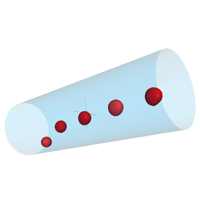
Inertial migration of a deformable particle in pipe flow

Dhiya Alghalibi, Marco E. Rosti, and Luca Brandt

Phys. Rev. Fluids 4, 104201 (2019) - Published 10 October, 2019

A study of the migration of a hyperelastic particle suspended in a Newtonian pipe flow for different Reynolds numbers and elasticity is presented. The particle deforms and undergoes a lateral displacement while traveling downstream through the pipe, finally focusing at the pipe centerline.

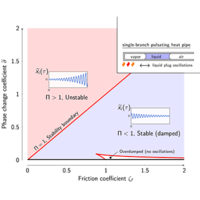
How evaporation and condensation lead to self-oscillations in the single-branch pulsating heat pipe

Albert Tessier-Poirier, Thomas Monin, Étienne Léveillé, Stéphane Monfray, Fabien Formosa, and Luc G. Fréchette

Phys. Rev. Fluids 4, 103901 (2019) - Published 9 October, 2019

The physics behind the instability at the source of oscillations in a single-branch pulsating heat pipe is investigated. Oscillations produced by the resonator increase in amplitude when pressure induced by evaporation-condensation (positive feedback mechanism) overcomes the viscous losses (dissipation).

Flow field evolution and entrainment in a free surface plunging jet

Syed Harris Hassan, Tianqi Guo, and Pavlos P. Vlachos

Phys. Rev. Fluids 4, 104603 (2019) - Published 9 October, 2019

An investigation finds that in free-surface plunging jets, shear layer vortices form right below the free surface, then develop and disintegrate faster than vortices in canonical free jets. This leads to shorter potential cores, faster decay of the mean centerline velocity, and enhanced liquid entrainment from the ambient.

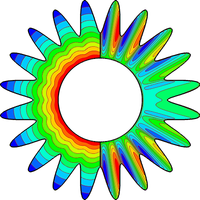
Thermoconvective instabilities in a horizontal porous annulus with an external wavy wall

Jabrane Belabid

Phys. Rev. Fluids 4, 103501 (2019) - Published 8 October, 2019

A numerical analysis reveals that the heat transfer inside a horizontal porous annulus filled with a saturated porous medium depends strongly on the waviness of the cold wall. Particular attention is paid to the influence of the waviness parameters on the thermoconvective instabilities.

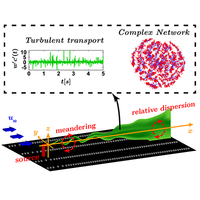
Experimental investigation of vertical turbulent transport of a passive scalar in a boundary layer: Statistics and visibility graph analysis

G. Iacobello, M. Marro, L. Ridolfi, P. Salizzoni, and S. Scarsoglio

Phys. Rev. Fluids 4, 104501 (2019) - Published 8 October, 2019

The dynamics of a passive scalar plume is experimentally studied in a rough-wall turbulent boundary layer. Besides classical statistics, complex networks are exploited to highlight the temporal structure of vertical turbulent transport series in terms of occurrence and intensity of extreme events.

Energy-based analysis and anisotropic spectral distribution of internal gravity waves in strongly stratified turbulence

Naoto Yokoyama and Masanori Takaoka

Phys. Rev. Fluids 4, 104602 (2019) - Published 8 October, 2019

The weak turbulence of internal gravity waves and the strong turbulence of eddies coexist in stratified turbulence. The wave-number range of the anisotropic weak-wave turbulence is identified based on energy decomposition and characteristic time scales.

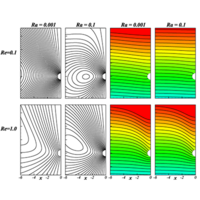
Solutal convection induced by dissolution

Julien Philippi, Michael Berhanu, Julien Derr, and Sylvain Courrech du Pont

Phys. Rev. Fluids 4, 103801 (2019) - Published 7 October, 2019

The buoyancy instability occurring at the interface of a soluble body suddenly immersed in a quiescent solvent is explored. Numerical simulations are used to derive and confirm scaling laws based on a constant solutal Rayleigh number. Dissolution erosion rates are predicted in some geological situations.

Sedimentation of a small sphere in stratified fluid

Hojun Lee, Itzhak Fouxon, and Changhoon Lee

Phys. Rev. Fluids 4, 104101 (2019) - Published 7 October, 2019
An extensive theoretical and numerical study of gravitational settling of small particles in a stratified fluid was performed. Adopting the integral equation on surface traction, we derived the drag enhancement due to stratification at low Reynolds and Peclet numbers, and confirmed with simulations.

Sign In to Your Journals Account

Filter

Recent Issues

Vol. 11, Iss. 10
October 2026
Vol. 11, Iss. 9
September 2026
Vol. 11, Iss. 8
August 2026
Vol. 11, Iss. 7
July 2026
Category
Article Type
Section

Filter

Article Lookup

Enter a citation