Recent Articles

Painting fluid motion using convolutional neural networks: An album of fluid motion 2.0

Maxime Bassenne, Andrew Banko, and Sadaf Sobhani

Phys. Rev. Fluids 4, 100513 (2019) - Published 24 October, 2019

Boundary effects on the onset of miscible viscous fingering in a Hele-Shaw flow

Anoop Kumar and Manoranjan Mishra

Phys. Rev. Fluids 4, 104004 (2019) - Published 24 October, 2019

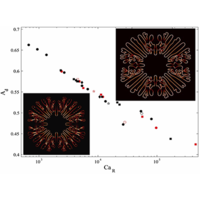
Linear stability analysis and nonlinear simulations confirm that the onset of viscous fingering (VF) instability is delayed in the miscible VF model with the absorbing boundary as compared to the reflective one. A threshold log mobility ratio is found for which such delayed onset is maximum.

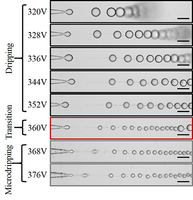
Far-field sensitivity of droplet generation: Exponential scaling and cutoff

Zehao Pan and Hsueh-Chia Chang

Phys. Rev. Fluids 4, 101701(R) (2019) - Published 23 October, 2019

Alternating current (AC) immersed electrospray exhibits a new microdripping phenomenon whose droplet size is exponentially sensitive to the applied field.

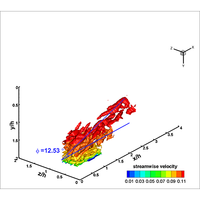
Scale-resolving simulations of turbulence: Equilibrium boundary layer analysis leading to near-wall closure modeling

Pedram Tazraei and Sharath S. Girimaji

Phys. Rev. Fluids 4, 104607 (2019) - Published 23 October, 2019

Closure model for turbulent-transport Prandtl numbers based on the equilibrium boundary layer analysis of filtered flow fields is developed. The analysis represents an important step forward toward using two-equation closures for scale resolving simulations of practical turbulent flows.

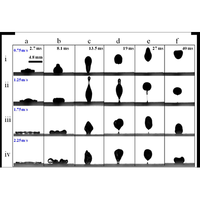
Onset of rebound suppression in non-Newtonian droplets post-impact on superhydrophobic surfaces

Purbarun Dhar, Soumya Ranjan Mishra, and Devranjan Samanta

Phys. Rev. Fluids 4, 103303 (2019) - Published 22 October, 2019

Experiments find that millimetric drops of a viscoelastic fluid impacting on a superhydrophobic surface at several meters per second do not rebound above a critical Weissenberg number of 1.

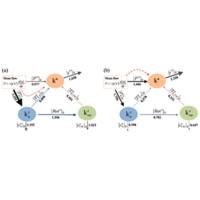
Role of the large-scale structures in spanwise rotating plane Couette flow with multiple states

Zhenhua Xia, Yipeng Shi, Minping Wan, Chao Sun, Qingdong Cai, and Shiyi Chen

Phys. Rev. Fluids 4, 104606 (2019) - Published 22 October, 2019

Energy transfers among the mean, the secondary, and the residual fields are different in RPCF with multiple states. The kinetic energy received by the residual field is mainly from the streamwise component of the secondary flows at R3 state (a) while it is mainly from the mean field at R2 state (b).

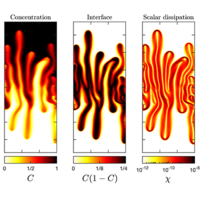
Universal behavior of scalar dissipation rate in confined porous media

Marco De Paoli, Vlad Giurgiu, Francesco Zonta, and Alfredo Soldati

Phys. Rev. Fluids 4, 101501(R) (2019) - Published 21 October, 2019

Gravity-driven Rayleigh-Taylor convective dissolution in porous media is controlled by buoyancy and diffusion. We show that the main features of the mixing dynamics of dissolution exhibits a superlinear scaling that is universal.

Transonic buffet instability: From two-dimensional airfoils to three-dimensional swept wings

Edorado Paladini, Samir Beneddine, Julien Dandois, Denis Sipp, and Jean-Christophe Robinet

Phys. Rev. Fluids 4, 103906 (2019) - Published 21 October, 2019

Global instability leads to the transonic buffet around a 2-D wing profile. We performed linear stability analyses for different swept angles to determine the 3-D buffet origin, finding that a 3-D initially stationary mode (zero swept angle) becomes progressively unsteady leading to the 3-D buffet.

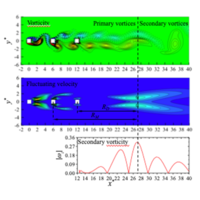
Evolution of the wake of three inline square prisms

Qinmin Zheng and Md. Mahbub Alam

Phys. Rev. Fluids 4, 104701 (2019) - Published 21 October, 2019

An investigation is conducted on the flow around three tandem prisms, shedding light on the evolution of the primary vortices to the secondary. The secondary-vortex-street onset corresponds to the local maximum vorticity amplitude associated with the secondary frequency.

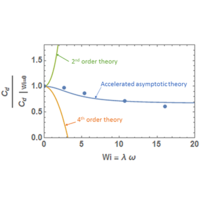
Steady sedimentation of a spherical particle under constant rotation

Kostas D. Housiadas

Phys. Rev. Fluids 4, 103301 (2019) - Published 18 October, 2019

An analytical formula is derived for the drag force on a particle translating in a viscoelastic fluid under the influence of an externally imposed torque. A decrease of the drag force as the rotation rate of the particle increases is predicted in agreement with numerical results from the literature.

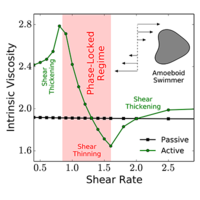
Rheological signature of microswimmer phase-locking under flow

Mohd Suhail Rizvi, Abdessamad Nait-Ouhra, Alexander Farutin, Philippe Peyla, Salima Rafai, and Chaouqi Misbah

Phys. Rev. Fluids 4, 103302 (2019) - Published 18 October, 2019

Unlike force-dipole swimmers, amoeboid swimmers affect the effective suspension viscosity in a nontrivial manner. Transitions between shear-thickening and shear-thinning behaviors, depending on applied shear rates, are due to the phase-locking of the swimmer dynamics with the shear flow.

Dynamics of a supersonic transitional flow over a backward-facing step

Weibo Hu, Stefan Hickel, and Bas van Oudheusden

Phys. Rev. Fluids 4, 103904 (2019) - Published 17 October, 2019

The transition mechanism and unsteady behavior behind a backward-facing step in the supersonic regime is investigated using large eddy simulation. Results show that there are three main frequency scales in the unsteady transition process.

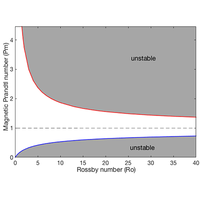
Two types of axisymmetric helical magnetorotational instability in rotating flows with positive shear

George Mamatsashvili, Frank Stefani, Rainer Hollerbach, and Günther Rüdiger

Phys. Rev. Fluids 4, 103905 (2019) - Published 17 October, 2019

We report a new type of double-diffusive magnetorotational instability in magnetized flow with radially increasing angular velocity (positive shear/Rossby number), which up to now was deemed stable. It can arise in the equatorial part of the solar tachocline, with a key role in magnetic activity.

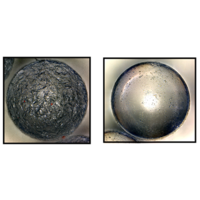
Influence of surface roughness on the rheology of immersed and dry frictional spheres

Franco Tapia, Olivier Pouliquen, and Élisabeth Guazzelli

Phys. Rev. Fluids 4, 104302 (2019) - Published 17 October, 2019

Pressure-imposed rheometry is used to examine the influence of surface roughness on the rheology of immersed and dry frictional spheres in the dense regime and to characterize the singular behaviors of these systems in the vicinity of the jamming transition.

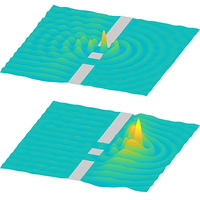
Wave fields in double-slit experiments with wave-driven droplets

Mads Rode, Jacob Madsen, and Anders Andersen

Phys. Rev. Fluids 4, 104801 (2019) - Published 17 October, 2019

Surface wave fields with wave-driven droplets that bounce on a vertically vibrated bath of the same liquid are investigated in slit experiments. Complex wave fields are observed during slit passage, and only minute differences between the wave fields are found in comparable single- and double-slit experiments.

Perspective on machine learning for advancing fluid mechanics

M. P. Brenner, J. D. Eldredge, and J. B. Freund

Phys. Rev. Fluids 4, 100501 (2019) - Published 16 October, 2019

A perspective is presented on how machine learning methods might advance fluid mechanics. Current limitations are discussed, though the potential impact is deemed high, so long as outcomes are held to the long-standing critical standards that should guide studies of flow physics.

Fluctuations in inertial dense homogeneous suspensions

Elise Alméras, Olivier Masbernat, Frédéric Risso, and Rodney O. Fox

Phys. Rev. Fluids 4, 102301(R) (2019) - Published 16 October, 2019

A model is derived by assuming that agitation in dense suspensions is driven by fluctuations of the solid-phase indicator function. The model is shown to accurately predict the velocity variances of both liquid and particles in inertial homogenous fluidized beds.

Numerical study of immiscible viscous fingering in chemically reactive Hele-Shaw flows: Production of surfactants

Reiko Tsuzuki, Qian Li, Yuichiro Nagatsu, and Ching-Yao Chen

Phys. Rev. Fluids 4, 104003 (2019) - Published 16 October, 2019

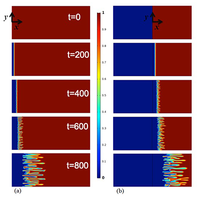
Viscous fingering on a chemically reactive immiscible interface is simulated by the phase-field method, focusing on temporal effects of produced surfactant which alter local interfacial tension continuously. A reference capillary number is proposed for the injected fluid area at breakthrough time.

Modeling subgrid-scale force and divergence of heat flux of compressible isotropic turbulence by artificial neural network

Chenyue Xie, Ke Li, Chao Ma, and Jianchun Wang

Phys. Rev. Fluids 4, 104605 (2019) - Published 16 October, 2019
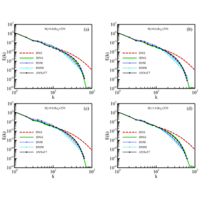
The subgrid-scale (SGS) force and the divergence of SGS heat flux are modeled directly by an artificial neural network for large eddy simulation of compressible turbulence, which is based on the first-order and second-order derivatives of filtered fields as input features.

Sign In to Your Journals Account

Filter

Recent Issues

Vol. 11, Iss. 10
October 2026
Vol. 11, Iss. 9
September 2026
Vol. 11, Iss. 8
August 2026
Vol. 11, Iss. 7
July 2026
Category
Article Type
Section

Filter

Article Lookup

Enter a citation