Recent Articles

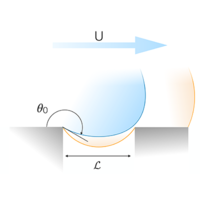
Contact line depinning from sharp edges

J. Graña-Otero and I. E. Parra Fabián

Phys. Rev. Fluids 4, 114001 (2019) - Published 11 November, 2019

Precise mathematical criteria for contact line depinning from sharp corners is derived using a variational formulation and turning point arguments. The application of these results to the analysis of the stability of nonwetting equilibria on superhydrophobic surfaces is also briefly addressed.

Logarithmic-layer turbulence: A view from the wall

Miguel P. Encinar and Javier Jiménez

Phys. Rev. Fluids 4, 114603 (2019) - Published 11 November, 2019

The observability of the flow away from the wall in turbulent channels is studied using noiseless, although potentially incomplete, wall measurements. The reconstructions deteriorate with the distance to the wall, but coherent motions are still observable.

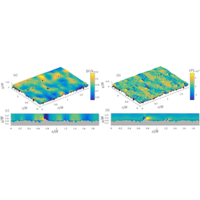
Dependence of the drag over superhydrophobic and liquid infused surfaces on the asperities of the substrate

Edgardo J. García-Cartagena, Isnardo Arenas, Jaehyeong An, and Stefano Leonardi

Phys. Rev. Fluids 4, 114604 (2019) - Published 11 November, 2019

We perform direct numerical simulations of turbulent channel flow with superhydrophobic or liquid infused surfaces on the lower wall. The texture reproduces etched sand-blasted aluminum. Dependence of the amount of drag reduction on interface deformation and pinnacle height distribution is discussed.

Shear viscosity of bimodal capsule suspensions in simple shear flow

Hiroki Ito, Daiki Matsunaga, and Yohsuke Imai

Phys. Rev. Fluids 4, 113601 (2019) - Published 7 November, 2019

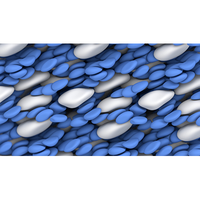
A well-known rheological property of a suspension of two sizes of rigid particles is a reduction in the shear viscosity. A numerical analysis shows that for bimodal capsule suspensions, the extent of the viscosity reduction is amplified by the deformability of the capsules.

Numerical simulation of electrovortex flows in cylindrical fluid layers and liquid metal batteries

W. Herreman, C. Nore, P. Ziebell Ramos, L. Cappanera, J.-L. Guermond, and N. Weber

Phys. Rev. Fluids 4, 113702 (2019) - Published 6 November, 2019

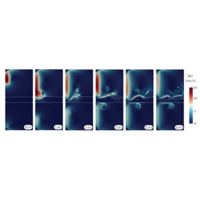
Electrovortex flows occur whenever thin electrodes are put in contact with wider liquid metal regions. An investigation shows that in liquid metal batteries, electrovortex flows can become so intense they can compromise the layered structure of the battery and cause a short circuit.

Lagrangian investigation of pseudo-turbulence in multiphase flow using superposable wakes

W. C. Moore and S. Balachandar

Phys. Rev. Fluids 4, 114301 (2019) - Published 6 November, 2019

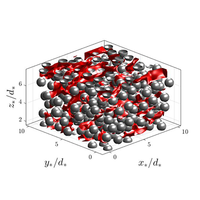
A method is introduced for approximating the fully resolved flow through a monodisperse array of spheres using only the locations of the spheres and the volume-averaged Reynolds number. A pseudoturbulence stress model is proposed for use in a Lagrangian framework.

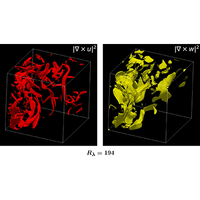
Intermittency of an incompressible passive vector convected by isotropic turbulence

Jingyuan Yang, Toshiyuki Gotoh, Hideaki Miura, and Takeshi Watanabe

Phys. Rev. Fluids 4, 114602 (2019) - Published 6 November, 2019

Direct numerical simulations of an incompressible passive vector in turbulence find that high pseudo-enstrophy domains are sheet-like, unlike the tube structure of the high enstrophy domain. The scaling exponents of the structure functions are intermediate between the velocity and passive scalar.

Formation and decay of eddy currents generated by crossed surface waves

V. M. Parfenyev, S. V. Filatov, M. Yu. Brazhnikov, S. S. Vergeles, and A. A. Levchenko

Phys. Rev. Fluids 4, 114701 (2019) - Published 6 November, 2019

We observe experimentally how two crossed standing surface waves excite a regular lattice of near-surface vortices. The dynamics of formation and decay of the lattice coincides with that predicted by our theoretical model. The mass transport in the vortices is primarily determined by Eulerian flow.

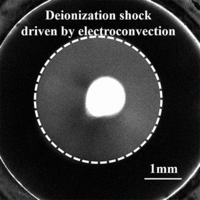
Deionization shock driven by electroconvection in a circular channel

Zhibo Gu, Bingrui Xu, Peng Huo, Shmuel M. Rubinstein, Martin Z. Bazant, and Daosheng Deng

Phys. Rev. Fluids 4, 113701 (2019) - Published 5 November, 2019

The deionization shock in microstructures has been essentially attributed to surface charge. It is demonstrated that deionization shock can also be driven by bulk electroconvection up to millimeter scale, shedding light on a new design for shock electrodialysis for desalination and water purification.

Higher-order realizable algebraic Reynolds stress modeling based on the square root tensor

Kazuhiro Inagaki, Taketo Ariki, and Fujihiro Hamba

Phys. Rev. Fluids 4, 114601 (2019) - Published 5 November, 2019

A higher-order realizable algebraic Reynolds stress modeling is proposed based on the square root tensor of the Reynolds stress. This model is expected to be useful in numerically stable predictions of turbulent flows with three-dimensional mean velocity, such as an axially rotating pipe flow.

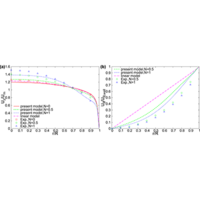
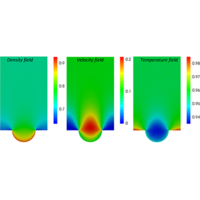
Numerical investigation of nanoporous evaporation using direct simulation Monte Carlo

Benzi John, Ryan Enright, James E. Sprittles, Livio Gibelli, David R. Emerson, and Duncan A. Lockerby

Phys. Rev. Fluids 4, 113401 (2019) - Published 4 November, 2019

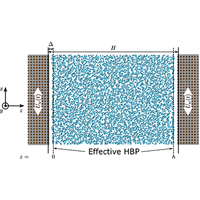
We numerically study the thin film evaporation process enabled by nanoporous membranes for electronic device cooling. Results show that the net evaporative mass flux is determined by an interplay between physical effects, quantified by the Knudsen number, porosity, evaporation coefficient, and meniscus shape.

Full characterization of the hydrodynamic boundary condition at the atomic scale using an oscillating channel: Identification of the viscoelastic interfacial friction and the hydrodynamic boundary position

Takeshi Omori, Naoki Inoue, Laurent Joly, Samy Merabia, and Yasutaka Yamaguchi

Phys. Rev. Fluids 4, 114201 (2019) - Published 1 November, 2019

We find that an analytical expression of liquid response to oscillatory motion of confining walls reproduces molecular dynamics simulation results.The viscoelastic friction coefficient and hydrodynamic boundary conditions with different wettabilities are unambiguously identified as fitting parameters.

Geometry of transient chaos in streamwise-localized pipe flow turbulence

Nazmi Burak Budanur, Akshunna S. Dogra, and Björn Hof

Phys. Rev. Fluids 4, 102401(R) (2019) - Published 31 October, 2019

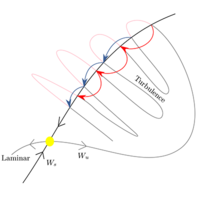
The homoclinic tangle at the laminar-turbulent boundary explains transient chaos observed in spatially localized turbulence.

Extensional and torsional pipe flow

Francisco Marques and Alvaro Meseguer

Phys. Rev. Fluids 4, 103908 (2019) - Published 31 October, 2019

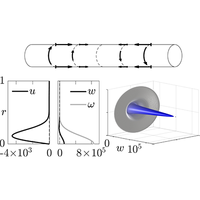
The fluid flow in an elastic pipe stretched and twisted in the axial and azimuthal directions is analyzed using a self-similar formulation. Many of the flows obtained develop intense and narrow swirling axial jets, that may exhibit flow-induced oscillations.

Robust flow reconstruction from limited measurements via sparse representation

Jared L. Callaham, Kazuki Maeda, and Steven L. Brunton

Phys. Rev. Fluids 4, 103907 (2019) - Published 30 October, 2019

Estimating the structure of a flow field from limited and uncertain measurement data is made challenging by the richness of structures in a complex flow. An investigation of sparse representation in a library of examples shows that this can provide robust, accurate reconstructions.

Kinetic Monte Carlo and hydrodynamic modeling of droplet dynamics on surfaces, including evaporation and condensation

Mounirah Areshi, Dmitri Tseluiko, and Andrew J. Archer

Phys. Rev. Fluids 4, 104006 (2019) - Published 30 October, 2019

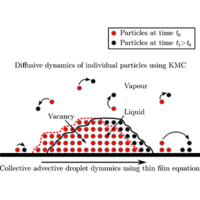
We develop a lattice model for liquid droplets on solid surfaces incorporating single-particle and larger-scale collective hydrodynamic motion. Contact angles and surface tensions are derived from microscopic parameters. Droplets joining, spreading, sliding, dewetting, and evaporating are analyzed.

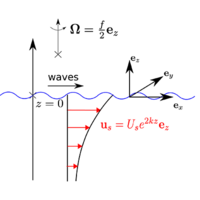
Surface gravity waves propagating in a rotating frame: The Ekman-Stokes instability

Kannabiran Seshasayanan and Basile Gallet

Phys. Rev. Fluids 4, 104802 (2019) - Published 30 October, 2019

When surface gravity waves propagate in a rotating frame, an “anti-Stokes” mean flow develops and cancels out most of the Stokes drift, resulting in extremely weak Lagrangian transport. This might not be the end of the story, however, as we show that such anti-Stokes flows are in fact unstable.

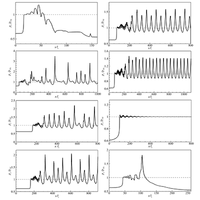
Bifurcation of pulsation instability in one-dimensional H2−O2 detonation with detailed reaction mechanism

Wenhu Han, Wenjin Ma, Chengeng Qian, Jennifer Wen, and Cheng Wang

Phys. Rev. Fluids 4, 103202 (2019) - Published 29 October, 2019

Classical modes of one-dimensional detonation are reproduced by using a real chemical kinetics. A bifurcation diagram is formed to identify the bifurcation points of pulsating instability and the detonation limits of pulsating detonations are found respectively at low and high Ar dilutions.

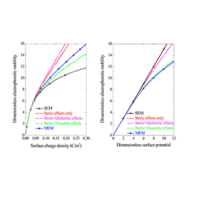
Ionic size, permittivity, and viscosity-related effects on the electrophoretic mobility: A modified electrokinetic model

J. J. López-García, J. Horno, and C. Grosse

Phys. Rev. Fluids 4, 103702 (2019) - Published 29 October, 2019

The standard electrokinetic model (SEM) is modified by considering hydrated ions as charged dielectric spheres so that in the modified model (MEM) the electrolyte solution becomes a non-homogeneous fluid with permittivity and viscosity values that are both functions of the local ionic concentrations.

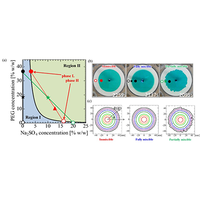
Fingering pattern induced by spinodal decomposition in hydrodynamically stable displacement in a partially miscible system

Ryuta X. Suzuki, Yuichiro Nagatsu, Manoranjan Mishra, and Takahiko Ban

Phys. Rev. Fluids 4, 104005 (2019) - Published 29 October, 2019

When a more viscous liquid displaces a less viscous one in a Hele-Shaw cell, a new instability of the interface is observed due to spontaneous convection occurring when there is a phase separation if the two liquids are partially miscible.

Sign In to Your Journals Account

Filter

Recent Issues

Vol. 11, Iss. 10
October 2026
Vol. 11, Iss. 9
September 2026
Vol. 11, Iss. 8
August 2026
Vol. 11, Iss. 7
July 2026
Category
Article Type
Section

Filter

Article Lookup

Enter a citation