Recent Articles

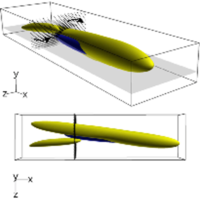
Rayleigh-Taylor-like instability in a foam film

Evgenia Shabalina, Antoine Bérut, Mathilde Cavelier, Arnaud Saint-Jalmes, and Isabelle Cantat

Phys. Rev. Fluids 4, 124001 (2019) - Published 4 December, 2019

A foam film is prepared in a controlled way, so that the top part of the film is much thicker than the bottom part. This situation is unstable under gravity and Rayleigh-Taylor-like fingers grow.The wavelength and the growth rate depend on the effective gravity and on the thick-film width.

Micron-sized double emulsions and nematic shells generated via tip streaming

Kunyun He, Francisco Campo-Cortés, Martyna Goral, Teresa López-León, and José Manuel Gordillo

Phys. Rev. Fluids 4, 124201 (2019) - Published 4 December, 2019

The smallest compound droplets reported up to date, with outer diameters comparable with a red blood cell, are produced in a continuous way at frequencies exceeding 10 kHz from the capillary breakup of the coaxial cylindrical jets issued from the tip of the conical drops formed using an outer coflow.

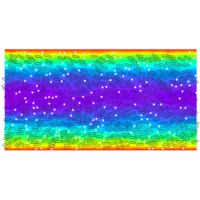
Systematic direct simulation Monte Carlo approach to characterize the effects of surface roughness on accommodation coefficients

Kishore K. Kammara, Rakesh Kumar, Amit K. Singh, and Arun K. Chinnappan

Phys. Rev. Fluids 4, 123401 (2019) - Published 3 December, 2019

The effects of surface roughness on accommodation coefficients are studied using the direct simulation Monte-Carlo (DSMC) approach. DSMC simulations are carried out by varying the roughness parameters. An empirical relationship between surface roughness and accommodation coefficients is established.

Membrane filtration with multiple fouling mechanisms

Pejman Sanaei and Linda J. Cummings

Phys. Rev. Fluids 4, 124301 (2019) - Published 3 December, 2019

A simplified mathematical model, which characterizes membrane internal pore structure accounts for multiple simultaneous membrane fouling mechanisms (adsorption, blocking, and cake formation) and is able to predict the optimum permeability.

Inertial drag in granular media

Shivakumar Athani and Pierre Rognon

Phys. Rev. Fluids 4, 124302 (2019) - Published 3 December, 2019

We find evidence that the granular drag force on an object moving through a granular material is strongly enhanced when the object is accelerating. This effect can be explained by showing that the accelerating object accelerates the grains nearby, inducing an inertial resistance.

Bretherton's buoyant bubble

Wassim Dhaouadi and John M. Kolinski

Phys. Rev. Fluids 4, 123601 (2019) - Published 2 December, 2019

Direct observation of the liquid film binding buoyant Bretherton bubbles reveals a van-der-Waals-stabilized thickness.

Rotational separation after temporary coalescence in binary droplet collisions

Kuo-Long Pan, Kuan-Ling Huang, Wan-Ting Hsieh, and Chi-Ru Lu

Phys. Rev. Fluids 4, 123602 (2019) - Published 2 December, 2019

In binary drop impact, in addition to reflexive separation and stretching separation, which occur at low and high impact angles (B), respectively, rotational separation is found at intermediate B. A generic model is developed to examine the scenarios and the interplay of various factors.

Deep learning of turbulent scalar mixing

Maziar Raissi, Hessam Babaee, and Peyman Givi

Phys. Rev. Fluids 4, 124501 (2019) - Published 2 December, 2019

Based on recent developments in physics-informed deep learning and deep hidden physics models, we put forth a framework for discovering turbulence models from scattered and potentially noisy spatio-temporal measurements of the probability density function.

Inverse energy cascade and vortical structure in the near-wall region of turbulent channel flow

Fujihiro Hamba

Phys. Rev. Fluids 4, 114609 (2019) - Published 27 November, 2019

An inverse cascade is found in the energy transfer in scale space of channel flow. The conditional average of the velocity field associated with the inverse cascade or negative subgrid-scale production reveals a long streamwise vortex near the wall with a short vortex in the upstream region.

Effects of artery size on the hydrodynamic diffusivity of red cells and other contained particles

Lydia I. Kolitsi and Stergios G. Yiantsios

Phys. Rev. Fluids 4, 113103 (2019) - Published 26 November, 2019

A numerical study finds that shear induced diffusivities increase with distance from the channel walls because of increasing mobility, up to an artery-size dependent maximum due to the diminishing local shear rate. At the center they remain finite owing to crossflow sweeps generated from the interaction of near-wall eddies.

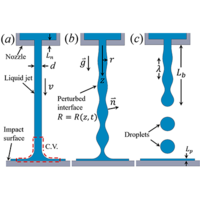
Normal impact force of Rayleigh jets

Benjamin R. Mitchell, Joseph C. Klewicki, Yannis P. Korkolis, and Brad L. Kinsey

Phys. Rev. Fluids 4, 113603 (2019) - Published 25 November, 2019

The normal impact force of Rayleigh jets is investigated for three possible impact scenarios: a) steady-state jet, b) wavy jet, and c) droplet train. Owing to momentum conservation, the peak force experienced by the droplet train is over three times greater than that of the steady jet.

Direct numerical simulation of low Reynolds number turbulent swirling pipe flows

Rey C. Chin and Jimmy Philip

Phys. Rev. Fluids 4, 114607 (2019) - Published 25 November, 2019

The axial and azimuthal mean momentum equation for swirling pipe flows are derived. Increasing the swirl strength increases the extent of the inertial region by pushing the beginning of the inertial region closer to the wall. This is due to the axial viscous forces rather than the azimuthal ones.

Lyapunov spectrum of forced homogeneous isotropic turbulent flows

Malik Hassanaly and Venkat Raman

Phys. Rev. Fluids 4, 114608 (2019) - Published 25 November, 2019

A local point of view is adopted on the chaoticity of turbulent flow, using the Lyapunov analysis. Among other findings, it is found that chaotic perturbation growth is a highly localized phenomenon that occurs in regions of high-velocity gradient but not in regions of high turbulence intensity.

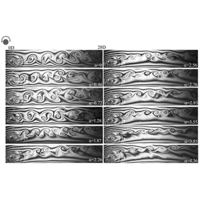
Flow past a rotating hydrophobic/nonhydrophobic circular cylinder in a flowing soap film

Navya Geethika Chikkam and Sanjay Kumar

Phys. Rev. Fluids 4, 114802 (2019) - Published 25 November, 2019

Flow past a rotating circular cylinder is investigated experimentally in flowing soap film at Re of 200 to 250. Vortex shedding suppression is not found. A mode of single signed vortices dependent on surface hydrophobicity, with a rotation sense opposite to that of cylinder rotation, is observed.

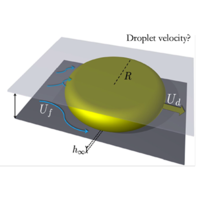
Predicting droplet velocity in a Hele-Shaw cell

Benjamin Reichert, Isabelle Cantat, and Marie-Caroline Jullien

Phys. Rev. Fluids 4, 113602 (2019) - Published 22 November, 2019

We study the motion of a low viscous non-wetting droplet in a Hele-Shaw cell while it is pushed by an external phase at low capillary numbers. The velocity can be strongly affected by a stagnant cap at the rear of the drop and we propose a model that remarkably reproduces the experimental data.

Bifurcations to turbulence in transitional channel flow

Masaki Shimizu and Paul Manneville

Phys. Rev. Fluids 4, 113903 (2019) - Published 22 November, 2019

In channel flow, the transition from turbulence displays a crossover from laminar-turbulent patterns following a two-dimensional directed-percolation scenario to a regime with localized turbulent bands statistically propagating along a single direction. A simple model accounts for this bifurcation.

Marine crustaceans with hairy appendages: Role of hydrodynamic boundary layers in sensing and feeding

Kaitlyn Hood, M. S. Suryateja Jammalamadaka, and A. E. Hosoi

Phys. Rev. Fluids 4, 114102 (2019) - Published 22 November, 2019

Crustaceans use their hairy appendages to sense and track food in flows with intermediate Reynolds number. A reduced order model is developed to predict the flow phase and generate a design principle for engineering flows past hairy surfaces.

Laboratory study of the wave-induced mean flow and set-down in unidirectional surface gravity wave packets on finite water depth

R. Calvert, C. Whittaker, A. Raby, P. H. Taylor, A. G. L. Borthwick, and T. S. van den Bremer

Phys. Rev. Fluids 4, 114801 (2019) - Published 22 November, 2019

We derive a multiple-scales solution for the Eulerian mean flow under wavepackets, which is driven by the divergence of Stokes drift and the setdown. This solution is valid for all water depths and is validated by flume experiments and recovers all previous solutions in their respective limits.

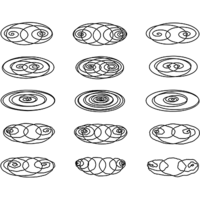
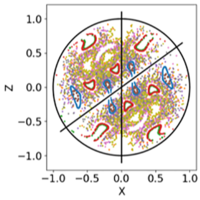
Chaos and mixing in self-propelled droplets

Reiner Kree and Annette Zippelius

Phys. Rev. Fluids 4, 113102 (2019) - Published 21 November, 2019

An investigation shows that simple flow inside a droplet can propel it along regular trajectories while simultaneously leading to chaotic motion of tracer particles. The resulting advective mixing can accelerate and even dominate transport by diffusion for biologically plausible Péclet and Batchelor numbers.

Data-based, reduced-order, dynamic estimator for reconstruction of nonlinear flows exhibiting limit-cycle oscillations

Juan Guzmán-Iñigo, Markus A. Sodar, and George Papadakis

Phys. Rev. Fluids 4, 114703 (2019) - Published 21 November, 2019

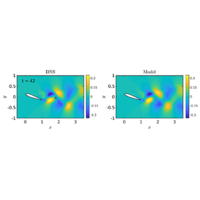
A data-based, linear dynamic estimator is developed to reconstruct the velocity field around an airfoil using measurements from a single sensor point in the wake. The performance of the estimator is very robust to the sensor location and to small changes in Reynolds number.

Sign In to Your Journals Account

Filter

Recent Issues

Vol. 11, Iss. 10
October 2026
Vol. 11, Iss. 9
September 2026
Vol. 11, Iss. 8
August 2026
Vol. 11, Iss. 7
July 2026
Category
Article Type
Section

Filter

Article Lookup

Enter a citation