Recent Articles

Refining the connection between the logarithmic velocity profile and energy spectrum based on eddy's inclination angle

Hao-Jie Huang

Phys. Rev. Fluids 4, 114702 (2019) - Published 20 November, 2019

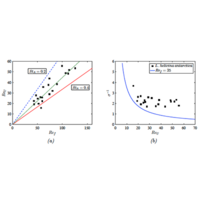
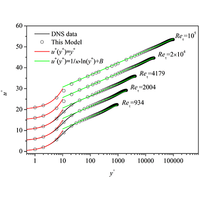
It has long been surmised that the “log” law of the mean-velocity profile (MVP) is closely related to the “−5/3 or −1” power law of the energy spectrum in wall-bounded turbulence. A refined model for the connection between MVP and the energy spectrum based on eddy’s inclination angle is proposed.

Extended Reynolds lubrication model for incompressible Newtonian fluid

Shintaro Takeuchi and Jingchen Gu

Phys. Rev. Fluids 4, 114101 (2019) - Published 19 November, 2019

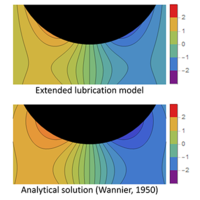
An extended lubrication model is proposed by taking into account a larger surface-to-surface distance than that for the Reynolds lubrication theory, and the wall-normal variation of the pressure is related to the longitudinal derivative of the local velocity of the Couette-Poiseuille flow.

Nonlinear Darcy flow dynamics during ganglia stranding and mobilization in heterogeneous porous domains

A. G. Yiotis, A. Dollari, M. E. Kainourgiakis, D. Salin, and L. Talon

Phys. Rev. Fluids 4, 114302 (2019) - Published 19 November, 2019

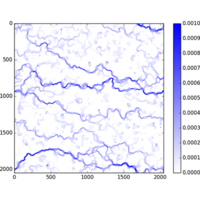
Development of “tortuous” mean ganglia flux paths during immiscible two-phase flow through a disordered and periodic 2D porous domain is studied. Results reveal that such paths are related to the gradual mobilization of stranded ganglia due to the pore-scale interplay between capillary, gravity, and viscous forces.

Landmarks and frontiers in biological fluid dynamics

John O. Dabiri

Phys. Rev. Fluids 4, 110501 (2019) - Published 18 November, 2019

The broad relevance of fluid mechanics to biology has been increasingly appreciated by engineers and biologists alike, leading to continued expansion of research in the field of biological fluid dynamics. A selection of classic and recent work that can guide future research is highlighted.

Singularities in fluid mechanics

H. K. Moffatt

Phys. Rev. Fluids 4, 110502 (2019) - Published 18 November, 2019

A dynamical system is described that captures the near-singular character of vortex reconnection, thus indicating how enstrophy in turbulent flow can become infinite in the zero-viscosity limit. Similarities with the near-singular behavior in the problem of cusp-formation at a free surface are identified.

Flight of the fruit fly

Itai Cohen

Phys. Rev. Fluids 4, 110503 (2019) - Published 18 November, 2019

Professor Itai Cohen describes the challenge of studying insect flight and, in the accompanying video recording of his invited lecture from the 71st annual APS DFD meeting, illustrates the mechanisms used by insects to control this behavior and achieve spellbinding acrobatic feats.

Horizontal axis wind turbine testing at high Reynolds numbers

Mark A. Miller, Janik Kiefer, Carsten Westergaard, Martin O. L. Hansen, and Marcus Hultmark

Phys. Rev. Fluids 4, 110504 (2019) - Published 18 November, 2019

The flow conditions of a full-scale wind turbine are reproduced in a laboratory with dynamic similarity, using a pressurized wind tunnel. Aerodynamic scale-effects persist at higher Re than previously believed, and it is shown that the boundary layer state is critical for turbine performance.

Coherent structure-based approach to modeling wall turbulence

Dennice F. Gayme and Benjamin A. Minnick

Phys. Rev. Fluids 4, 110505 (2019) - Published 18 November, 2019

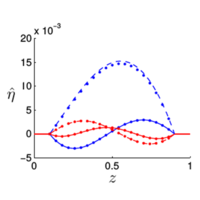
A restricted nonlinear representation of the flow as a streamwise constant large-scale interacting with dynamically restricted perturbations faithfully reproduces low order statistics, cross-stream structures and energy transport in turbulent channels, at vastly reduced computational costs.

Colloidal hydrodynamics of biological cells: A frontier spanning two fields

Akshay J. Maheshwari, Alp M. Sunol, Emma Gonzalez, Drew Endy, and Roseanna N. Zia

Phys. Rev. Fluids 4, 110506 (2019) - Published 18 November, 2019

Colloidal biology is a frontier of exploration in biological cells bridging the operational gap between structural biology (atomistic resolution over nanoseconds) and systems biology (minutes of operation, no spatial resolution). Colloid physics bridges this gap where much of cell machinery operates.

Some fluid mechanical aspects of artistic painting

Roberto Zenit

Phys. Rev. Fluids 4, 110507 (2019) - Published 18 November, 2019

Artistic painting is analyzed with fluid mechanics. We identify hydrodynamic instabilities which are either prevented or induced to create textures of aesthetic value. In watercolor painting the ‘coffee stain’ instability can be induced or prevented by varying pigment type and amount and paper wetness.

Corrsin lecture on hairy hydrodynamics

A. E. Hosoi

Phys. Rev. Fluids 4, 110508 (2019) - Published 18 November, 2019

Simple models for hairy surfaces interacting with flows are derived, and used to extract optimization and design principles in idealized contexts. Reconfiguration, in which flow couples to the hairs geometric configuration, is investigated along with drainage of thin films through beds of hairs.

Orientation control and nonlinear trajectory tracking of colloidal particles using microfluidics

Dinesh Kumar, Anish Shenoy, Songsong Li, and Charles M. Schroeder

Phys. Rev. Fluids 4, 114203 (2019) - Published 18 November, 2019

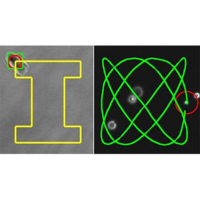
A new flow-based technique for precisely manipulating the orientation and trajectory of anisotropic Brownian particles using path-following control, without the need for optical or electric fields, is presented.

Influence of wall-attached structures on the boundary of the quiescent core region in turbulent pipe flow

Jongmin Yang, Jinyul Hwang, and Hyung Jin Sung

Phys. Rev. Fluids 4, 114606 (2019) - Published 18 November, 2019

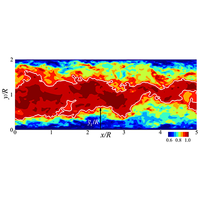
The entrainment phenomena of the quiescent core region in a turbulent pipe flow are examined by characterizing the tall wall-attached structures of the streamwise velocity fluctuations. The quiescent core region is the uniform momentum zone with the highest streamwise velocity magnitude.

Characteristics of swimming shelled Antarctic pteropods (Limacina helicina antarctica) at intermediate Reynolds number regime

Mohammad Mohaghar, Deepak Adhikari, and Donald R. Webster

Phys. Rev. Fluids 4, 111101(R) (2019) - Published 15 November, 2019

Shelled Antarctic pteropods (aquatic snails nicknamed “sea butterflies”) swim with a pair of parapodia (or “wings”) in a high efficiency propulsion regime when the Reynolds number based on the flapping exceeds 35.

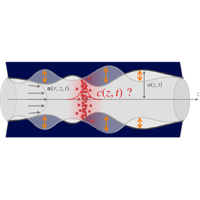
Active control of dispersion within a channel with flow and pulsating walls

Sophie Marbach and Karen Alim

Phys. Rev. Fluids 4, 114202 (2019) - Published 15 November, 2019

The effect of pulsating channel walls on transport and dispersion of solutes along a channel is investigated. Hands-on analytic expressions to model dispersion in this setting using a versatile method are derived. Different scenarios where dispersion may be enhanced or suppressed are found.

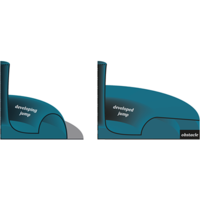
Role of gravity and capillary waves in the origin of circular hydraulic jumps

Hossein Askarizadeh, Hossein Ahmadikia, Claas Ehrenpreis, Reinhold Kneer, Ahmadreza Pishevar, and Wilko Rohlfs

Phys. Rev. Fluids 4, 114002 (2019) - Published 14 November, 2019

A study shows that hydraulic jumps are governed by both gravitational and capillary forces. The jump location results from a competition of supercritical flow with gravity-capillary waves traveling in the upstream direction. Fluid properties, flow conditions, and the state of development scale the respective forces.

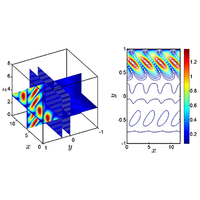
Coriolis force-driven instabilities in stratified miscible layers on a rotationally actuated microfluidic platform

Saunak Sengupta, Sukhendu Ghosh, Sandeep Saha, and Suman Chakraborty

Phys. Rev. Fluids 4, 113902 (2019) - Published 13 November, 2019

We find unique perturbations in rotational flows because of flow instabilities.

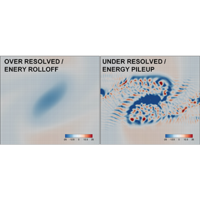
Resolution-induced anisotropy in large-eddy simulations

Sigfried W. Haering, Myoungkyu Lee, and Robert D. Moser

Phys. Rev. Fluids 4, 114605 (2019) - Published 13 November, 2019

Large eddy simulation (LES) of complex geometries often require discretization with high aspect ratio cells which can cause loss of simulation fidelity. We examine the effects of anisotropic resolution in LES and propose a tensor eddy viscosity to directly address resolution anisotropy.

Efficient implementation of elastohydrodynamics via integral operators

A. L. Hall-McNair, T. D. Montenegro-Johnson, H. Gadêlha, D. J. Smith, and M. T. Gallagher

Phys. Rev. Fluids 4, 113101 (2019) - Published 12 November, 2019

Many systems in physics and life sciences are characterised by microscopic flexible fibers interacting through viscous flow. We describe an efficient modeling framework taking into account nonlocal interactions, applied to sedimenting and shear flows with multiple fibers, and flagellar propulsion.

Effect of base-state curvature on self-excited high-frequency oscillations in flow through an elastic-walled channel

Thomas J. Ward and Robert J. Whittaker

Phys. Rev. Fluids 4, 113901 (2019) - Published 11 November, 2019
We derive a new “tube law” for elastic-walled channels, which takes into account the axial stretching that arises because of axial curvature in the base state. We quantify the effect of the new law on oscillatory fluid-structure-interaction modes in the channel and their stability.

Sign In to Your Journals Account

Filter

Recent Issues

Vol. 11, Iss. 10
October 2026
Vol. 11, Iss. 9
September 2026
Vol. 11, Iss. 8
August 2026
Vol. 11, Iss. 7
July 2026
Category
Article Type
Section

Filter

Article Lookup

Enter a citation