Recent Articles

Deformation and burst of a liquid droplet with viscous surface moduli in a linear flow field

Natasha Singh and Vivek Narsimhan

Phys. Rev. Fluids 5, 063601 (2020) - Published 1 June, 2020

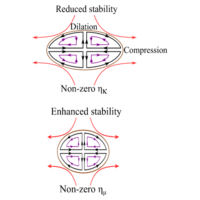
We investigate conditions for the breakup of a droplet with viscous surface moduli, under the assumption of weak flow and negligible Marangoni forces. The viscous interface is treated as a homogenous fluid obeying the Boussinesq–Scriven constitutive law. We observed that the presence of surface shear viscosity stabilizes the droplet, while that of surface dilational viscosity destabilizes it. The destabilizing effect of surface dilational viscosity appears similar to surfactant convection effects, while the stabilizing impact of surface shear viscosity appears similar to surfactant dilution.

Shape evolution of compound droplet in combined presence of electric field and extensional flow

Somnath Santra, Devi Prasad Panigrahi, Sayan Das, and Suman Chakraborty

Phys. Rev. Fluids 5, 063602 (2020) - Published 1 June, 2020

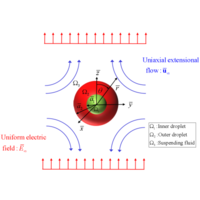
We study the unique morphodynamics of a compound droplet resulting from the interplay between an imposed electric field and an extensional flow. The nonintuitive findings include the interconversion of shape-evolution patterns of the compound droplet system depending on the background flow strength, electric field strength, electrophysical properties, and here unveiled post-breakup dynamics. We also show that including an electric field causes an intricate dependence of extensional viscosity on the electrical properties of the inner droplet - a paradigm not prevalent in pure extensional flow.

Dynamics of a steady liquid flow in a rim bounding a falling wall film: Influence of aerodynamic effects

Johannes Feldmann, Ilia V. Roisman, and Cameron Tropea

Phys. Rev. Fluids 5, 064001 (2020) - Published 1 June, 2020

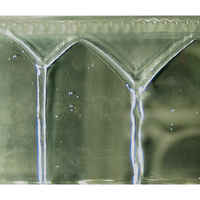
After breakup and emergence of a three-phase contact line, an aerodynamically driven surface-bound liquid film contracts in a characteristic triangular manner to eventually feed a rivulet. The dynamics in this film contraction zone is described experimentally and analytically where two side rims can be identified, framing a center region of thin-film flow. The side rims show a converging shape, thus defining the overall appearance of the film contraction zone.

Dynamic response of a compressible binary fluid mixture

Julien Lombard, I. Pagonabarraga, and E. Corvera Poiré

Phys. Rev. Fluids 5, 064201 (2020) - Published 1 June, 2020

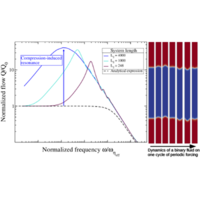
In a binary fluid subject to periodic forcing the compressibility of the lower viscosity phase generates resonances in the system dynamics. In a zero-mean flow the flow amplitude could be optimized by driving the system at certain frequencies with possible increases of over an order of magnitude. When compressibility is irrelevant single fluid universal behavior can be recovered. In both situations the results may apply to a variety of microfluidic systems, such as devices with drops, fluids with trapped air bubbles, and mixing devices, since these are often subject to periodic forces.

Three-dimensionality of leading-edge vortices on high aspect ratio plunging wings

N. Chiereghin, S. Bull, D. J. Cleaver, and I. Gursul

Phys. Rev. Fluids 5, 064701 (2020) - Published 1 June, 2020

Experiments that explore leading-edge vortex formation for plunging high-aspect-ratio swept and unswept wings are presented. For the unswept wing, the leading-edge vortex sheds and moves inboard, whereas on the swept wing, it moves outboard, leading to significant differences in the wing root bending moment. Axial velocity distribution through the vortex filament revealed jetlike, wakelike, and uniform axial velocity profiles.

Effects of moving contact line on filament pinch-off dynamics of viscoelastic surfactant fluids

Shijian Wu and Hadi Mohammadigoushki

Phys. Rev. Fluids 5, 053303 (2020) - Published 29 May, 2020

Experiments illustrate that the moving fluid contact line can significantly affect the extensional rheology of viscoelastic surfactant solutions. A scaling analysis is provided to rationalize the effects of contact-line spreading on extensional rheology of viscoelastic fluids.

How pointed can magnetized ferrofluid tips be?

Aaron Madden, Juan Fernandez de la Mora, Hadi Sabouri, Nguyen Pham, and Brian Hawkett

Phys. Rev. Fluids 5, 053604 (2020) - Published 29 May, 2020

The typical magnetized ferrofluid tip radius is ~0.1 mm, where capillary stress balances magnetostatic stress. Here we confirm experimentally the controlling role of magnetic saturation in more general conditions, even for ferrofluid menisci in highly nonuniform magnetic fields created by supporting them at a ferrous needle tip facing a strong magnet. We use a wide range of ferrofluid tensions and solvent polarities. Substantial changes in saturation magnetization are achieved with solvent evaporation, and record tip radii to 9.5 mm demonstrated at high volume fractions of magnetic particles.

Theory of hydrodynamic interaction of two spheres in wall-bounded shear flow

Itzhak Fouxon, Boris Rubinstein, Zhouyang Ge, Luca Brandt, and Alexander Leshansky

Phys. Rev. Fluids 5, 054101 (2020) - Published 29 May, 2020

It is shown theoretically that the presence of a wall induces qualitative and quantitative changes in the hydrodynamic interaction between two particles in a shear flow. The phase portrait of particles’ relative motion is rather different from the classical Batchelor and Green’s theory corresponding to an unbounded shear flow. It has the same topology upon varying the distance between the particle pair and the wall and contains new, previously overlooked, regions of closed trajectories. The theory is able to explain the origin of open swapping trajectories found earlier in numerical simulations.

Active and finite-size particles in decaying quantum turbulence at low temperature

Umberto Giuriato and Giorgio Krstulovic

Phys. Rev. Fluids 5, 054608 (2020) - Published 29 May, 2020

Motivated by current experiments, quantum turbulence in the presence of active and finite size particles is investigated numerically. We show that particles do not affect the development of the Kolmogorov regime, and the large scale Lagrangian observables are also compatible with a classical picture. Particles stay trapped inside superfluid vortices with occasional detachment and recapture. At small scales, particle dynamics is dominated by a fast precession frequency from the Magnus effect. Moreover, we observe that particle acceleration decorrelates much faster than in classical turbulence.

Drag force in immersed granular materials

Tanvir Hossain and Pierre Rognon

Phys. Rev. Fluids 5, 054306 (2020) - Published 28 May, 2020

Objects buried in granular materials can move when subjected to a large enough force. Experiments show that their mobility response is strongly affected by the presence of interstitial water, as it then features a visco-elasto-plastic dynamics.

Dynamics of floating objects at high particulate Reynolds numbers

H. Ghaffarian, D. Lopez, E. Mignot, H. Piegay, and N. Riviere

Phys. Rev. Fluids 5, 054307 (2020) - Published 28 May, 2020

The dynamics of high Reynolds number floating objects in one- and two-dimensional free surface flows are studied theoretically and experimentally. The results can greatly simplify the analyses and computations of the motion of floating objects at high particulate Reynolds number, first by identifying a characteristic distance, scaling the length of the acceleration phase, and then by showing that once the flow velocity is reached the object is transported as a passive tracer.

Robust principal component analysis for modal decomposition of corrupt fluid flows

Isabel Scherl, Benjamin Strom, Jessica K. Shang, Owen Williams, Brian L. Polagye, and Steven L. Brunton

Phys. Rev. Fluids 5, 054401 (2020) - Published 28 May, 2020

Robust principal component analysis (RPCA) is a powerful technique from robust statistics that can be used to extract dominant coherent structures from flow fields corrupted with outliers and missing measurements. The effectiveness of RPCA on flows acquired experimentally and by simulation is demonstrated. In all cases, RPCA is able to de-noise these fields and vastly improve subsequent modal analysis, showing that RPCA can be used to robustly process particle image velocimetry flow fields.

Finite-time localized singularities as a mechanism for turbulent dissipation

Christophe Josserand, Yves Pomeau, and Sergio Rica

Phys. Rev. Fluids 5, 054607 (2020) - Published 28 May, 2020

Turbulence is one of the oldest unsolved problems of physics, with no satisfactory explanation based on the solutions of fluids equations. To overcome this difficulty, a scenario consisting of spatiotemporal singularities, à la Leray, is proposed, mediating dissipation in a simpler partial differential equation that shares many of the critical aspects of fluid turbulence.

Quantized orbital-chasing liquid metal heterodimers directed by an integrated pilot-wave field

Jianbo Tang, Xi Zhao, and Jing Liu

Phys. Rev. Fluids 5, 053603 (2020) - Published 27 May, 2020

A liquid metal hydrodynamic pilot-wave system reveals fascinating droplet and bath dynamics. Both the bouncing droplets and the oscillating bath meniscus become harmonic wave emitters and the superposition of their waves forms an integrated pilot-wave field. Riding on the pilot waves, dissimilar liquid metal droplet pairs (heterodimers) show kaleidoscopic double-quantized, directional, in-orbit chasing motions.

Simulating cilia-driven mixing and transport in complex geometries

Hanliang Guo, Hai Zhu, and Shravan Veerapaneni

Phys. Rev. Fluids 5, 053103 (2020) - Published 26 May, 2020

An efficient hybrid numerical method for ciliary flow is proposed, combining the boundary integral method and the method of regularized stokeslets. It is capable of simulating ciliary flows and particle transport in complex 2D confined geometries. The effects of metachronal waves and geometries on ciliary transport as well as fluid mixing are analyzed. Size effect of submerged rigid particles inside the confined geometries is also studied.

Bundled slender-body theory for elongated geometries in swimming bacteria

Bin Liu and Jeremias Gonzalez

Phys. Rev. Fluids 5, 053102 (2020) - Published 22 May, 2020

An elongated but finite body is represented by a bundle of thin filaments for redeeming the theoretical treatment of the slender-body theory, validated by comparing its predictions with known solutions. As an immediate application, this bundled slender-body theory is used to model swimming microorganisms that consist of both thin motile organelles and cell bodies with finite aspect ratios.

Suspension rheology of adhesive particles at high shear-rates

J. J. J. Gillissen, A. Papadopoulou, S. Balabani, M. K. Tiwari, and H. J. Wilson

Phys. Rev. Fluids 5, 053302 (2020) - Published 22 May, 2020

An experimentally verification of a novel theoretical relationship between the suspension viscosity and the interparticle adhesion force F is presented.

Oblique collisions of two wetted spheres

Robert H. Davis and Jacob W. Sitison

Phys. Rev. Fluids 5, 054305 (2020) - Published 22 May, 2020

When a pair of wetted particles undergoes an oblique collision their liquid layers overlap and cause lubrication and capillary forces. The relative motion in the direction normal to sphere surfaces in the contact region is then arrested, and the pair of particles can either remain agglomerated, experience rapid rebound, or rotate and slowly separate as a result of centrifugal forces. Collision laws for wet particles are presented, and the conditions leading to the different outcomes are determined.

Using braids to quantify interface growth and coherence in a rotor-oscillator flow

Margaux Filippi, Marko Budišić, Michael R. Allshouse, Séverine Atis, Jean-Luc Thiffeault, and Thomas Peacock

Phys. Rev. Fluids 5, 054504 (2020) - Published 22 May, 2020

The growth rate of material interfaces is an important proxy for mixing and reaction rates in fluid dynamics. Within experimental limits, mathematical braids can be used to identify regions of coherence within the flow that are distinct from regions of high mixing and to estimate growth rates of material interfaces.

Surface heat loss and chemical kinetic response in deflagration-to-detonation transition in microchannels

Wenhu Han, Jin Huang, Gongtian Gu, Cheng Wang, and Chung K. Law

Phys. Rev. Fluids 5, 053201 (2020) - Published 21 May, 2020
We examine how heat loss at walls affects the deflagration-to-detonation transition. We find that in the adiabatic case, autoignition near the wall produces fast flames in the boundary layer, while autoignition does not occur in the boundary layer for the case with heat loss at the walls.

Sign In to Your Journals Account

Filter

Recent Issues

Vol. 11, Iss. 10
October 2026
Vol. 11, Iss. 9
September 2026
Vol. 11, Iss. 8
August 2026
Vol. 11, Iss. 7
July 2026
Category
Article Type
Section

Filter

Article Lookup

Enter a citation