Recent Articles

Influence of nonlinear thermocapillary effect on Marangoni patterns in thin film

Alexander B. Mikishev and Alexander A. Nepomnyashchy

Phys. Rev. Fluids 5, 054001 (2020) - Published 8 May, 2020

A study of the effect of temperature variation of surface tension on the nonlinear Marangoni convection and pattern selection for monotonic and oscillatory instabilities in a heated thin liquid layer is presented.

Weakly nonlinear analysis of the Saffman-Taylor problem in a radially spreading fluid annulus

Pedro H. A. Anjos and Shuwang Li

Phys. Rev. Fluids 5, 054002 (2020) - Published 8 May, 2020

Viscous fingering formation in a three-layer radial Hele-Shaw flow is studied. The inclusion of a third layer of fluid adds a new outer interface that couples with the inner one. It is found that the initial distance between these two interfaces has a great impact on the final morphologies of the patterns.

Density-ratio-invariant mean-species profile of classical Rayleigh-Taylor mixing

Yu-cang Ruan, You-sheng Zhang, Bao-lin Tian, and Xin-ting Zhang

Phys. Rev. Fluids 5, 054501 (2020) - Published 8 May, 2020

Understanding mixing induced by Rayleigh-Taylor instability is of great interest for Inertial Confinement Fusion and Supernova physics. We study species profiles of classical Rayleigh-Taylor mixing numerically with direct numerical simulations and theoretically by asymptotic analysis. A density-independent hybrid profile of mass and molar fraction is derived which shows good agreement with numerical results and experiments. Using this hybrid profile we find an analytical formula for mass and molar fraction which can be further applied to derive mixing mass and mixing degree.

Particle transport and resuspension by shoaling internal solitary waves

David Deepwell, Raphaël Sapède, Liam Buchart, Gordon E. Swaters, and Bruce R. Sutherland

Phys. Rev. Fluids 5, 054303 (2020) - Published 7 May, 2020

Shoaling internal solitary waves induce strong velocity gradients along the near bed. Typically this has been thought to cause particle resuspension through a Shield-type criterion. However, it is shown that a significant separating flow exists in the flank of the shoaling wave, which acts to lift particles into the water column.

Freezing process of ferrofluid droplets: Numerical and scaling analyses

Wen-Zhen Fang, Hui Zhang, Chao-Yang Zhang, and Chun Yang

Phys. Rev. Fluids 5, 053601 (2020) - Published 6 May, 2020

Direct numerical simulations, using the lattice Boltzmann method, and scaling analyses present the underlying physics for the freezing process of ferrofluid droplets under magnetic squeeze and lift conditions. The effects of magnetization and volume expansion upon freezing on the shape profile of droplets are included in the numerical models. The morphology evolution of ferrofluid droplets and its influences on the droplet freezing time are presented.

Biaxial extensional viscous dissipation in sheets expansion formed by impact of drops of Newtonian and non-Newtonian fluids

Ameur Louhichi, Carole-Ann Charles, Ty Phou, Dimitris Vlassopoulos, Laurence Ramos, and Christian Ligoure

Phys. Rev. Fluids 5, 053602 (2020) - Published 6 May, 2020

Freely expanding liquid sheets of Newtonian fluids and non-Newtonian fluids are produced by the impact of a drop on a repellent surface that suppresses shear viscous dissipation. For each sample, an effective biaxial extensional Ohnesorge number is identified that controls entirely the maximum expansion factor.

Mean transport of inertial particles in viscous streaming flows

Mathieu Le Provost and Jeff D. Eldredge

Phys. Rev. Fluids 5, 054302 (2020) - Published 6 May, 2020

A body oscillating in a fluid can produce a steady viscous streaming flow due to mean nonlinear interactions of oscillatory flow components. Effects of the fast-scale oscillations on the slow mean transport are difficult to resolve when calculating inertial particle transport. Using asymptotic analysis and generalized Lagrangian mean theory, we develop mean transport equations for the long-time particle trajectories, skipping over the fast scales without ignoring their effect. Calculations with these transport equations are several orders of magnitude faster than was previously possible.

Flow-induced segregation and dynamics of red blood cells in sickle cell disease

Xiao Zhang, Christina Caruso, Wilbur A. Lam, and Michael D. Graham

Phys. Rev. Fluids 5, 053101 (2020) - Published 4 May, 2020

We present cell-scale simulations for an idealized model of blood flow in sickle cell disease (SCD): a confined binary suspension of flexible biconcave discoids and stiff curved prolate spheroids representing healthy and sickle RBCs, respectively. Like white blood cells and platelets, sickle cells are found to be driven from the bulk flow toward the walls (top image), a phenomenon called margination. Marginated sickle cells induce large transient peaks in wall shear stress (bottom image). These large, rapid stress fluctuations may lead to the blood vessel wall damage observed in SCD.

Method of separation of vibrational motions for applications involving wetting, superhydrophobicity, and microparticle extraction

Md Syam Hasan and Michael Nosonovsky

Phys. Rev. Fluids 5, 054201 (2020) - Published 4 May, 2020

Nonlinear vibrations lead to such effects as the stabilization of an inverted pendulum on a vibrating foundation and size separation of particles of a granular material. When applied to fluid mechanics, unusual effects including jamming holes in a vibrating tank with liquid, vibrational propulsion, and multiphase flow separation are found.

Compaction front and pore fluid pressurization in horizontally shaken drained granular layers

Shahar Ben-Zeev, Einat Aharonov, Renaud Toussaint, Stanislav Parez, and Liran Goren

Phys. Rev. Fluids 5, 054301 (2020) - Published 4 May, 2020

We numerically simulate a gently shaken fluid-saturated granular layer. Above a critical imposed acceleration an upward moving compaction front forms. The front divides the layer in two: above the front, a compacting fluidlike sublayer with a lithostatic pore pressure gradient (PPG), and under it, a compacted solidlike sublayer with a hydrostatic PPG. This front, and the controlling parameters of the coupled flow (permeability and fluid viscosity, rather than granular parameters), are theoretically predicted. These results can be inputs for saturated soil response to earthquake excitation.

Non-Kolmogorov scaling for two-particle relative velocity in two-dimensional inverse energy-cascade turbulence

Tatsuro Kishi, Takeshi Matsumoto, and Sadayoshi Toh

Phys. Rev. Fluids 5, 054601 (2020) - Published 4 May, 2020

A conditional sampling method to remove initial separation dependence on the Richardson–Obukhov t3 law of relative separation in two-dimensional inverse energy-cascade turbulence is proposed. The method enables the study of temporal scaling of the Lagrangian velocity increment in a robust way. It is shown that the scaling of the second-order moment of the velocity increment differs from t1, which is the prediction based on Kolmogorov’s phenomenology, and that time evolution of the probability distribution function of the increment is self-similar.

Liquid bridge length scale based nondimensional groups for mapping transitions between regimes in capillary break-up experiments

Karel Verbeke, Susanna Formenti, Francesco Briatico Vangosa, Christos Mitrias, Naveen Krishna Reddy, Patrick D. Anderson, and Christian Clasen

Phys. Rev. Fluids 5, 051901(R) (2020) - Published 1 May, 2020

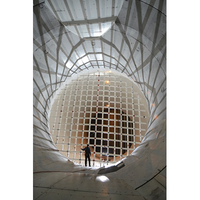
Experiments and theoretical arguments explore different regimes of the capillary breakup of a liquid bridge, depending on the viscosity of the outer fluid and the length of the bridge.

Jetting behavior in drop-on-demand printing: Laboratory experiments and numerical simulations

E. Antonopoulou, O. G. Harlen, M. A. Walkley, and N. Kapur

Phys. Rev. Fluids 5, 043603 (2020) - Published 29 April, 2020

A combined numerical and experimental study reveals the optimal range of fluid properties for inkjet printing. The parameter space of fluid viscosity and surface tension required to produce single drops at a prescribed speed is identified and shows an additional restriction on the Reynolds number in order to jet single droplets.

Analysis of the dissipative range of the energy spectrum in grid turbulence and in direct numerical simulations

Anastasiia Gorbunova, Guillaume Balarac, Mickaël Bourgoin, Léonie Canet, Nicolas Mordant, and Vincent Rossetto

Phys. Rev. Fluids 5, 044604 (2020) - Published 29 April, 2020

To determine how a fluid carries its energy down to microscopic scales where it is dissipated, a result from the assumption-free theory of the nonperturbative renormalization group was tested, using numerical simulations and data from the ONERA wind tunnel. The findings confirm that the kinetic energy spectrum follows the predicted stretched exponential in the dissipation range .

Dynamics of droplet formation and flow regime transition in a T-shaped microfluidic device with a shear-thinning continuous phase

Venu Gopal Agarwal, Rattandeep Singh, Supreet Singh Bahga, and Amit Gupta

Phys. Rev. Fluids 5, 044203 (2020) - Published 28 April, 2020

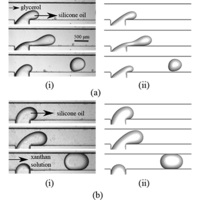
Simulations using a three-dimensional lattice Boltzmann multicomponent model are used to investigate droplet formation in a T-junction microchannel for a shear-thinning continuous phase. The shear-thinning behavior is captured using the Carreau-Yasuda model and is validated with experiments. A greater shear-thinning tendency of the continuous phase fluid is shown to be responsible for an increase in size and a change in shape of droplets from spherical to plug-shaped, typically observed in low capillary number Newtonian flows.

Turbulence modulation in particle-laden stationary homogeneous isotropic turbulence using one-dimensional turbulence

Marco Fistler, Alan Kerstein, David O. Lignell, and Michael Oevermann

Phys. Rev. Fluids 5, 044308 (2020) - Published 28 April, 2020

The one-dimensional-turbulence method is extended to capture turbulence modulation caused by particles in stationary forced, homogeneous isotropic turbulence. Because of the very low computational costs of the one-dimensional model, it enables, after validation with direct numerical simulations, the study of turbulent parameter ranges that are not otherwise accessible. This study is a first step in the development toward a reliable subgrid-scale model for high-turbulent large-eddy simulations.

Aris-Taylor dispersion in the subarachnoid space

Luca Salerno, Giulia Cardillo, and Carlo Camporeale

Phys. Rev. Fluids 5, 043102 (2020) - Published 27 April, 2020

A complete theory to assess the longitudinal dispersion of a passive solute injected in an annular porous cavity and subjected to a pulsatile flow is provided. The model serves to ameliorate intrathecal therapies in the cerebrospinal fluid within the subarachnoid cavity, and it highlights the key role of the anatomical fine structures and cerebrospinal fluid pulsations.

Mathematical model to determine the effect of a sub-glycocalyx space

Mohit P. Dalwadi, John R. King, Rosemary J. Dyson, and Kenton P. Arkill

Phys. Rev. Fluids 5, 043103 (2020) - Published 27 April, 2020

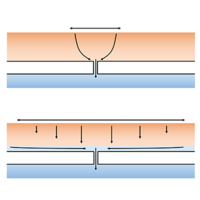
The exact geometry of the thin glycocalyx layer that coats the interior of blood vessels is unknown. A mathematical model is developed to predict how differences in geometry affect the hydraulic flow through the glycocalyx, and how the glycocalyx geometry could be inferred through experiments.

Coupled nonhomogeneous flows and flow-enhanced concentration fluctuations during startup shear of entangled polymer solutions

Michael C. Burroughs, Abhishek M. Shetty, L. Gary Leal, and Matthew E. Helgeson

Phys. Rev. Fluids 5, 043301 (2020) - Published 27 April, 2020

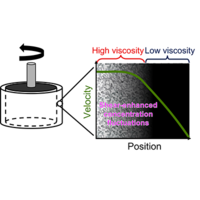
A new type of transient shear banding in entangled polymer solutions observed in Taylor-Couette flow is reported. A novel combination of rheo-particle-tracking-velocimetry and rheo-microscopy reveals that the banded structure correlates with spatial variations in shear-enhanced concentration fluctuations. The results suggest that local concentration fluctuations, enhanced by shear, lead to extra dissipation within the fluid, which increases the effective fluid viscosity that can drive large flow nonuniformities when such dissipation varies spatially within the flow.

Symmetry-based nonperturbative micromanipulation in a three-dimensional microfluidic device

Jeremias Gonzalez and Bin Liu

Phys. Rev. Fluids 5, 044202 (2020) - Published 27 April, 2020

A three-dimensional microfluidic device with embedded symmetries enables rich flow controls for complex manipulations of particles. These flow characteristics, especially a strain-free flow with uniform flow velocities, are protected by symmetries. This nonperturbative capability serves as a supplement to current perturbative micromanipulation approaches.

Sign In to Your Journals Account

Filter

Recent Issues

Vol. 11, Iss. 10
October 2026
Vol. 11, Iss. 9
September 2026
Vol. 11, Iss. 8
August 2026
Vol. 11, Iss. 7
July 2026
Category
Article Type
Section

Filter

Article Lookup

Enter a citation