Recent Articles

Capillary jumps of fluid-fluid fronts across an elementary constriction in a model open fracture

Ramon Planet, Lautaro Díaz-Piola, and Jordi Ortín

Phys. Rev. Fluids 5, 044002 (2020) - Published 8 April, 2020

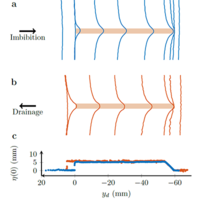
Capillary processes governing fluid-fluid displacements produce leap movements of the interface between invading and displaced fluids, and hysteresis or lag between invasion and withdrawal. We examine the passage of a fluid front through a localized constriction in a Hele-Shaw cell. Our experiments show there are large capillary jumps at one end which cause a microscale hysteresis cycle while at the other end the front is reversibly pinned. With a mass-spring model we reproduce the experimental data without fitting parameters, providing insight beyond phenomenological approaches.

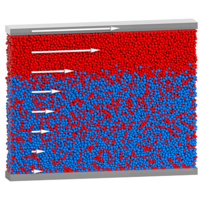
Increase of turbulent drag by polymers in particle suspensions

Marco Edoardo Rosti and Luca Brandt

Phys. Rev. Fluids 5, 041301(R) (2020) - Published 7 April, 2020

Viscoelastic turbulent flows of particle suspensions are studied using direct numerical simulations. In the presence of a moderate concentration of particles, the beneficial effect of polymers in terms of drag reduction are lost, and an increase in drag is observed for sufficiently dense suspensions.

Making droplets glow in turbulence

Humberto Bocanegra Evans, Nico Dam, Guus Bertens, and Willem van de Water

Phys. Rev. Fluids 5, 044303 (2020) - Published 7 April, 2020

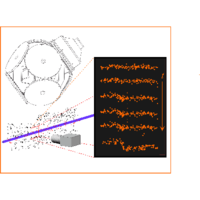
Particle- and droplet-laden flows occur in many natural and industrial processes. To probe their dynamics at high particle concentration we use phosphorescent droplets that can be tagged with a laser. Only the tagged droplets emit light, so that subsets of particles can be selected inside a dense cloud. In our proof of concept experiments we obtain statistical information about the droplet distribution in space, and observe their clustering dynamics in a time period that spans a few turnovers of the smallest eddies in turbulence.

Interpenetrating spiral vortices and other coexisting states in suspension Taylor-Couette flow

Prashanth Ramesh and Meheboob Alam

Phys. Rev. Fluids 5, 042301(R) (2020) - Published 6 April, 2020

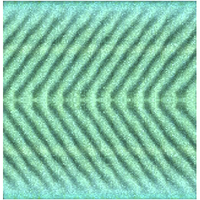
Considering a non-Brownian particulate suspension undergoing Taylor-Couette flow with only the inner cylinder rotating, we report new patterns such as interpenetrating spiral vortices in which upward and downward helical vortices co-exist, and also Taylor vortices coexisting with either spiral or wavy vortices.

Acoustic flows in a slightly rarefied gas

Nicholas Z. Liu, Daniel R. Ladiges, Jason Nassios, and John E. Sader

Phys. Rev. Fluids 5, 043401 (2020) - Published 6 April, 2020

The Navier-Stokes equations with a no-slip boundary condition can be used to model continuum gas flows. For rarefied flows, however, alternative transport equations and boundary conditions are needed. We perform a matched asymptotic expansion on the Boltzmann equation and formulate transport equations and boundary conditions for slightly rarefied acoustic flows. We demonstrate their utility by studying oscillatory flows generated between two heated plates, thermal creep and rectilinear motion of a sphere, and compare to the Navier-Stokes-Fourier equations with slip boundary conditions.

Regularized extended-hydrodynamic equations for a rarefied granular gas and the plane shock waves

M. H. Lakshminarayana Reddy and Meheboob Alam

Phys. Rev. Fluids 5, 044302 (2020) - Published 6 April, 2020

Motions of grains such as in dust storms, sand dunes, snow avalanches, Saturn’s rings, and others are categorized as “granular” flows. We have used the Maxwell-Boltzmann kinetic theory to analyze rapid granular flows with an analogy between the motion of macroscopic grains and the random motion of atoms in molecular gases, with a crucial difference that the grains collide inelastically. The inelasticity is responsible for many peculiar behaviors of granular gases as we demonstrate by considering shock-wave propagation in granular gases with higher-order hydrodynamic equations.

Investigation of flow past a cylinder embedded on curved and flat surfaces

Pankaj Jagad, Mamdouh S. Mohamed, and Ravi Samtaney

Phys. Rev. Fluids 5, 044701 (2020) - Published 6 April, 2020

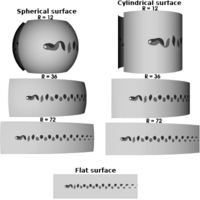
A discrete exterior calculus investigation of flow past a stationary cylinder of circular, triangular, or square cross section embedded on a spherical or cylindrical surface shows insignificant effect of the embedding surface curvature. The contributing parameters, such as the magnitude of the Gaussian curvature term relative to the magnitude of the viscous term around the cylinder and the effect of the geometrical constraint, are insignificant. Is the dynamics of the flow past bluff bodies universal?

Segregation models for density-bidisperse granular flows

Yifei Duan, Paul B. Umbanhowar, Julio M. Ottino, and Richard M. Lueptow

Phys. Rev. Fluids 5, 044301 (2020) - Published 3 April, 2020

A kinetic-theory-based model of granular flow which predicts the depth-varying segregation velocities of rising and sinking particles in density-bidisperse mixtures is presented. The segregation velocity results from a balance between the buoyant force, due to particle density and concentration, and the interspecies drag force from kinetic theory, which depends on interparticle friction and local flow conditions.

Jet breakup in superfluid and normal liquid He4

N. B. Speirs, K. R. Langley, P. Taborek, and S. T. Thoroddsen

Phys. Rev. Fluids 5, 044001 (2020) - Published 2 April, 2020

The breakup of jets of superfluid and normal liquid 4He is studied between 1.2 K and the liquid-vapor critical point at 5.2 K. Both gas and liquid properties vary widely over this small temperature range, creating a unique parameter space with variations of several orders of magnitude for the Ohnesorge number, Reynolds number, and gas-liquid density ratio. The five breakup regimes seen previously, and transitions between them, are described in detail and shown pictorially. New criteria are proposed for the Rayleigh to 1st wind, 1st wind to sinuous, and sinuous to 2nd wind transitions.

Dynamics of liquid nanothreads: Fluctuation-driven instability and rupture

Chengxi Zhao, Duncan A. Lockerby, and James E. Sprittles

Phys. Rev. Fluids 5, 044201 (2020) - Published 2 April, 2020

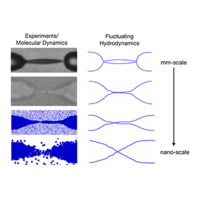
The influence of thermal fluctuations on the dynamics of nanoscale liquid threads is investigated using both molecular dynamics (MD) and a stochastic lubrication equation (SLE) derived from fluctuating hydrodynamics. These methods recover a range of breakup profiles, including the ‘double cone’, and we quantify their occurrence statistics. The SLE is about 5000 times faster than MD and permits access to a broader range of parameters. We use it to probe the final stages of rupture and compare to proposed similarity solutions, showing its usefulness for investigating nanoscale interfacial flows.

Scaling laws in axisymmetric magnetohydrodynamic duct flows

A. Poyé, O. Agullo, N. Plihon, W. J. T. Bos, V. Desangles, and G. Bousselin

Phys. Rev. Fluids 5, 043701 (2020) - Published 1 April, 2020

The features of axisymmetric magnetohydrodynamic duct flows in annular geometry, driven by current injection perpendicular to an externally applied magnetic field, is investigated numerically and analytically. Scaling laws for the velocity in the three regimes previously reported in the literature are derived for a wide range of control parameters and systematically compared to experimental data.

Oscillating grid generating turbulence near gas-liquid interfaces in shear-thinning dilute polymer solutions

T. Lacassagne, S. Simoëns, M. EL Hajem, and J.-Y. Champagne

Phys. Rev. Fluids 5, 033301 (2020) - Published 31 March, 2020

A first experimental characterization of low Reynolds number, oscillating grid generated, and near-surface turbulence in shear-thinning dilute polymer solutions is presented. Energy transfer and horizontal damping mechanisms are evidenced. The evolution of the viscous sublayer depth can be explained by both viscous and shear-thinning effects.

Differential diffusion effects on density-driven instability of reactive flows in porous media

Timan Lei and Kai H. Luo

Phys. Rev. Fluids 5, 033903 (2020) - Published 31 March, 2020

In diverse applications such as enhanced oil recovery and carbon sequestration, solute A in fluid 1 diffuses into fluid 2 where it reacts with solute B following A + B → C. Pore-scale simulations based on the lattice Boltzmann method reveal intricate density-driven instability and differential diffusion effects. New fingering regimes are observed under certain combinations of density ratios, diffusivity ratios, and Rayleigh number ratios among the participating fluids and species.

Generalized Shields criterion for weakly cohesive granular materials

Florian Brunier-Coulin, Pablo Cuéllar, and Pierre Philippe

Phys. Rev. Fluids 5, 034308 (2020) - Published 30 March, 2020

The erosion onset and kinetics of weakly cohesive granular materials based on experimental data from optically adapted jet erosion tests is investigated. The scouring kinetics are examined qualitatively for samples with an intergranular cohesion induced by either liquid or solid bonds. From a quantitative perspective, the erosion onset for the case of solid bond cohesion is here described by a generalized form of the usual Shields criterion including a cohesion number defined from yield tensile values considering both the micro- and macroscales.

Capillary bulldozing of sedimented granular material confined in a millifluidic tube

Guillaume Dumazer, Bjørnar Sandnes, Knut Jørgen Måløy, and Eirik G. Flekkøy

Phys. Rev. Fluids 5, 034309 (2020) - Published 30 March, 2020

When granular matter is involved in a confined two-phase flow, three ingredients that do not usually occur together must be considered in parallel: viscosity, capillarity, and solid friction. The displacement regimes of a gas-liquid interface along a horizontal millifluidic tube containing a sedimented granular phase are documented in detail. Experimental observations are made with a simple setup, and an associated theoretical interpretation that can describe a spectrum of capillary bulldozing regimes is developed.

Structure of coherent columnar vortices in three-dimensional rotating turbulent flow

I. V. Kolokolov, L. L. Ogorodnikov, and S. S. Vergeles

Phys. Rev. Fluids 5, 034604 (2020) - Published 30 March, 2020

The turbulence in a fast rotating fluid becomes effectively two-dimensional. The inverse energy cascade leads to formation of coherent columnar vortices. An analytical theory describing interaction of such a vortex with turbulent pulsations is developed. The radial velocity profile of the vortex is established.

From modulational instability to focusing dam breaks in water waves

Félicien Bonnefoy, Alexey Tikan, François Copie, Pierre Suret, Guillaume Ducrozet, Gaurav Prabhudesai, Guillaume Michel, Annette Cazaubiel, Eric Falcon, Gennady El, and Stéphane Randoux

Phys. Rev. Fluids 5, 034802 (2020) - Published 27 March, 2020

The Benjamin-Feir, or modulational, instability has been regarded as the main mechanism of spontaneous disintegration of broad weakly nonlinear wavepackets in deep water waves. We report water wave experiments with another result. For a range of initial parameters, a nearly rectangular initial wavepacket develops a strongly nonlinear modulation with two dispersive shock waves expanding from the edges of the wavepacket towards the center at finite speed. This is supported by theory based on the semiclassical limit of the one-dimensional focusing nonlinear Schrodinger equation.

Interaction network analysis in shear thickening suspensions

Marcio Gameiro, Abhinendra Singh, Lou Kondic, Konstantin Mischaikow, and Jeffrey F. Morris

Phys. Rev. Fluids 5, 034307 (2020) - Published 23 March, 2020

Dense frictional particulate suspensions in a viscous liquid respond to applied shear in a complex manner that includes continuous or discontinuous shear thickening. This change in rheology as a function of particle packing fraction and/or applied stress is associated with a formation of complex interaction networks that develop on a mesoscopic scale. The properties of these networks, analyzed by the newly developed tools based on persistent homology in both two and three spatial dimensions, are found to be closely related to the macroscopic system response.

Local analysis of the clustering, velocities, and accelerations of particles settling in turbulence

Mohammadreza Momenifar and Andrew D. Bragg

Phys. Rev. Fluids 5, 034306 (2020) - Published 20 March, 2020

We use three-dimensional Voronoi tessellation to perform a local analysis of particle motion in isotropic turbulence while independently varying the flow Reynolds and Froude number, and particle Stokes number. Among other interesting findings, our local analysis shows that in flow regions where particles are clustered, fluid accelerations at the particle positions are significant. These results call into question the validity of the “sweep-stick” mechanism for particle clustering in turbulence, which states that inertial particles cluster in flow regions where the fluid acceleration is zero.

Shape oscillations of a viscoelastic droplet suspended in a viscoelastic host liquid

Fang Li, Xie-Yuan Yin, and Xie-Zhen Yin

Phys. Rev. Fluids 5, 033610 (2020) - Published 19 March, 2020
The small-amplitude oscillation of a liquid droplet suspended in an immiscible host liquid is studied, where both liquids are assumed viscoelastic. An analytical characteristic equation is derived, and the damping rate and angular frequency that describe the droplet oscillation are numerically solved. The effect of the properties of the host liquid, including its density, viscosity and elasticity, on the viscoelastic droplet oscillation is examined for the quadrupole mode. The host liquid is found to make the droplet oscillation more complex and the mechanisms behind that are discussed.

Sign In to Your Journals Account

Filter

Recent Issues

Vol. 11, Iss. 10
October 2026
Vol. 11, Iss. 9
September 2026
Vol. 11, Iss. 8
August 2026
Vol. 11, Iss. 7
July 2026
Category
Article Type
Section

Filter

Article Lookup

Enter a citation