Recent Articles

Scaling of Rayleigh-Taylor mixing in porous media

G. Boffetta, M. Borgnino, and S. Musacchio

Phys. Rev. Fluids 5, 062501(R) (2020) - Published 22 June, 2020

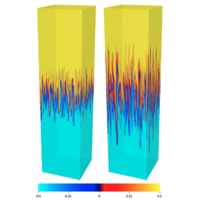
Rayleigh-Taylor mixing in a porous medium is studied numerically in two and three dimensions. Density plumes are found to grow in a non-self-similar way, with length increasing faster than width. The evolution of the mixing layer is found to be quantitatively different in two and three dimensions.

Study of drag reduction using periodic spanwise grooves on incompressible viscous laminar flows

Pooyan Tirandazi and Carlos H. Hidrovo

Phys. Rev. Fluids 5, 064102 (2020) - Published 22 June, 2020

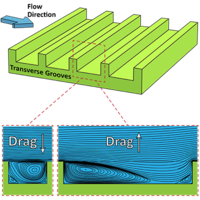
Engineered surface textures can manipulate boundary layers affecting fluid drag. We study periodic, infinitely long spanwise grooves on a laminar boundary layer over a plate for 1000 < ReL < 25000. Below a certain width-to-depth aspect ratio (AR), a primary vortex inside each groove causes the freestream to “slip over”, reducing skin friction. Increasing AR poses a tradeoff in drag reduction due to pressure drag from groove vertical walls. Overall, transverse grooves for laminar flow can reduce total drag up to 10% compared to a flat plate, despite increasing the wetted surface area.

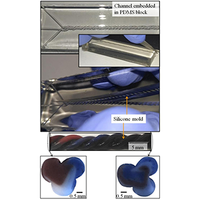
Analysis of mixing in a helical microchannel

Pravat Rajbanshi and Animangsu Ghatak

Phys. Rev. Fluids 5, 064502 (2020) - Published 22 June, 2020

Examining fluid flow inside a monolithic, three-dimensionally oriented, microfluidic channel is experimentally challenging because it does not permit a laser sheet to be effectively applied; tracking microscopic tracer particles is difficult; and monolithic construction prevents access to any material inside. We overcome these problems with an approach which captures the flow both along the channel axis and in a plane perpendicular to it, yet lets us capture the flow pattern over a wide Reynolds number range. Our observations corroborate results from flow simulations.

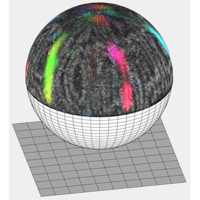
Rotating spherical gap convection in the GeoFlow International Space Station (ISS) experiment

Florian Zaussinger, Peter Haun, Peter S. B. Szabo, Vadim Travnikov, Mustafa Al Kawwas, and Christoph Egbers

Phys. Rev. Fluids 5, 063502 (2020) - Published 19 June, 2020

The GeoFlow experiment on the International Space Station was the first experiment to investigate rotating convection in a radial gravitylike force field. This led to the first observation of the existence of global columnar cells in a microgravity environment. The flow structures are identified by a machine learning algorithm and complemented by numerical simulations.

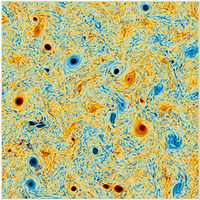
Role of the forcing dimensionality in thin-layer turbulent energy cascades

Basile Poujol, Adrian van Kan, and Alexandros Alexakis

Phys. Rev. Fluids 5, 064610 (2020) - Published 19 June, 2020

The transition from forward to inverse energy cascade in turbulent flows in thin layers, varying the functional form of the forcing and the thickness of the layer, is investigated. As the forcing function becomes more three-dimensional, the inverse cascade is suppressed and the critical height hc, where the transition occurs, is decreased.

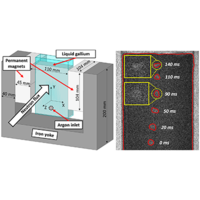
Phase boundary dynamics of bubble flow in a thick liquid metal layer under an applied magnetic field

Mihails Birjukovs, Valters Dzelme, Andris Jakovics, Knud Thomsen, and Pavel Trtik

Phys. Rev. Fluids 5, 061601(R) (2020) - Published 18 June, 2020

Dynamic neutron radiography is used to observe the effect of a transverse magnetic field on argon bubbles rising through a thick layer of liquid gallium without interactions with the container walls.

Oscillation in the temperature profile of the large-scale circulation of turbulent convection induced by a cubic container

Dandan Ji and Eric Brown

Phys. Rev. Fluids 5, 063501 (2020) - Published 18 June, 2020

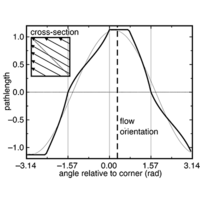
In turbulent Rayleigh-Bénard convection in a cubic cell, a new oscillation is found in the temperature profile shape of the large-scale circulation (LSC). This geometry dependence is explained by a model which assumes that heat conducted to the LSC from thermal boundary layers is proportional to the LSC path length along the boundary layers at the top and bottom plates. In a non-circular cross-section cell, oscillations of the flow orientation around a corner lead to container shape oscillations in the LSC reference frame, and thus a path length oscillation of the LSC.

Sensitivity gradients of surface geometry modifications based on stability analysis of compressible flows

Alejandro Martinez-Cava, Miguel Chávez-Modena, Eusebio Valero, Javier de Vicente, and Esteban Ferrer

Phys. Rev. Fluids 5, 063902 (2020) - Published 18 June, 2020

A discrete framework to calculate eigenvalue sensitivity gradients to geometrical changes is introduced and applied to the compressible Navier-Stokes equations. The novel formulation is used to control global instabilities in compressible turbulent flow scenarios, modeled through Reynolds-averaged Navier-Stokes approaches. The sensitivity gradients are exploited to include local surface deformations that delay or enhance the onset of instabilities and can modify their associated frequency.

Study on stretching liquid bridges with symmetric and asymmetric surface wettability

Jiayi Zhao, Nan Zhou, Kaixuan Zhang, Shuo Chen, and Yang Liu

Phys. Rev. Fluids 5, 064003 (2020) - Published 18 June, 2020

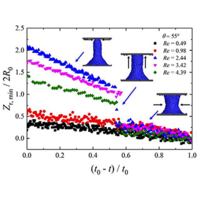
The rupture process of stretching liquid bridges is determined by competition between contact line slip velocity and liquid bridge thinning velocity. Poorer surface wettability and larger stretching velocity help increase slip velocity and enable the liquid bridge to slip off surfaces. In addition, the shift moment of minimal radius of stretching liquid bridges is related to surface wettability, regardless of plate stretching velocity. Finally, satellite drop formation is related to the sequential order of appearance of the liquid bridge slipping off the plate and the breakup of the filament.

Large eddy simulations of wall jets with coflow for the study of turbulent Prandtl number variations and data-driven modeling

Ali Haghiri and Richard D. Sandberg

Phys. Rev. Fluids 5, 064501 (2020) - Published 18 June, 2020

A machine-learning technique is used to develop data-driven models for turbulent heat flux prediction in wall jets with co-flow The training data are obtained by performing highly-resolved large-eddy simulations of nine cases covering various flow and geometry conditions. Robust Reynolds-averaged Navier-Stokes based heat-transfer closures are obtained, and a significant error reduction in predicting adiabatic wall effectiveness is achieved using the machine-learnt models.

Fully nonlinear simulations of unidirectional extreme waves provoked by strong depth transitions: The effect of slope

Yaokun Zheng, Zhiliang Lin, Yan Li, T. A. A. Adcock, Ye Li, and T. S. van den Bremer

Phys. Rev. Fluids 5, 064804 (2020) - Published 18 June, 2020

Recent studies of surface gravity waves propagating over a sloping bottom have shown that an increase in the probability of extreme waves can be triggered by depth variations in sufficiently shallow waters. A boundary element method is used to show that this increase in probability is greatest when the slope is steepest, i.e., for a step. A harmonic separation technique shows that the second-order terms in wave steepness are responsible for the change in the statistical properties near the depth transition.

Steady and oscillatory flow in the human bronchial tree

Sahar Jalal, Tristan Van de Moortele, Omid Amili, and Filippo Coletti

Phys. Rev. Fluids 5, 063101 (2020) - Published 17 June, 2020

Magnetic resonance velocimetry is used to investigate the steady inhalation, steady exhalation, and oscillatory flow in a 3D-printed realistic airway geometry for physiologically relevant regimes ranging from quiet breathing to respiration under high-frequency ventilation. Additionally, the pendulluft phenomenon is demonstrated experimentally for the first time, using both Eulerian velocity fields and Lagrangian path lines.

Unsteady fluid-structure interactions in a soft-walled microchannel: A one-dimensional lubrication model for finite Reynolds number

Tanmay C. Inamdar, Xiaojia Wang, and Ivan C. Christov

Phys. Rev. Fluids 5, 064101 (2020) - Published 17 June, 2020

What happens when a fluid is pumped into a soft microchannel with height as small as the diameter of a human hair? The microchannel inflates under the flow pressure, while the flow within is affected by the resistance of the wall to deformation. We develop a mathematical model and simulate the ensuing fluid–structure interaction. Even after complex oscillations of the channel wall, we show that the final inflated state is stable. Our model highlights the parameter sets that determine the steady state wall deformation and hydrodynamic pressure distribution across a wide range of systems.

Separating adverse-pressure-gradient and Reynolds-number effects in turbulent boundary layers

C. Sanmiguel Vila, R. Vinuesa, S. Discetti, A. Ianiro, P. Schlatter, and R. Örlü

Phys. Rev. Fluids 5, 064609 (2020) - Published 17 June, 2020

Wall turbulence is characterized by a near-wall cycle of streaks and quasistreamwise vortices apparent as an invariant inner peak in the premultiplied energy spectra. A second, outer peak is known to emerge in this spectral view and become energized with increasing Reynolds number (Re) as well as adverse pressure gradient (APG). An analysis of experimental data sets examines how this outer peak scales with Re and APG and whether their imprint on the near-wall small scales are different.

Optimal perturbations and transition energy thresholds in boundary layer shear flows

Chris Vavaliaris, Miguel Beneitez, and Dan S. Henningson

Phys. Rev. Fluids 5, 062401(R) (2020) - Published 16 June, 2020

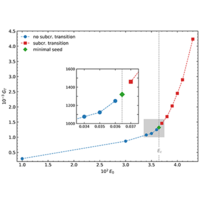
Adjoint-based optimization is performed in a Blasius boundary layer flow, leading to the computation of the subcritical transition critical energy threshold and associated minimal seed. Simulation results demonstrate the physical characteristics and key energy growth mechanisms of the perturbations. Phase-space representation of the minimal seed’s evolution leads to the identification of a persistent attracting region.

Conical shear-driven parametric instability of steady flow in precessing spheroids

Yasufumi Horimoto, Atsushi Katayama, and Susumu Goto

Phys. Rev. Fluids 5, 063901 (2020) - Published 16 June, 2020

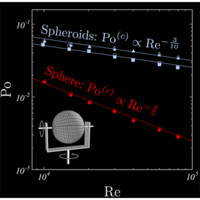
The flow instability in a precessing spheroid is a fundamental subject of fluid mechanics and is also important in geophysics because Earth is precessing. There are at least three instabilities: elliptical, shearing, and conical shear. Theory predicts the dominance of the latter in a regime that depends on the spin rate and container’s ellipticity. Laboratory experiments that perfectly support the theory are presented.

Chaos and information in two-dimensional turbulence

Daniel Clark, Lukas Tarra, and Arjun Berera

Phys. Rev. Fluids 5, 064608 (2020) - Published 16 June, 2020

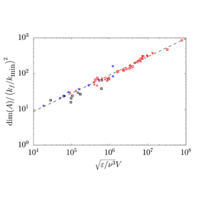
Using fully resolved direct numerical simulations of two-dimensional homogeneous and isotropic turbulence, the Kolmogorov-Sinai entropy and attractor dimension are measured across a wide range of Reynolds numbers. In contrast with the three-dimensional case, these quantities are dependent on the system size and forcing length scale, providing further evidence of nonuniversality in two-dimensional turbulence.

Hysteretic wave drag in shallow water

G. P. Benham, R. Bendimerad, M. Benzaquen, and C. Clanet

Phys. Rev. Fluids 5, 064803 (2020) - Published 16 June, 2020

When a boat is pushed at constant force from deep water to shallow water, the drag changes in such a way that two possible states emerge, corresponding to a slow speed and a fast speed. A study of the dynamical behavior in such a transition, including possible hysteresis routes, with reference to real applications such as rowing sports is presented

Jet ejection following drop impact on micropillared hydrophilic substrates

Anayet Ullah Siddique, Marcus Trimble, Feng Zhao, Mark M. Weislogel, and Hua Tan

Phys. Rev. Fluids 5, 063606 (2020) - Published 15 June, 2020

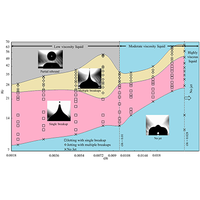
The jetting phenomenon from impinging droplets on partially wetting hydrophilic substrates composed of cylindrical micropillars is studied. Impact velocity and fluid viscosity are varied to characterize the jets. It is found that the jetting phenomenon arises for certain ranges of Weber and Ohnesorge numbers. Jet speed, height, and diameter scale linearly with the Weber number. The scaling analysis indicates that the jet is produced by pure inertial focusing of radial flow due to the collapse of an air cavity formed at the center of the drop during the recoiling phase of the impact.

Data compression for turbulence databases using spatiotemporal subsampling and local resimulation

Zhao Wu, Tamer A. Zaki, and Charles Meneveau

Phys. Rev. Fluids 5, 064607 (2020) - Published 15 June, 2020
A data compression methodology for fluid dynamics is introduced. The simulation domain is divided into subdomains with equal size, and the simulation data is compressed by storing it only on the subdomain boundaries. When data is requested by users, a re-simulation of the Navier-Stokes equations within the subdomain is performed using the stored boundary data. The data storage scheme is carefully designed to avoid any errors during the compression-decompression process. A 40:1 lossless compression ratio is easily achieved.

Sign In to Your Journals Account

Filter

Recent Issues

Vol. 11, Iss. 10
October 2026
Vol. 11, Iss. 9
September 2026
Vol. 11, Iss. 8
August 2026
Vol. 11, Iss. 7
July 2026
Category
Article Type
Section

Filter

Article Lookup

Enter a citation