Recent Articles

Decaying two-dimensional turbulence undergoes statistical heating

J. G. Esler and R. K. Scott

Phys. Rev. Fluids 5, 074601 (2020) - Published 2 July, 2020

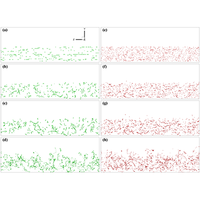
Simulations of decaying two-dimensional turbulence show a persistent trend in the statistical temperature, from “colder” states in which dipoles are prevalent, to “hotter” states dominated by clusters of like-signed vortices. The spontaneous heating effect is shown to be consistent with a decay law for the vortex number density that is faster than the t−2/3 law deduced from similarity arguments.

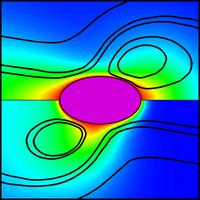
Hydrodynamic forces on a clean spherical bubble translating in a wall-bounded linear shear flow

Pengyu Shi, Roland Rzehak, Dirk Lucas, and Jacques Magnaudet

Phys. Rev. Fluids 5, 073601 (2020) - Published 1 July, 2020

Fully resolved simulations are conducted to determine hydrodynamic forces on clean spherical bubbles translating near a flat rigid wall in a linear shear flow. Flows range from low-but-finite Re to nearly inviscid situations. Based on simulation results, semi-empirical expressions for drag and lift forces at arbitrary Re, relative shear rate, and separation distance are found. These improve over current ‘point-particle’ models which ignore wall effects, and may be used to predict realistic bubble trajectories and distributions in wall-bounded flows.

Transient growth analysis of oblique shock-wave/boundary-layer interactions at Mach 5.92

Anubhav Dwivedi, Nathaniel Hildebrand, Joseph W. Nichols, Graham V. Candler, and Mihailo R. Jovanović

Phys. Rev. Fluids 5, 063904 (2020) - Published 30 June, 2020

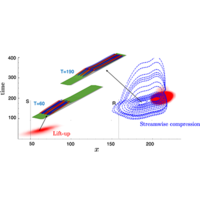
Experimental studies of a transitional shock-wave–boundary-layer interaction identify robust streaklike flow structures. In order to account for the emergence of these three-dimensional flow features, growth of small initial perturbations around the two-dimensional laminar base flow is examined. The most significant transient amplification originates from the upstream streamwise vortices, which are not related to modal instabilities. Unique to separated high-speed flows, the impinging shock compresses the boundary layer, thereby causing the growth of the streaks.

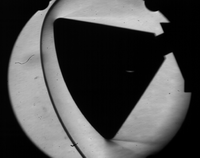
Experimental investigation of the solid-liquid separation in a stirred tank owing to viscoelasticity

Weheliye Hashi Weheliye, Giovanni Meridiano, Luca Mazzei, and Panagiota Angeli

Phys. Rev. Fluids 5, 063302 (2020) - Published 29 June, 2020

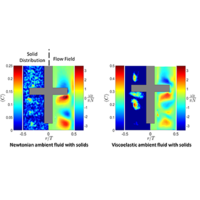
Experiments demonstrate that viscoelastic-induced particle migration concentrates solids at the core of vortices in particle suspensions. The findings can successfully be applied to the separation of solids suspended in a viscoelastic liquid with small density difference between the phases, high liquid viscosity, and small-sized particles. The proposed separation method is low cost and relevant to many chemical engineering processes.

Cooperation and competition of viscoelastic fluids and elastomeric microtubes subject to pulsatile forcing

Aimee M. Torres Rojas and E. Corvera Poiré

Phys. Rev. Fluids 5, 063303 (2020) - Published 29 June, 2020

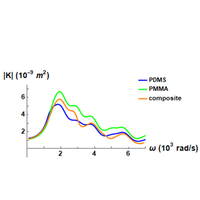
The cooperation and competition of viscoelastic fluids, subject to pulsatile forcing, with the elastomeric microtubes that confine them is explored. Tuning of system parameters allows for the excitation of different modes, and resonances can be achieved by driving the fluid with the appropriate pulsatile pressure drop. The results are relevant at microscales and potentially useful for tailoring composite microfluidic devices, where one can induce an increase or decrease of the amplitude of the longitudinally averaged flow, relative to the one of tubes made of a single material.

Electrowetting diminishes contact line friction in molecular wetting

Petter Johansson and Berk Hess

Phys. Rev. Fluids 5, 064203 (2020) - Published 29 June, 2020

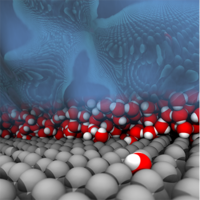
In electrowetting, an electrostatic potential is applied to a droplet to increase its wettability. As the droplet rapidly spreads to its new equilibrium state, contact line friction is greatly diminished. Molecular dynamics simulations show that this effect is present at molecular scales and is related to how liquid molecules advance the contact line.

Microroughness-induced disturbances in supersonic blunt body flow

Thomas Schilden, Alexej Pogorelov, Sohel Herff, and Wolfgang Schröder

Phys. Rev. Fluids 5, 063903 (2020) - Published 26 June, 2020

To identify the mechanism triggering boundary layer transition on a spherical forebody of an Apollo type re-entry capsule, direct numerical simulations of perturbed flow are analyzed. The perturbations are generated by deterministic distributed surface roughnesses that resemble model surface imperfections that are mounted on a capsule model in corresponding experiments. The receptivity of the capsule boundary layer to the roughness and the subsequent disturbance growth are analyzed.

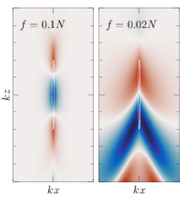
Flows induced by Coriolis-influenced vertically propagating two-dimensional internal gravity wave packets

Bruce R. Sutherland, Wyatt Reeves, and Ton S. van den Bremer

Phys. Rev. Fluids 5, 064805 (2020) - Published 25 June, 2020

In the absence of background rotation, the Eulerian flow induced by two-dimensional internal wave packets is well known to have the structure of long trailing internal waves. We show that rotation makes these waves evanescent and the structure of the flow over the waves in the wave packet qualitatively changes, with implications for the modulational stability of the waves.

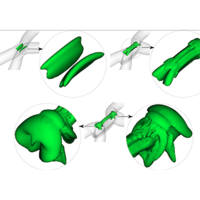
Aeroacoustic noise generation due to vortex reconnection

Hamid Daryan, Fazle Hussain, and Jean-Pierre Hickey

Phys. Rev. Fluids 5, 062702(R) (2020) - Published 24 June, 2020

Compressible direct numerical simulation of vortex reconnection uncovers the source and far-field pattern of aeroacoustic noise.

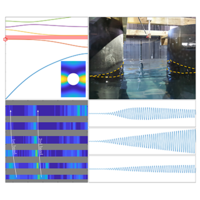
Experimental realization of broadband control of water-wave-energy amplification in chirped arrays

A. J. Archer, H. A. Wolgamot, J. Orszaghova, L. G. Bennetts, M. A. Peter, and R. V. Craster

Phys. Rev. Fluids 5, 062801(R) (2020) - Published 24 June, 2020

An experimental demonstration is presented that a chirped array of cylinders can be designed to control the spatial distribution of water wave energy and substantially amplify target frequencies at specified locations, over a broad range of frequencies, consistent with linear band-gap theory.

Axisymmetric squirmers in Stokes fluid with nonuniform viscosity

Patrick S. Eastham and Kourosh Shoele

Phys. Rev. Fluids 5, 063102 (2020) - Published 24 June, 2020

Numerical techniques are employed to study the locomotion of a spheroidal squirmer in a complex fluid with a nutrient-dependent viscosity. It is found that the nonuniform viscosity significantly affects the pressure field around the swimmer rather than the velocity field. Results obtained here will be helpful in interpreting experimental observation where a microswimmer significantly affects a fluid’s local rheology.

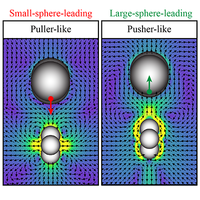
Kinematics of a simple reciprocal model swimmer at intermediate Reynolds numbers

Thomas Dombrowski and Daphne Klotsa

Phys. Rev. Fluids 5, 063103 (2020) - Published 24 June, 2020

A study of the kinematics, power and recovery strokes, fluid flows, and efficiency of a reciprocal dumbbell swimmer with finite inertia finds that the swimmer’s average flow field is dominated by the flow during its power stroke, and it switches from pullerlike to pusherlike depending on the (finite) Reynolds number.

Flow transitions and mapping for undulating swimmers

Muhammad Saif Ullah Khalid, Junshi Wang, Haibo Dong, and Moubin Liu

Phys. Rev. Fluids 5, 063104 (2020) - Published 24 June, 2020

Unfolding the connection between kinematics and physiology of natural swimming species is of much value for bioinspired designs of autonomous underwater vehicles. Extensive numerical investigations find which wavelength of the undulating motion of carangiform and anguilliform swimmers is suitable to maximize their swimming performance in terms of thrust production and efficiency under different flow conditions. It is also explained how jet switching in the wake of a swimmer deteriorates the hydrodynamic efficiency of anguilliform and carangiform swimmers.

Efficient autocatalytic reactive mixing and solitary chemical waves in laminar flows

Thomas D. Nevins, Daniel E. Troyetsky, and Douglas H. Kelley

Phys. Rev. Fluids 5, 063201 (2020) - Published 24 June, 2020

Chemical reactors often need to generate products quickly, with minimal stirring energy. What flow is best? By studying two-dimensional laminar flows via advection-diffusion simulations and via simulations of moving chemical reaction fronts, analytic predictions of converged front shape and reaction rate are devised. In the regime studied, concentrating kinetic energy in small regions causes the fastest reactions.

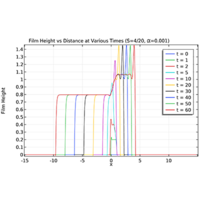
Thin liquid film resulting from a distributed source on a vertical wall

Yadong Ruan, Ali Nadim, and Marina Chugunova

Phys. Rev. Fluids 5, 064004 (2020) - Published 24 June, 2020

If a thin liquid film is generated from a source region on a vertical surface, it may flow down the wall as a result of gravity or, if there is a strong upward air current, get carried up by the resulting shear stress. An analysis of the dynamics of such a system both with and without surface tension finds that at low source strengths, the film is carried entirely upward, whereas for stronger source strengths, the bulk of the film falls down while some is still carried upward by the air flow. Surface tension strongly affects the film profiles and the speeds of the fronts.

Using helicity to investigate scalar transport in wall turbulence

Q. Nguyen and D. V. Papavassiliou

Phys. Rev. Fluids 5, 062601(R) (2020) - Published 23 June, 2020

Since flow regions of high helicity are associated with low dissipation of kinetic energy, helicity can be used to mark the flow structures that are major contributors to turbulent scalar dispersion. Employing a Lagrangian approach to compare the helicity between scalar tracers and fluid particles in the same flow field shows that flow structures that contribute to the transport of low Schmidt number markers are different than those for fluid particles. This is quite important in anisotropic wall turbulence, where the interplay between molecular and turbulent transport is critical.

Drag reduction for swept flat plate flow

Marian Albers and Wolfgang Schröder

Phys. Rev. Fluids 5, 064611 (2020) - Published 23 June, 2020

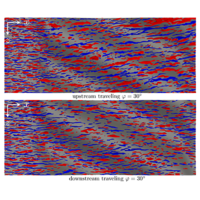
Drag reduction in turbulent boundary layer flow via swept transversal surface waves is investigated by large-eddy simulations. For partially downstream traveling waves, a decreased friction drag reduction and positively contributing pressure drag are determined while the opposite occurs for partially upstream traveling waves. It is also shown that an amplification of the outer layer turbulence can coexist with a drag-reduced near-wall state.

Proper orthogonal decomposition analysis and modelling of the wake deviation behind a squareback Ahmed body

Bérengère Podvin, Stéphanie Pellerin, Yann Fraigneau, Antoine Evrard, and Olivier Cadot

Phys. Rev. Fluids 5, 064612 (2020) - Published 23 June, 2020

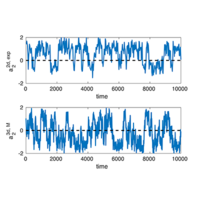
The global wake dynamics of an Ahmed body are correctly captured by a proper-orthogonal-decomposition (POD)-based low-dimensional model. The POD modes include the quasisteady wake deviation with intermittent switches, both vortex shedding modes and bubble pumping mechanisms.

Permanence of large eddies in decaying variable-density homogeneous turbulence with small Mach numbers

O. Soulard, J. Griffond, B.-J. Gréa, and G. Viciconte

Phys. Rev. Fluids 5, 064613 (2020) - Published 23 June, 2020

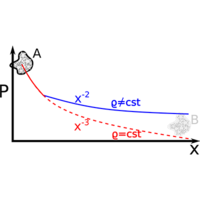
Density variations modify the way pressure transports information over large distances. As a result, the long-range correlations of the velocity field behave differently in constant- and variable-density flows. This raises the question of the permanence of large eddies in variable-density turbulence. Does this principle also hold in this context? If yes, how is it expressed? An exploration of these issues is presented.

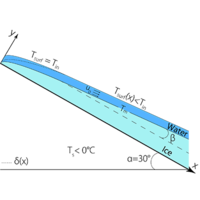
Freezing a rivulet

Antoine Monier, Axel Huerre, Christophe Josserand, and Thomas Séon

Phys. Rev. Fluids 5, 062301(R) (2020) - Published 22 June, 2020

Water flowing down a freezing plane builds a static layer of ice on which it keeps flowing. After a rapid diffusive ice growth, the system reaches a steady state resulting from the balance between the heat flow in the water and in the ice. This gives the ice a surprising linear shape.

Sign In to Your Journals Account

Filter

Recent Issues

Vol. 11, Iss. 10
October 2026
Vol. 11, Iss. 9
September 2026
Vol. 11, Iss. 8
August 2026
Vol. 11, Iss. 7
July 2026
Category
Article Type
Section

Filter

Article Lookup

Enter a citation