Recent Articles

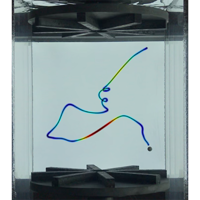
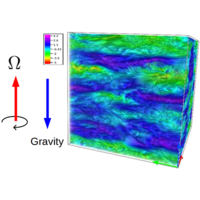
Low-dimensional model of the large-scale circulation of turbulent Rayleigh-Bénard convection in a cubic container

Dandan Ji and Eric Brown

Phys. Rev. Fluids 5, 064606 (2020) - Published 12 June, 2020

Low-dimensional models are desirable for turbulent flow problems that are otherwise impractical to solve. A model describing the dynamics of the orientation of convection rolls as diffusion in a potential determined by the shape of the cell is tested. In a cubic Rayleigh-Bénard convection cell, measurements confirm the model prediction of a four-well potential, along with advected oscillation modes centered around potential minima at corners, driven by turbulent fluctuations with a restoring force due to the noncircular shape of the cell cross section.

Ultrasound-enhanced mass transfer during single-bubble diffusive growth

Álvaro Moreno Soto, Pablo Peñas, Guillaume Lajoinie, Detlef Lohse, and Devaraj van der Meer

Phys. Rev. Fluids 5, 063605 (2020) - Published 11 June, 2020

The effect of ultrasound on the diffusive growth of a single spherical bubble growing on a substrate in supersaturated carbonated water is quantified. It is found that the diffusive growth of surface bubbles can be easily enhanced by 2 orders of magnitude during volumetric resonance. This convective growth is shown to be caused by vigorous acoustic microstreaming arising from the nonspherical bubble oscillations.

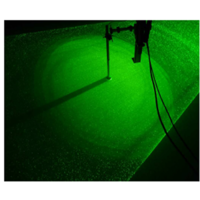
Velocity and acceleration statistics in particle-laden turbulent swirling flows

Sofía Angriman, Pablo D. Mininni, and Pablo J. Cobelli

Phys. Rev. Fluids 5, 064605 (2020) - Published 11 June, 2020

Particle-laden turbulent flows in von Karman laboratory experiments and in Taylor-Green direct numerical simulations display remarkable similarities, both for tracers as well as for inertial particles. A method to test models for particle dynamics in turbulent flows, exploiting these similarities, is presented. The effect of the mean flow is also considered, showing how it impacts scaling properties of particles’ statistics, and how it affects inertial range behavior.

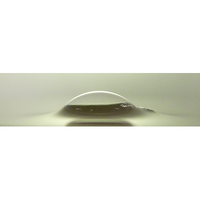
Self-induced flows enhance the levitation of Leidenfrost drops on liquid baths

Benjamin Sobac, Laurent Maquet, Alexis Duchesne, Hatim Machrafi, Alexey Rednikov, Pierre Dauby, Pierre Colinet, and Stéphane Dorbolo

Phys. Rev. Fluids 5, 062701(R) (2020) - Published 9 June, 2020

In a study of the Leidenfrost levitation of a droplet on a hot liquid bath, rather than, classically, on an extremely hot plate, an existential feedback is revealed. The droplet induces a bath flow, whose fickle structure is explored both experimentally and theoretically. In turn, the flow drastically enhances the heat transfer to the droplet by convective means, thus ensuring such an evaporative levitation despite the poorly conducting liquid medium of the bath.

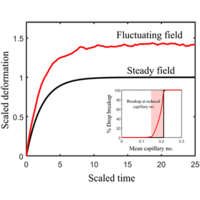
Deformation of a conducting drop in a randomly fluctuating electric field

Rajarshi Sengupta, Lynn M. Walker, and Aditya S. Khair

Phys. Rev. Fluids 5, 063701 (2020) - Published 9 June, 2020

The interaction of surrounding drops is modeled as a temporally fluctuating electric field around a test drop. Because of the field-squared dependence, the drop deformation is larger under a fluctuating electric field than under a steady field. Consequently, drop breakup is observed at mean capillary numbers smaller than the critical capillary number for breakup under a steady field. Moreover, fluctuations drive drop breakup faster than a steady field.

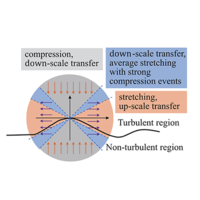
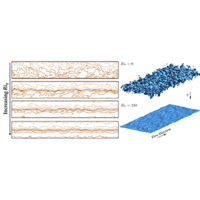
Energy cascade at the turbulent/nonturbulent interface

Y. Zhou and J. C. Vassilicos

Phys. Rev. Fluids 5, 064604 (2020) - Published 9 June, 2020

Interscale energy transfers at the turbulent/non-turbulent interface are from small to large scales near the interface’s tangent plane where motions are predominantly stretching, but from large to small scales in other directions where motions are predominantly compressive. This predominance is partly due to extreme compressive motions which can be significantly more likely than extreme stretching motions even where motions are on average stretching.

Lifetime of a single bubble on the surface of a water and ethanol bath

Elise Lorenceau and Florence Rouyer

Phys. Rev. Fluids 5, 063603 (2020) - Published 8 June, 2020

The time a single bubble stays on a liquid bath surface depends on deterministic drainage. However, for pure water, stochastic local disturbances also affect bubble death. For binary systems like water/alcohol mixtures (WAM), preferential evaporation of one component is crucial. We examine stochastic and deterministic effects on WAM bubble lifetime statistically using an automated bubble generator. The bubble lifetime probability density and the increase in its average with ethanol concentration depends on stabilizing Marangoni stresses arising from evaporation-induced heterogeneities.

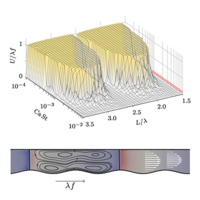
Microfluidic slug transport on traveling-wave surface topographies by mechanowetting

Edwin de Jong, Jaap M. J. Den Toonder, and Patrick R. Onck

Phys. Rev. Fluids 5, 063604 (2020) - Published 8 June, 2020

A theoretical study shows that mechanowetting can transport fluid compartments by means of traveling surface waves. Mechanowetting is a propulsion mechanism that exploits capillary forces at fluid interfaces and deforming surface topographies, enabling fluid slugs to be transported at the speed of the surface waves. The effectiveness of the method for microfluidic propulsion is quantified by means of computational fluid dynamics simulations and an intuitive theoretical model.

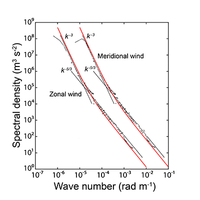
Quasinormal scale elimination theory of the anisotropic energy spectra of atmospheric and oceanic turbulence

Boris Galperin and Semion Sukoriansky

Phys. Rev. Fluids 5, 063803 (2020) - Published 8 June, 2020

Quasinormal scale elimination theory of rotating turbulence offers a new explanation of physics governing atmospheric and oceanic spectra including the well-known Nastrom and Gage spectra observed in the upper troposphere and lower stratosphere. The terrestrial circulations may be characterized as flows with “compactified dimensionality” (spatial dimension between 2 and 3). Such flows may have both inverse and direct cascades in the same inertial range (dual cascade) and their spectral amplitudes may be determined not by energy/enstrophy fluxes, but by the magnitude of the Coriolis parameter.

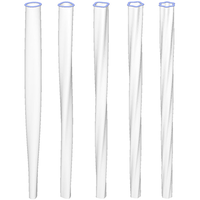
Formation of twisted liquid jets

Akira Kageyama and Yuna Goto

Phys. Rev. Fluids 5, 064002 (2020) - Published 8 June, 2020

Surface oscillations of a liquid jet, like water falling from a faucet, are common. For an orifice with n-fold rotational symmetry, the jet cross section oscillates between two symmetrical shapes. Called axis switching, it is a standing wave superposition of two opposite azimuthal ripples. We show that by adjusting the velocity profile at the orifice just one ripple can form. The jet surface is twisted from the single ripple, although the jet has no axial angular momentum. Simulations show that twisted jets can form with various n-fold rotational symmetries, including the regular square.

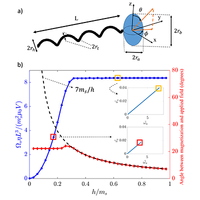
Saturation and coercivity limit the velocity of rotating active magnetic microparticles

Kiarash Samsami, Seyed Amir Mirbagheri, Farshad Meshkati, and Henry Chien Fu

Phys. Rev. Fluids 5, 064202 (2020) - Published 8 June, 2020

The magnetization of real materials responds to the applied magnetic field, notably by saturating at a maximum magnitude and being coerced to be closer to the applied field direction. These effects are particularly important for soft magnetic materials, which are often used in magnetic microrobotic swimmers. Previous understanding has been based on models of permanent magnets which neglect these effects, but new work shows that taking them into account leads to an unappreciated physical limit on swimming velocities for magnetically rotated microswimmers.

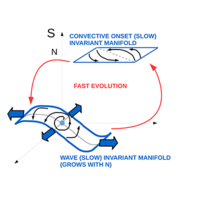
From waves to convection and back again: The phase space of stably stratified turbulence

N. E. Sujovolsky and P. D. Mininni

Phys. Rev. Fluids 5, 064802 (2020) - Published 8 June, 2020

An efficient path for energy dissipation is often looked for in wave turbulence systems. Fluid elements in stratified turbulence are shown to alternate between two invariant sets of solutions: waves and local convection, the latter connected to effective dissipation of energy. The fast evolution between these solutions explains enhancement of extreme events and balance relations in stratified flows.

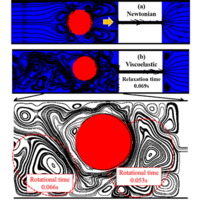
Nonwetting droplet oscillation and displacement by viscoelastic fluids

Chiyu Xie, Ke Xu, Kishore Mohanty, Moran Wang, and Matthew T. Balhoff

Phys. Rev. Fluids 5, 063301 (2020) - Published 5 June, 2020

Simulations and theory reveal oscillations of droplets when driven by viscoelastic fluids because of their elastic memory effect. The viscoelastic oscillation helps release trapped droplets from hard-to-displace positions.

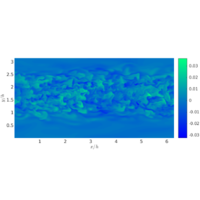
Characteristics of quasistationary near-wall turbulence subjected to strong stable stratification in open-channel flows

Amir Atoufi, K. Andrea Scott, and Michael L. Waite

Phys. Rev. Fluids 5, 064603 (2020) - Published 5 June, 2020

Turbulent open channel-flow under strongly stable thermal stratification is investigated. It is shown that the dominant effects of strong stable stratification on the characteristics of near-wall turbulence are transient. The budget of turbulent kinetic energy, the budget for the tangential Reynolds stress, and the relevant length scales are discussed. It is shown that near-wall turbulence at quasistationarity is approximately insensitive to the choice of upper thermal boundary condition.

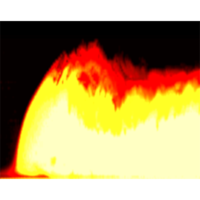
Energetics and mixing efficiency of lock-exchange gravity currents using simultaneous velocity and density fields

Partho Mukherjee and Sridhar Balasubramanian

Phys. Rev. Fluids 5, 063802 (2020) - Published 3 June, 2020

Gravity currents, a genre of stratified shear flow, are a tremendous source of turbulence and mixing in ocean and atmosphere. Using high-resolution laser diagnostics, large-, intermediate- and small-scale flow features of an evolving current are measured in laboratory experiments. From this, the turbulent fluxes, mixing efficiency, and eddy diffusivity are quantified, which helps in inferring the state of turbulence inside the current. The results add new insights into modeling of stratified shear flows.

Dynamic one-equation-based subgrid model for large-eddy simulation of stratified turbulent flows

R. Ranjan, M. K. Venkataswamy, and S. Menon

Phys. Rev. Fluids 5, 064601 (2020) - Published 3 June, 2020

The locally dynamic one-equation based subgrid-scale is extended for large-eddy simulation of stably stratified turbulent flows. It is comprehensively assessed by simulating turbulent channel flow for a range of Reynolds and Richardson numbers. It captures all the key flow features, such as suppression of vertical turbulent transport, presence of internal waves and pycnocline, and decrease of the friction coefficient and Nusselt number. The turbulence statistics show good agreement with the reference results thus demonstrating its applicability to stratified flows with variable mean shear.

Transition from non-swirling to swirling axisymmetric turbulence

Zecong Qin, Hugues Faller, Bérengère Dubrulle, Aurore Naso, and Wouter J. T. Bos

Phys. Rev. Fluids 5, 064602 (2020) - Published 3 June, 2020

Axisymmetric turbulence is shown to exhibit a critical transition between two flow states. This transition is triggered by the anisotropy of the forcing of the system.

Instabilities and layering of a heated laboratory anticyclone

M. J. Burin, J. Sommeria, and S. Viboud

Phys. Rev. Fluids 5, 063801 (2020) - Published 2 June, 2020

We present the first laboratory-based results on thermohaline vortex decay. Anticyclonic vortices 1m in diameter were generated within a stratified tank on a rotating platform. Besides an m=2 baroclinic instability, if heated, initially convective edge features yield at later times to diffusive convection and layering: the presumed beginnings of a thermohaline staircase.

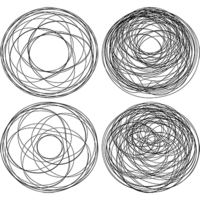
Motion of buoyant point vortices

Jeffrey R. Carpenter and Anirban Guha

Phys. Rev. Fluids 5, 064702 (2020) - Published 2 June, 2020

A general Hamiltonian description for the trajectories of any number of interacting buoyant vortices in a homogeneous ambient fluid is presented. It constitutes an idealized description of coherent vortex structures in environmental flows where buoyancy forces are relevant for the evolution of such structures. The addition of buoyancy to this simple system results in the earlier appearance of chaos in the motion of buoyant vortex structures.

Single-particle Lagrangian statistics from direct numerical simulations of rotating-stratified turbulence

D. Buaria, A. Pumir, F. Feraco, R. Marino, A. Pouquet, D. Rosenberg, and L. Primavera

Phys. Rev. Fluids 5, 064801 (2020) - Published 2 June, 2020
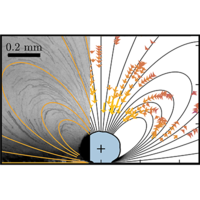
Turbulent fluid flows such as those in the ocean and the nocturnal atmosphere are strongly affected by Earth’s rotation and a stable density stratification. Using direct numerical simulations of the governing equations, the Lagrangian dispersion of particles in such flows is investigated. The anisotropy of various Lagrangian statistics is quantified, and different flow regimes are identified based on underlying linear and nonlinear physical processes. Comparisons with theory are made when appropriate.

Sign In to Your Journals Account

Filter

Recent Issues

Vol. 11, Iss. 10
October 2026
Vol. 11, Iss. 9
September 2026
Vol. 11, Iss. 8
August 2026
Vol. 11, Iss. 7
July 2026
Category
Article Type
Section

Filter

Article Lookup

Enter a citation