Recent Articles

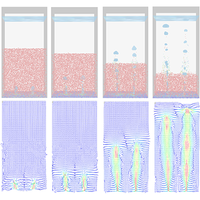
Effects of double orifice spacing on bubble behaviors and hydrodynamics in gas-liquid-solid systems through VOF-DEM method

Haozhe Zhang, Na Zhao, Xiaotong Luo, and Jingtao Wang

Phys. Rev. Fluids 7, 024303 (2022) - Published 22 February, 2022

The volume of fluid and discrete element model (VOF-DEM) method is employed to calculate the formation and rising of double bubbles generated through two different orifices in a gas-liquid-solid flow system. The deviation and coalescence of bubble queues which occur during the bubble rising process are discussed and analyzed with velocity vector diagrams. By comparing when particles are laid at the bottom or settling, it is found that free settlement of particles can weaken the deviation of the bubble queues. Moreover, finding a suitable distance between two orifices for enhanced particle entrainment under different air in-taking velocities is also studied.

Effect of viscous-convective subrange on passive scalar statistics at high Reynolds number

Kedar Prashant Shete, David J. Boucher, James J. Riley, and Stephen M. de Bruyn Kops

Phys. Rev. Fluids 7, 024601 (2022) - Published 22 February, 2022

In modeling turbulent mixing at high Reynolds number (Re), the small-scale statistics of a passive scalar are assumed similar to those of the velocity. Research shows this to be invalid at either high Re or high Schmidt number individually. We hypothesize that both inertial-convective and viscous-convective subranges are needed for sufficient scale separation in both velocity and scalar fields, such that small-scale statistics of the scalar approach those of the velocity. We explore this using direct numerical simulations of up to 142563 and find that at high Taylor Reynolds number of 633, similarity may be assumed between velocity and scalar statistics for mixing in water, but not in air.

Suppression of vortex-induced vibration of a circular cylinder by a finite-span flexible splitter plate

Guo-Peng Cui and Li-Hao Feng

Phys. Rev. Fluids 7, 024708 (2022) - Published 22 February, 2022

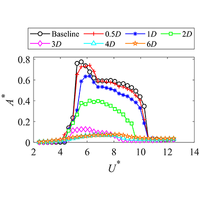
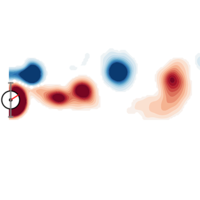
We present experiment and analysis of the effectiveness of a flexible splitter plate in the suppression of vortex-induced vibration (VIV) of a circular cylinder. The important finding is that it is not necessary to suppress VIV by a full-span flexible splitter plate, while efficient control can be achieved by a finite-span one. The fluid-structure interaction and control mechanism are revealed by analysis of wake evolution and force characteristics.

Wake identification of stratified flows using dynamic mode decomposition

Chan-Ye Ohh and Geoffrey R. Spedding

Phys. Rev. Fluids 7, 024801 (2022) - Published 22 February, 2022

In a density-stratified fluid, the wakes generated by a submerged body or topography can be placed into a number of distinct flow regimes, depending on the balance of forces represented by the Reynolds number, Re, and Froude number, Fr. Here we propose a dynamic mode decomposition (DMD) based classifier to automatically sort stratified wakes based on their strongest DMD modes. The performance of the classifier in a test range of low {Re, Fr} yields insights into the development of further data-driven methods for the more challenging and fully turbulent wakes expected from bodies and geographical features.

Canonical orbits for rapidly deforming planar microswimmers in shear flow

Eamonn A. Gaffney, Mohit P. Dalwadi, Clément Moreau, Kenta Ishimoto, and Benjamin J. Walker

Phys. Rev. Fluids 7, L022101 (2022) - Published 18 February, 2022

Classically, the rotation of ellipsoids in shear Stokes flow is captured by Jeffery’s orbits. Here, we demonstrate that Jeffery’s orbits also describe high-frequency shape-deforming swimmers moving in the plane of a shear flow. In doing so, we support the use of these simple models for capturing shape-changing swimmer dynamics in studies of active matter and highlight the ubiquity of ellipsoid-like dynamics in complex systems.

Damping effect on transverse flow-induced vibration of a rotating circular cylinder and its implied energy harvesting performance

Jisheng Zhao, Mark C. Thompson, and Kerry Hourigan

Phys. Rev. Fluids 7, 023905 (2022) - Published 17 February, 2022

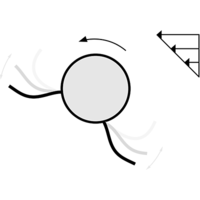
Flow-induced vibration (FIV) of bluff bodies has recently been considered as a potential source for renewable energy harvesting. This study presents a comprehensive experimental investigation of structural damping effects on the rotation-enhanced FIV response of an elastically mounted circular cylinder at moderate Reynolds numbers in a free stream. We find that the FIV of a rotating cylinder is associated with different harmonic fluid forcing components and wake modes than the non-rotating counterpart, despite a similar three-branch response. For implied energy harvesting we demonstrate a 33% increase in the peak power output compared to the non-rotating case in a range of rotation rates.

Sparse sensor-based cylinder flow estimation using artificial neural networks

Kevin H. Manohar, Chris Morton, and Paul Ziadé

Phys. Rev. Fluids 7, 024707 (2022) - Published 17 February, 2022

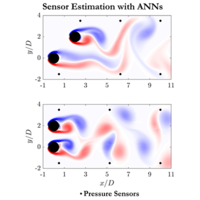
Despite the rising use of machine learning for flow estimation problems, a standard set of flows from which estimators and predictors can be developed, compared and assessed is currently lacking within the fluid dynamics community. This work presents two challenge flow cases for the advancement of sparse sensor-based flow estimation techniques. Feedforward and long short-term memory neural networks are used in conjunction with the proper orthogonal decomposition to predict velocity fields in the wake of two cylinders in proximity using sparsely-placed pressure sensors.

Reversal of effects from gel production in a reacting flow dependent on gel strength

Sae Hirano, Yuichiro Nagatsu, and Ryuta X. Suzuki

Phys. Rev. Fluids 7, 023201 (2022) - Published 16 February, 2022

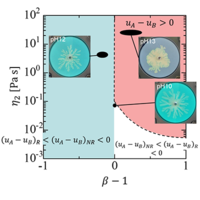
In reacting flows, changes in fluid physical properties induced by chemical reactions can alter the flow dynamics. Generally, flows change more significantly with larger changes in properties. However, here we demonstrate that the effect on the flow reverses depending on the degree of change in the properties due to the reaction in a reacting flow with gel production, through experiments involving high-precision rheological measurements and our proposed theory. This occurs because viscoelastic properties of the gel differently affect flow dynamics depending on the gel strength.

Analyzing flow behavior of shear-thinning fluids in a planar abrupt contraction/expansion microfluidic geometry

Fatemeh Khalkhal and Susan Muller

Phys. Rev. Fluids 7, 023303 (2022) - Published 16 February, 2022

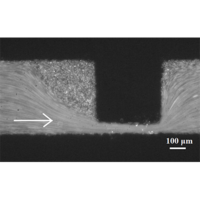
Due to its vast range of industrial applications, viscoelastic entry flow behavior and stability in abrupt contraction/expansion geometries have been a subject of interest for quite some time. However, due to the strong dependence of flow instabilities and vortex formation near the constriction entrance in non-Newtonian fluids on the geometry and the fluid rheology, generalizations can not easily be made. In the present study, we examine and compare the flow behavior of several shear-thinning fluids in a new planar contraction/expansion geometry that is symmetric in the flow direction and about the midplane of the depth but asymmetric with respect to the “contraction” direction.

Cavitation bubble dynamics in a shear-thickening fluid

Guillaume T. Bokman, Outi Supponen, and Simo A. Mäkiharju

Phys. Rev. Fluids 7, 023302 (2022) - Published 15 February, 2022

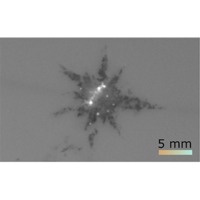
Cylindrical cavitation bubbles, capable of generating extreme strain rates, are experimentally and theoretically studied in shear-thickening suspensions. Starting from the limit between continuous and discontinuous shear thickening regimes, cavitation bubbles deform increasingly with increasing solid volume fraction until bubbles are replaced by cavitation-induced fractures.

Resonant triad interactions in a stably stratified uniform shear flow

Lima Biswas and Priyanka Shukla

Phys. Rev. Fluids 7, 023904 (2022) - Published 15 February, 2022

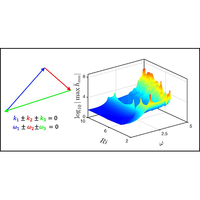
Resonant triad interactions among internal gravity waves in the presence of a uniform shear flow have been explored using analytical and numerical techniques. The existence of self-resonances among internal waves induced by the background shear flow is shown from the linear theory. For different mode interaction cases, the linear approach alone is insufficient for a broader range of control parameters. Hence, the divergence of the second-order solutions representing the superharmonic wave has been used to predict the resonating modes.

Effect of horizontal aspect ratio on magnetoconvective instabilities in liquid metals

Lekha Sharma, Manojit Ghosh, and Pinaki Pal

Phys. Rev. Fluids 7, 023502 (2022) - Published 14 February, 2022

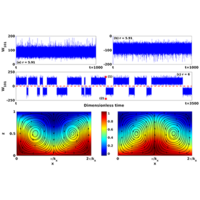
Three-dimesional direct numerical simulations are performed to investigate the effect of the horizontal aspect ratio on magnetoconvective instabilities using plane layer Rayleigh-Bénard geometry in the presence of an external uniform horizontal magnetic field. The onset of oscillatory instability is found to scale with magnetic field strength with two distinct scaling laws. The scaling exponent gradually decreases with the increment in the aspect ratio. Different transition routes to chaos have been found depending on the aspect ratio and the magnetic field strength. We find that transient chaotic flow reversals eventually lead to persistent chaotic flow reversals.

Nonlinear spatiotemporal instabilities in two-dimensional electroconvective flows

Zhe Feng, Dongdong Wan, Mengqi Zhang, and Bo-Fu Wang

Phys. Rev. Fluids 7, 023701 (2022) - Published 11 February, 2022

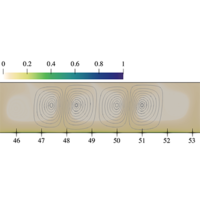
This work studies nonlinear spatiotemporal stability of two-dimensional electroconvection between two flat plates subjected to a through-flow, using numerical simulations and weakly nonlinear analyses. We found that the traveling speeds of the leading and trailing edges of the wave packet in the nonlinear regime are consistent with the linear ones. We derived for the first time the Ginzburg-Landau equation (GLE) using an amplitude expansion method extending earlier work of Pham and Suslov. This GLE can predict the absolute growth rate even when the parameters are away from the linear critical conditions, outperforming the GLE derived using a multiple-scale expansion method.

Revisiting the linear instabilities of plane channel flow between compliant walls

Smail Lebbal, Frédéric Alizard, and Benoît Pier

Phys. Rev. Fluids 7, 023903 (2022) - Published 11 February, 2022

By revisiting the linear dynamics of plane channel flow between compliant walls it is shown that the instability is mainly dominated by perturbations of varicose symmetry. The prevailing modes are of traveling-wave-flutter type and governed by the reduced velocity, a nondimensional control parameter measuring the response of the flexible wall to hydrodynamic loading. Analysis of the energy transfer mechanisms reveals that a stabilizing effect for one class of modes is often accompanied by a destabilizing effect for another class. Thus it seems impossible to significantly delay instability onset by wall compliance.

Pattern selection in Rayleigh-Bénard convection with nonlinear viscoelastic fluids

Xin Zheng, Fouad Hagani, M'hamed Boutaous, Ronnie Knikker, Shihe Xin, and Dennis A. Siginer

Phys. Rev. Fluids 7, 023301 (2022) - Published 10 February, 2022

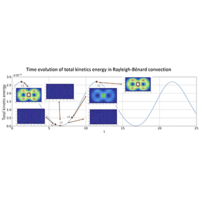
A numerical investigation is conducted of Rayleigh-Bénard convection in a rectangular enclosure of aspect ratio 2:1 filled by a class of nonlinear viscoelastic fluids represented by the Phan Thien-Tanner (PTT) constitutive equation. The objective is to provide a detailed interpretation of the physical mechanisms involved in Rayleigh-Bénard convection for a viscoelastic fluid. An energy analysis highlights the different physical mechanisms involved in oscillatory convection. The results show the contribution of the elastic terms in the evolution of the kinetic energy of the structures. At a second critical Rayleigh number the oscillatory convection with two rollers becomes stationary again.

Applicability of large eddy simulations to capture turbulence attenuation in particle-laden channel flows

Naveen Rohilla, Pradeep Muramulla, and Partha S. Goswami

Phys. Rev. Fluids 7, 024302 (2022) - Published 10 February, 2022

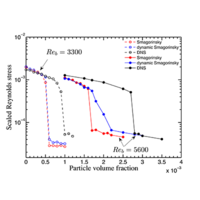
The applicability of large eddy simulation (LES) (Smagorinksy and dynamic Smagorinsky) models in predicting turbulence modulation is investigated. The LES models capture the turbulence modulation/fluctuations accurately at low volume fractions. However, at high volume loading, the LES models underpredict the turbulent kinetic energy production, which results in an underprediction of the particle volume loading where complete turbulence collapse is observed. The study highlights that modeling error in LES models is more significant at high particle volume loading than the filtering error and inaccuracy in feedback force.

Gust mitigation through closed-loop control. I. Trailing-edge flap response

Johannes E. Pohl, Rolf Radespiel, Benjamin Herrmann, Steven L. Brunton, and Richard Semaan

Phys. Rev. Fluids 7, 024705 (2022) - Published 10 February, 2022

In this work, we quantify and model the unsteady lift response to dynamic flap actuation from wind tunnel experiments at Re = 1.8×10⁶. The quantification relies on two newly proposed metrics that characterize the dynamic lift hysteresis and allow describing its evolution under different pitching conditions. The modeling strategy yields one nonlinear model and a set of linear models relating the unsteady airfoil lift coefficient distribution to the flap deflection angle δ.

Gust mitigation through closed-loop control. II. Feedforward and feedback control

Benjamin Herrmann, Steven L. Brunton, Johannes E. Pohl, and Richard Semaan

Phys. Rev. Fluids 7, 024706 (2022) - Published 10 February, 2022

In Part II of this series we characterize and model gust effects on the research airfoil, and employ them for control. Critical to gust mitigation is detection of the gust onset and its amplitude before impact, which we measure by an X-wire sensor positioned at two separate locations upstream of the test airfoil. Different closed-loop control strategies are compared, including model-based feedback, hand-tuned proportional-integral (PI) feedback, only feedforward, and combined feedback and feedforward controllers. The experimental results demonstrate the effectiveness of the combined approach in mitigating the lift fluctuations during quasi-random gust encounters at various α and δ.

Laminar vortex dynamics around forward-swept wings

Kai Zhang and Kunihiko Taira

Phys. Rev. Fluids 7, 024704 (2022) - Published 9 February, 2022

We numerically study laminar separated flows over forward-swept wings at Reynolds number Re=400. The flows over forward-swept wings generally feature a pair of counter-rotating tip vortices, which shape the wake dynamics significantly. The forward-swept wing also experiences enhanced lift with additional vortex lift under tip-vortex-induced downwash effects. The present results provide a comprehensive understanding of sweep effects on laminar separated flows over finite-aspect-ratio wings and offers coverage of less-explored areas of the low-Re aerodynamic database.

Feeding flow and membranelle filtration in ciliates

Mads Rode, Thomas Kiørboe, and Anders Andersen

Phys. Rev. Fluids 7, 023102 (2022) - Published 8 February, 2022

Feeding of ciliates on suspended food particles is complex and relies typically on coordinated motion in bands of transversal rows of cilia known as membranelles. We explore and model the fluid dynamics of feeding flow and particle retention in upstream collecting ciliates that use a single membranelle band to both generate feeding flow, retain food particles, and transport them to the cell mouth.

Sign In to Your Journals Account

Filter

Recent Issues

Vol. 11, Iss. 10
October 2026
Vol. 11, Iss. 9
September 2026
Vol. 11, Iss. 8
August 2026
Vol. 11, Iss. 7
July 2026
Category
Article Type
Section

Filter

Article Lookup

Enter a citation