Recent Articles

Electrokinetics in two-dimensional complicated geometries: Conformal mapping and experimental comparison

Zhibo Gu, Peng Huo, Bingrui Xu, Mingzhuo Su, Martin Z. Bazant, and Daosheng Deng

Phys. Rev. Fluids 7, 033701 (2022) - Published 11 March, 2022

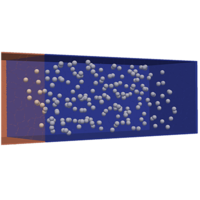
By employing conformal mapping in conjunction with an experimental approach we investigate electrokinetics in two-dimensional complicated geometries, such as an eccentric annulus, concentric ellipse, and corner geometry. Conformal mapping, a powerful theoretical tool, potentially inspires future work on electrokinetics in complicated geometries, while shedding light on promising applications, including shock electrodialysis, water treatment, and electrophoresis for particle manipulation in microfluidic devices.

Approach and separation of bundles of quantized vorticity

George S. E. Grimes and Andrew W. Baggaley

Phys. Rev. Fluids 7, 034701 (2022) - Published 11 March, 2022

Bundles of quantized vorticity are believed to be the building block of the quasiclassical regime of quantum turbulence. We show that these bundles approach and separate from one another obeying a fundamental scaling law which has been observed in reconnections of single quantized vortices and classical vortex tubes.

Tubular-body theory for viscous flows

Lyndon Koens

Phys. Rev. Fluids 7, 034101 (2022) - Published 10 March, 2022

The hydrodynamics of cable-like bodies play an important role in many biological and mechanical systems. These flows can be accurately modeled using slender-body theory when the body is isolated, thin, and not too coiled, but can be difficult to model outside these limits. In this paper we develop tubular-body theory; a slender-body theory-like method that allows the flow around such bodies to be determined exactly.

Evaporative capillary rise

Jungtaek Kim, Yeonsu Jung, and Ho-Young Kim

Phys. Rev. Fluids 7, L032001 (2022) - Published 9 March, 2022

We investigate the rise dynamics of a volatile liquid within an open vertical channel, which requires us to consider the effects of capillarity, gravity, viscosity, and evaporation together. Upon quantifying the enhanced evaporation near the solid-liquid-gas contact line and setting up a theoretical model for the rise height, we show how to find an optimal channel dimension that maximizes the equilibrium rise height. This work can lay a foundation for understanding the evaporative capillary rise dynamics occurring in porous media.

Energy transfer of hypersonic and high-enthalpy boundary layer instabilities and transition

Xianliang Chen, Liang Wang, and Song Fu

Phys. Rev. Fluids 7, 033901 (2022) - Published 8 March, 2022

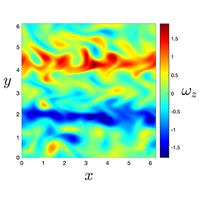
Flow instability of hypersonic and high-enthalpy boundary layers with thermal-chemical nonequilibrium (TCNE) effects is studied for Mach numbers of up to 15. It is quantitatively illustrated that the TCNE effects change the disturbance characteristics predominantly through mean flow modification. In the oblique-mode breakdown case, the intensive energy transfer between the selected modes and their harmonic waves is found to occur where they interact strongly with the mean flow. (LΓ and NΓ in the figure are separately the energy transfer through the linear and nonlinear terms in the disturbance energy-norm equation.)

Response of ∼100 micron water jets to intense nanosecond laser blasts

Lihao Gao, Yanchu Liu, Hui Tang, and Weiwei Deng

Phys. Rev. Fluids 7, 034001 (2022) - Published 7 March, 2022

Once a transparent liquid jet is ablated by an intense nanosecond laser pulse, the blast breaks the liquid column into two sections with a logarithmically growing gap that originates from the blast center. We found that the jet acts like an optical fiber which transmits a few percent of the pulsed optical energy upstream, leading to the material removal of the nozzle orifice. The accompanied thermal explosion forms a sunflower patterned liquid sheet near the nozzle orifice. The present results may provide insights for long range optical energy transmission and liquid-jet guided micromachining applications.

Effect of a small curvature of the surfaces on microscale lubrication of a gas for large Knudsen numbers

Toshiyuki Doi

Phys. Rev. Fluids 7, 034201 (2022) - Published 7 March, 2022

Lubrication flow of a gas in a microscale gap between coaxial circular cylinders with a nonuniform accommodation coefficient is studied on the basis of kinetic theory. The Boltzmann equation is studied analytically using the slowly varying approximation when the dimensionless curvature, namely the gap size divided by the radius of the inner cylinder, is small. It is demonstrated that a nonnegligible effect of small curvature affects the lubrication performance when the Knudsen number is large.

Diffusiophoresis in a Taylor-dispersing solute

Robben E. Migacz and Jesse T. Ault

Phys. Rev. Fluids 7, 034202 (2022) - Published 7 March, 2022

The motion of particles in a channel containing solute is, in part, a result of diffusiophoresis. Previous studies of diffusiophoresis in narrow channels have focused on quasi-one-dimensional dynamics. We consider the two-dimensional dynamics in an early-time regime. In this regime, spanwise variations in solute concentration have not yet diminished, and cross-channel particle migration may be significant.

Dynamics of a partially wetting droplet under wind and gravity

Alireza Hooshanginejad and Sungyon Lee

Phys. Rev. Fluids 7, 033601 (2022) - Published 4 March, 2022

Inspired by a rain droplet on a windshield, we theoretically study the dynamics of a partially wetting droplet subject to wind and gravity. Our reduced mathematical model couples the pressure drag induced by the flow separation over the drop and the gravitational force to characterize the drop’s depinning conditions. The results of our lubrication model reveal the limits of up-slope depinning, pinning, and down-slope depinning for varying drop sizes and wind speeds. Our model can be used to identify optimum windshield angles for drop depinning for different ranges of flow speeds.

Shock interacting with a random array of stationary particles underwater

Jacob Behrendt, S. Balachandar, and T. P. McGrath

Phys. Rev. Fluids 7, 023401 (2022) - Published 28 February, 2022

In this paper, particle-resolved inviscid simulations of shock propagation over randomly distributed beds are performed, with the goal of quantifying the force on individual particles. An important observation was that the inviscid drag force on some particles remained consistently positive, while others consistently negative, even long after the passage of the shock. These persistent forces are inviscid quasi-steady contributions which, with the viscous counterpart, will play an essential role in the particle’s long-term dispersion if allowed to move in response to the force.

Stability of respiratory-like droplets under evaporation

Carola Seyfert, Javier Rodríguez-Rodríguez, Detlef Lohse, and Alvaro Marin

Phys. Rev. Fluids 7, 023603 (2022) - Published 28 February, 2022

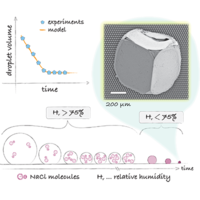
Recent studies have shown that enveloped viruses contained in airborne respiratory droplets lose infectability fastest at intermediate ambient relative humidities. Studying the evaporation dynamics of respiratory-like droplets in air reveals that, at high humidity, the salt dissolved in respiratory drops inhibits their evaporation indefinitely while at low humidity the drop evaporates leaving a porous solid residue, inside which virions may survive for long times. We conclude that the optimal relative humidity for minimal infectability should coincide with that at which droplets remain liquid and contain high salt concentrations for long periods of time.

Analysis of wall mass transfer in turbulent pipe flow combining extended proper orthogonal decomposition and Fukagata-Iwamoto-Kasagi identity

Rasmus Korslund Schlander, Stelios Rigopoulos, and George Papadakis

Phys. Rev. Fluids 7, 024603 (2022) - Published 28 February, 2022

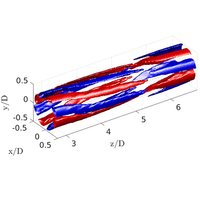
We analyze the coherent motions of the velocity and passive scalar field in a turbulent pipe flow. Using Extended Proper Orthogonal Decomposition (EPOD), we can identify the velocity modes most correlated with the scalar modes. We then apply the Fukagata-Iwamoto-Kasagi (FIK) identity to identify the contribution of each velocity and scalar mode on the time-average Sherwood number.

Fluctuation-driven dynamics in nanoscale thin-film flows: Physical insights from numerical investigations

Chengxi Zhao, Jingbang Liu, Duncan A. Lockerby, and James E. Sprittles

Phys. Rev. Fluids 7, 024203 (2022) - Published 25 February, 2022

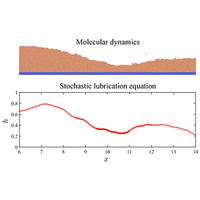
A stochastic lubrication equation (SLE) is solved numerically to investigate fluctuating hydrodynamics of three nanoscale thin-film flows: (1) droplet spreading, where power laws are derived; (2) droplet coalescence, where molecular dynamics results are reproduced by the SLE and it is discovered that thermal fluctuations decelerate the process; and (3) thin-film rupture, where, in the regime considered, disjoining pressure dominates the final stages of rupture.

Multiscale interplay of curvature and hydrodynamic slippage in flow over a patterned topography

Mainendra Kumar Dewangan and Subhra Datta

Phys. Rev. Fluids 7, 024002 (2022) - Published 24 February, 2022

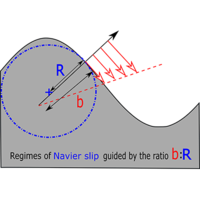
Various surface friction regimes, including a transition from slippery to sticky behavior, are uncovered through multiscale asymptotic analysis of flow over a rough surface.

Connection between attached eddies, friction factor, and mean-velocity profile

H. R. Anbarlooei, F. Ramos, and D. O. A. Cruz

Phys. Rev. Fluids 7, 024602 (2022) - Published 24 February, 2022

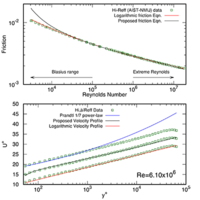
This work connects attached eddies to wall friction by relating momentum transfer normal to the lower-bound of the energetic range with the wall shear stress. Our model predicts successfully the transition of the friction factor after the Blasius regime to the extreme Reynolds numbers range. The results show the same accuracy as the well-known logarithmic laws for both the friction factor and the mean velocity profile.

Reinforcement learning for pursuit and evasion of microswimmers at low Reynolds number

Francesco Borra, Luca Biferale, Massimo Cencini, and Antonio Celani

Phys. Rev. Fluids 7, 023103 (2022) - Published 23 February, 2022

Using reinforcement learning, we study the coevolution of pursuing-evasion policies of two microswimmers that can sense each other only through hydrodynamic signals, which provide ambiguous information. We show that both agents find effective ways to overcome the difficulties set by partial information, and we explain the main discovered strategies. The setting here developed may offer a framework to study prey-predator interactions in more complex situations.

K-core analysis of shear-thickening suspensions

Omer Sedes, Hernan A. Makse, Bulbul Chakraborty, and Jeffrey F. Morris

Phys. Rev. Fluids 7, 024304 (2022) - Published 23 February, 2022

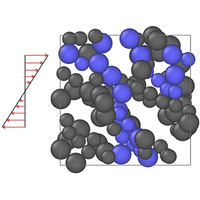
Strong continuous and discontinuous shear thickening (CST and DST) have been shown to be rationalized by the formation of a network of frictional contacts. This continuously evolving network is investigated here using k-core analysis of configurations obtained based on a discrete-particle simulation method. The approach identifies clusters in which each particle has at least k contacts with other particles in the same cluster. We find that the k-core structures display universal behavior as a function of contact number except at the shear thickening transition, where there is a sharp increase in the stress carried by the 3-cores in DST, with this increase largely absent for CST.

Machine-learning energy-preserving nonlocal closures for turbulent fluid flows and inertial tracers

Alexis-Tzianni G. Charalampopoulos and Themistoklis P. Sapsis

Phys. Rev. Fluids 7, 024305 (2022) - Published 23 February, 2022

Machine learning turbulence closures for non-homogeneous and non-isotropic flows is a challenging task. The novelty of the presented approach is the adoption of a universal constraint associated with the energy preservation of the nonlinear terms, which is valid for any turbulent system. This constraint is embedded in the training process, and in combination with nonlocal representations in space and time, results in significant improvement for the resulted coarse scale models.

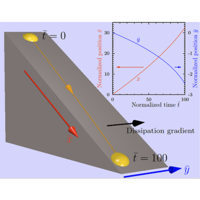
Lateral drift of liquid droplets sliding down substrates with nonuniform dissipation

P. Galatola

Phys. Rev. Fluids 7, 023602 (2022) - Published 22 February, 2022

Understanding and controlling the motion of liquid droplets is important both from a fundamental point of view and in many applications. In this work, we theoretically analyze the dynamics of a liquid droplet sliding down a ramp under the action of gravity. We show that when the dissipation (which we account for by means of an effective contact line viscosity) has a gradient in the direction orthogonal to gravity, the droplet, while sliding down, drifts laterally in the direction opposite to the dissipation gradient. We validate our analytical results, obtained in the limit of low Bond numbers, by a numerical solution of our model.

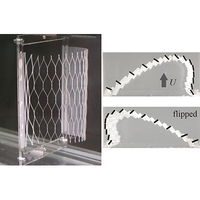
Flow-induced deformation of kirigami sheets

Tom Marzin, Kerian Le Hay, Emmanuel de Langre, and Sophie Ramananarivo

Phys. Rev. Fluids 7, 023906 (2022) - Published 22 February, 2022

Kirigami cutting technique turns inextensible sheets into highly stretchable devices via the opening of pores. This work investigates experimentally the deformation of such poro-elastic structures in a water flow. We show that the cut pattern allows tailoring the magnitude of sheet expansion, by providing a simple and robust way to tune mechanical properties. But importantly, stretched kirigami sheets feature a three-dimensional mesostructure that dictates the direction of local fluid forces, notably leading here to asymmetric deformation of symmetric planar sheets.

Sign In to Your Journals Account

Filter

Recent Issues

Vol. 11, Iss. 10
October 2026
Vol. 11, Iss. 9
September 2026
Vol. 11, Iss. 8
August 2026
Vol. 11, Iss. 7
July 2026
Category
Article Type
Section

Filter

Article Lookup

Enter a citation