Recent Articles

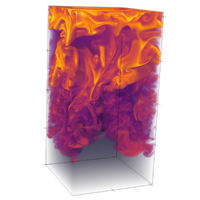
Numerical simulations of the three-dimensionalization of a shear flow in radiatively forced cold water below the density maximum

Andrew P. Grace, Marek Stastna, K. G. Lamb, and K. Andrea Scott

Phys. Rev. Fluids 7, 023501 (2022) - Published 7 February, 2022

In cold water (temperatures between water’s freezing point and the temperature of maximum density), near-surface heating (from the sun) generates dense water which in turn induces vertical currents. If there is a near-surface current, the resulting convective instabilities efficiently move momentum from the current to regions lower in the water column. Then, there is an induced momentum flux across the plume boundary leading to a complicated series of three-dimensional interactions resulting in turbulence. How might this process be affected by factors such as water clarity and current speed?

Wrinkling and multiplicity in the dynamics of deformable sheets in uniaxial extensional flow

Yijiang Yu and Michael D. Graham

Phys. Rev. Fluids 7, 023601 (2022) - Published 7 February, 2022

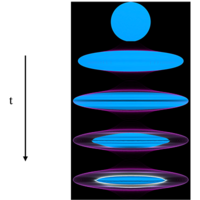
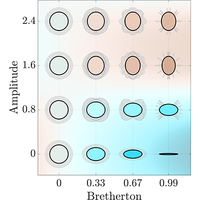
Dynamics of freely suspended elastic sheets in uniaxial extensional flow at zero Reynolds number are examined. Sheets can exhibit a coil-stretch-like transition with increasing flow strength, together with a bistable regime in which both a relatively compact state or a fully stretched state can be found. Sufficiently flexible sheets can wrinkle to form different conformations that can be predicted by a linear stability analysis. Wrinkling strongly modifies the dynamics via hydrodynamic screening of the fluid trapped in the folds of the wrinkled sheet.

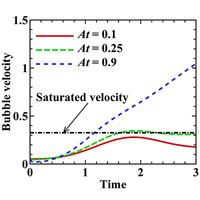
Nonlinear saturation of bubble evolution in a two-dimensional single-mode stratified compressible Rayleigh-Taylor instability

Cheng-Quan Fu, Zhiye Zhao, Xin Xu, Pei Wang, Nan-Sheng Liu, Zhen-Hua Wan, and Xi-Yun Lu

Phys. Rev. Fluids 7, 023902 (2022) - Published 7 February, 2022

For the compressible Rayleigh-Taylor instability (RTI), density stratification is found to cause different bubble behaviors for different Atwood number (At) values. We propose a modified buoyancy-drag model that interprets the physical mechanism causing these behaviors, and analyze the acceleration behavior of a bubble at high At in detail. This work provides a more comprehensive understanding of the compressibility effects on nonlinear evolution of RTI.

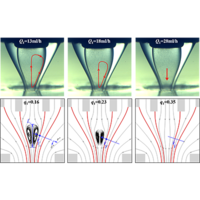
Experimental and numerical investigations on characteristics of coaxial liquid cone in coflow focusing

Kai Mu, Chunyu Zhang, Ting Si, and Hang Ding

Phys. Rev. Fluids 7, 024001 (2022) - Published 7 February, 2022

This work examines the interfacial instability and flow patterns of the liquid cone in capillary co-flow focusing. The flow field of the outermost driving flow is estimated with the potential flow model, and the startup process of the coaxial cone is analyzed. The effect of various parameters on the cone instability is studied. Moreover, the flow field inside the cone is visualized through the particle tracing method and numerical simulation, showing that flow rates have a significant impact on the size of the recirculation flow.

Condensation and wicking of water on solid nanopatterns

Jae Hong Lee, Buyoung Jung, Gui-su Park, and Ho-Young Kim

Phys. Rev. Fluids 7, 024202 (2022) - Published 7 February, 2022

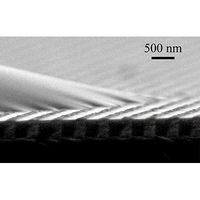
We produce images of water-gas interfaces at a size of tens to hundreds of nanometers. An environmental scanning electron microscope with reduced electron-beam-induced heating is used for nanoscale liquid observation. We found that water completely wets very narrow hydrophobic nanometric grooves when condensing, although it cannot invade the gaps when an external drop contacts the same patterns.

Fluid-structure interaction of a flexible cantilever cylinder at low Reynolds numbers

Shayan Heydari, Neelesh A. Patankar, Mitra J. Z. Hartmann, and Rajeev K. Jaiman

Phys. Rev. Fluids 7, 024702 (2022) - Published 7 February, 2022

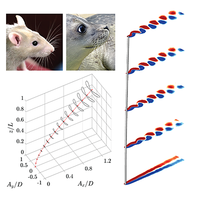
Mammals such as rats and seals can sense their surroundings with their whiskers. This work examines the coupled dynamics of a flexible cantilever cylinder in the laminar subcritical Reynolds regime to pinpoint the underlying mechanism of flow-induced vibration in sensory whiskers. We find that when certain conditions are satisfied, the cylinder undergoes sustained oscillations due to the frequency lock-in phenomenon in this Reynolds regime. The knowledge generated through this work helps clarify the role of flow-induced vibrations in sensing via whiskers and has relevance to the development of innovative bio-inspired flow-sensing devices for next-generation robotic vehicles.

Surface morphing for aerodynamic flows at low and stalled angles of attack

Ernold Thompson and Andres Goza

Phys. Rev. Fluids 7, 024703 (2022) - Published 7 February, 2022

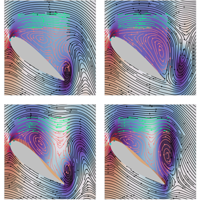
Due to advances in materials science, surface-driven actuation is an increasingly promising strategy for altering aerodynamic flows to improve aerodynamic performance. There are questions about how it can be used for aerodynamic flow control. We numerically study the effect of traveling-wave surface morphing actuation on an airfoil at low Reynolds number (Re). For the flow considered, we discuss the interaction between actuation and the vortex formation process and the resulting variation in temporal and time-averaged lift. The relation between surface kinematics and flow features found could be extended to other vortex dominated flows at comparable as well as higher Re.

Taylor dispersion in thin liquid films of volatile mixtures: A quantitative model for Marangoni contraction

O. Ramírez-Soto and S. Karpitschka

Phys. Rev. Fluids 7, L022001 (2022) - Published 7 February, 2022

Marangoni contraction describes the apparent dewetting behavior of certain volatile mixtures from high-energy surfaces due to Marangoni flows. These flows also lead to strong mixing in the droplets. Here we demonstrate that this process is fully captured in the lubrication approximation if one accounts for Taylor dispersion. We derive the dimensionally reduced form of the advection-diffusion problem of bulk mixtures in thin films, showing that Taylor dispersion is required to establish consistent orders in the long-wave expansion.

Direct numerical simulation of turbulence and microphysics in the Pi Chamber

Theodore MacMillan, Raymond A. Shaw, Will H. Cantrell, and David H. Richter

Phys. Rev. Fluids 7, 020501 (2022) - Published 4 February, 2022

Direct numerical simulation is applied to the Pi Chamber experimental facility to understand droplet growth and activation in the context of moist Rayleigh-Bénard turbulence. While many bulk features of the experimental observations are represented well, the Lagrangian approach to droplet microphysics is used to gain insight where experiments cannot. Common assumptions regarding the activation-deactivation cycle and droplet lifetime are shown to be likely erroneous.

Effects of rapid yawing on simple swimmer models and planar Jeffery's orbits

Benjamin J. Walker, Kenta Ishimoto, Eamonn A. Gaffney, Clément Moreau, and Mohit P. Dalwadi

Phys. Rev. Fluids 7, 023101 (2022) - Published 4 February, 2022

Many swimmers oscillate rapidly as they move, though the details of this fast motion are often neglected in their study. Here, we explore the long-term effects that these oscillations can have on swimmer motion, identifying intuitive conditions on the rapid oscillations that preclude the accumulation of long-term biases in self-propelling objects. We also highlight how the combination of fast oscillations and external flow can lead to significant and unexpected changes of behavior, which we consider in the context of the classical Jeffery’s orbit.

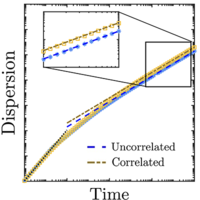
Impact of velocity correlations on longitudinal dispersion in space-Lagrangian advective transport models

Tomás Aquino and Andrés Velásquez-Parra

Phys. Rev. Fluids 7, 024501 (2022) - Published 4 February, 2022

Space-Lagrangian random walk models conceptualize advective transport in heterogeneous media in terms of collections of particles undergoing fixed-length steps along flow streamlines. We study the impact of velocity correlation structure on longitudinal dispersion for different point velocity statistics. We find that asymptotic equivalence requires the step length of an uncorrelated continuous time random walk to be higher than the correlation length when velocity correlations decay exponentially with distance. We characterize the conditions for equivalence for broad classes of velocity distributions.

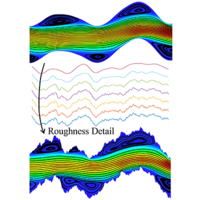
Influence of multiscale surface roughness on permeability in fractures

Zhongzheng Wang, Yanyao Bao, Jean-Michel Pereira, Emilie Sauret, and Yixiang Gan

Phys. Rev. Fluids 7, 024101 (2022) - Published 3 February, 2022

Fractures typically contain multiscale surface features and can impact the fluid flow within. Direct numerical simulations across a wide range of Reynolds number have been carried out on surfaces with roughness details of different length scales. The overestimation in permeability due to surface approximation is quantified, leading to a unified function combining the effects of fracture aperture and surface roughness features.

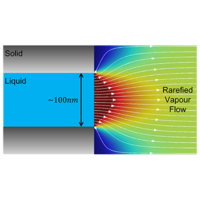
Efficient moment method for modeling nanoporous evaporation

Thomas C. De Fraja, Anirudh S. Rana, Ryan Enright, Laura J. Cooper, Duncan A. Lockerby, and James E. Sprittles

Phys. Rev. Fluids 7, 024201 (2022) - Published 3 February, 2022

Evaporative nanoporous membranes have the potential to unlock the next generation of high-power electronics by providing much needed compact and efficient cooling solutions. Here, we develop a novel modeling framework for this class of flows and, in doing so, demonstrate that conventional fluid mechanics, based on the Navier-Stokes-Fourier paradigm is inaccurate, because the domain sizes are comparable to the mean free path in the gas (i.e. the vapor flow is rarefied). Instead, we show that recently developed higher-order moment methods provide both an accurate and efficient method for computing these evaporative flows and thus providing simulation-for-design capabilities at the nanoscale.

Experimental validation of fluid inertia models for a cylinder settling in a quiescent flow

F. Cabrera-Booman, M. Z. Sheikh, B. Mehlig, N. Plihon, M. Bourgoin, A. Pumir, and A. Naso

Phys. Rev. Fluids 7, 024301 (2022) - Published 3 February, 2022

This work studies experimentally the angular and translational dynamics of elongated cylindrical particles settling in a quiescent fluid at low Reynolds numbers. The measured force and torque are compared with expressions accounting for the effect of fluid inertia, obtained either in the slender-rod limit or in the case of spheroids.

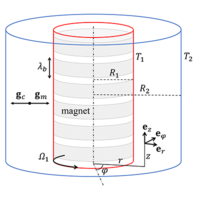
Thermomagnetic instability of a ferrofluid in a differentially heated Taylor-Couette system

Antoine Meyer, Anupam Hiremath, and Innocent Mutabazi

Phys. Rev. Fluids 7, 023901 (2022) - Published 1 February, 2022

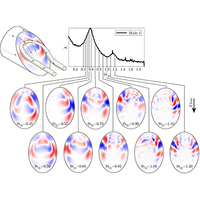
Ferrofluids have a very wide range of possible values of Prandtl number since they are water-based or oil-based. Recent research has highlighted the important role played by the centrifugal buoyancy in highly viscous fluids. The present paper investigates the impact of the centrifugal buoyancy on the thermomagnetic instability in a ferrofluid confined in a cylindrical annulus with a rotating inner cylinder, with a special interest on the effect of viscosity.

Time-resolved particle image velocimetry and pressure sensitive paint measurements of afterbody flow dynamics

Fernando Zigunov, Prabu Sellappan, Farrukh Alvi, Yuta Ozawa, Yuji Saito, Taku Nonomura, and Keisuke Asai

Phys. Rev. Fluids 7, 024701 (2022) - Published 1 February, 2022

A pair of counter-rotating vortices is produced in the wake of typical cargo aircraft fuselages due to their ramp shape. With a fast polymer-ceramic pressure sensitive paint (PC-PSP), we measure the global pressure fluctuations at very low velocities (15 to 75 m/s) in a surrogate cylinder with a slanted edge model. Through spectral proper orthogonal decomposition, we observe a family of convective pressure waves with peak energy at frequencies matching the vortex wandering frequencies in this flow.

Pairwise scattering and bound states of spherical microorganisms

C. Darveniza, T. Ishikawa, T. J. Pedley, and D. R. Brumley

Phys. Rev. Fluids 7, 013104 (2022) - Published 31 January, 2022

Accurately calculating pairwise collisions between swimming microorganisms typically requires the use of numerical simulations in which hydrodynamic interactions are fully resolved. Here, we utilize analytical expressions for forces and torques acting on two closely separated spherical squirmers to evaluate their scattering dynamics and bound states, by varying incoming angles, the squirmer parameter β, and gravitational field strengths. These results compare well with full numerical solutions obtained using boundary element methods, highlighting lubrication theory as a candidate for use in future mesoscale continuum models.

Impacts of wall conditions on flame acceleration at the early stages of burning in channels

Mohammed AlKhabbaz, Furkan Kodakoglu, Damir Valiev, and V’yacheslav Akkerman

Phys. Rev. Fluids 7, 013201 (2022) - Published 31 January, 2022

The role of mechanistic (free-slip or non-slip) and thermal (adiabatic or isothermal) wall conditions on flame acceleration at the early stages of burning in channels is studied by computational simulations of the reacting flow equations involving fully compressible hydrodynamics and transport properties (heat conduction, diffusion and viscosity). A qualitatively new effect is observed in the case of isothermal walls preheated to a high temperature. Specifically, additional flame segments are formed near a wall in that case, leading eventually to emergence and propagation of an intriguing octopus-like flame front.

Gradient-free optimization of chaotic acoustics with reservoir computing

Francisco Huhn and Luca Magri

Phys. Rev. Fluids 7, 014402 (2022) - Published 31 January, 2022

The suppression of chaotic acoustic oscillations is a challenging problem in optimization. This is because gradient-based optimization struggles to optimize chaotic systems. In this paper, we develop a Bayesian approach based on reservoir computing to suppress chaotic oscillations without calculating the gradient.

Chiral pattern in nonrotating spherical convection

Akira Kageyama and Nobuaki Ohno

Phys. Rev. Fluids 7, 013502 (2022) - Published 28 January, 2022

Thermal convection in a nonrotating spherical shell with central gravity is known to have symmetric solutions in terms of three-dimensional discrete rotation. All the solutions have reflection symmetry. We found a new type of symmetric steady convection with chirality. The pattern consists of six pairs of spiral rolls placed on 12 faces of a regular spherical dodecahedron. There are two configurations that are mirror images of one another.

Sign In to Your Journals Account

Filter

Recent Issues

Vol. 11, Iss. 10
October 2026
Vol. 11, Iss. 9
September 2026
Vol. 11, Iss. 8
August 2026
Vol. 11, Iss. 7
July 2026
Category
Article Type
Section

Filter

Article Lookup

Enter a citation