Recent Articles

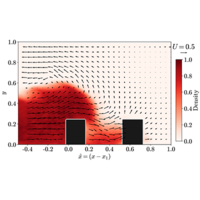
Wake bifurcations behind two circular disks in tandem arrangement

Jianzhi Yang, Xiaowei Zhu, Minghou Liu, Changjian Wang, Yuxin Wu, and Zhihe Shen

Phys. Rev. Fluids 7, 064102 (2022) - Published 30 June, 2022

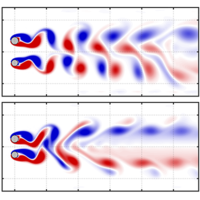
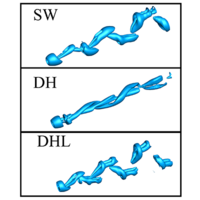
The flow over two three-dimensional bluff bodies in tandem arrangement is widely encountered in both natural environments and engineering applications. Here we perform a detailed numerical investigation on the wake bifurcations behind two axisymmetric bluff bodies in tandem. Our study explores the overall range of Re between 100 - 500 and the separation distance S/d=1, 2, 4, and 6. Seven main wake regimes are identified, and detailed wake bifurcation scenarios depending on Re and the separation distance are provided.

Improved guidelines of indoor airborne transmission taking into account departure from the well-mixed assumption

Jorge S. Salinas, K. A. Krishnaprasad, N. Zgheib, and S. Balachandar

Phys. Rev. Fluids 7, 064309 (2022) - Published 30 June, 2022

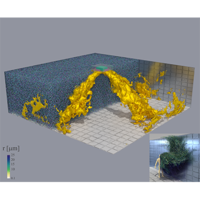
We use large eddy simulations with the Euler-Lagrange point-particle approach to assess the appropriateness of the well-mixed theory in predicting indoor risk of contagion. A novel ‘statistical overloading’ technique allows us to analyze infinitely many scenarios, with only one data-rich simulation. The figure shows the droplet nuclei (left half of the room; see color map for radius of nuclei ‘r’) and an iso-surface of velocity magnitude (in yellow). The inset (bottom right) shows one of the infinitely many expiratory events that can be analyzed.

Transient behavior of through-flowing gravity currents interacting with a roughness array

Alex Meredith, Craig McConnochie, Roger Nokes, and Claudia Cenedese

Phys. Rev. Fluids 7, 063802 (2022) - Published 29 June, 2022

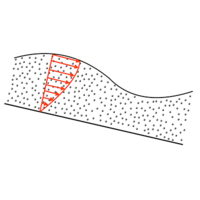
We investigate the transient response of gravity currents moving through a relatively sparse array of roughness elements. The work builds on earlier studies which assumed that the currents were in a quasi-steady state. We find that the current decelerates and that the density structure changes from the head and tail structure of a smooth bed gravity current to a wedge shape.

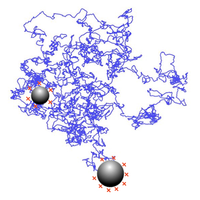
Brownian coagulation of like-charged aerosol particles

Pijush Patra and Anubhab Roy

Phys. Rev. Fluids 7, 064308 (2022) - Published 29 June, 2022

In this study we explore the role of Brownian coagulation on bidisperse like-charged spherical particles interacting via non-continuum hydrodynamics interactions. It is well established in the existing literature that van der Waals interactions enhance the coagulation rate. However, the role of near-field attractive electrostatic forces on the pair interactions of like-charged aerosols is relatively less explored. We have found that electrostatic interactions enhance the coagulation rate between like-charged Brownian particles while interacting through non-continuum hydrodynamics.

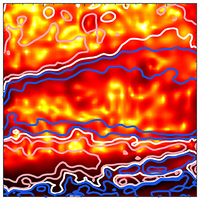
Near-wall lubricating layer in drag-reduced flows of rigid polymers

Lucas Warwaruk and Sina Ghaemi

Phys. Rev. Fluids 7, 064605 (2022) - Published 29 June, 2022

We experimentally investigate the drag-reduced channel flow of an inelastic, shear-thinning rigid polymer solution. Particle image velocimetry and shear-viscosity measurements are used to obtain instantaneous distributions of the shear viscosity within the turbulent domain. We elucidate that drag reduction for rigid polymers is primarily driven by a thin lubricating layer that consists of low-viscosity fluid near the channel wall.

Effect of the Cassie state in grooved channels on one-dimensional sound waves

Anna Zigelman, Ariella Mansfield, and Amir D. Gat

Phys. Rev. Fluids 7, 064803 (2022) - Published 29 June, 2022

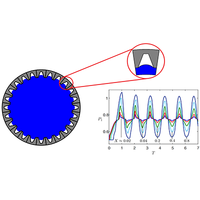
We study the effect of superhydrophobic boundaries on the propagation of nonlinear acoustic waves. A cylindrical liquid-filled tube with longitudinally grooved boundaries, whose cross-sectional sketch is shown in the figure, is considered. We derive a model containing an interplay between the pressure and the shape of the liquid-gas interface, subject to contact line hysteresis, which is a dominant mechanism for energy dissipation. For example, a sudden increase in the inlet (located at 𝑋 = 0) pressure and no flux boundary conditions in the outlet (𝑋 = 1), results (after an initial transient) in slowly decaying pressure oscillations with an increasing amplitude towards the outlet.

Experiments on a single large particle segregating in bedload transport

Hugo Rousseau, Julien Chauchat, and Philippe Frey

Phys. Rev. Fluids 7, 064305 (2022) - Published 28 June, 2022

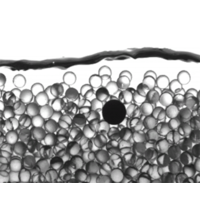
We investigate experimentally the behavior of a large particle in turbulent bedload transport when varying the Shields number and the size ratio. For size ratios above unity the large particle segregates upward with two steps: a first stage with slow and intermittent motion and then, a second stage in which the particle accelerates suddenly until the top of the bed. While the kinematics of the second stage is repeatable for a given configuration, it is not the case for the first stage. A transition in the size ratio is also observed: above a size ratio r=1.7, the spatial trajectory of the intruder becomes linear with a constant slope, independent of the Shields number and the size ratio.

Nonsteady discharge of granular media from a silo driven by a pressurized gas

Z. Zou, P. Ruyer, P.-Y. Lagrée, and P. Aussillous

Phys. Rev. Fluids 7, 064306 (2022) - Published 28 June, 2022

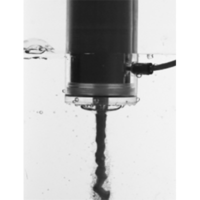
Motivated by an application to nuclear safety, we studied the effect of an imposed gas over-pressure on the discharge flow of granular media from a cylindrical silo. The size and type of particles and surrounding fluid where discharge occurs were varied, using air and water to test a coolant fluid for nuclear safety. Particle and air flow rates are found to increase during discharge with constant over-pressure conditions. A two-phase continuum model is used with a frictional rheology for particle-particle interactions. This model is solved numerically and we propose a simple quasi-steady analytical model with the air-pressure gradient at the orifice as a driving force in addition to gravity.

Wavy regime of a colloidal falling film

Darish Jeswin Dhas and Anubhab Roy

Phys. Rev. Fluids 7, 064307 (2022) - Published 28 June, 2022

We explore the linear stability and subsequent formation of nonlinear waves in a colloidal, gravity-driven falling film flow. The problem of a gravity-driven falling film devoid of any microstructure has been well studied. However, the role of particulate suspensions in the stability and dynamics of such systems is less explored. We perform a linear stability analysis and observe that the presence of colloidal particles stabilizes both the long-wave surface and short-wave shear instability modes. We also derive nonlinear models in the framework of long-wave theory using Benney’s gradient expansion and the Integral Boundary Layer (IBL) approach to study the systems’ wavy dynamics.

Transition to three-dimensional flow in thermal convection with spanwise rotation

K. Lüdemann and A. Tilgner

Phys. Rev. Fluids 7, 063502 (2022) - Published 27 June, 2022

Convection in a frame of reference rotating rapidly about an axis perpendicular to the direction of gravity is a model system for convection in the equatorial region of gaseous planets and is realized in recent laboratory experiments. It is found that the transition from rotationally constrained two-dimensional to three-dimensional flows in this system does not occur at some fixed Rossby number. Instead, the Rossby number at the transition depends on the Reynolds number of the flow. The transition occurs when the Taylor columns which constitute the two-dimensional flow become unstable to elliptical instability.

Physical impact of a surfactant on the nonlinear oscillations of a microbubble considering a dynamic surface tension and subject to an external acoustic field

C. Yepez, J. Naude, and F. Méndez

Phys. Rev. Fluids 7, 063603 (2022) - Published 27 June, 2022

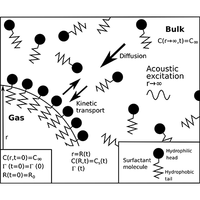
In this work, we study the transport of surfactant molecules to the surface of an oscillating microbubble when an acoustic pressure is used as driving force to promote the nonlinear oscillation. We consider a dynamic surface tension as a function of the surfactant concentration and a large diffusive Péclet number, as occurs in several applications. The surfactant concentration equation is solvable by using a similarity transformation which simplifies the problem, whereas the equation for the radius evolution is solved by the 4th order Runge-Kutta method.

Droplet dissolution driven by emerging thermal gradients and Marangoni flow

Binglin Zeng (曾炳霖), Yuliang Wang (王玉亮), Christian Diddens, Harold J. W. Zandvliet, and Detlef Lohse

Phys. Rev. Fluids 7, 064006 (2022) - Published 27 June, 2022

The lifetime τ of an isothermal and purely diffusively dissolving droplet in a host liquid scales as τ∼R02 with its initial radius R0. Here we experimentally find and theoretically derive a completely different droplet dissolution behavior, resulting in τ∼R04. It occurs when the dissolution dynamics is controlled by local heating of the liquid, leading to a modified solubility and a thermal Marangoni flow around the droplet.

Two-time Lagrangian velocity correlation function for particle pairs in two-dimensional inverse energy-cascade turbulence

Tatsuro Kishi, Takeshi Matsumoto, and Sadayoshi Toh

Phys. Rev. Fluids 7, 064604 (2022) - Published 27 June, 2022

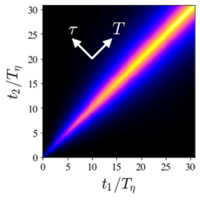
We numerically investigate a two-time Lagrangian velocity correlation function for particle pairs in two-dimensional energy inverse-cascade turbulence. We propose a self-similar form of the correlation function via incomplete similarity and numerically verify it and determine the scaling exponents. Our results suggest a possibility not to recover the Richardson-Obukhov law at infinite Reynolds number.

Wake interactions between two side-by-side circular cylinders with different sizes

Kai Zhang and Md. Naimul Haque

Phys. Rev. Fluids 7, 064703 (2022) - Published 27 June, 2022

We quantify the mutual interaction effects between two parallel wakes caused by a mismatch in the size of a cylinder pair.

Arbitrary extension of the antibubble lifetime

W. Wang, F. Lin, X. Wei, J. Zou, and S. Dorbolo

Phys. Rev. Fluids 7, L061601 (2022) - Published 27 June, 2022

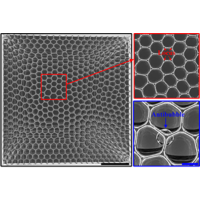
The lifetime of antibubbles - droplets separated from a liquid bath by a thin layer of air - has typically been too short for further study or application. We experimentally demonstrate a mechanical method for extending the antibubble lifetime from minutes to hours. The recorded longest lifetime is up to 13 hours. In our method, vertical vibrations stabilize the air film as successive shocks on the antibubble top compensate the upward air drainage. To suppress Faraday waves, the liquid surface is covered with bubbles. A theoretical model is built to obtain the threshold for a long-lived antibubble. In the figure, the black scale bar is 20mm and the blue one 2mm.

Multitime structure functions and the Lagrangian scaling of turbulence

Sofía Angriman, Pablo D. Mininni, and Pablo J. Cobelli

Phys. Rev. Fluids 7, 064603 (2022) - Published 24 June, 2022

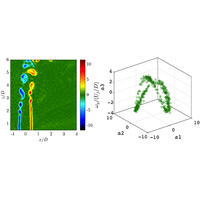
Large-scale flow components are known to affect Lagrangian inertial-range turbulent statistics. Multitime structure functions are shown to be a powerful and robust tool to disentangle these contributions from tracers’ statistics in a turbulent von Kármán experiment, in Taylor-Green direct numerical simulations, and in isotropic and homogeneous turbulence. Multitime statistics also improve Lagrangian intermittency measurements.

Asymmetric forcing of convectively unstable transverse jets

Andrea Besnard, Elijah W. Harris, and Ann R. Karagozian

Phys. Rev. Fluids 7, 063902 (2022) - Published 23 June, 2022

In gas phase experiments we explore the effect of asymmetric and helical excitation of the flow about the exit plane of a jet injected perpendicularly into crossflow. Simultaneous acetone planar laser-induced fluorescence imaging and stereo particle image velocimetry quantify the effects of such excitation on jet structure, vorticity, and scalar mixing, while proper orthogonal decomposition of the images enables determination of characteristic dynamical signatures related to important jet features.

Mechanisms leading to the formation of double-diffusive layers during unidirectional solidification of aqueous NH4Cl solution

Ila Thakur, Shyamprasad Karagadde, and Atul Srivastava

Phys. Rev. Fluids 7, 063501 (2022) - Published 22 June, 2022

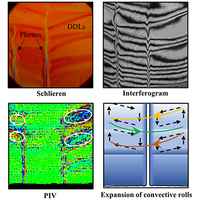
Double diffusive layers (DDLs) are one of the flow patterns which arise due to the coupled effects of thermal and solutal gradients and find relevance in large-scale applications. We report observations of DDLs using unidirectional solidification of a binary mixture, which naturally introduces thermal and solutal buoyant flows. The convection rolls at the opposite sidewalls, having an opposite sense of rotation, ultimately merge to form the DDLs that expand throughout the breadth of the test chamber. Our research on exploring the mechanisms of DDLs uses a combination of nonintrusive techniques capturing full-field measurements in real-time to obtain insights on their evolution.

Dipole-flow disturbed by a circular inclusion of conductivity different from the background: From deterministic to a self-consistent analytical solution

Gerardo Severino, Francesco De Paola, and Gerardo Toraldo

Phys. Rev. Fluids 7, 064101 (2022) - Published 22 June, 2022

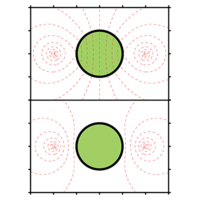
An analytical solution is presented for dipole-flow disturbed by a circular inclusion of conductivity different from the background. The effective conductivity is computed by means of the self-consistent approach and results, in general, in a nonlocal property.

How molecular effects affect solutal Marangoni flows

Petter Johansson, Guillaume Galliéro, and Dominique Legendre

Phys. Rev. Fluids 7, 064202 (2022) - Published 22 June, 2022
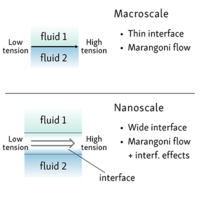
The treatment of fluid-fluid interfaces in flows becomes important as systems approach the nanoscale. At such scales interfaces have a distinct width and properties such as shear viscosity differ from those of the bulk phases. Using molecular dynamics simulations we show how these effects can be quantified and modeled in the case of nanoscale Marangoni convection. The success of our approach suggests that it can also be used for generalized nanoscale flows involving fluid-fluid interfaces.

Sign In to Your Journals Account

Filter

Recent Issues

Vol. 11, Iss. 10
October 2026
Vol. 11, Iss. 9
September 2026
Vol. 11, Iss. 8
August 2026
Vol. 11, Iss. 7
July 2026
Category
Article Type
Section

Filter

Article Lookup

Enter a citation