Recent Articles

Gravity-induced double encapsulation of liquids using granular rafts

Alireza Hooshanginejad, Sunghwan Jung, Ellen Longmire, and Sungyon Lee

Phys. Rev. Fluids 7, 064003 (2022) - Published 8 June, 2022

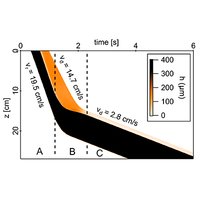
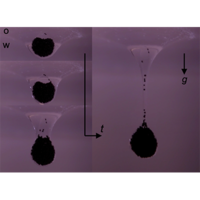
In this study, we experimentally reveal the liquid-like and solid-like behaviors of millimetric liquid marbles when they sediment in oil towards a water layer below. Upon dynamically interacting with the oil-water interface, an aqueous armored droplet is shown to either rupture or remain intact as the oil surrounding the drop pinches off. The pinch-off in the novel gravity-driven regime leads to the double-encapsulation of aqueous solutions, which enables their secure transport in a wet environment. We also present scaling laws that account for the drop’s weight and the oil viscosities, in good agreement with the experiments.

Effect of Weissenberg number on polymer-laden turbulence

Sajjad ur Rehman, Junghoon Lee, and Changhoon Lee

Phys. Rev. Fluids 7, 064303 (2022) - Published 8 June, 2022

By adopting the direct force formulation in a finitely extensible nonlinear elastic (FENE) model for the feedback force by laden polymers to stationary isotropic turbulence, we clearly identified the energy flow between turbulence and polymers. The stretching motion of turbulence is suppressed by the polymer springs with large Weissenberg number, resulting in suppression of turbulent kinetic energy and energy dissipation.The direct force model seems to be more efficient in providing physical insight than the polymer stress model based on the conformation tensor.

Trapping and escape of viscous fingers in a soft Hele-Shaw cell

Gunnar G. Peng, Callum Cuttle, Finn Box, Jian Hui Guan, Anne Juel, Christopher W. MacMinn, and Draga Pihler-Puzović

Phys. Rev. Fluids 7, L062001 (2022) - Published 8 June, 2022

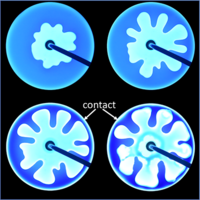
We study viscous fingering instability in a soft Hele-Shaw cell, in which one of the walls is replaced by a bounded elastomer. For sufficiently high flow rates in our experiments, fingers can get trapped because the deforming solid contacts the opposite wall, sealing the cell near its rim, although in numerical simulations of axisymmetric bubble expansion at the same control parameters, the interface escapes. For parameter regimes in which narrower fingers grow, we find the opposite behavior: the cell seals in axisymmetric numerics but fingers escape the cell in experiments, suggesting that viscous fingering can either promote or suppress the choking of the cell.

Triple line destabilization: Tuning film thickness through meniscus curvature

P. Hayoun, A. Letailleur, J. Teisseire, F. Lequeux, E. Verneuil, and E. Barthel

Phys. Rev. Fluids 7, 064002 (2022) - Published 7 June, 2022

The stability of a dynamic meniscus depends upon its macroscopic curvature. In particular, the critical velocity for the dynamic wetting transition is affected by the meniscus curvature which, as such, emerges as a thickness selection mechanism for liquid film deposition. These ideas have been demonstrated experimentally by flowing water in tubes at high velocities and rationalized by numerical modeling.

Regimes of steady jetting in electrohydrodynamic jet printing

Abhishek K. Singh, Rajiv K. Srivastava, and Supreet Singh Bahga

Phys. Rev. Fluids 7, 063701 (2022) - Published 6 June, 2022

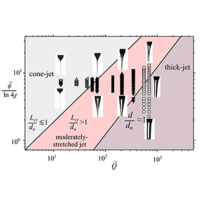
Electrohydrodynamic (EHD) jet printing is an additive manufacturing technique in which an electrified jet of functional ink is deposited on a motion-controlled substrate. Through experimental visualization of EHD jets, current measurements and scaling analysis, we show that steady EHD jetting can occur in three regimes: the cone-jet, moderately stretched jet, and thick-jet regimes. These EHD jetting regimes differ with respect to the relative importance of surface convection and bulk conduction currents downstream of the jet.

Effects of vapor-liquid phase transitions on sound-wave propagation: A molecular dynamics study

Yuta Asano, Hiroshi Watanabe, and Hiroshi Noguchi

Phys. Rev. Fluids 7, 064302 (2022) - Published 6 June, 2022

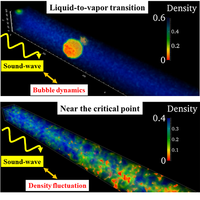
With molecular dynamics simulations (MDS) we explore the effects of the liquid-to-vapor transition on sound waves including observation of bubble dynamics due to Bjerknes forces on a molecular scale. The usefulness of MDS for the phase transition, bubble growth, and bubble-sound interaction is demonstrated without the use of any phenomenological models.

Lateral flow interactions enhance speed and stabilize formations of flapping swimmers

Joel W. Newbolt, Jun Zhang, and Leif Ristroph

Phys. Rev. Fluids 7, L061101 (2022) - Published 6 June, 2022

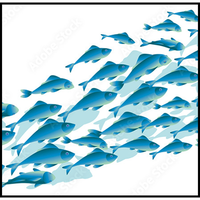
A swimming fish leaves behind an orderly pattern of vortices, but schools of fish are not ordered into lattice arrangements. Our experiments on robotic hydrofoils show how flapping swimmers can benefit from hydrodynamic interactions and stay in a school even without specific positioning relative to neighbors.

Influence of thermal effects on the breakup of thin films of nanometric thickness

R. H. Allaire, L. J. Cummings, and L. Kondic

Phys. Rev. Fluids 7, 064001 (2022) - Published 2 June, 2022

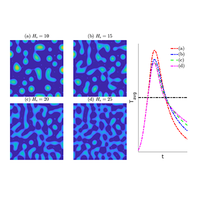
We use an asymptotic model to study instabilities of free surface films of nanometric thickness on thermally conductive substrates in two and three spatial dimensions. The film evolution is simulated using efficient GPU-based simulations which, when combined with the developed asymptotic model, allow for fully nonlinear time-dependent simulations in large three-dimensional computational domains. We find that the properties of the thermally conductive substrate - in particular its thickness and rate of heat loss - play a critical role in controlling the film temperature and dynamics. The graphic shows the influence of substrate thickness (Hs) on film temperature and breakup.

Dynamics of water imbibition through hydrogel-coated capillary tubes

Sooyoung Chang, Kaare H. Jensen, and Wonjung Kim

Phys. Rev. Fluids 7, 064301 (2022) - Published 1 June, 2022

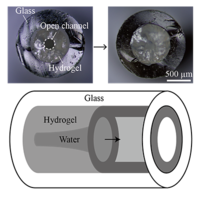
Capillary flow through hydrogel-coated capillary tubes was investigated experimentally and theoretically. The results show how the absorption and swelling of hydrogel regulate capillary flow. Water imbibition through porous hydrogel materials can be understood as analogous to flow through a channel that deforms with water absorption. Therefore, this study provides a better understanding of water absorption through porous hydrogel materials, which are widely used for agricultural substrates, hygienic products, and microfluidic devices.

Magnetic manipulation of diamagnetic droplet on slippery liquid-infused porous surface

Lin Feng, Xin-Yao He, Ji-Long Zhu, and Wan-Yuan Shi

Phys. Rev. Fluids 7, 053602 (2022) - Published 31 May, 2022

Magnetic manipulation of a deionized (DI) water droplet on a slippery liquid-infused porous surface (SLIPS) is realized by a single magnet. The ultra-low friction nature of SLIPS enables a small magnetic reprelling force to actuate the droplet forward successfully at a velocity of 1 mm/s. In addition, this method exhibits great potential for transporting low-surface-tension fluids such as sodium dodecyl sulfate (SDS) droplets, bubbles, and magnetic nanofluids, which offer potential benefits for the design and applications of magnetically actuated droplets in droplet microfluidics.

Effect of streak employing control of oblique-breakdown in a supersonic boundary layer with weak wall heating/cooling

M. Celep, A. Hadjadj, M. S. Shadloo, S. Sharma, M. Yildiz, and M. J. Kloker

Phys. Rev. Fluids 7, 053904 (2022) - Published 31 May, 2022

High skin friction and thermal loads are inevitable consequences of turbulent flows in supersonic flights. Here, the use of boundary-layer streaks is studied by direct numerical simulations in order to prevent/delay turbulence from occuring at M_∞=2.0. The stabilizing/destabilizing effects (y/δ_in=0.517 in the image) of the streaks under the influence of various thermal boundary conditions are examined and the effective amplitude range in delaying transition is revealed.

Capillary adsorption of droplets into a funnel-like structure

Yanchen Wu, Fei Wang, Weidong Huang, Michael Selzer, and Britta Nestler

Phys. Rev. Fluids 7, 054004 (2022) - Published 31 May, 2022

The capability of droplet absorption into a funnel-like capillary tube is enormously affected by the combined influence of the droplet size, the opening angle, and the intrinsic wettability. Through a quantitative investigation of the penetration criteria, we demonstrate that a finite-volume droplet can be totally absorbed by a hydrophobic funnel-like structure depending on the opening angle. This result is sharply contrary to the previous conclusion for infinite-volume droplets in straight capillary tubes and our predictions extend the limit of the maximum contact angle for the complete penetration of droplets into capillary tubes in the literature.

One-dimensional compression of a saturated elastoviscoplastic medium

Daniel T. Paterson, Tom S. Eaves, Duncan R. Hewitt, Neil J. Balmforth, and D. Mark Martinez

Phys. Rev. Fluids 7, 054303 (2022) - Published 31 May, 2022

We explore a model for compaction of a two-phase medium in which the solid is allowed to deform elasto-viscoplastically. Previous models for compression of colloidal and cellulose fiber suspensions often prescribe the solid stress as a material function of the local solid concentration. Our current model distinguishes between purely elastic or plastic deformation and allows a solid viscous response. This is crucial for model comparison to experiment where a dramatic improvement over inelastic constitutive models is demonstrated.

Darcy-Reynolds forces during intrusion into granular-fluid beds

Joshua Strader, Neil Causley, Joshua A. Dijksman, and Abram H. Clark

Phys. Rev. Fluids 7, 054304 (2022) - Published 31 May, 2022

Intrusion into fluid-grain mixtures can lead to very large stresses and surprising solid-like behavior. One important mechanism, captured by Darcy-Reynolds theory, involves a feedback effect between the expansion of the granular material (Reynolds dilation) and the flow of fluid through the pores between grains (Darcy flow). We build on prior work to demonstrate the effectiveness of Darcy-Reynolds theory in capturing the forces over a wide range of physical parameters. We also demonstrate a breakdown of the theoretical predictions for very large viscosity fluids, and we suggest a hypothesis for this deviation.

Hierarchical clustering method of volumetric vortical regions with application to the late stage of laminar-turbulent transition

Kazuo Matsuura and Yasuhide Fukumoto

Phys. Rev. Fluids 7, 054703 (2022) - Published 31 May, 2022

This paper proposes a hierarchical clustering method which can analyze the behavior of vortices in detail by dividing volumetric vortical regions obtained by a direct numerical simulation into individual groups of vortical points and automatically tracking them. In addition to visualizing and tracking the instantaneous spatial distribution and temporal motion of each point set of vortices linked by a data hierarchy (inclusivity), which is called “p-clusters” in a unified manner, it is now possible to mechanically search for common local dynamics among many different vortical structures found in transitional and turbulent flows.

Phases of active matter composed of multicellular magnetotactic bacteria near a hard surface

Alexander Petroff, Alejandra Rosselli-Calderon, Ben Roque, and Pradeep Kumar

Phys. Rev. Fluids 7, 053102 (2022) - Published 27 May, 2022

Multicellular magnetotactic bacteria (MMB) – the only known obligately multicellular species of bacteria – use the geomagnetic field to navigate the pore space of water-saturated sediment. To investigate how MMB navigate around obstructions, we orient a magnetic field to direct thousands of MMB toward the hard surface of a microfluidic chamber. MMB in a sub-millitesla field distribute exponentially about the surface as an active gas with a penetration length λ proportional to the distance a colony swims before aligning with the applied field. At a critical magnetic field λ shrinks to the size of a single MMB colony and the active gas condenses into an active two-dimensional fluid.

Effect of interface dynamic deformations on instabilities of buoyancy-thermocapillary convection in a two-fluid two-layer system

Alexander Gelfgat

Phys. Rev. Fluids 7, 053503 (2022) - Published 27 May, 2022

The effect of interfacial disturbances on instabilities of buoyant/thermocapillary convective flows in rectangular cavities is studied in a series of numerical experiments. The relation between interface deformations and the Boussinesq approximation is discussed. It is shown that including interface disturbances in the model can alter the critical temperature difference by approximately 10%, producing either a destabilizing, or a stabilizing effect.

Droplets on lubricated surfaces: The slow dynamics of skirt formation

Zhaohe Dai and Dominic Vella

Phys. Rev. Fluids 7, 054003 (2022) - Published 27 May, 2022

Lubricated surfaces are formed by coating surfaces with a thin layer of oil lubricant. We consider a model problem to understand how lubricated surfaces respond to the deposition of a droplet, which induces forces on the lubricant via its Laplace pressure and the triple line (the Neumann balance). This forcing leads to the formation of a meniscus around the droplet, or ‘skirt’. We show that the properties of the skirt depends on the amount of lubricant available in the lubricant reservoir and also that the the evolution towards the equilibrium is extremely slow.

Stress-activated constraints in dense suspension rheology

Abhinendra Singh, Grayson L. Jackson, Michael van der Naald, Juan J. de Pablo, and Heinrich M. Jaeger

Phys. Rev. Fluids 7, 054302 (2022) - Published 27 May, 2022

Simulations link nanoscale particle properties to bulk rheology via microscopic stress-activated constraints. The framework shows quantitative agreement with experimental rheology data.

Spectral decomposition of wall-attached/detached eddies in compressible and incompressible turbulent channel flows

Ming Yu, ChunXiao Xu, JianQiang Chen, PengXin Liu, YaLu Fu, and XianXu Yuan

Phys. Rev. Fluids 7, 054607 (2022) - Published 27 May, 2022

A spectral decomposition method is proposed to segregate the contributions of wall-attached/wall-detached and self-similar/non-self-similar eddies by taking advantage of the proper orthogonal decomposition. It is applied to analyze the compressible and incompressible turbulent channel flows to verify the Reynolds number and compressibility effects on velocity fluctuations and investigate whether the temperature fluctuations share similar features. The statistical properties of eddies of each category have been discussed in detail.

Sign In to Your Journals Account

Filter

Recent Issues

Vol. 11, Iss. 10
October 2026
Vol. 11, Iss. 9
September 2026
Vol. 11, Iss. 8
August 2026
Vol. 11, Iss. 7
July 2026
Category
Article Type
Section

Filter

Article Lookup

Enter a citation