Recent Articles

Hydrodynamic instabilities of activity-balanced binary suspensions

Bryce Palmer, Wen Yan, and Tong Gao

Phys. Rev. Fluids 7, 063101 (2022) - Published 21 June, 2022

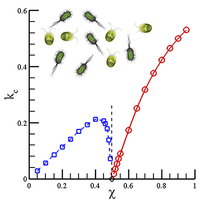
We have built a mean-field kinetic model to study the underlying hydrodynamic instabilities in dilute, activity-balanced pusher-puller binary suspensions that produce near-zero mean extra stress. We have successfully demonstrated that mixing pushers and pullers in such binary systems may lead to much richer behaviors than a simple neutralization process due to the cancellation of stresslets from both species. Also, we find the instability mechanisms to be different from those derived for pure pushers or pullers, where a net extensile extra stress typically indicates unstable dynamics.

Lasting effects of discontinuous shear thickening in cornstarch suspensions upon flow cessation

Jae Hyung Cho, Andrew H. Griese, Ivo R. Peters, and Irmgard Bischofberger

Phys. Rev. Fluids 7, 063302 (2022) - Published 21 June, 2022

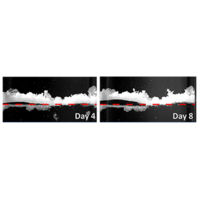
Discontinuous shear-thickening (DST) fluids exhibit complex stress relaxation upon flow cessation. We investigate the relaxation behavior of dense cornstarch suspensions via rotational rheometry and find that the relaxation timescales and the residual stress increase with the apparent viscosity measured in the DST state prior to the flow cessation. Within the framework that attributes DST to the lubricated-to-frictional transition of interparticle contact, our results indicate that the lasting effects of the DST state arise from partial retention of frictional force chains after flow cessation.

Diffusion in a fluid flow generated by a source at the apex of a wedge

P. L. Krapivsky

Phys. Rev. Fluids 7, 064502 (2022) - Published 21 June, 2022

A flow of an incompressible viscous fluid in a wedge generated by a source at the apex is a rare exact solution of the Navier-Stokes equations. We analyze a diffusing particle advected by this flow and show that in a wedge with absorbing boundaries the survival probability decays algebraically with time. The computation of the decay exponent reduces to finding the ground state energy of the quantum particle in a potential well with a shape determined by the radial flow velocity.

Vortex induced vibration of a circular cylinder colliding with a rigid wall

Arnab Kumar De and Sandip Sarkar

Phys. Rev. Fluids 7, 064702 (2022) - Published 21 June, 2022

The vortex-induced vibration of a circular cylinder near a solid wall exhibits two modes of collision with the wall, namely, “Impact” and “Gracing.” At the minimum position of the cylinder nearer the wall, the “Impact” case corroborates an abrupt change in the velocity gradient with a positive repulsive force magnitude. In contrast, the cylinder embraces the wall and moves away during the “Gracing” case, revealing a linear variation of the velocity gradient and nearly-zero repulsive force. The lift signal shows a sudden discontinuity for the “Impact” situation while rendering a continuous variation for the “Gracing.”

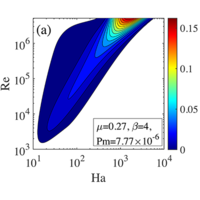
From helical to standard magnetorotational instability: Predictions for upcoming liquid sodium experiments

Ashish Mishra, George Mamatsashvili, and Frank Stefani

Phys. Rev. Fluids 7, 064802 (2022) - Published 21 June, 2022

This work is a first preparatory theoretical study for upcoming magnetorotational instability (MRI) experiments with liquid sodium planned within the DRESDYN project. Therefore, we focus on the characteristics of MRI for typical values of the main parameters of the basic magnetized Taylor-Couette (TC) flow achievable in these experiments. In contrast to previous attempts at finding MRI in the laboratory, our results clearly indicate that standard MRI and its helically modified version can be detected for the first time in the DRESDYN-TC device, including the astrophysically important Keplerian rotation, despite the very small magnetic Prandtl number of liquid sodium.

Bifurcations in droplet collisions

A. Dubey, K. Gustavsson, G. P. Bewley, and B. Mehlig

Phys. Rev. Fluids 7, 064401 (2022) - Published 16 June, 2022

Recent studies show that hydrodynamic interactions qualitatively change the collision rate between droplets settling in a steady straining flow. We explain the dependence of the collision rate on the non-dimensional settling speed by analyzing the bifurcations of the underlying dynamical system.

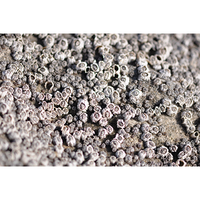
Investigation of rough-wall turbulence over barnacle roughness with increasing solidity using direct numerical simulations

Sotirios Sarakinos and Angela Busse

Phys. Rev. Fluids 7, 064602 (2022) - Published 16 June, 2022

Surface fouling by marine organisms such as barnacles has a major impact on the shipping sector. We use direct numerical simulations to investigate how the fluid dynamical properties of a surface change as it is gradually covered by barnacle colonies. The roughness effect peaks at intermediate coverage when approximately half of the surface is covered by barnacles. We further investigate how the roughness is perceived by the outer part of the flow using the blanketing layer concept and find a linear relationship between the roughness function and the effective slope of the blanketing layer.

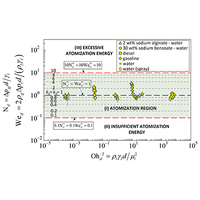
Possible, impossible, and expected diameters and production rates of droplets in aerosols and sprays

Maksim Mezhericher and Howard A. Stone

Phys. Rev. Fluids 7, 063602 (2022) - Published 15 June, 2022

Liquid atomization processes are used in many delivery and coating systems involving pure solvents, solutions, and suspensions. Here we develop a theoretical description of droplet sizes and flow rates in aerosols and sprays, using the first principles of conservation of mass and energy, and employing dimensional and scale analyses. Our study explores the overall range of mean droplet diameters between 0.1-100 μm and Ohnesorge numbers between 0.01-100. We find a reasonable agreement between the theory and experiments, and our theoretical framework contributes to understanding of liquid atomization and can be used for comparison between different spray and aerosol production techniques.

Nonmodal elastic instability and elastic waves in weakly perturbed channel flow

Ron Shnapp and Victor Steinberg

Phys. Rev. Fluids 7, 063901 (2022) - Published 15 June, 2022

Adding tiny amounts of long polymer chains to a fluid dramatically alters its behavior. In this work, we show that channel flows of such viscoelastic fluids at vanishingly small Reynolds numbers are highly sensitive to weak disturbances, even though they are linearly stable. We thus show experimentally that a weak disturbance elicits strong fluctuations with a continuous spectrum in three different regimes and elastic waves far from the excitation location through a non-modal bifurcation.

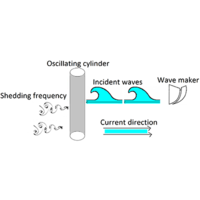
Frequency and phase lock-in behind circular cylinder in the presence of random irregular waves

Iskander Abroug and Nizar Abcha

Phys. Rev. Fluids 7, 064801 (2022) - Published 15 June, 2022

The effect of random waves and steady current on the wake of an elastically mounted cylinder is studied in a series of experiments. The relation between the vortex shedding frequency and waves’ nonlinearities is discussed. A phase-based method is proposed in order to detect the presence of a subharmonic phase lock-in phenomenon.

Perturbative model for the second-order velocity structure function tensor in turbulent shear flows

Samvit Kumar, Charles Meneveau, and Gregory Eyink

Phys. Rev. Fluids 7, 064601 (2022) - Published 14 June, 2022

A model for the second order velocity structure function tensor, based on Kolmogorov’s theory and valid for the inertial range, is proposed, incorporating the effect of anisotropy as a linear perturbation to the standard isotropic form. Structure functions measured from direct numerical simulations of channel flow and from experimental measurements in turbulent boundary layers are compared with predicted behavior and reasonable agreement is found.

Fluid-structure interaction of a bio-inspired passively deployable flap for lift enhancement

Nirmal J. Nair and Andres Goza

Phys. Rev. Fluids 7, 064701 (2022) - Published 14 June, 2022

Covert-feathers-inspired passive flow control is beneficial for aerodynamic performance at post-stall angles of attack. However, most studies model covert feathers as a rigidly attached or a freely moving flap on a wing. The performance of a flap mounted via a torsional spring, emblematic to the finite stiffness of bird feathers, has remained unexplored. We simulate strongly coupled fluid-structure interactions of flow past a stationary airfoil with a passively deployable, torsionally mounted flap on the suction surface. We then perform a parametric study and an in-depth analysis of the dominant flow features that affect performance.

Unified integral model for the lock-release and cooling-source gravity currents

Yangyue Zhang and Ruifeng Hu

Phys. Rev. Fluids 7, 063801 (2022) - Published 13 June, 2022

The downburst outflow that triggers thunderstorms and sandstorms can be regarded as a cooling source gravity current (CSGC), which may be quite different from the lock-release gravity current (LRGC). We propose a unified integral model incorporating a continuous velocity transition across the density interface for both CSGC and LRGC. The integral model for CSGC correlates the front characteristics with the thermodynamic and geometric properties of the cooling source, verified by direct numerical simulations. Results also demonstrate that the influence of the shear layer in the dense fluids tends to vanish in LRGC and could be predominant in CSGC.

Phase field modeling in liquid binary mixtures: Isothermal and nonisothermal problems

Rodica Borcia, Ion Dan Borcia, Michael Bestehorn, Deewakar Sharma, and Sakir Amiroudine

Phys. Rev. Fluids 7, 064005 (2022) - Published 13 June, 2022

Based on the conservative phase field model of Lowengrub and Truskinovsky for almost incompressible liquid binary mixtures, we propose an extended scheme for studying immiscible/miscible liquids. Below a critical temperature Tc, the liquids are immiscible with separating interfaces. Above Tc interfacial effects vanish and the liquids become perfectly miscible. The free energy density of the system depends not only on the system composition through the phase field ϕ but also on the reduced temperature r=(Tc−T)/Tc. The free energy transforms through Tc to permit a two-phase system in the subcritical (immiscible) regime and a mono phase in the supercritical (miscible) regime.

Active control of particle position by boundary slip in inertial microfluidics

Chengliang Xuan, Weiyin Liang, Bing He, and Binghai Wen

Phys. Rev. Fluids 7, 064201 (2022) - Published 13 June, 2022

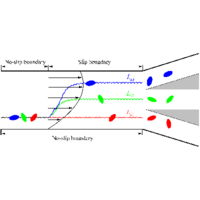
A scheme is presented to actively control particulate position in inertial microfluidics. The unilateral slip boundary is applied to regulate the velocity distribution of the flow field in the microchannel, thus the vertical equilibrium position of the particle can be changed with the slip length. Three kinds of typical particles, namely circular, elliptical, and rectangular, are simulated. The results demonstrate that the vertical equilibrium positions can be manipulated within 40% of the channel width. If the boundary slip is adjusted by some technique, such as electrowetting, then real-time control can be achieved.

Particle segregation using crystal-like structure of capsules in wall-bounded shear flow

Shunichi Ishida, Ryota Matsumoto, Daiki Matsunaga, and Yohsuke Imai

Phys. Rev. Fluids 7, 063601 (2022) - Published 10 June, 2022

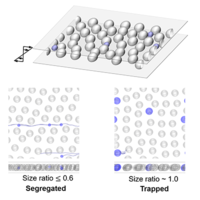
In a wall-bounded shear flow, deformable particles form a crystal-like structure. To examine particle sorting in microfluidic devices we added small capsules (SC) to a system where large capsules (LC) form a crystal structure, and find that the movement of SC changes significantly with size ratio Ra. When SC and LC are of comparable size (Ra∼1), the small capsules are trapped in the crystal structure, whereas when SC are smaller (Ra∼0.6 or lower) the SC deplete from the crystal layer due to low lift velocity. This suggests that the crystal structure of capsules can be used to trap capsules of comparable sizes, or to exclude capsules of smaller sizes.

Chaotic mixing in an acoustically driven cavity flow

Jingang Qu, Daniel Henry, Sophie Miralles, Valéry Botton, and Florence Raynal

Phys. Rev. Fluids 7, 064501 (2022) - Published 10 June, 2022

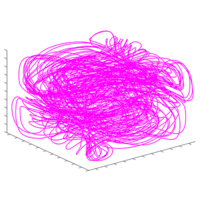
We investigate the mixing properties of an acoustic driven flow in a parallelepipedic cavity with square basis. Relying on nonnormal reflections, an acoustic beam with a square path is obtained, generating a global complex flow in the cavity which enables chaotic advection. For a moderate power of the source, the chaotic region invades the whole cavity, illustrating that acoustic streaming can be used successfully as a nonintrusive tool to mix efficiently.

Thermodynamically consistent coarse-graining of polar active fluids

Scott Weady, David B. Stein, and Michael J. Shelley

Phys. Rev. Fluids 7, 063301 (2022) - Published 9 June, 2022

Starting from continuum kinetic theory, we derive a mean-field theory and entropy-based closure model for a polar active fluid. Analysis and simulation show the model closely approximates both the transient and nonequilibrium dynamics of the kinetic theory. Taking advantage of the model’s reduced degrees of freedom, we perform large-scale simulations of turbulent active suspensions in two and three dimensions.

Leaky-dielectric phase field model for the axisymmetric breakup of an electrified jet

Kaartikey Misra and Manuel Gamero-Castaño

Phys. Rev. Fluids 7, 064004 (2022) - Published 9 June, 2022

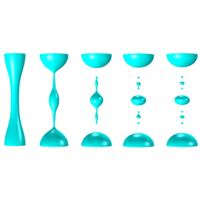
We explore the axisymmetric breakup of electrified jets under wide ranges of the Taylor number (Γ), the Ohnesorge number (𝑂h) and the wavenumber (𝑘) which are relevant to electrosprays operating in the cone-jet mode. We extend prior numerical and experimental results by developing a phase field EHD model to account for the behavior of the jet after the pinch-off. For 𝑂h > 1, a much broader distribution of droplet size is observed which originates from the pinch-off region of the jet. For Γ ≥ 1.5, the primary droplets are always unstable irrespective of the viscosity level.

Enhanced transport in a porous medium due to dissolved salt

G. Licsandru and M. Prat

Phys. Rev. Fluids 7, 064304 (2022) - Published 9 June, 2022
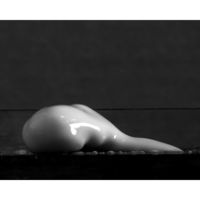
Evaporation – condensation effects in a porous medium containing saline water enhance water transport and explain salt crust faster upward displacement.

Sign In to Your Journals Account

Filter

Recent Issues

Vol. 11, Iss. 10
October 2026
Vol. 11, Iss. 9
September 2026
Vol. 11, Iss. 8
August 2026
Vol. 11, Iss. 7
July 2026
Category
Article Type
Section

Filter

Article Lookup

Enter a citation