Highlights

Lagrangian coherent structures control solute dispersion in heterogeneous poroelastic media

Junhong Wu, Daniel Lester, Michael G. Trefry, and Guy Metcalfe

Phys. Rev. Fluids 9, 044501 (2024) - Published 9 April, 2024

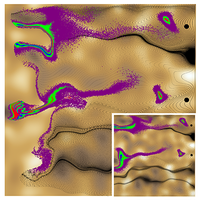
This study focuses on how Lagrangian coherent structures (LCSs) control solute dispersion in heterogeneous poroelastic media (HPM). We show how interactions between medium compressibility, conductivity heterogeneity, and periodic forcing give rise to complex flows and diverse LCS types (KAM islands, chaotic saddles, etc) that have profound impacts on diffusive solute transport (main image) that do not arise in the steady counterpart (inset). Strongly anomalous transport impacts both spatial moments and residence time distributions and persists at low Péclet numbers. This study reveals the complex transport phenomena that can arise in HPM and shows how LCSs govern solute dispersion.

Machine-learning-augmented domain decomposition method for near-wall turbulence modeling

Shiyu Lyu, Jiaqing Kou, and Nikolaus A. Adams

Phys. Rev. Fluids 9, 044603 (2024) - Published 5 April, 2024

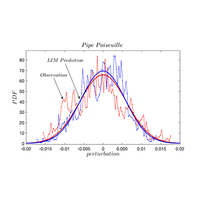
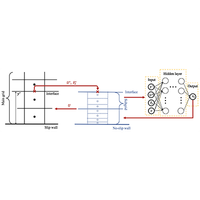
In this work, we developed a novel framework for incorporating the near-wall non-overlapping domain decomposition (NDD) method with the machine learning technique. It allows the solution to be calculated with a Robin-type (slip) wall boundary condition on a relatively coarse mesh and then be corrected in the near-wall region by solving the thin boundary-layer equations on a fine subgrid. Through an estimated turbulent viscosity profile provided by a neural network, the proposed method can be easily extended to different turbulence models and achieve commendable accuracy for the test cases of turbulent wall-bounded flows at various Reynolds numbers.

Finite speed of sound effects on asymmetry in multibubble cavitation

Mandeep Saini, Youssef Saade, Daniel Fuster, and Detlef Lohse

Phys. Rev. Fluids 9, 043602 (2024) - Published 2 April, 2024

Cavitation bubbles are present in a plethora of industrial and medical applications, and their understanding proves crucial to the development and tuning processes. In this study, we perform three dimensional direct numerical simulations (DNS) of multiple cavitation bubbles driven by pressure waves. Similarly observed in previously conducted experiments, it is found that these bubbles can exhibit an asymmetry in the direction of wave propagation. We show that this asymmetry is a consequence of the force induced by the wave on the bubbles, due to the finite speed of sound in the liquid medium.

Model for the cyclonic bias of convective vortices in a rotating system

Jenny Dingwall and John R. Taylor

Phys. Rev. Fluids 9, 033503 (2024) - Published 26 March, 2024

We address the long-standing mystery surrounding the rotational bias of convective vortices in the atmosphere (dust devils) and the ocean. We investigate the bias using large-eddy simulations of free convection configured for the ocean, but the idealization of our simulations makes the results more broadly relevant to a wide range of flows. We propose a theory that the addition of many small convective vortices, each of which exhibit a small bias, leads to a much more significant bias for large convective vortices. We apply this new theory to typical convective conditions in the ocean and the terrestrial and Martian atmospheres.

Model for the dynamics of the large-scale circulations in two-layer turbulent convection

Yu Sun, Yi-Chao Xie, Jin-Xiao Xie, Jin-Qiang Zhong, Jianwei Zhang, and Ke-Qing Xia

Phys. Rev. Fluids 9, 033501 (2024) - Published 22 March, 2024

A physically motivated low-dimensional model describes properly the interaction of two vertically-aligned large-scale circulations (LSC) in two-layer turbulent convection, and predicts their preferred flow states of thermal and viscous coupling. The model reveals that flow reversals can be achieved when turbulent fluctuations drive the LSC azimuthal diffusion into a flow state such that the two LSC planes are orthogonal to each other, the strength of the LSC in the high Rayleigh number fluid layer then reduces to zero deterministically. The model provides satisfactory interpretation for the high occurrence frequency of flow reversals observed in two-layer turbulent convection.

On granular flows: From kinetic theory to inertial rheology and nonlocal constitutive models

Diego Berzi

Phys. Rev. Fluids 9, 034304 (2024) - Published 20 March, 2024

The case is made that the kinetic theory of granular gases provides the long-sought universal framework to predict the flow of realistic particles from dilute to very dense conditions. In so doing, the popular inertial rheology and its nonlocal extension to deal with heterogeneities based on the granular fluidity concept are derived as special limits of the kinetic theory.

Stresslet in a dilute suspension of rigid spheres in an Oldroyd-B fluid

Boon Siong Neo and Eric S. G. Shaqfeh

Phys. Rev. Fluids 9, 033301 (2024) - Published 15 March, 2024

The stresslet in a dilute suspension of rigid spheres in a viscoelastic (Oldroyd-B) fluid is studied under imposed shear and uniaxial extensional flow. We observe that, due to its hyperbolic nature, the polymer constitutive equation can be directly evaluated along streamlines of the flow. Specifically, evaluating along streamlines on the particle surface, in the limit of the Newtonian flow fields, produces an analytical scaling which we evaluate and test against numerical results. This approach also provides physical insight into the mechanism driving the observed trends.

Interaction between swarming active matter and flow: The impact on Lagrangian coherent structures

Xinyu Si and Lei Fang

Phys. Rev. Fluids 9, 033101 (2024) - Published 8 March, 2024

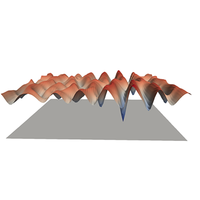
We find that the impact of active matter on Lagrangian coherent structures (LCSs) was much more significant compared to localized random noise with similar energy. This is because the perturbation generated by active matter could couple with the background flow and further deform the LCSs. In addition, rotational elliptical regions of the flow were much more susceptible to active matter perturbation than the hyperbolic regions. Lastly, we revealed that the LCSs could be decently altered even at a small number density of active matter.

High-fidelity reconstruction of large-area damaged turbulent fields with a physically constrained generative adversarial network

Qinmin Zheng, Tianyi Li, Benteng Ma, Lin Fu, and Xiaomeng Li

Phys. Rev. Fluids 9, 024608 (2024) - Published 29 February, 2024

In this work, we propose a novel framework for the high-fidelity reconstruction of large-area damaged turbulent fields with high resolution based on a physically constrained generative adversarial network. The network leverages complete/sparse fields of velocity components as physical constraints and adopts a PatchGAN discriminator network. The proposed reconstruction framework has been shown to achieve excellent reconstruction performance. The reconstructed flow fields are consistent with the raw flow fields in terms of magnitude, power spectrum, and two-point correlation function.

Viscoplastic rimming flow inside a rotating cylinder

Thomasina V. Ball and Neil J. Balmforth

Phys. Rev. Fluids 9, 023304 (2024) - Published 27 February, 2024

When a small fraction of viscoplastic fluid is placed into a rotating cylinder, steady states can be reached with pool at the bottom of the cylinder and a residual coating elsewhere. Lubrication theory used to model the film thickness builds on previous models by bridging between two asymptotic limits, incorporating both the gravitational force along the cylinder and the hydrostatic pressure gradients. The model predicts steady states are reached after a small number of rotations and allows exploration of drainage when the cylinder comes to a halt. Experiments using a Carbopol suspension provide a suitable comparison to test the thin film theory.

Plume-surface interaction during lunar landing using a two-way coupled DSMC-DEM approach

A. Bajpai, A. Bhateja, and R. Kumar

Phys. Rev. Fluids 9, 024306 (2024) - Published 23 February, 2024

In this investigation, a novel two-way coupled gas-granular solver is developed, incorporating direct simulation Monte Carlo (DSMC) for gas particle collisions and discrete element method (DEM) for granular particle interactions. Gas-grain interaction model consists of momentum and energy exchange between the two phases. Using this framework, we have performed a comprehensive study of dust dispersion due to plume impingement on a lunar surface. We have predicted not only the velocity field of gas and grain phases, but also their temperature field, which can be meaningful information for spacecraft designers.

Statistical state dynamics-based study of the stability of the mean statistical state of wall-bounded turbulence

Brian F. Farrell and Petros J. Ioannou

Phys. Rev. Fluids 9, 024605 (2024) - Published 21 February, 2024

In wall turbulence, the time-mean flow is returned to after almost any disturbance, which indicates that it is a stable statistical feature underlying the disorder of turbulence. However, the stability of this statistical feature can not be determined directly from the stability of the time-mean flow itself. What is required is a statistical stability analysis method. We determine the statistical stability of the time-mean state by averaging the dynamics of the return to the time-mean state over the turbulent attractor using the linear inverse model method.

Arresting of interfacial phase separation with an imposed flow

Ryuta X. Suzuki, Shoji Seya, Takahiko Ban, Manoranjan Mishra, and Yuichiro Nagatsu

Phys. Rev. Fluids 9, 024003 (2024) - Published 14 February, 2024

We experimentally investigate displacement of a more viscous liquid by a less viscous one in a Hele-Shaw cell using an aqueous two phase system, where phase separation occurs in the growing liquid-liquid interfacial region, by varying the injection flow rate and the phase separation rate. We show that the degree of the interfacial phase separation scales as a unique function of the ratio of the flow and phase separation rates and it decreases with the ratio. These results demonstrate that the interfacial phase separation is arrested by the imposed flow and determined by competition between the flow and phase separation rates. The arresting effect and the mechanism are numerically verified.

Instability and rupture of sheared viscous liquid nanofilms

Vira Dhaliwal, Christian Pedersen, Kheireddin Kadri, Guillaume Miquelard-Garnier, Cyrille Sollogoub, Jorge Peixinho, Thomas Salez, and Andreas Carlson

Phys. Rev. Fluids 9, 024201 (2024) - Published 8 February, 2024

Liquid nanofilms are subject to rupture due to intermolecular forces triggered by surface perturbations arising from thermal fluctuations. When a shear stress is imposed at the free surface it becomes stable in the direction of shear, but perturbations can still grow in the perpendicular direction to the shear.

Autothermotaxis of volatile drops

Pallav Kant, Mathieu Souzy, Nayoung Kim, Devaraj van der Meer, and Detlef Lohse

Phys. Rev. Fluids 9, L012001 (2024) - Published 31 January, 2024

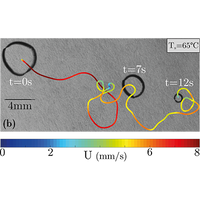
We present an extraordinary phenomenon that emerges from seemingly simple ingredients: a volatile droplet deposited on a highly wetting and heat-conducting warm substrate. Contrary to prevailing intuition that the deposited droplet would spread more and evaporate faster, we find that the droplet instead undergoes contraction and in addition it spontaneously and erratically moves, for substrate temperatures well below the boiling point of the liquid. We term this remarkable phenomenon “Autothermotaxis” and show that it originates from the thermal Marangoni flow in the droplet which undergoes an instability. The thermal Marangoni flow is also the reason for the contraction of the droplet.

Koopman-based model predictive control with morphing surface: Regulating the flutter response of a foil with an active flap

Tso-Kang Wang and Kourosh Shoele

Phys. Rev. Fluids 9, 014702 (2024) - Published 24 January, 2024

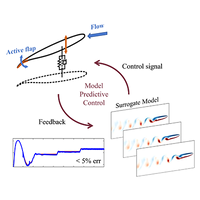
In this work, we demonstrated how model predictive control (MPC) can effectively manipulate a highly nonlinear foil-and-flap system to follow designated lift trajectories to sub-5% error. The surrogate model is built through a data-driven method merging fluidic and structural information which can be readily deployed to numerous fluid-structure interaction systems. The rapid optimization procedure utilized to generate the control signal can also be used for estimating ambient environmental change

Conformations, correlations, and instabilities of a flexible fiber in an active fluid

Scott Weady, David B. Stein, Alexandra Zidovska, and Michael J. Shelley

Phys. Rev. Fluids 9, 013102 (2024) - Published 18 January, 2024

Many biological systems rely on interactions between active processes and passive, deformable structures to properly function. An important example is chromatin in the cell nucleus, where ATP-powered processes, such as transcription or DNA repair, act on the chromatin fiber and influence its motion. Motivated by this system, in this study we develop and analyze a model of a flexible fiber in an active suspension as an analog to a chromatin fiber in an active environment - the nucleoplasm. Interactions between the suspension and the fiber lead to a novel bend instability, and nonlinear simulations identify coherent motions and conformations of the fiber over long timescales.

Dispersion and deformation of molecular patterns written in turbulent air

Willem van de Water, Nico Dam, and Enrico Calzavarini

Phys. Rev. Fluids 9, 014502 (2024) - Published 12 January, 2024

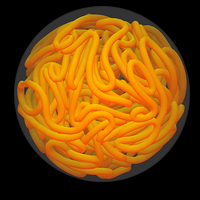
This letter “H” is written in turbulent air by tagging molecules in the focus of intense laser beams that cross in space. In the course of 40 microseconds, turbulence deforms and disperses the pattern. It could be used as a way to measure the velocity of the turbulent eddies. However, more importantly, it reveals the intricate interplay between molecular diffusion and turbulent dispersion.

Marangoni vortex rings in miscible spreading

Anurag Pant and Baburaj. A Puthenveettil

Phys. Rev. Fluids 9, L012701 (2024) - Published 11 January, 2024

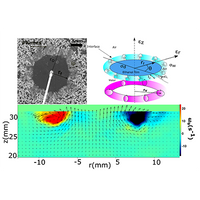
This work investigates the dynamics of a unique, radially expanding vortex ring in a water layer when a miscible, volatile drop of ethanol spreads as a film on the air-water interface. The study unravels the link between the dynamics at the interface and the generation of vorticity in the water layer below it. A novel scaling is proposed for the radius and velocity of such vortex rings, where they are shown to be dependent on time as well as the properties of the drop and the substrate.

Amplitude of water pouring sound

Mouad Boudina, Joonoh Kim, and Ho-Young Kim

Phys. Rev. Fluids 8, L122002 (2023) - Published 21 December, 2023
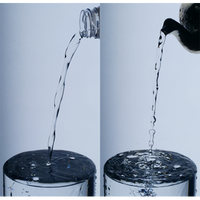
The familiar pouring sound we all hear when preparing tea or coffee has been a rare topic of study so far, despite its importance in several applications. We experimentally find that the sound amplitude increases with the jet corrugation, indicating that thin jets are louder than thick ones for the same given height. When pouring from a high distance, the jet breaks up into impacting drops, and the amplitude increases with the jet length and diameter. Results show that the jet corrugation relates to the volume of entrained air, hence the pouring sound can enter as a practical method to measure water aeration rates.

Sign In to Your Journals Account

Filter

Section

Filter

Article Lookup

Enter a citation