Highlights

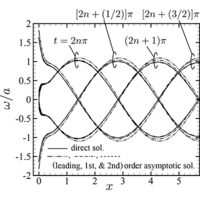
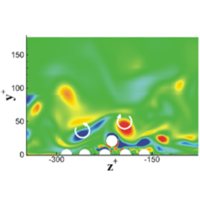
Absolute instability of impinging leading edge vortices in a submodel of a bileaflet mechanical heart valve

Hadi Zolfaghari and Dominik Obrist

Phys. Rev. Fluids 4, 123901 (2019) - Published 6 December, 2019

Mechanical heart valves have been linked to the production of unphysiological turbulent blood flow. As a first step toward a model for laminar-turbulent transition in this flow, an absolute instability in the impinging leading-edge vortices that develop between the valve leaflets is identified.

Bifurcations to turbulence in transitional channel flow

Masaki Shimizu and Paul Manneville

Phys. Rev. Fluids 4, 113903 (2019) - Published 22 November, 2019

In channel flow, the transition from turbulence displays a crossover from laminar-turbulent patterns following a two-dimensional directed-percolation scenario to a regime with localized turbulent bands statistically propagating along a single direction. A simple model accounts for this bifurcation.

Laboratory study of the wave-induced mean flow and set-down in unidirectional surface gravity wave packets on finite water depth

R. Calvert, C. Whittaker, A. Raby, P. H. Taylor, A. G. L. Borthwick, and T. S. van den Bremer

Phys. Rev. Fluids 4, 114801 (2019) - Published 22 November, 2019

We derive a multiple-scales solution for the Eulerian mean flow under wavepackets, which is driven by the divergence of Stokes drift and the setdown. This solution is valid for all water depths and is validated by flume experiments and recovers all previous solutions in their respective limits.

Characteristics of swimming shelled Antarctic pteropods (Limacina helicina antarctica) at intermediate Reynolds number regime

Mohammad Mohaghar, Deepak Adhikari, and Donald R. Webster

Phys. Rev. Fluids 4, 111101(R) (2019) - Published 15 November, 2019

Shelled Antarctic pteropods (aquatic snails nicknamed “sea butterflies”) swim with a pair of parapodia (or “wings”) in a high efficiency propulsion regime when the Reynolds number based on the flapping exceeds 35.

Logarithmic-layer turbulence: A view from the wall

Miguel P. Encinar and Javier Jiménez

Phys. Rev. Fluids 4, 114603 (2019) - Published 11 November, 2019

The observability of the flow away from the wall in turbulent channels is studied using noiseless, although potentially incomplete, wall measurements. The reconstructions deteriorate with the distance to the wall, but coherent motions are still observable.

Density contrast matters for drop fragmentation thresholds at low Ohnesorge number

Florence Marcotte and Stéphane Zaleski

Phys. Rev. Fluids 4, 103604 (2019) - Published 25 October, 2019

Droplet breakup is classically controlled by the ratio of flow kinetic to surface energy (Weber number). From axisymmetric simulations and simple model-scaling arguments we show how the critical Weber numbers for breakup and bursting/stripping transition depend on the droplet/carrier density ratio.

Whiskey webs: Microscale “fingerprints” of bourbon whiskey

Stuart J. Williams, Martin J. Brown, VI, and Adam D. Carrithers

Phys. Rev. Fluids 4, 100511 (2019) - Published 24 October, 2019

The evaporation of a drop of American whiskey leaves a characteristic web-like pattern that isn’t observed in Scotch whisky and other distillates.

Sound waves propagating in a slightly rarefied gas over a smooth solid boundary

Masanari Hattori and Shigeru Takata

Phys. Rev. Fluids 4, 103401 (2019) - Published 11 October, 2019

A fluid-dynamic-type system for acoustic phenomena in the slip-flow regime is obtained with an asymptotic analysis of the linearized Boltzmann equation. The system permits a comprehensive understanding of the phenomena. The occurrence of various non-Navier-Stokes effects is clarified.

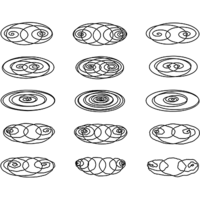
Hydrodynamics and rheology of a vesicle doublet suspension

Bryan Quaife, Shravan Veerapaneni, and Y.-N. Young

Phys. Rev. Fluids 4, 103601 (2019) - Published 10 October, 2019

Effects of membrane-membrane adhesion on vesicle hydrodynamics are studied theoretically (using lubrication theory) and numerically (using time-adaptive boundary integral simulations). Novel vesicle dynamics are quantified to help design future microfluidic experiments to probe membrane adhesion.

Fully resolved simulations of a stationary finite-sized particle in wall turbulence over a rough bed

Xing Li, S. Balachandar, Hyungoo Lee, and Bofeng Bai

Phys. Rev. Fluids 4, 094302 (2019) - Published 26 September, 2019

Direct numerical simulations are used to investigate forces on a stationary finite-sized particle in wall turbulence over a rough bed of hemispherical particles. Results show that lift is the main contributor of wall-normal force and can be well predicted with proper application of existing models.

Internal waves in a shear background current: Transition from solitary-wave regime to dispersive-wave regime

Chengzhu Xu and Marek Stastna

Phys. Rev. Fluids 4, 094801 (2019) - Published 11 September, 2019

For a given stratification, the presence of a shear background current may significantly alter the wave form of internal waves. Depending on the direction and strength of background shear, it could prevent the formation of solitary waves but enable the formation of a dispersive wave train.

Extensional rheology of a dilute particle-laden viscoelastic solution

Anika Jain, Jonas Einarsson, and Eric S. G. Shaqfeh

Phys. Rev. Fluids 4, 091301(R) (2019) - Published 9 September, 2019

Numerical simulations of viscoelastic flow around an isolated particle find that, while the particle contribution to bulk elongational viscosity of a suspension increases at small strains, at larger strains the particle is shielded by stretched polymers, leading to a decrease in relative viscosity.

Controlled gliding and perching through deep-reinforcement-learning

Guido Novati, L. Mahadevan, and Petros Koumoutsakos

Phys. Rev. Fluids 4, 093902 (2019) - Published 6 September, 2019

Gliding is an energetically efficient mode of transportation. It is shown that reinforcement learning identifies gliding strategies with minimum energy expenditure and fastest time of arrival, with better performance than model-based optimal control, while being robust to perturbations.

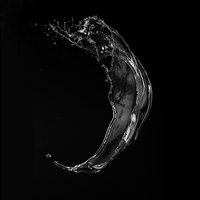
Wind-sustained viscous solitons

M. Aulnette, M. Rabaud, and F. Moisy

Phys. Rev. Fluids 4, 084003 (2019) - Published 21 August, 2019

Wind blown at very viscous liquid surface generates a small amplitude wave packet which sporadically forms large-amplitude fluid bumps rapidly propagating downstream. These viscous solitons, emitted in a region of large shear stress, are sustained by the wind and propagate in a lower stress region.

Controlling capillary fingering using pore size gradients in disordered media

Nancy B. Lu, Christopher A. Browne, Daniel B. Amchin, Janine K. Nunes, and Sujit S. Datta

Phys. Rev. Fluids 4, 084303 (2019) - Published 21 August, 2019

A pore size gradient dramatically alters the pathway taken by a nonwetting fluid as it flows through a porous medium. Microfluidic experiments and pore-network modeling elucidate how this behavior depends on the competition between the gradient and pore-scale disorder.

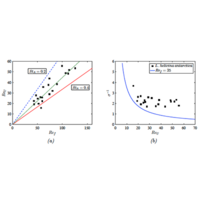
Self-propulsion of a helical swimmer in granular matter

Rogelio Valdés, Verónica Angeles, Elsa de la Calleja, and Roberto Zenit

Phys. Rev. Fluids 4, 084302 (2019) - Published 13 August, 2019

An experimental study of the motion of a self-propelled helix in granular matter shows that there is an optimal pitch angle at which the swimming speed reaches a maximum value. The measurements are compared with predictions with granular resistive force theory, leading to good agreement.

Viscoelastic film flows over an inclined substrate with sinusoidal topography. I. Steady state

D. Pettas, G. Karapetsas, Y. Dimakopoulos, and J. Tsamopoulos

Phys. Rev. Fluids 4, 083303 (2019) - Published 8 August, 2019

Fluid elasticity opposes inertia, creating a static hump and a cusp ahead of it on the film free surface. Nonlinear phenomena, such as resonance of the liquid film with the bottom undulations, are intensified or suppressed by the presence of shear-thinning and elasticity.

Viscoelastic film flows over an inclined substrate with sinusoidal topography. II. Linear stability analysis

D. Pettas, G. Karapetsas, Y. Dimakopoulos, and J. Tsamopoulos

Phys. Rev. Fluids 4, 083304 (2019) - Published 8 August, 2019

Stability to linear disturbances of arbitrary wavelength is studied using Floquet theory. Fluid elasticity stabilizes the flow and creates a small window where all disturbances are damped at supercritical conditions. Shear-thinning is destabilizing and may generate disturbances of wavelength shorter than that of the geometry.

Segmented flows of viscous threads in microchannels

Thomas Cubaud

Phys. Rev. Fluids 4, 084201 (2019) - Published 8 August, 2019

Hydrodynamic interactions between droplets and high-viscosity fluid threads are investigated in microchannels. A complementary approach is adopted where the thread size is varied for diverse droplet concentrations to help reveal a range of basic fluid structures.

Statistics of rigid fibers in strongly sheared turbulence

Dennis Bakhuis, Varghese Mathai, Ruben A. Verschoof, Rodrigo Ezeta, Detlef Lohse, Sander G. Huisman, and Chao Sun

Phys. Rev. Fluids 4, 072301(R) (2019) - Published 15 July, 2019

Despite tremendous turbulent fluctuation in a high-Reynolds number Taylor-Couette flow, dispersed millimetric fibers show a preferred alignment with respect to the inner cylinder of the apparatus. Using a simplified model based on Jeffery’s equations, the orientation can be reasonably predicted.

Sign In to Your Journals Account

Filter

Section

Filter

Article Lookup

Enter a citation