Highlights

Gravity-driven thermoviscous liquid film down a heated or cooled vertical cylinder

Sana Khanum and Naveen Tiwari

Phys. Rev. Fluids 5, 094005 (2020) - Published 18 September, 2020

Gravity-driven flow of a liquid over an isothermal cylinder is unconditionally unstable. The flow of a thermoviscous fluid over a heated or cooled substrate shows interesting stability behavior. The relevant parameters in the model affect the spatiotemporal nature of the instability.

Statistical transition to turbulence in plane channel flow

Sébastien Gomé, Laurette S. Tuckerman, and Dwight Barkley

Phys. Rev. Fluids 5, 083905 (2020) - Published 25 August, 2020

The subcritical route to turbulence in shear flows is characterized by metastable localized turbulent-laminar patterns. In plane channel flow, these take the form of intermittent oblique turbulent bands, which either proliferate or decay on timescales that depend on the Reynolds number. A statistical study via direct numerical simulations in a narrow tilted domain leads to the determination of a crossing Reynolds number of around 965, above which the probability for a band to split outpaces its probability to disappear.

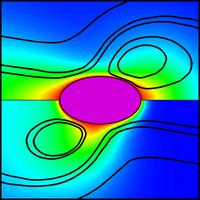
Lift induced by slip inhomogeneities in lubricated contacts

Aidan Rinehart, Uğis Lācis, Thomas Salez, and Shervin Bagheri

Phys. Rev. Fluids 5, 082001(R) (2020) - Published 11 August, 2020

A small change of slip boundary condition within a lubrication region breaks the fore-aft symmetry, which leads to a significant lift force. The change of slippage arises naturally on surfaces where physical and/or chemical properties are not perfectly constant. The induced lift force may result in nontrivial trajectories of particles traveling near surfaces.

Particle monolayer assembly in evaporating salty colloidal droplets

Myrthe A. Bruning, Laura Loeffen, and Alvaro Marin

Phys. Rev. Fluids 5, 083603 (2020) - Published 10 August, 2020

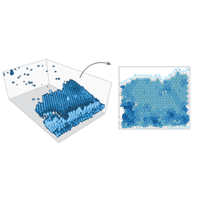
Evaporating a sessile colloidal droplet containing small amounts of salt results in the formation of a ring-shaped stain, resembling the classical coffee-stain effect. However, this ring shape is the only similarity: The structure is actually formed by a single monolayer of particles at the liquid-air interface of the droplet and driven by a solutal Marangoni flow. An experimental study, particle-per-particle, of the formation of this monolayer is presented and numerical simulations are performed to understand the particle aggregation mechanism.

Lagrangian and Eulerian drag models that are consistent between Euler-Lagrange and Euler-Euler (two-fluid) approaches for homogeneous systems

S. Balachandar

Phys. Rev. Fluids 5, 084302 (2020) - Published 10 August, 2020

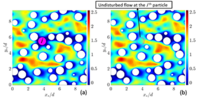
The undisturbed flow of a particle controls both the undisturbed flow force and the perturbation (quasi-steady, added-mass and history) forces. With the pairwise interaction extended point particle framework we evaluate the undisturbed flow of each particle in a random array through superposition of the perturbation flow induced by all its neighbors. From this the undisturbed flow statistics can be calculated. We obtain a force consistency relation between drag on an individual particle for use in an Euler-Lagrange simulation and the average drag suitable for use in an Euler-Euler simulation.

Coherent turbulence and entrainment in a supersonic, axisymmetric, separated/reattaching shear layer

Branden M. Kirchner, Gregory S. Elliott, and J. Craig Dutton

Phys. Rev. Fluids 5, 084605 (2020) - Published 10 August, 2020

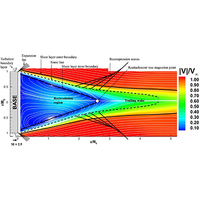
Pressure loading in massively separated flow regions is intimately tied to the entrainment characteristics of the separated shear layer, which also determines the streamwise distance required for shear layer reattachment. Using stereoscopic particle image velocimetry measurements of a Mach 2.49 longitudinal cylinder wake, a clear relationship between the presence of coherent turbulent structures (i.e., hairpin vortices) and the shear layer reattachment length is demonstrated.

Generation of weakly nonlinear turbulence of internal gravity waves in the Coriolis facility

Clément Savaro, Antoine Campagne, Miguel Calpe Linares, Pierre Augier, Joël Sommeria, Thomas Valran, Samuel Viboud, and Nicolas Mordant

Phys. Rev. Fluids 5, 073801 (2020) - Published 20 July, 2020

The oceans’ interior is stratified in density and thus can sustain internal wave propagation. These waves, when nonlinear, can generate a state of wave turbulence and contribute significantly to the global energy dissipation of ocean circulation. However, a full theoretical description of the statistical properties of such stratified turbulence is still being sought. We performed very large scale experiments in the Coriolis facility in Grenoble, France and observed a state of wave turbulence of internal waves, which will enable comparisons with theory and numerical simulations.

Effects of shear-thinning viscosity and viscoelastic stresses on flagellated bacteria motility

Zijie Qu and Kenneth S. Breuer

Phys. Rev. Fluids 5, 073103 (2020) - Published 10 July, 2020

Experiments show that shear-thinning viscosity experienced by rotating flagella is the major reason for the enhancement of bacterial swimming speed in a non-Newtonian fluid. Shear-induced normal stress plays an important role in promoting flagella bundling.

Revisiting the Taylor-Culick approximation: Retraction of an axisymmetric filament

Jean-Lou Pierson, Jacques Magnaudet, Edson José Soares, and Stéphane Popinet

Phys. Rev. Fluids 5, 073602 (2020) - Published 10 July, 2020

The Taylor-Culick approximation for a filament is revisited using numerical simulations. When the inertia force balances the surface tension force, a spherical blob appears at the extremity of the filament. This feature has a key impact on the tip dynamics, which moves with an oscillating velocity that has a mean value close to the Taylor-Culick prediction. On the other hand, in the viscous dominated regime, the radius of the filament grows uniformly over time, and no blob forms, making the tip velocity decrease after a short transient.

Ultralow effective interfacial tension between miscible molecular fluids

Alessandro Carbonaro, Luca Cipelletti, and Domenico Truzzolillo

Phys. Rev. Fluids 5, 074001 (2020) - Published 10 July, 2020

For sufficiently low interfacial tension, spinning drops develop dumbbell shapes, with two large heads connected by a thinner central body. The time evolution of such shapes is exploited to investigate the effective interfacial tension (EIT) at the boundary between miscible molecular fluids. The EIT is found to be as low as 250 nN/m in water-glycerol systems, in excellent agreement with values calculated via an existing phase field model.

Self-learning how to swim at low Reynolds number

Alan Cheng Hou Tsang, Pun Wai Tong, Shreyes Nallan, and On Shun Pak

Phys. Rev. Fluids 5, 074101 (2020) - Published 10 July, 2020

Machine learning is integrated into low-Reynolds-number locomotion to enable a class of self-learning, adaptive (smart), micro-swimmers. Instead of specifying locomotory gaits in advance, a self-learning swimmer develops and adapts its propulsion strategy based on interactions with the surroundings via reinforcement learning. Without requiring prior knowledge, the swimmer can recover previously known propulsion strategies, and improve and adapt in different media. This development can enable the design of smart micro-robots with robust locomotive capabilities in complex environments

Experimental realization of broadband control of water-wave-energy amplification in chirped arrays

A. J. Archer, H. A. Wolgamot, J. Orszaghova, L. G. Bennetts, M. A. Peter, and R. V. Craster

Phys. Rev. Fluids 5, 062801(R) (2020) - Published 24 June, 2020

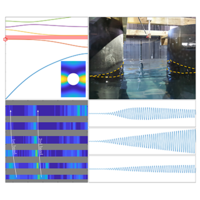
An experimental demonstration is presented that a chirped array of cylinders can be designed to control the spatial distribution of water wave energy and substantially amplify target frequencies at specified locations, over a broad range of frequencies, consistent with linear band-gap theory.

Axisymmetric squirmers in Stokes fluid with nonuniform viscosity

Patrick S. Eastham and Kourosh Shoele

Phys. Rev. Fluids 5, 063102 (2020) - Published 24 June, 2020

Numerical techniques are employed to study the locomotion of a spheroidal squirmer in a complex fluid with a nutrient-dependent viscosity. It is found that the nonuniform viscosity significantly affects the pressure field around the swimmer rather than the velocity field. Results obtained here will be helpful in interpreting experimental observation where a microswimmer significantly affects a fluid’s local rheology.

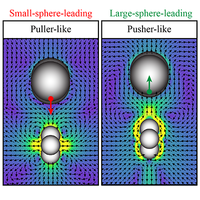
Kinematics of a simple reciprocal model swimmer at intermediate Reynolds numbers

Thomas Dombrowski and Daphne Klotsa

Phys. Rev. Fluids 5, 063103 (2020) - Published 24 June, 2020

A study of the kinematics, power and recovery strokes, fluid flows, and efficiency of a reciprocal dumbbell swimmer with finite inertia finds that the swimmer’s average flow field is dominated by the flow during its power stroke, and it switches from pullerlike to pusherlike depending on the (finite) Reynolds number.

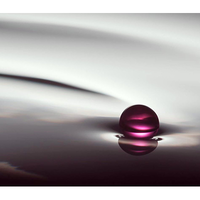
Self-induced flows enhance the levitation of Leidenfrost drops on liquid baths

Benjamin Sobac, Laurent Maquet, Alexis Duchesne, Hatim Machrafi, Alexey Rednikov, Pierre Dauby, Pierre Colinet, and Stéphane Dorbolo

Phys. Rev. Fluids 5, 062701(R) (2020) - Published 9 June, 2020

In a study of the Leidenfrost levitation of a droplet on a hot liquid bath, rather than, classically, on an extremely hot plate, an existential feedback is revealed. The droplet induces a bath flow, whose fickle structure is explored both experimentally and theoretically. In turn, the flow drastically enhances the heat transfer to the droplet by convective means, thus ensuring such an evaporative levitation despite the poorly conducting liquid medium of the bath.

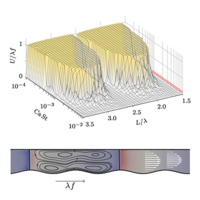
Microfluidic slug transport on traveling-wave surface topographies by mechanowetting

Edwin de Jong, Jaap M. J. Den Toonder, and Patrick R. Onck

Phys. Rev. Fluids 5, 063604 (2020) - Published 8 June, 2020

A theoretical study shows that mechanowetting can transport fluid compartments by means of traveling surface waves. Mechanowetting is a propulsion mechanism that exploits capillary forces at fluid interfaces and deforming surface topographies, enabling fluid slugs to be transported at the speed of the surface waves. The effectiveness of the method for microfluidic propulsion is quantified by means of computational fluid dynamics simulations and an intuitive theoretical model.

Formation of twisted liquid jets

Akira Kageyama and Yuna Goto

Phys. Rev. Fluids 5, 064002 (2020) - Published 8 June, 2020

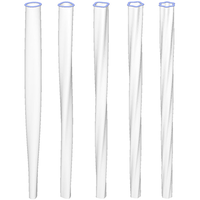
Surface oscillations of a liquid jet, like water falling from a faucet, are common. For an orifice with n-fold rotational symmetry, the jet cross section oscillates between two symmetrical shapes. Called axis switching, it is a standing wave superposition of two opposite azimuthal ripples. We show that by adjusting the velocity profile at the orifice just one ripple can form. The jet surface is twisted from the single ripple, although the jet has no axial angular momentum. Simulations show that twisted jets can form with various n-fold rotational symmetries, including the regular square.

Saturation and coercivity limit the velocity of rotating active magnetic microparticles

Kiarash Samsami, Seyed Amir Mirbagheri, Farshad Meshkati, and Henry Chien Fu

Phys. Rev. Fluids 5, 064202 (2020) - Published 8 June, 2020

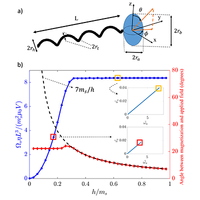
The magnetization of real materials responds to the applied magnetic field, notably by saturating at a maximum magnitude and being coerced to be closer to the applied field direction. These effects are particularly important for soft magnetic materials, which are often used in magnetic microrobotic swimmers. Previous understanding has been based on models of permanent magnets which neglect these effects, but new work shows that taking them into account leads to an unappreciated physical limit on swimming velocities for magnetically rotated microswimmers.

Robust principal component analysis for modal decomposition of corrupt fluid flows

Isabel Scherl, Benjamin Strom, Jessica K. Shang, Owen Williams, Brian L. Polagye, and Steven L. Brunton

Phys. Rev. Fluids 5, 054401 (2020) - Published 28 May, 2020

Robust principal component analysis (RPCA) is a powerful technique from robust statistics that can be used to extract dominant coherent structures from flow fields corrupted with outliers and missing measurements. The effectiveness of RPCA on flows acquired experimentally and by simulation is demonstrated. In all cases, RPCA is able to de-noise these fields and vastly improve subsequent modal analysis, showing that RPCA can be used to robustly process particle image velocimetry flow fields.

Using braids to quantify interface growth and coherence in a rotor-oscillator flow

Margaux Filippi, Marko Budišić, Michael R. Allshouse, Séverine Atis, Jean-Luc Thiffeault, and Thomas Peacock

Phys. Rev. Fluids 5, 054504 (2020) - Published 22 May, 2020

The growth rate of material interfaces is an important proxy for mixing and reaction rates in fluid dynamics. Within experimental limits, mathematical braids can be used to identify regions of coherence within the flow that are distinct from regions of high mixing and to estimate growth rates of material interfaces.

Sign In to Your Journals Account

Filter

Section

Filter

Article Lookup

Enter a citation