Highlights

Feedback-free microfluidic oscillator with impinging jets

A. Bertsch, A. Bongarzone, M. Duchamp, P. Renaud, and F. Gallaire

Phys. Rev. Fluids 5, 054202 (2020) - Published 13 May, 2020

Microscale pulsatile liquid flows which self-oscillate in laminar flow conditions and are based on facing impinging jets were studied both experimentally and using direct numerical simulations. The two facing jets first bifurcate in opposite directions and later approach one another, collide, and switch sides, with a regular periodicity. Experimentally, the evolution of the self-oscillation frequency was shown to be dependent on the jet separation distance and average velocity. Simulated velocity fields provide information on vortical flow structure evolution at the self-oscillation onset.

Reconstructing the time evolution of wall-bounded turbulent flows from non-time-resolved PIV measurements

C. Vamsi Krishna, Mengying Wang, Maziar S. Hemati, and Mitul Luhar

Phys. Rev. Fluids 5, 054604 (2020) - Published 13 May, 2020

Laboratory Particle Image Velocimetry (PIV) systems are often limited in their ability to resolve broadband spatio-temporal fluctuations in turbulent flows due to hardware constraints. Here we develop linear models to reconstruct the time evolution of wall-bounded turbulent flows from non-time resolved PIV snapshots. These models are integrated forward and backward in time using the snapshots as initial conditions, and the resulting predictions fused. This retains small-scale fluctuations in the flow field and resolves velocity spectra at frequencies higher than the system Nyquist limit.

Modeling and design optimization for pleated membrane filters

Yixuan Sun, Pejman Sanaei, Lou Kondic, and Linda J. Cummings

Phys. Rev. Fluids 5, 044306 (2020) - Published 27 April, 2020

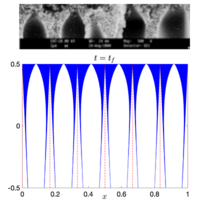
Pleated membrane filters are used in a wide variety of applications. A model is derived to predict and optimize the performance of a pleated membrane filter (in terms of how pore radius varies in the depth of the filter membrane) as adsorptive fouling (standard blocking) occurs. For the chosen objective function the optimized pore shape is found to be funnel-like. The model may be the first to predict deterioration in particle retention with standard blocking alone.

Increase of turbulent drag by polymers in particle suspensions

Marco Edoardo Rosti and Luca Brandt

Phys. Rev. Fluids 5, 041301(R) (2020) - Published 7 April, 2020

Viscoelastic turbulent flows of particle suspensions are studied using direct numerical simulations. In the presence of a moderate concentration of particles, the beneficial effect of polymers in terms of drag reduction are lost, and an increase in drag is observed for sufficiently dense suspensions.

From modulational instability to focusing dam breaks in water waves

Félicien Bonnefoy, Alexey Tikan, François Copie, Pierre Suret, Guillaume Ducrozet, Gaurav Prabhudesai, Guillaume Michel, Annette Cazaubiel, Eric Falcon, Gennady El, and Stéphane Randoux

Phys. Rev. Fluids 5, 034802 (2020) - Published 27 March, 2020

The Benjamin-Feir, or modulational, instability has been regarded as the main mechanism of spontaneous disintegration of broad weakly nonlinear wavepackets in deep water waves. We report water wave experiments with another result. For a range of initial parameters, a nearly rectangular initial wavepacket develops a strongly nonlinear modulation with two dispersive shock waves expanding from the edges of the wavepacket towards the center at finite speed. This is supported by theory based on the semiclassical limit of the one-dimensional focusing nonlinear Schrodinger equation.

Local analysis of the clustering, velocities, and accelerations of particles settling in turbulence

Mohammadreza Momenifar and Andrew D. Bragg

Phys. Rev. Fluids 5, 034306 (2020) - Published 20 March, 2020

We use three-dimensional Voronoi tessellation to perform a local analysis of particle motion in isotropic turbulence while independently varying the flow Reynolds and Froude number, and particle Stokes number. Among other interesting findings, our local analysis shows that in flow regions where particles are clustered, fluid accelerations at the particle positions are significant. These results call into question the validity of the “sweep-stick” mechanism for particle clustering in turbulence, which states that inertial particles cluster in flow regions where the fluid acceleration is zero.

Theory for undercompressive shocks in tears of wine

Yonatan Dukler, Hangjie Ji, Claudia Falcon, and Andrea L. Bertozzi

Phys. Rev. Fluids 5, 034002 (2020) - Published 17 March, 2020

Tears of wine, in which a thin layer of a water-ethanol mixture travel up an inclined surface against gravity and then fall down in the form of tears, have been observed in wine glasses for centuries. It has been modeled with a conservation law with a nonconvex flux and higher order diffusion due to the bulk surface tension. The resulting nonclassical “undercompressive” shock solutions are the main driver of the destabilizing front forming the “wine tears”. Prior modeling did not address the wine tears but rather the behavior of the film at earlier stages and the behavior of the meniscus.

Initial regime of drop coalescence

Christopher R. Anthony, Michael T. Harris, and Osman A. Basaran

Phys. Rev. Fluids 5, 033608 (2020) - Published 13 March, 2020

What is the initial regime of coalescence when two drops just touch at a point? This long-standing problem has proven formidable because of the smallness of the bridge that is required to connect the drops at the initial instant in any continuum simulation. Here, initial bridge radii, heights, and radii of curvature as small as 10−6, 10−12, and 10−18 are achieved, showing that coalescence always begins in a Stokes regime. The inertially limited viscous regime is shown to be a Taylor-Culick-like regime seen only when drops are initially separated by a finite distance.

Bouncing, chasing, or pausing: Asymmetric collisions of active droplets

Kevin Lippera, Michael Benzaquen, and Sébastien Michelin

Phys. Rev. Fluids 5, 032201(R) (2020) - Published 10 March, 2020

Small differences in the size of colliding chemically active droplets lead to three strikingly different dynamic behaviours: (i) an asymmetric rebound where both droplets reverse directions, (ii) a chasing regime leading to a bound state with both droplets swimming together, and (iii) a pausing regime where the larger droplet is temporarily stopped. Such diversity and sensitivity of the exact droplet properties may influence the complex collective dynamics of chemically active droplets.

Retraction dynamics of water droplets after impacting upon solid surfaces from hydrophilic to superhydrophobic

Fujun Wang and Tiegang Fang

Phys. Rev. Fluids 5, 033604 (2020) - Published 10 March, 2020

The retraction dynamics of water droplets impacting on surfaces with different wettabilities is studied. Three modes of droplet retractions can be classified as inertial, capillary, and spherical-cap. A new model is proposed to predict the inertial-mode retraction rate of water droplets on different surfaces. The scaling of retraction curves is revised to reveal the similarity behavior of droplet retraction dynamics.

Active matter in a viscoelastic environment

Emmanuel L. C. VI M. Plan, Julia M. Yeomans, and Amin Doostmohammadi

Phys. Rev. Fluids 5, 023102 (2020) - Published 24 February, 2020

A two-phase model of active nematic matter within a passive polymeric phase is shown to capture important cellular dynamics, such as cell division and motility, in viscoelastic fluids. The results show the suppressing effect of polymer relaxation and viscosity on the dynamics of active matter.

Friction scaling laws for transport in active turbulence

Sanjay C. P. and Ashwin Joy

Phys. Rev. Fluids 5, 024302 (2020) - Published 13 February, 2020

A continuum model is used to study the transport of light particles in a dense bacterial suspension. Universal scaling laws are provided for the diffusion coefficient, mean vortex size, and relaxation time as a function of fluid friction. The findings should apply to transport phenomena in generic active systems such as dense bacterial suspensions, microtubule networks, or even artificial swimmers, to name a few.

Multiscale approach to model steady meniscus evaporation in a wetting fluid

Kishan Bellur, Ezequiel F. Médici, Chang Kyoung Choi, James C. Hermanson, and Jeffrey S. Allen

Phys. Rev. Fluids 5, 024001 (2020) - Published 10 February, 2020

Evaporation flux in the thin transition film close to the wall is up to 100 times greater than at the center of a wetting meniscus. Despite higher evaporation flux, the thin film accounts for a relatively small part of the total evaporation from the liquid-vapor interface. The thin-film contribution is directly proportional to the solid wall thermal conductivity and inversely proportional to vapor pressure and Bond number.

Buoyancy-driven dispersion in confined drying of liquid binary mixtures

Jean-Baptiste Salmon and Frédéric Doumenc

Phys. Rev. Fluids 5, 024201 (2020) - Published 10 February, 2020

The impact of buoyancy on the solute mass transport in an evaporating liquid mixture confined in a horizontal slit is studied theoretically. Solvent evaporation at one end of the slit induces solute concentration gradients, which, in turn, drive free convection, thus dispersing solutes in a steadily increasing length scale along the slit.

Coupled convection and internal gravity waves excited in water around its density maximum at 4°C

P. Léard, B. Favier, P. Le Gal, and M. Le Bars

Phys. Rev. Fluids 5, 024801 (2020) - Published 5 February, 2020

Experiments and three-dimensional direct numerical simulations are carried out to investigate the interaction between a turbulent convective layer and a stratified layer in a self-organizing fluid. Internal gravity waves are generated, and a reversing horizontal large-scale flow is seen in the stratified layer, driven by a third intermediate layer.

Instability and dripping of electrified liquid films flowing down inverted substrates

R. J. Tomlin, R. Cimpeanu, and D. T. Papageorgiou

Phys. Rev. Fluids 5, 013703 (2020) - Published 29 January, 2020

The multiphysics problem of a liquid film wetting an inclined substrate under the influence of a stabilizing electric field is considered. The use of a spatial stability analysis to predict the threshold of dripping suppression is assessed via reduced-order modeling and direct numerical simulation.

Two regime cooling in flow induced by a spark discharge

Bhavini Singh, Lalit K. Rajendran, Pavlos P. Vlachos, and Sally P. M. Bane

Phys. Rev. Fluids 5, 014501 (2020) - Published 14 January, 2020

Cooling of the flow induced by a spark plasma discharge is found to occur at two different rates: an initially fast cooling regime followed by a slow cooling regime. Convective cooling in the fast regime contributes to 30–50% of the total cooling and occurs within the first millisecond of the induced flow.

Asymmetric rectified electric fields generate flows that can dominate induced-charge electrokinetics

Aref Hashemi, Gregory H. Miller, and William D. Ristenpart

Phys. Rev. Fluids 5, 013702 (2020) - Published 8 January, 2020

Extant theories for induced-charge electrokinetics (ICEK) sometimes fail to predict even the correct direction of flow. By combining the recently discovered phenomenon of asymmetric rectified electric fields with a generalized form of ICEK, this long-standing dilemma is explained.

Transient growth in thermocapillary liquid layers

Kai-Xin Hu, Sheng Zheng, and Qi-Sheng Chen

Phys. Rev. Fluids 5, 014001 (2020) - Published 6 January, 2020

Transient growth in thermocapillary liquid layers is examined by nonmodal stability theory. Rather large transient growth occurs in subcritical flows at small Prandtl numbers. The growth decreases with Prandtl number but increases with Biot number, while its energy comes from the basic flow.

Gravity induced formation of spinners and polar order of spherical microswimmers on a surface

Zaiyi Shen and Juho S. Lintuvuori

Phys. Rev. Fluids 4, 123101 (2019) - Published 12 December, 2019

When squirmer type swimmers sediment on a flat surface, the near field hydrodynamic interactions lead to the formation of small spinners at low concentrations. Higher surface coverage results in a polar order of the swimmers and a particle vortex is observed when confined by a circular wall.

Sign In to Your Journals Account

Filter

Section

Filter

Article Lookup

Enter a citation