Highlights

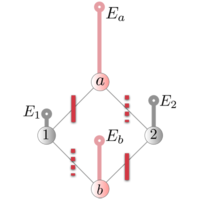
Cascades in multiplex financial networks with debts of different seniority

Charles D. Brummitt and Teruyoshi Kobayashi

Phys. Rev. E 91, 062813 (2015) - Published 24 June, 2015

A model of a banking network predicts the balance of high- and low-priority debts that ensures financial stability.

Dusty plasma cavities: Probe-induced and natural

B. J. Harris, L. S. Matthews, and T. W. Hyde

Phys. Rev. E 91, 063105 (2015) - Published 22 June, 2015

The dust particles contained in a complex plasma can form two-dimensional crystals, and the authors experimentally study cavities formed in these crystals. They show that cavities that are produced by positively and negatively charged probes, and those that are naturally occurring, are due to three different mechanisms.

Optimizing information flow in small genetic networks. IV. Spatial coupling

Thomas R. Sokolowski and Gašper Tkačik

Phys. Rev. E 91, 062710 (2015) - Published 15 June, 2015

The authors construct a spatial-stochastic model of gene regulation and analyze the effect of spatial coupling on the ability of a genetic network to specify positional information. They find conditions in which diffusive coupling can markedly improve information transmission in spatially coupled stochastic gene expression models.

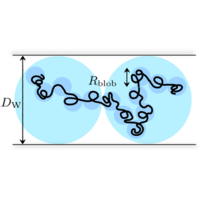
Cylindrical confinement of semiflexible polymers

Pablo Vázquez-Montejo, Zachary McDargh, Markus Deserno, and Jemal Guven

Phys. Rev. E 91, 063203 (2015) - Published 15 June, 2015

The authors study shapes and associated forces for a closed semiflexible polymer bound to the inside or the outside of a cylinder.

Spatial distribution of thermal energy in equilibrium

Yohai Bar-Sinai and Eran Bouchbinder

Phys. Rev. E 91, 060103(R) (2015) - Published 9 June, 2015

According to the equipartition theorem, in a classical system at equilibrium, thermal energy is equally distributed among the degrees of freedom appearing as quadratic forms in the Hamiltonian. Asking the question what is the spatial distribution of the thermal energy, the authors find a general upper bound and show that the details depend on dimensionality, interactions, and disorder.

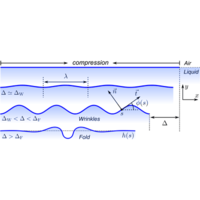
Wrinkles and folds in a fluid-supported sheet of finite size

Oz Oshri, Fabian Brau, and Haim Diamant

Phys. Rev. E 91, 052408 (2015) - Published 29 May, 2015

A laterally compressed sheet floating on a liquid shows a pattern of regular wrinkles, and as compression increases eventually goes through a transition to a single narrow fold. A previous calculation for infinite sheets did not reproduce this experimentally observed wrinkle-to-fold transition, but the authors’ extension of the theory to sheets of finite size does account for it.

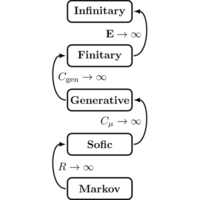
Signatures of infinity: Nonergodicity and resource scaling in prediction, complexity, and learning

James P. Crutchfield and Sarah Marzen

Phys. Rev. E 91, 050106(R) (2015) - Published 27 May, 2015

The authors develop a method for analysis of time series generated by a class of complex processes. They identify the mechanism that causes information divergence at each level in a hierarchy of such processes.

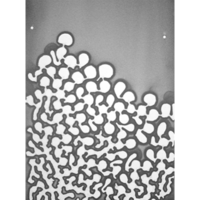
Bubbles breaking the wall: Two-dimensional stress and stability analysis

Jon Alm Eriksen, Benjy Marks, Bjørnar Sandnes, and Renaud Toussaint

Phys. Rev. E 91, 052204 (2015) - Published 26 May, 2015

The authors consider a system of air invading a mixture of liquid and beads, where for a large enough fraction of beads the air forms a network of bubbles connected by small channels. In order to understand the intermittent dynamics of the bubble formation, they develop a model of the stress in the packed beads at the edge of the bubbles.

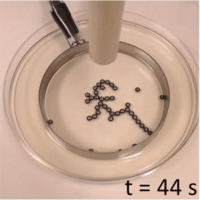
End-directed evolution and the emergence of energy-seeking behavior in a complex system

Dilip Kondepudi, Bruce Kay, and James Dixon

Phys. Rev. E 91, 050902(R) (2015) - Published 18 May, 2015

Conducting beads in a viscous fluid are subjected to a high voltage. The authors observe the formation of a mobile treelike structure that evolves towards dynamic states with higher total current, or equivalently, higher rates of entropy production.

Scaling regimes of a semiflexible polymer in a rectangular channel

E. Werner and B. Mehlig

Phys. Rev. E 91, 050601(R) (2015) - Published 14 May, 2015

Semiflexible polymers in channels with a rectangular cross section are studied as models for DNA molecules confined to nanochannels. The authors find that the average extension of the polymers is approximately independent of the rectangle aspect ratio, whereas the extension variance depends strongly on both dimensions of the rectangle.

Stochastic thermodynamics of hidden pumps

Massimiliano Esposito and Juan M. R. Parrondo

Phys. Rev. E 91, 052114 (2015) - Published 11 May, 2015

The authors consider a reversible driving mechanism operating between two states of a small system. In a coarse-grained description of the system that hides the driving mechanism, the estimated entropy production will be higher than the true one, contrary to what would be expected.

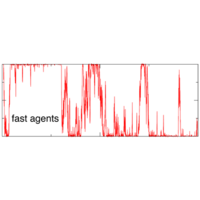
Follow the leader: Herding behavior in heterogeneous populations

Guillem Mosquera-Doñate and Marián Boguñá

Phys. Rev. E 91, 052804 (2015) - Published 11 May, 2015

In this work the authors study the spontaneous emergence of leadership and consensus in large heterogeneous populations. They find that the presence of agents acting at very different time scales and a hierarchical organization among them may give rise to a phase in which a fraction of agents self-organize and lead the global behavior of the population.

Stochastic thermodynamics of Langevin systems under time-delayed feedback control: Second-law-like inequalities

M. L. Rosinberg, T. Munakata, and G. Tarjus

Phys. Rev. E 91, 042114 (2015) - Published 14 April, 2015

Many small stochastic systems, such as nanodevices and molecular machines, are subject to feedback processes with a nonzero response time. The authors study the thermodynamics of such time-delayed feedback processes, and derive inequalities that provide bounds on the amount of work that can be extracted from the surrounding heat bath.

Prediction of frequencies in thermosolutal convection from mean flows

Sam E. Turton, Laurette S. Tuckerman, and Dwight Barkley

Phys. Rev. E 91, 043009 (2015) - Published 14 April, 2015

The authors solve a long-standing problem in the stability of fluids that are subject to opposing gradients of temperature and solute concentration. Their analysis demonstrates that oscillation frequencies of traveling convection waves (but not those of standing waves) can be predicted from the mean fields.

Colloidal dynamics over a tilted periodic potential: Nonequilibrium steady-state distributions

Xiao-guang Ma, Pik-Yin Lai, Bruce J. Ackerson, and Penger Tong

Phys. Rev. E 91, 042306 (2015) - Published 13 April, 2015

Using a tilted two-layer colloidal system, the authors systematically study the effect of an external force on nonequilibrium steady-state distributions of colloidal particles diffusing over a periodic potential.

Exact asymptotics of the current in boundary-driven dissipative quantum chains in large external fields

Zala Lenarčič and Tomaž Prosen

Phys. Rev. E 91, 030103(R) (2015) - Published 24 March, 2015

This paper studies the steady-state current in a quantum chain driven by both boundary terms and an external force. The authors develop a perturbation expansion allowing for an exact treatment for large forces, and find large current rectification as well as resonance effects in the current at specific values of the force.

Hydrodynamic synchronization of autonomously oscillating optically trapped particles

Ivna Kavre, Andrej Vilfan, and Dušan Babič

Phys. Rev. E 91, 031002(R) (2015) - Published 20 March, 2015

The authors study synchronization of oscillating micron-sized elliptical particles that are dispersed in water and trapped in separate focused laser beams. The experimental observations can be described by a phenomenological model for optical and hydrodynamic forces. This system of oscillating particles could serve as a model for studying hydrodynamic synchronization of biological cilia.

Collective dynamics of soft active particles

Ruben van Drongelen, Anshuman Pal, Carl P. Goodrich, and Timon Idema

Phys. Rev. E 91, 032706 (2015) - Published 13 March, 2015

This work proposes a model of collective dynamics in which active particles interact with each other only through short-ranged rules. With different interaction parameters, the model leads to migrating, rotating, and jammed swarms, and swarms with run-and-tumble motion. The authors also find that the diffusion constant of a swarm can be up to three orders of magnitude larger than that of a single particle.

Statistics of a neuron model driven by asymmetric colored noise

Finn Müller-Hansen, Felix Droste, and Benjamin Lindner

Phys. Rev. E 91, 022718 (2015) - Published 27 February, 2015

The authors study the influence of correlations and asymmetry of dichotomous noise on the output of a simple integrate-and-fire neuron model. They derive analytical expressions for the statistics and discuss how their results for a single neuron model might be applied to a study of up-down states in a population of neurons.

Photoactivated biological processes as quantum measurements

A. Imamoglu and K. B. Whaley

Phys. Rev. E 91, 022714 (2015) - Published 24 February, 2015

A new formalism determines whether quantum-mechanical effects are necessary for photoactivated biological processes to occur.

Sign In to Your Journals Account

Filter

Section

Filter

Article Lookup

Enter a citation