Highlights

Detecting vortices in superconductors: Extracting one-dimensional topological singularities from a discretized complex scalar field

Carolyn L. Phillips, Tom Peterka, Dmitry Karpeyev, and Andreas Glatz

Phys. Rev. E 91, 023311 (2015) - Published 20 February, 2015

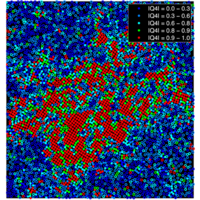
The authors present an algorithm to isolate vortices in discretized numerical simulation data in finer detail than has previously been done. They apply their method to extract topological defects from a simulation of a type-II superconductor.

Flow and clogging of a sheep herd passing through a bottleneck

A. Garcimartín, J. M. Pastor, L. M. Ferrer, J. J. Ramos, C. Martín-Gómez, and I. Zuriguel

Phys. Rev. E 91, 022808 (2015) - Published 17 February, 2015

This paper studies a clogging process of a flock passing through a narrow door. The authors suggest a quantitative definition of clogging and find experimentally that the passage times have a broad distribution with power-law tail. These findings might help with the understanding and management of human crowds.

Bonded-cell model for particle fracture

Duc-Hanh Nguyen, Emilien Azéma, Philippe Sornay, and Farhang Radjai

Phys. Rev. E 91, 022203 (2015) - Published 9 February, 2015

The authors investigate fracture properties of a disklike particle under compression. The particle is modeled as an aggregate of rigid polygonal cells obtained from Voronoi tessellation and bonded by forces along common sides. Fracture occurs when critical contacts of cells percolate across the particle.

Confined disclinations: Exterior versus material constraints in developable thin elastic sheets

Efi Efrati, Luka Pocivavsek, Ruben Meza, Ka Yee C. Lee, and Thomas A. Witten

Phys. Rev. E 91, 022404 (2015) - Published 9 February, 2015

A flat elastic sheet can be made to buckle into three dimensions by either an intrinsic deformation of the sheet itself or by pressing the sheet at one point. The authors find that under small deformations, these internal and external constraints have equivalent effects. The equilibrium shape of the sheet is determined by a particular combination of the parameters measuring the strength of the two deformations.

Susceptibility of large populations of coupled oscillators

Hiroaki Daido

Phys. Rev. E 91, 012925 (2015) - Published 28 January, 2015

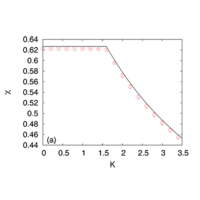
This paper studies how the degree of synchronization in a large population of coupled oscillators responds to a periodic external force. After introducing the concept of susceptibility for the response to the external force, the author finds that in the case of uniform coupling, this susceptibility diverges at the phase transition to macroscopic synchronization. For the case of random coupling, the susceptibility exhibits a cusp when the system enters a glasslike phase.

Universality and criticality of a second-order granular solid-liquid-like phase transition

Gustavo Castillo, Nicolás Mujica, and Rodrigo Soto

Phys. Rev. E 91, 012141 (2015) - Published 26 January, 2015

The authors experimentally study a vibrating granular layer that shows a transition between a disordered, liquidlike phase and a phase with ordered, crystalline clusters. They study the properties of this nonequilibrium phase transition and find evidence for universality in the critical exponents.

Diverging viscosity and soft granular rheology in non-Brownian suspensions

Takeshi Kawasaki, Daniele Coslovich, Atsushi Ikeda, and Ludovic Berthier

Phys. Rev. E 91, 012203 (2015) - Published 26 January, 2015

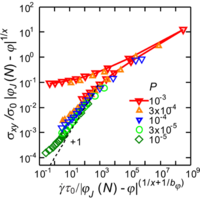
The authors did large-scale three-dimensional simulations of non-Brownian suspensions of soft- and hard-sphere particles. From measurements of viscosity over five orders of magnitude, they conclude that rheology at the jamming density is described by a sum of three power laws, and that asymptotic behaviors are not simply connected by scaling functions.

Fluid flow enhances the effectiveness of toxin export by aquatic microorganisms: A first-passage perspective on microvilli and the concentration boundary layer

Nicholas A. Licata and Aaron Clark

Phys. Rev. E 91, 012709 (2015) - Published 26 January, 2015

The authors study the effects of fluid flow on solute transport away from model aquatic microorganisms. They conclude that toxins released from surface protrusions (microvilli) have less impact on their immediate surroundings, like pollutants released from a tall chimney reaching into the wind. They suggest that the length of microvilli evolved to reach through the concentration boundary layer.

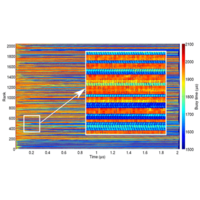
Idle waves in high-performance computing

Stefano Markidis, Juris Vencels, Ivy Bo Peng, Dana Akhmetova, Erwin Laure, and Pierre Henri

Phys. Rev. E 91, 013306 (2015) - Published 20 January, 2015

In parallel applications running on supercomputers, the computation is divided among processes, each one solving part of the problem. The authors provide a description of a large number of processes as a continuous medium and find that local small delays (idle periods) can propagate as waves and lead to an overall degradation in performance of the computation.

General three-state model with biased population replacement: Analytical solution and application to language dynamics

Francesca Colaiori, Claudio Castellano, Christine F. Cuskley, Vittorio Loreto, Martina Pugliese, and Francesca Tria

Phys. Rev. E 91, 012808 (2015) - Published 9 January, 2015

Interaction among speakers of a language may explain why frequently used verbs tend to remain irregular even as language evolves over generations.

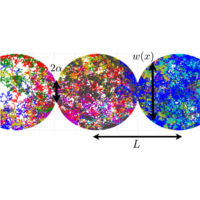
Diagnosing hyperuniformity in two-dimensional, disordered, jammed packings of soft spheres

Remi Dreyfus, Ye Xu, Tim Still, L. A. Hough, A. G. Yodh, and Salvatore Torquato

Phys. Rev. E 91, 012302 (2015) - Published 8 January, 2015

This paper proposes a method for determining whether experimentally obtained jammed packings of soft spheres are hyperuniform (a state in which density fluctuations diminish towards zero at the largest length scales). Using experiments and computer simulations the authors study the influence of polydispersity, image noise, and finite-size effects on hyperuniformity.

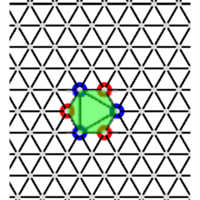
Dynamics of vacancies in two-dimensional Lennard-Jones crystals

Zhenwei Yao and Monica Olvera de la Cruz

Phys. Rev. E 90, 062318 (2014) - Published 29 December, 2014

In a molecular dynamics study of n-point vacancies in two-dimensional crystals, the authors find the surprising result that two-point vacancies diffuse significantly faster than one-point and three-point vacancies.

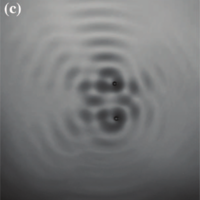
Interaction of two walkers: Wave-mediated energy and force

Christian Borghesi, Julien Moukhtar, Matthieu Labousse, Antonin Eddi, Emmanuel Fort, and Yves Couder

Phys. Rev. E 90, 063017 (2014) - Published 29 December, 2014

The authors study the global energy of a system of bound pairs of bouncing droplets (walkers) and the wave field they generate on a liquid surface. They find that the energy stored in the wave field is proportional to the kinetic energy of the droplets. Their simple theoretical model accounts for many of their experimental results.

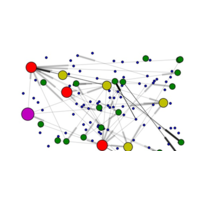
Propagation of economic shocks in input-output networks: A cross-country analysis

Martha G. Alatriste Contreras and Giorgio Fagiolo

Phys. Rev. E 90, 062812 (2014) - Published 19 December, 2014

A network analysis finds that the European economies with the most interconnections, like Germany, are the most vulnerable to economic crises in the absence of government intervention.

Effective diffusion of confined active Brownian swimmers

Mario Sandoval and Leornardo Dagdug

Phys. Rev. E 90, 062711 (2014) - Published 18 December, 2014

The authors analyze the diffusion of self-propelled particles subject to thermal fluctuations in narrow two-dimensional channels. Theoretical results and simulations are presented for the effective diffusion coefficient along the length of the channel, which depends on the channel shape and the particles’ activity.

Edge effects on water droplet condensation

Marie-Gabrielle Medici, Anne Mongruel, Laurent Royon, and Daniel Beysens

Phys. Rev. E 90, 062403 (2014) - Published 10 December, 2014

Droplets of water vapor condensing on a cool surface may grow more quickly or slowly around certain discontinuities such as edges and cavities. The authors study this phenomenon experimentally and theoretically in various configurations. In certain cases, the growth can be enhanced by nearly 500% on edges or corners.

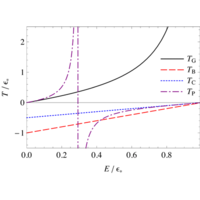
Thermodynamic laws in isolated systems

Stefan Hilbert, Peter Hänggi, and Jörn Dunkel

Phys. Rev. E 90, 062116 (2014) - Published 9 December, 2014

The authors compare definitions of entropy and temperature commonly used for microcanonical ensembles. They show that microcanonical temperatures do not, in general, specify heat flow between two initially isolated systems. The main result is that only the Gibbs volume entropy, which implies non-negative temperatures, satisfies the thermodynamic laws.

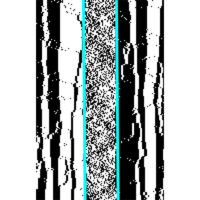
Nonequilibrium statistical mechanics of a two-temperature Ising ring with conserved dynamics

Nicholas Borchers, Michel Pleimling, and R. K. P. Zia

Phys. Rev. E 90, 062113 (2014) - Published 5 December, 2014

The one-dimensional Ising lattice gas on a ring is studied far from equilibrium by holding a subsystem in one region at a different temperature than the rest of the system. Numerical simulations show several remarkable features of the system, including the counterintuitive observation that the subsystem can become more ordered when its temperature is raised.

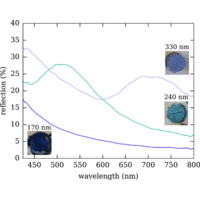
Absence of red structural color in photonic glasses, bird feathers, and certain beetles

Sofia Magkiriadou, Jin-Gyu Park, Young-Seok Kim, and Vinothan N. Manoharan

Phys. Rev. E 90, 062302 (2014) - Published 3 December, 2014

Colloidal glasses, bird feathers, and beetle scales can all show angle-independent structural colors, i.e., colors due to the microscopic structure of the material rather than to a pigment. However, there are few examples of such photonic glasses with red colors in nature. This work shows that the absence of pure red color can be explained by the tendency of individual particles to backscatter light more strongly in the blue, changing any red component into an overall purple color.

Path-integral calculation for the emergence of rapid evolution from demographic stochasticity

Hong-Yan Shih and Nigel Goldenfeld

Phys. Rev. E 90, 050702(R) (2014) - Published 26 November, 2014

The authors propose and analyze a minimal stochastic model that can predict rapid evolution in predator-prey systems. The paper presents simulations that are relevant to a recent experimental study. Their theoretical model should be useful to estimate the risk of extinction and the impact of environmental changes in a number of ecosystems.

Sign In to Your Journals Account

Filter

Section

Filter

Article Lookup

Enter a citation