Highlights

Direct simulations of homogeneous bubble nucleation: Agreement with classical nucleation theory and no local hot spots

Jürg Diemand, Raymond Angélil, Kyoko K. Tanaka, and Hidekazu Tanaka

Phys. Rev. E 90, 052407 (2014) - Published 21 November, 2014

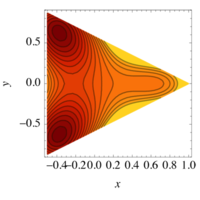
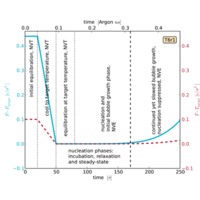
This work presents extensive microcanonical molecular dynamics simulations of a Lennard-Jones liquid to directly measure the rate of bubble nucleation. Nucleation rates are found that are in reasonable agreement with classical nucleation theory, and local hot spots, which were reported in earlier simulations, are not observed.

Temperature gradients in equilibrium: Small microcanonical systems in an external field

Alberto Salazar, Hernán Larralde, and François Leyvraz

Phys. Rev. E 90, 052127 (2014) - Published 14 November, 2014

This work studies the statistical mechanical properties of a small gaseous system in a constant external field. The authors find that in the microcanonical ensemble the presence of the applied field gives rise to intrinsic equilibrium inhomogeneities, such as a variation in the local kinetic temperature along the field. This effect, as expected, vanishes in the thermodynamic limit.

Simple model for multiple-choice collective decision making

Ching Hua Lee and Andrew Lucas

Phys. Rev. E 90, 052804 (2014) - Published 10 November, 2014

The authors study a model for decision making between interacting agents that can choose between any number of possible options. They highlight the connection with variants of the Potts model from statistical physics, and find parallels to such phenomena as spontaneous symmetry breaking and avalanches.

Geometrical model for malaria parasite migration in structured environments

Anna Battista, Friedrich Frischknecht, and Ulrich S. Schwarz

Phys. Rev. E 90, 042720 (2014) - Published 22 October, 2014

This work presents a stochastic model for the motion patterns of sporozoites (malaria parasites) moving in complex environments. The authors identify key migration patterns in arrays of circular obstacles, to predict the effect of anisotropy and of different obstacle sizes on the trajectories, and finally to gain insight into the complexity of three-dimensional migration.

How memory generates heterogeneous dynamics in temporal networks

Christian L. Vestergaard, Mathieu Génois, and Alain Barrat

Phys. Rev. E 90, 042805 (2014) - Published 9 October, 2014

Time-varying social interaction networks empirically show heterogeneous dynamics, such as bursty behavior and broad distributions of event durations. The authors propose four microscopic memory mechanisms from which these heterogeneities emerge.

Diffusion and bulk flow in phloem loading: A theoretical analysis of the polymer trap mechanism for sugar transport in plants

Julia Dölger, Hanna Rademaker, Johannes Liesche, Alexander Schulz, and Tomas Bohr

Phys. Rev. E 90, 042704 (2014) - Published 8 October, 2014

The authors develop a model for movement of water and sugars within the leaves of plants. Using the available experimental data, they conclude that it is feasible for sugar to be loaded into the plant vascular system by diffusion through pores and then effectively trapped by transformation into larger sugars. Their model should stimulate additional experimental and theoretical studies.

Collective excitations of hydrodynamically coupled driven colloidal particles

Harel Nagar and Yael Roichman

Phys. Rev. E 90, 042302 (2014) - Published 3 October, 2014

In this work the authors experimentally show the tuning of a hydrodynamically induced pairing interaction between two colloidal particles driven around an optical trap. They find that the interactions between pairs of particles give rise to nondecaying excitations (phonons) with characteristic dispersion relations.

Effect of individual behavior on epidemic spreading in activity-driven networks

Alessandro Rizzo, Mattia Frasca, and Maurizio Porfiri

Phys. Rev. E 90, 042801 (2014) - Published 2 October, 2014

A mathematical model quantifies how the behavior of individuals can influence the spreading of diseases.

Active elastic dimers: Cells moving on rigid tracks

J. H. Lopez, Moumita Das, and J. M. Schwarz

Phys. Rev. E 90, 032707 (2014) - Published 18 September, 2014

The authors study a minimal model for cells moving along fibers in the extracellular matrix. The model consists of two beads and an active spring moving along a rigid track. With parameters estimated from experimental observations, this relatively simple model reproduces a variety of experimental observations and can be readily extended for other studies.

Stability of liquid films covered by a carpet of self-propelled surfactant particles

Andrey Pototsky, Uwe Thiele, and Holger Stark

Phys. Rev. E 90, 030401(R) (2014) - Published 15 September, 2014

The authors study a thin liquid film covered by self-propelled surfactant particles and find that depending on the strength of the rotational diffusion and the swimming velocity, the in-plane motion can stabilize a flat film or induce film instabilities of various kinds.

Effect of single-site mutations on hydrophobic-polar lattice proteins

Guangjie Shi, Thomas Vogel, Thomas Wüst, Ying Wai Li, and David P. Landau

Phys. Rev. E 90, 033307 (2014) - Published 15 September, 2014

The authors provide a method to calculate systematically the effect of single-site mutations on thermodynamic and structural properties of large hydrophobic-polar lattice protein models. Their method provides a way to calculate properties such as mean energy, heat capacity, and ground-state population of proteins larger than what is currently feasible with atomistic models.

Effect of volume fraction on granular avalanche dynamics

Nick Gravish and Daniel I. Goldman

Phys. Rev. E 90, 032202 (2014) - Published 3 September, 2014

In this study of pre- and postavalanche dynamics of a dry granular material, the authors find that granular slope stability and avalanche onset dynamics depend sensitively on the initial packing fraction. They find a critical packing fraction, below and above which the dynamics of grain motion differ.

Jamming in finite systems: Stability, anisotropy, fluctuations, and scaling

Carl P. Goodrich, Simon Dagois-Bohy, Brian P. Tighe, Martin van Hecke, Andrea J. Liu, and Sidney R. Nagel

Phys. Rev. E 90, 022138 (2014) - Published 27 August, 2014

In the thermodynamic limit, packings of soft repulsive spheres at zero temperature exhibit a sharp transition to an isotropic jammed structure. Finite jammed systems are anisotropic, and the authors analyze the effects of finite size to understand how the isotropic limit is approached as the system size increases.

Survival of a static target in a gas of diffusing particles with exclusion

Baruch Meerson, Arkady Vilenkin, and P. L. Krapivsky

Phys. Rev. E 90, 022120 (2014) - Published 18 August, 2014

Dodging a trap: The time-dependent “avoidance probability” that all particles in a mobile gas manage to avoid a static absorbing target is obtained analytically as a function of target size, particle concentration, and spatial dimension. In one dimension the result turns out to depend on the nature (deterministic or random) of the initial condition.

Mach-like capillary-gravity wakes

Frédéric Moisy and Marc Rabaud

Phys. Rev. E 90, 023009 (2014) - Published 18 August, 2014

This paper studies the wave pattern created by a vertical surface-piercing cylinder in the capillary-gravity regime experimentally, analytically, and numerically. The authors find that for a range of Bond numbers the angle of maximum wave amplitude follows a Mach-like law at large velocity.

Laboratory alluvial fans in one dimension

L. Guerit, F. Métivier, O. Devauchelle, E. Lajeunesse, and L. Barrier

Phys. Rev. E 90, 022203 (2014) - Published 13 August, 2014

An experimental and theoretical study of a one-dimensional model of an alluvial fan provides insight into features of a familiar two-dimensional phenomenon. In their one-dimensional model, the authors show that the fan grows quasistatically at moderate sediment discharge and maintains its slope just above the critical threshold for sediment transport.

Complex architecture of primes and natural numbers

Guillermo García-Pérez, M. Ángeles Serrano, and Marián Boguñá

Phys. Rev. E 90, 022806 (2014) - Published 12 August, 2014

Prime numbers, and their distribution in the sequence of natural numbers, are of interest for fundamental as well as practical reasons. The authors introduce a stochastic model based on a network representation that closely matches some statistical properties of the prime numbers, and that can be useful as a tool in the study of the distribution of primes.

Spectral properties and dynamical tunneling in constant-width billiards

B. Dietz, T. Guhr, B. Gutkin, M. Miski-Oglu, and A. Richter

Phys. Rev. E 90, 022903 (2014) - Published 7 August, 2014

The authors study the dynamics of a certain type of quantum billiards, whose classical counterparts have a phase space that consists of two separate, chaotic, parts. While in the classical case transitions between these two parts are forbidden, the authors show experimentally and theoretically that in the quantum case tunneling is possible between the two regions with chaotic dynamics.

Emergence of limit-periodic order in tiling models

Catherine Marcoux, Travis W. Byington, Zongjin Qian, Patrick Charbonneau, and Joshua E. S. Socolar

Phys. Rev. E 90, 012136 (2014) - Published 29 July, 2014

The authors examine a number of two- and three-dimensional tiling models that, if cooled slowly, undergo an infinite sequence of phase transitions at which sublattices of increasing size crystallize. This cooling process can lead to an ordered nonperiodic state at zero temperature that is not necessarily the ground state of the system.

Logarithmic finite-size effects on interfacial free energies: Phenomenological theory and Monte Carlo studies

Fabian Schmitz, Peter Virnau, and Kurt Binder

Phys. Rev. E 90, 012128 (2014) - Published 25 July, 2014

The interfacial tension between coexisting phases is a fundamental quantity, but its computation by computer simulations remains a challenging problem. The authors analyze the origins of finite-size effects in such computations, tracing one of the corrections to a “domain breathing” mechanism where order parameter fluctuations in the bulk and the motion of the interface are correlated.

Sign In to Your Journals Account

Filter

Section

Filter

Article Lookup

Enter a citation