Highlights

Self-adaptive formation of uneven node spacings in wild bamboo

Hiroyuki Shima, Motohiro Sato, and Akio Inoue

Phys. Rev. E 93, 022406 (2016) - Published 10 February, 2016

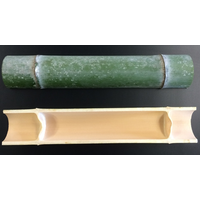
In this paper, the authors set out to understand the uneven spacing of the nodes that divide bamboo stems into chambers. Using arguments of classical mechanics combined with experimental data, they conclude that the observed node spacing is an optimal configuration that enhances growing while providing mechanical stability against bending.

Demonstrating universal scaling for dynamics of Yukawa one-component plasmas after an interaction quench

T. K. Langin, T. Strickler, N. Maksimovic, P. McQuillen, T. Pohl, D. Vrinceanu, and T. C. Killian

Phys. Rev. E 93, 023201 (2016) - Published 3 February, 2016

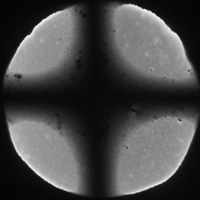
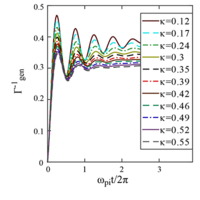
The authors study the equilibration dynamics of ultracold plasmas, where a rapid increase in temperature after plasma creation is followed by temperature oscillations. They verify that this behavior exhibits universal scaling, so that plasmas with a range of densities and temperatures show identical dynamics in scaled units.

Critical wind speed at which trees break

E. Virot, A. Ponomarenko, É. Dehandschoewercker, D. Quéré, and C. Clanet

Phys. Rev. E 93, 023001 (2016) - Published 2 February, 2016

This paper aims to understand the physics behind the observation that there seems to exist a critical wind speed at which trees are damaged by trunk failure. The authors do so by modeling the trees as fragile rods and by using Hooke’s law and Griffith’s theory of fracture. Interestingly, the critical speed hardly depends on tree characteristics, in agreement with field data collected after storms.

Physical origin of nonequilibrium fluctuation-induced forces in fluids

T. R. Kirkpatrick, J. M. Ortiz de Zárate, and J. V. Sengers

Phys. Rev. E 93, 012148 (2016) - Published 27 January, 2016

Casimir forces have been shown to arise from fluctuations in a variety of systems, both classical and quantum. In this paper, the authors present two mechanisms for the appearance of Casimir forces in non-equilibrium fluids, namely the coupling of hydrodynamic modes and the existence of inhomogeneous thermal noise. They identify the former as the leading contribution, and show that its effect is much larger than that of other Casimir forces.

Intellectual interchanges in the history of the massive online open-editing encyclopedia, Wikipedia

Jinhyuk Yun (윤진혁), Sang Hoon Lee (이상훈), and Hawoong Jeong (정하웅)

Phys. Rev. E 93, 012307 (2016) - Published 22 January, 2016

A study of the entire editing history of English Wikipedia shows that the articles cluster into four categories based on how frequently and how aggressively they are edited.

Phases and structures of sunset yellow and disodium cromoglycate mixtures in water

Akihiro Yamaguchi, Gregory P. Smith, Youngwoo Yi, Charles Xu, Silvia Biffi, Francesca Serra, Tommaso Bellini, Chenhui Zhu, and Noel A. Clark

Phys. Rev. E 93, 012704 (2016) - Published 12 January, 2016

This paper addresses the phase behavior of mixtures of chromonic liquid crystals, aggregated aromatic compounds with ionic peripherals dissolved in water. The authors find a wealth of different phases depending on the relative concentrations of the ternary mixture, and attempt to explain the resultant behavior based on the degree of order of the independent components.

Anisotropic confinement effects in a two-dimensional plasma crystal

I. Laut, S. K. Zhdanov, C. Räth, H. M. Thomas, and G. E. Morfill

Phys. Rev. E 93, 013204 (2016) - Published 8 January, 2016

The mode-coupling instability is a mechanism that induces melting of a strongly coupled plasma crystal to a weakly coupled swirling state. The authors study the recently observed breaking of spectral symmetry of the wave-energy distribution of the melting dusty plasma, and ascribe it to the anisotropy of the confining potential well.

Slip boundary conditions over curved surfaces

Lin Guo, Shiyi Chen, and Mark O. Robbins

Phys. Rev. E 93, 013105 (2016) - Published 6 January, 2016

This paper examines the influence of the surface curvature on the slip boundary condition in simple fluids. Using molecular dynamics simulations, the authors find a distortion of the fluid structure near the wall influenced by the degree of curvature, and a change in the slip length that can be accounted for by the friction between the first fluid layer and the surface.

Richtmyer-Meshkov instability of a three-dimensional SF6-air interface with a minimum-surface feature

Xisheng Luo, Ben Guan, Ting Si, Zhigang Zhai, and Xiansheng Wang

Phys. Rev. E 93, 013101 (2016) - Published 5 January, 2016

A detailed experimental study of the Richtmyer-Meshkov instability of a three-dimensional interface reveals bubble-like structures behind the shocked interface and slower growth than that predicted by two-dimensional linear models. Initial conditions were reproducibly prepared using a free-standing soap film to initially separate the heavy and the light gases. Evolution of the shocked interface was captured by time-resolved schlieren photography.

Optimality and adaptation of phenotypically switching cells in fluctuating environments

Merzu Kebede Belete and Gábor Balázsi

Phys. Rev. E 92, 062716 (2015) - Published 31 December, 2015

The authors study a model for growth of cells in populations that switch phenotypes in fluctuating environments. They investigate the effects of switching rates and asymmetric population growth and find conditions in which the commonly held assumption, that optimal growth occurs when frequency of phenotype switching equals that of environmental fluctuations, does not hold.

Conservative perturbation theory for nonconservative systems

Tirth Shah, Rohitashwa Chattopadhyay, Kedar Vaidya, and Sagar Chakraborty

Phys. Rev. E 92, 062927 (2015) - Published 29 December, 2015

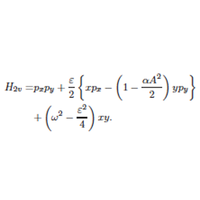
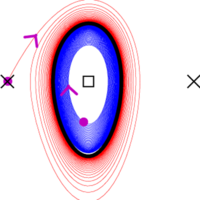
The authors develop a method to use canonical perturbation theory in the framework of dissipative systems that possess limit cycles. They derive a Hamiltonian augmented by an auxiliary dynamical system so that energy is conserved and the original dynamics is not affected. This approach opens up possible avenues to treat quantized dissipative systems.

Multifractal to monofractal evolution of the London street network

Roberto Murcio, A. Paolo Masucci, Elsa Arcaute, and Michael Batty

Phys. Rev. E 92, 062130 (2015) - Published 17 December, 2015

An analysis of London’s street network shows how the network has evolved over time from a heterogeneous to homogeneous fractal pattern.

Network-based model of the growth of termite nests

Young-Ho Eom, Andrea Perna, Santo Fortunato, Eric Darrouzet, Guy Theraulaz, and Christian Jost

Phys. Rev. E 92, 062810 (2015) - Published 9 December, 2015

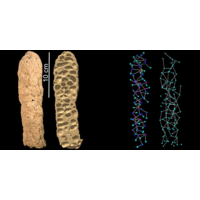
A new model shows how complex termite nests can be built using only local interactions between the insects.

Between giant oscillations and uniform distribution of droplets: The role of varying lumen of channels in microfluidic networks

Olgierd Cybulski, Slawomir Jakiela, and Piotr Garstecki

Phys. Rev. E 92, 063008 (2015) - Published 8 December, 2015

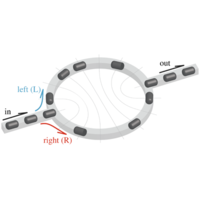
This paper addresses the variation in the flow in microfluidic networks when the cross-sectional area of a channel is varied, by studying the pattern of drops choosing sides in a microfluidic loop with a common inlet and outlet. The authors find that small variations in the area of one of the routes affect the path distribution of the droplets, and present a controlled model that can be used advantageously to engineer different patterns.

Viscoelasticity of a homeotropic nematic slab

Patrick Oswald

Phys. Rev. E 92, 062508 (2015) - Published 7 December, 2015

In this paper, the author studies the viscoelasticity of a nematic liquid-crystal slab in different frequency regimes using theory and experiments. Whereas the system behaves as an isotropic liquid with well-defined viscosities at low and high frequencies, at intermediate frequencies the elastic and viscous moduli become comparable. The frequency ranges for each system depend on the sample thickness and the elastic constants of the nematic.

Pattern formation in flocking models: A hydrodynamic description

Alexandre P. Solon, Jean-Baptiste Caussin, Denis Bartolo, Hugues Chaté, and Julien Tailleur

Phys. Rev. E 92, 062111 (2015) - Published 4 December, 2015

The authors study the flocking transition, in the framework of two well-known physical models, from a hydrodynamic perspective. They find a infinite set of stable propagating solutions of three different types, and find that the fastest propagating ones correspond to the largest ordered domains, naturally leading to phase separation through a process of coarsening.

Experimental study of synchronization of coupled electrical self-oscillators and comparison to the Sakaguchi-Kuramoto model

L. Q. English, Zhuwei Zeng, and David Mertens

Phys. Rev. E 92, 052912 (2015) - Published 30 November, 2015

The authors explored synchronization dynamics of a system of coupled electronic oscillators. From a series of measurements on a pair of coupled oscillators, they obtained two adjustable parameters for the Sakaguchi-Kuramoto model. They found good agreement between predictions of this model and their experimental measurements on a system of 20 oscillators.

Random walk with random resetting to the maximum position

Satya N. Majumdar, Sanjib Sabhapandit, and Grégory Schehr

Phys. Rev. E 92, 052126 (2015) - Published 19 November, 2015

The authors consider a one-dimensional random walk in which the walker can randomly reset its path by jumping to its farthest (rightmost) visited position. This scheme can be studied analytically, and may have applications to current problems in reactions, animal behavior, and search strategies.

Shapeable sheet without plastic deformation

Naomi Oppenheimer and Thomas A. Witten

Phys. Rev. E 92, 052401 (2015) - Published 13 November, 2015

The authors explore the concept of shapeability, the capacity of a material to deform and then retain its shape under sufficiently weak external forces, in crumpled sheets. By modeling the material as a set of deformed spring lattices in different shapes, they explore the conditions for irreversible deformation and study the local configuration of the spring lattice, showing that a significant number of the elastic bonds retain their displaced position after relaxing the system. This opens the door for potential experimental applications on elastic sheets with shape memory.

Direct relations between morphology and transport in Boolean models

Christian Scholz, Frank Wirner, Michael A. Klatt, Daniel Hirneise, Gerd E. Schröder-Turk, Klaus Mecke, and Clemens Bechinger

Phys. Rev. E 92, 043023 (2015) - Published 30 October, 2015
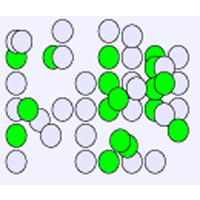
The authors combine experiment, theory, and simulations to study the relationship between morphology and permeability in models consisting of overlapping circular or elliptical grains. They point out how their models may also apply to different types of structures.

Sign In to Your Journals Account

Filter

Section

Filter

Article Lookup

Enter a citation