Highlights

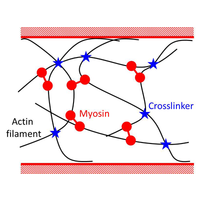
Percolation mechanism drives actin gels to the critically connected state

Chiu Fan Lee and Gunnar Pruessner

Phys. Rev. E 93, 052414 (2016) - Published 20 May, 2016

This paper aims to provide a theoretical framework for the recent experimental observation that actomyosin networks exhibit a scale-free, power-law structure reminiscent of self-organized criticality. The authors explain this phenomenon by invoking the notion of percolation with trapping, in which clusters of voids can develop and persist. This approach also provides additional predictions that will stimulate more experimental work.

Micromechanics of nonlinear plastic modes

Edan Lerner

Phys. Rev. E 93, 053004 (2016) - Published 16 May, 2016

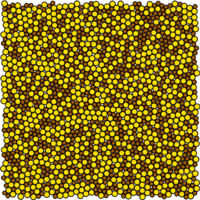
This paper presents an atomistic theory of the onset and scaling of nonlinear plastic modes arising from the deformation of elastic solids. The author shows that, in spite of some similarities, these modes exhibit a different behavior when compared with the conventional eigenmodes associated with the diagonalization of the dynamical matrix; this makes them a suitable variable to gain further insight in the problem of glasses subjected to external stresses.

Analysis of electrolyte transport through charged nanopores

P. B. Peters, R. van Roij, M. Z. Bazant, and P. M. Biesheuvel

Phys. Rev. E 93, 053108 (2016) - Published 13 May, 2016

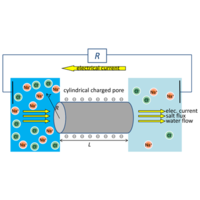
This paper revisits the classic problem of ionic species passing through a charged channel. The authors introduce several assumptions that simplify the problem and, as a result, are able to produce a full solution for the three-dimensional fluid and ion profiles. As an application of the theoretical approach, the paper analyzes the performance of a reverse electrodialysis device.

Tunable depletion potentials driven by shape variation of surfactant micelles

Matthew D. Gratale, Tim Still, Caitlin Matyas, Zoey S. Davidson, Samuel Lobel, Peter J. Collings, and A. G. Yodh

Phys. Rev. E 93, 050601(R) (2016) - Published 11 May, 2016

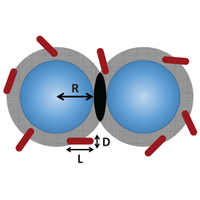
Depletion forces arise as a result of an entropic imbalance when small nonadsorbing objects are introduced in a suspension of large objects. This paper explores the experimental consequences of using nonspherical depletants whose anisotropy can be tuned using temperature, and thus it opens up the possibility of immediate, real-time tuning of the interparticle attraction.

Pattern transition, microstructure, and dynamics in a two-dimensional vibrofluidized granular bed

Istafaul H. Ansari and Meheboob Alam

Phys. Rev. E 93, 052901 (2016) - Published 9 May, 2016

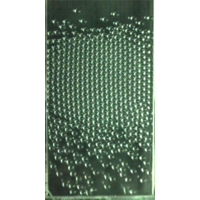
When a granular bed is vibrated, a full array of different patterns arises. This was initially observed and empirically systematized by Faraday in the 1830’s and it has been extensively studied ever since. The authors in this paper study the formation of these patters in a purely two-dimensional system, and explore the influence of the container length, vibration amplitude, and acceleration on the system’s behavior, which ranges from a solid-base mode where the particles follow the driving plate to a Leidenfrost-like pattern.

Fractional telegrapher's equation from fractional persistent random walks

Jaume Masoliver

Phys. Rev. E 93, 052107 (2016) - Published 3 May, 2016

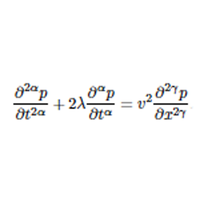
This paper extends the telegrapher’s equation to the description of anomalous diffusion by considering a continuous-time random walk that maintains or changes direction with certain probabilities. The author presents fractional differential equations for the evolution of the probability density function and shows that their limiting behaviors describe different instances of diffusion.

Charge renormalization in nominally apolar colloidal dispersions

Daniel J. Evans, Andrew D. Hollingsworth, and David G. Grier

Phys. Rev. E 93, 042612 (2016) - Published 25 April, 2016

This manuscript shows experimental results on the electrostatic repulsion of seemingly neutral spheres suspended in an apolar solvent. The authors determine the particles’ interaction potential by tracking their motion using microscopy and show it to be compatible with charge renormalization theory. They hypothesize that the presence of charge is due to the adsorption of free cations arising from the solvent.

Bilayer-thickness-mediated interactions between integral membrane proteins

Osman Kahraman, Peter D. Koch, William S. Klug, and Christoph A. Haselwandter

Phys. Rev. E 93, 042410 (2016) - Published 18 April, 2016

The authors present a theoretical approach to the elastic equations associated with lipid bilayer deformation induced by embedded proteins. They provide analytic and numerical solutions for several boundary conditions and interaction potentials and find that variations in the protein shape strongly influence the nature of the interaction between the membrane and the protein.

Nondeterministic self-assembly of two tile types on a lattice

S. Tesoro and S. E. Ahnert

Phys. Rev. E 93, 042412 (2016) - Published 18 April, 2016

Self-assembly occurs naturally in many biological processes, such as the aggregation of proteins or formation of amyloid fibrils. As a starting point for modeling these complex systems, this paper proposes a simple stochastic model of self-assembly of a mixture of two types of tiles. The authors find a variety of concentration-dependent behaviors, with a sharp transition separating finite structures and ones that can grow indefinitely.

Non-Hermitian localization in biological networks

Ariel Amir, Naomichi Hatano, and David R. Nelson

Phys. Rev. E 93, 042310 (2016) - Published 15 April, 2016

The authors analyze the eigenvalues and eigenvectors of certain asymmetric tridiagonal matrices. They find a rich and complex behavior in the distribution of eigenvalues and the localization properties of eigenvectors. This has implications that can help understand features of the dynamics of neural networks, as well as neural development in organisms.

Quantum ring-polymer contraction method: Including nuclear quantum effects at no additional computational cost in comparison to ab initio molecular dynamics

Christopher John, Thomas Spura, Scott Habershon, and Thomas D. Kühne

Phys. Rev. E 93, 043305 (2016) - Published 7 April, 2016

This paper presents a computational method that can take into account the quantum nature of the nuclei in ab-initio path-integral molecular dynamics simulations. The scheme uses an empirical decomposition of the potential into a hard and soft part using an auxiliary potential. The authors show that the approach provides reliable results without extra computational cost.

Retarding the growth of the Rosensweig instability unveils a new scaling regime

Adrian Lange, Christian Gollwitzer, Robin Maretzki, Ingo Rehberg, and Reinhard Richter

Phys. Rev. E 93, 043106 (2016) - Published 5 April, 2016

This paper shows experimental results on the Rosensweig instability, the formation of hexagonal patterns in the surface of a ferrofluid after applying a magnetic field. By using a highly viscous magnetic fluid the dynamics of the system are slowed down and this allows for the study of the pattern growth in regimes that were not accessible to experiments before.

Echoes from anharmonic normal modes in model glasses

Justin C. Burton and Sidney R. Nagel

Phys. Rev. E 93, 032905 (2016) - Published 25 March, 2016

This paper addresses the onset of phonon echoes in glassy materials using arguments from classical physics. Using computer simulations of disordered materials quenched at zero temperature, the authors conclude that these echoes can be caused by the large anharmonicity of quasilocalized, low-frequency classical vibrational modes.

Growth, collapse, and stalling in a mechanical model for neurite motility

Pierre Recho, Antoine Jerusalem, and Alain Goriely

Phys. Rev. E 93, 032410 (2016) - Published 18 March, 2016

This paper presents a mechanical model of neurite motility. By relying on the cytoskeletal architecture of the neurite, the model accounts for the three observed experimental states, namely collapsed, static, and motile. It also explains known results from drug treatments and suggests future experimental tests on neuronal regeneration.

Sensing and tuning microfiber chirality with nematic chirogyral effect

Simon Čopar, David Seč, Luis E. Aguirre, Pedro L. Almeida, Mallory Dazza, Miha Ravnik, Maria H. Godinho, Pawel Pieranski, and Slobodan Žumer

Phys. Rev. E 93, 032703 (2016) - Published 15 March, 2016

The authors use polarized optical microscopy to investigate director field structure around fibers immersed in a nematic medium. They demonstrate coupling between chirality of the fibers and mechanical response of tilted defect rings between domains of nematic molecules aligned along the fibers.

Rotation of melting ice disks due to melt fluid flow

S. Dorbolo, N. Adami, C. Dubois, H. Caps, N. Vandewalle, and B. Darbois-Texier

Phys. Rev. E 93, 033112 (2016) - Published 14 March, 2016

In this paper the authors aim to explain the spontaneous rotation of melting ice bodies floating on the surface of water. As the liquid is cooled down by the ice, the elements of fluid closest to the interface reach 4oC, the point of maximum density, and settle, creating a downward flow that results in a vertical vortex that sets the ice body in rotational motion. The authors recreate the phenomenon successfully in the lab.

Noise-enhanced coupling between two oscillators with long-term plasticity

Leonhard Lücken, Oleksandr V. Popovych, Peter A. Tass, and Serhiy Yanchuk

Phys. Rev. E 93, 032210 (2016) - Published 8 March, 2016

The authors address the plasticity of the coupling between neurons subjected to stochastic excitations. By reducing the problem to a system of two neurons, they show the onset of new states that do not appear in deterministic models. Interestingly, they find that noise could act to stabilize the coupling and enhance synchronization.

Constrained growth of complex scale-independent systems

Laurent Hébert-Dufresne, Antoine Allard, Jean-Gabriel Young, and Louis J. Dubé

Phys. Rev. E 93, 032304 (2016) - Published 3 March, 2016

Scale-free distributions of resources arise in very diverse systems, such as in the distribution of wealth or of the population of cities. By coupling the overall population growth with the individual growth in resources, the authors propose a model describing the emergence of such behavior. Through this model, the authors introduce a method to reconstruct the past or forecast the future from a snapshot of data.

Quantifying group specificity of animal vocalizations without specific sender information

Heike Vester, Kurt Hammerschmidt, Marc Timme, and Sarah Hallerberg

Phys. Rev. E 93, 022138 (2016) - Published 25 February, 2016

A new spectral analysis method can automatically find differences in the calls of whales from separate groups.

Floquet topological semimetal phases of an extended kicked Harper model

Raditya Weda Bomantara, Gudapati Naresh Raghava, Longwen Zhou, and Jiangbin Gong

Phys. Rev. E 93, 022209 (2016) - Published 16 February, 2016
The authors introduce two additional periodic system parameters into a kicked Harper model and provide evidence that this extended model can show a variety of effects associated with topological semimetal phases.

Sign In to Your Journals Account

Filter

Section

Filter

Article Lookup

Enter a citation