Highlights

Critical behavior of a two-step contagion model with multiple seeds

Wonjun Choi, Deokjae Lee, and B. Kahng

Phys. Rev. E 95, 062115 (2017) - Published 12 June, 2017

Using a two-step extension of a well-known epidemic model with multiple seeds, the authors observe two different spreading behaviors. Depending on the concentration of initially infected seeds, the epidemic transition can be a hybrid one showing both continuous and discontinuous behavior, or a continuous one.

Bubble gating in biological ion channels: A density functional theory study

Florian Gußmann and Roland Roth

Phys. Rev. E 95, 062407 (2017) - Published 12 June, 2017

This paper presents results on the distribution of a liquid inside a biological ion channel, using density functional theory. The authors find their results consistent with the bubble-gating model, in which pockets of low density fluid that appear in narrow passages trigger the gating of the channel.

Shear banding, discontinuous shear thickening, and rheological phase transitions in athermally sheared frictionless disks

Daniel Vågberg, Peter Olsson, and S. Teitel

Phys. Rev. E 95, 052903 (2017) - Published 30 May, 2017

This paper presents a model of the flow behavior of granular soft materials under shear. The authors introduce a tangentially directed viscous interaction, along with a contact force, and study a two-dimensional athermal system using computer simulations. Their results show a distinctive transition in the system’s rheological behavior which, in turn, may give rise to shear banding.

Local time of Lévy random walks: A path integral approach

Václav Zatloukal

Phys. Rev. E 95, 052136 (2017) - Published 23 May, 2017

This paper uses a path-integral method to study the local time of random walks, i.e. the time spent in the vicinity of an arbitrary point. The author focuses on time-independent Hamiltonians where a connection between the local time and the resolvent of the Hamiltonian is shown, and studies in detail the special case of Levy flights

Model of the best-of-N nest-site selection process in honeybees

Andreagiovanni Reina, James A. R. Marshall, Vito Trianni, and Thomas Bose

Phys. Rev. E 95, 052411 (2017) - Published 22 May, 2017

This paper presents a model for collective decision making applied to a swarm of honeybees choosing a nest. The authors tackle the extension of a known binary option model to an arbitrary number of choices, and study the situation when one option is better than the rest.

General scaling relations for locomotion in granular media

James Slonaker, D. Carrington Motley, Qiong Zhang, Stephen Townsend, Carmine Senatore, Karl Iagnemma, and Ken Kamrin

Phys. Rev. E 95, 052901 (2017) - Published 10 May, 2017

The authors find scaling relations that describe locomotion in granular media for a wide range of problems. Experimental tests and simulations demonstrate the validity of their simple model for rigid wheels of various shapes. An extension to different gravitational environments provides a model relevant for space exploration.

Designing nucleosomal force sensors

M. Tompitak, L. de Bruin, B. Eslami-Mossallam, and H. Schiessel

Phys. Rev. E 95, 052402 (2017) - Published 8 May, 2017

The authors used a recently developed computational method to design a model nucleosome in which the DNA strand remains stably wrapped around the eight proteins in the octamer when no force is applied, but quickly unwraps under external tension. The work suggests the possibility that DNA sequences may have evolved on real genomes to affect physical properties of the nucleosome.

Kinetic discrimination of a polymerase in the presence of obstacles

Ilana Bogod and Saar Rahav

Phys. Rev. E 95, 042408 (2017) - Published 25 April, 2017

This paper studies the influence of obstacles on the speed and fidelity of RNA copying by a polymerase. The authors observe that while the speed of the copying process depends on the details of the interaction between the obstacle and the polymerase, the fidelity does not.

Decomposition of strongly charged topological defects

Samo Kralj, Bryce S. Murray, and Charles Rosenblatt

Phys. Rev. E 95, 042702 (2017) - Published 18 April, 2017

This paper studies the tendency of two dimensional topological defects of large defect strength to break up into elementary units. The authors study the process and the resulting structures theoretically for different ways of enforcing the defects, and test some of their predictions experimentally in nematic liquid crystals.

Solution of the Lindblad equation for spin helix states

V. Popkov and G. M. Schütz

Phys. Rev. E 95, 042128 (2017) - Published 17 April, 2017

This paper studies transport in a quantum spin chain driven by particular boundary terms, and identifies a family of stationary solutions. The solutions are current-carrying nonequilibrium states that correspond to ballistic transport, and whose properties depend on the details of the boundary terms.

Sugar export limits size of conifer needles

Hanna Rademaker, Maciej A. Zwieniecki, Tomas Bohr, and Kaare H. Jensen

Phys. Rev. E 95, 042402 (2017) - Published 7 April, 2017

This paper proposes an explanation for the relatively uniform size of conifer needles, as compared with the leaves of broad-leaved plants. The explanation lies in the particular dynamics of sugar transport, as larger needlelike leaves would create regions of stagnant fluid that cannot be overcome by the vascular osmotic pressure.

Quantum walks: The first detected passage time problem

H. Friedman, D. A. Kessler, and E. Barkai

Phys. Rev. E 95, 032141 (2017) - Published 28 March, 2017

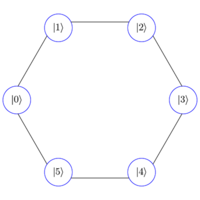
This paper aims to extend the first-passage problem to quantum walks. Starting from the Schrödinger equation and applying projective measurements at fixed time intervals, the authors construct the statistics of first detection times for open and closed systems. The results are quite different from those for classical random walks, although some similarities remain.

Collisional model of energy dissipation in three-dimensional granular impact

Cacey Stevens Bester and Robert P. Behringer

Phys. Rev. E 95, 032906 (2017) - Published 22 March, 2017

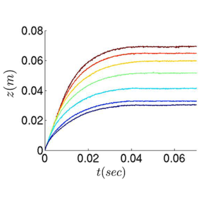
This paper extends to three dimensions the collisional model for penetration of a granular medium by a solid object. The authors performed impact experiments with objects of different shapes in dry granular beds using high-speed imaging. The results show that the main drag force on objects colliding with a granular bed arises from perpendicular collisions with chains of granular particles.

Model of polar auxin transport coupled to mechanical forces retrieves robust morphogenesis along the Arabidopsis root

J. Roberto Romero-Arias, Valeria Hernández-Hernández, Mariana Benítez, Elena R. Alvarez-Buylla, and Rafael A. Barrio

Phys. Rev. E 95, 032410 (2017) - Published 16 March, 2017

In this paper, the authors explore the role of mechanical and chemical influences in morphogenesis, specifically, the emergence of cellular patterns in the growth of plant roots. Their model couples cell division to the local concentration of the hormone auxin and physical elastic forces, and is able to reproduce experimental observations in real roots.

Fluctuations around mean walking behaviors in diluted pedestrian flows

Alessandro Corbetta, Chung-min Lee, Roberto Benzi, Adrian Muntean, and Federico Toschi

Phys. Rev. E 95, 032316 (2017) - Published 15 March, 2017

Experiments tracking people as they walk down a corridor reveal universal behaviors that, if incorporated into models, could ensure safe flow in large crowds.

Measurement-induced operation of two-ion quantum heat machines

Suman Chand and Asoka Biswas

Phys. Rev. E 95, 032111 (2017) - Published 7 March, 2017

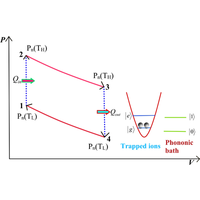
This paper presents a model for a quantum heat machine using two interacting trapped ions, with the vibrational mode of the ions acting as the cold bath. This approach allows for operation as either a heat engine or a refrigerator by performing a suitably chosen projective measurement of the electronic states.

Theory of deflagration in disordered media

Mauro Schiulaz, Christopher R. Laumann, Alexander V. Balatsky, and Boris Z. Spivak

Phys. Rev. E 95, 032103 (2017) - Published 2 March, 2017

This paper studies the propagation of heat in the combustion of nonuniform explosive solids. The authors model the system as a network of propagation points or hot spots, and find two different behaviors for the transition from a finite to an infinite burned area: one that is similar to percolation and one where the transition is first order, depending on the strength of the heat dissipation.

Triangles bridge the scales: Quantifying cellular contributions to tissue deformation

Matthias Merkel, Raphaël Etournay, Marko Popović, Guillaume Salbreux, Suzanne Eaton, and Frank Jülicher

Phys. Rev. E 95, 032401 (2017) - Published 1 March, 2017

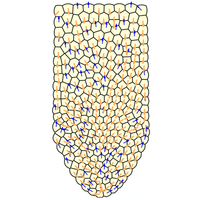
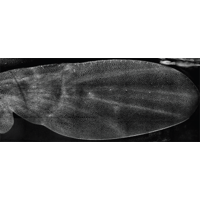
This paper addresses the deformation of two-dimensional networks of cells, such as thin biological tissues, using geometrical considerations. The authors use a triangulation scheme to identify the main contributions to the strain generated when the tissue is deformed, and apply their method to the particular case of a fruit-fly wing.

Linear instability in Rayleigh-stable Taylor-Couette flow

Kengo Deguchi

Phys. Rev. E 95, 021102(R) (2017) - Published 28 February, 2017

This paper describes the behavior of Taylor-Couette flows at large Reynolds numbers and shows the onset of a linear instability in this extreme regime. The instability also appears in flows where the square of the angular momentum is increasing outward from the axis of rotation and which are stable according to the inviscid Rayleigh criterion.

Modeling structure and resilience of the dark network

Manlio De Domenico and Alex Arenas

Phys. Rev. E 95, 022313 (2017) - Published 27 February, 2017

Network theory explains why an unsearchable portion of the Internet used for anonymous exchanges is particularly resistant to failures and attacks.

Sign In to Your Journals Account

Filter

Section

Filter

Article Lookup

Enter a citation