Highlights

Phase diagram of restricted Boltzmann machines and generalized Hopfield networks with arbitrary priors

Adriano Barra, Giuseppe Genovese, Peter Sollich, and Daniele Tantari

Phys. Rev. E 97, 022310 (2018) - Published 20 February, 2018

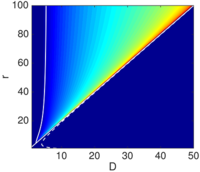
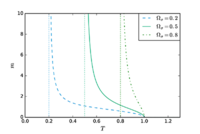
This paper studies the connection between Hopfield networks and restricted Boltzmann machines, two common tools in the developing area of machine learning. The work focuses on the behavior of models whose variables are either discrete and binary or take on a range of continuous values. The authors find a large degree of robustness in the retrieval capabilities of the models, especially when the number of stored patterns is small.

Dynamically generated patterns in dense suspensions of active filaments

K. R. Prathyusha, Silke Henkes, and Rastko Sknepnek

Phys. Rev. E 97, 022606 (2018) - Published 12 February, 2018

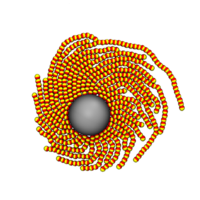
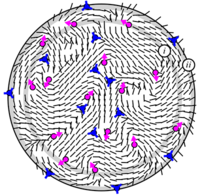
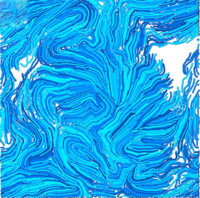
In this work, the authors simulated the dynamics of a dense suspension of self-propelled semiflexible filaments. One intriguing finding is a crossover from a state of coherently flowing bundles of filaments to one without global flow, formed by individual filaments coiled into rotating spirals. The model has the potential to inspire further experimental studies on motility assays and also on swimming bacteria.

Hierarchical collective motion of a mixture of active dipolar Janus particles and passive charged colloids in two dimensions

J. Harder and A. Cacciuto

Phys. Rev. E 97, 022603 (2018) - Published 7 February, 2018

The authors investigate the behavior of large passive charged colloids in a suspension of smaller active dipolar Janus particles. Their systematic computer simulations demonstrate that colloid–dipolar-particle complexes form spontaneously and exhibit a variety of rotational and translational motions, depending on the strength of the active forces and the concentrations of the two species.

Bending transition in the penetration of a flexible intruder in a two-dimensional dense granular medium

Nicolas Algarra, Panagiotis G. Karagiannopoulos, Arnaud Lazarus, Damien Vandembroucq, and Evelyne Kolb

Phys. Rev. E 97, 022901 (2018) - Published 5 February, 2018

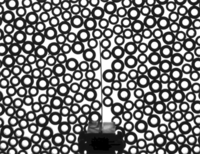
Interesting behavior occurs when a flexible body interacts with a flow. The authors investigate such behavior experimentally by immersing a flexible fiber in a granular two-dimensional flow close to the jamming transition. They highlight a bending transition of the fiber when it is longer than a characteristic length, and an associated transition in the structure of the granular medium.

Low-noise phase of a two-dimensional active nematic system

Suraj Shankar, Sriram Ramaswamy, and M. Cristina Marchetti

Phys. Rev. E 97, 012707 (2018) - Published 29 January, 2018

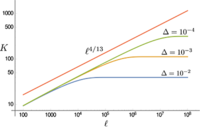
Self-propelled elongated particles in two dimensions can form an active nematic phase. The authors show that this phase exhibits the same quasi-long-range order as equilibrium nematic and polar liquid crystals, but also find particular features such as strong finite-size effects and a nonuniversal exponent in the behavior of density fluctuations.

Snap-buckling in asymmetrically constrained elastic strips

Tomohiko G. Sano and Hirofumi Wada

Phys. Rev. E 97, 013002 (2018) - Published 23 January, 2018

Experiments show snap-buckling transitions in an elastic strip that is hinged on one side and clamped on the other. The authors find a discontinuous transition in the forces in the vicinity of the snap instability, and put forward a theory that describes the behavior observed in the experiments. They also hint at possible applications of these results for mechanical metamaterials, and as blueprints for materials with particular tensile and compressive properties.

Lee-Yang zeros and large-deviation statistics of a molecular zipper

Aydin Deger, Kay Brandner, and Christian Flindt

Phys. Rev. E 97, 012115 (2018) - Published 12 January, 2018

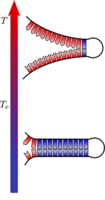
The authors investigate a thermal phase transition in a molecular zipper model of a double-stranded macromolecule. From energy fluctuations in small zippers, they show that they can predict the temperature at which a phase transition occurs in the thermodynamic limit. The work suggests similar relationships between fluctuations in other small systems and their phase behavior.

Insensitivity of active nematic liquid crystal dynamics to topological constraints

Michael M. Norton, Arvind Baskaran, Achini Opathalage, Blake Langeslay, Seth Fraden, Aparna Baskaran, and Michael F. Hagan

Phys. Rev. E 97, 012702 (2018) - Published 10 January, 2018

Computer simulations are used to study the effect of confinement on the dynamics of active nematic liquid crystals. The authors find that active nematic systems, in contrast to passive systems, are rather insensitive to topological constraints. Topological charges required by container geometry are relegated to a small layer along the boundary, creating a bulklike interior for these active systems.

Theoretical analysis of the distribution of isolated particles in totally asymmetric exclusion processes: Application to mRNA translation rate estimation

Khanh Dao Duc, Zain H. Saleem, and Yun S. Song

Phys. Rev. E 97, 012106 (2018) - Published 9 January, 2018

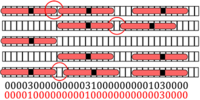
This paper extends the treatment of a simple stochastic transport model to account for the distribution of particles, and applies it to ribosomes involved in messenger RNA translation. This approach makes it possible to describe properties such as the average distance between particles and the number of collisions. These results can be used as support for recently developed experimental techniques like ribosome profiling.

Linking biological and physical aging: Dynamical scaling of multicellular regeneration

Yuting Lou, Jufeng Xia, Wei Tang, and Yu Chen

Phys. Rev. E 96, 062418 (2017) - Published 27 December, 2017

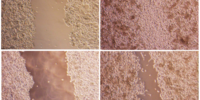
Wound healing experiments suggest that biological aging can be defined in a similar way to physical aging in soft materials like glasses.

Noise-driven neuromorphic tuned amplifier

Duccio Fanelli, Francesco Ginelli, Roberto Livi, Niccoló Zagli, and Clement Zankoc

Phys. Rev. E 96, 062313 (2017) - Published 26 December, 2017

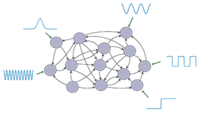
In this paper neuronal excitations are studied using a stochastic model on a directed lattice. This system behaves as a tunable amplifier, which can be used to enhance and sharpen stimuli and, thus, might serve to encode different signals in the brain. The authors also propose that this minimalistic approach could inspire a device to detect low-intensity signals.

Theory of nonstationary Hawkes processes

Neta Ravid Tannenbaum and Yoram Burak

Phys. Rev. E 96, 062314 (2017) - Published 26 December, 2017

For so-called Hawkes processes, random events linked by linear interactions, correlation functions can be calculated analytically. The authors of this paper extend the theory to processes with time-dependent inputs, and show how correlations are influenced by the structure of the network and the properties of the external stimuli. As an example they apply the theory to the case of neural networks.

Dynamical density functional theory analysis of the laning instability in sheared soft matter

A. Scacchi, A. J. Archer, and J. M. Brader

Phys. Rev. E 96, 062616 (2017) - Published 26 December, 2017

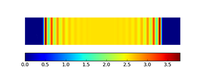
At sufficiently high shear, colloidal suspensions exhibit a distinct behavior called laning, in which they self-organize into strings or layers of particles to facilitate flow. This paper presents a linear stability analysis of the dynamical density functional theory with a kernel that accounts for the lateral effect of particle collisions. It is possible to extract the dispersion relation of the suspension and, thus, predict the onset of the laning behavior.

Diffusiophoresis in nonadsorbing polymer solutions: The Asakura-Oosawa model and stratification in drying films

Richard P. Sear and Patrick B. Warren

Phys. Rev. E 96, 062602 (2017) - Published 6 December, 2017

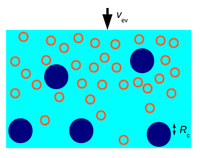
This article discusses the physics of stratification of colloidal particles and smaller polymer molecules in drying liquid films. The authors focus on the motion of colloidal particles in response to a concentration gradient of polymer molecules, and include the effect of solvent backflow. Their model provides an explanation for the depletion of colloidal particles at the top surface.

Bayesian inference with information content model check for Langevin equations

Jens Krog and Michael A. Lomholt

Phys. Rev. E 96, 062106 (2017) - Published 5 December, 2017

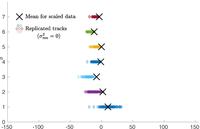
Bayesian inference can be used as a method to analyze statistical data from single-particle-tracking experiments. The authors develop a complementary test to judge the quality of the fit, and they present results on how their scheme applies to a theoretical example of position-dependent mobility.

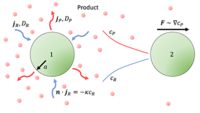
Antiswarming: Structure and dynamics of repulsive chemically active particles

Wen Yan and John F. Brady

Phys. Rev. E 96, 060601(R) (2017) - Published 1 December, 2017

The authors investigate collective behavior of repulsive Brownian particles. Simulations and analytical studies reveal that chemically active repulsive particles, when confined to a constant-volume domain, may undergo a liquid-to-crystal phase transition analogous to that found for positive ions in one-component plasmas. Experimental tests of the predictions appear to be feasible.

Inverse Bremsstrahlung current drive

Vadim R. Munirov and Nathaniel J. Fisch

Phys. Rev. E 96, 053211 (2017) - Published 29 November, 2017

The generation of current from electron-ion Bremsstrahlung absorption is one of the open problems in plasma physics. In this paper, the authors extend previous results for the current generated by colliding electrons and ions in the presence of incoming photons. Understanding the mechanisms behind this plasma current can have important consequences for astrophysical systems and inertial confinement fusion.

Universal Gaussian behavior of driven lattice gases at short times

Valerio Volpati, Urna Basu, Sergio Caracciolo, and Andrea Gambassi

Phys. Rev. E 96, 052136 (2017) - Published 27 November, 2017

In this work, the authors study the behavior of equilibrium and nonequilibrium lattice gas models. They find that, although the models belong to different universality classes and exhibit different critical properties, they display very similar behavior at short times after a critical quench. The short-time dynamics can be described with an effective Gaussian theory.

Three-body interactions improve contact prediction within direct-coupling analysis

Michael Schmidt and Kay Hamacher

Phys. Rev. E 96, 052405 (2017) - Published 9 November, 2017

The authors develop a computational method to include three-body interactions in a model for predicting residue contacts in a protein from sequence information. They demonstrate the higher accuracy achieved by their model compared to models with only two-body interactions.

Experimental determination of phase transitions by means of configurational entropies in finite Yukawa balls

Matthias Mulsow and André Melzer

Phys. Rev. E 96, 053202 (2017) - Published 9 November, 2017
Yukawa structures are ordered clusters of charged particles that can be realized with colloidal particles suspended in a plasma. The authors present experimental results on the melting of such three-dimensional structures. They find different phases by changing the local temperature with a laser, and characterize them using configurational entropy and correlation functions

Sign In to Your Journals Account

Filter

Section

Filter

Article Lookup

Enter a citation