Highlights

Contact line friction of electrowetting actuated viscous droplets

Quoc Vo and Tuan Tran

Phys. Rev. E 97, 063101 (2018) - Published 1 June, 2018

Droplets on a surface immersed in oil are made to spread and retract by switching on and off a potential difference between the droplets and the surface. The authors find that the contact line friction depends on the viscosities of the droplet and the surrounding oil and that it does not depend significantly on the driving force or the direction of motion.

Stochastic approach and fluctuation theorem for charge transport in diodes

Jiayin Gu and Pierre Gaspard

Phys. Rev. E 97, 052138 (2018) - Published 29 May, 2018

Charge transport in a diode is modeled using a stochastic approach, based on diffusion-reaction equations. Using their results for the transport of electrons and holes, the authors are able to connect traditional descriptions of diodes with nonequilibrium thermodynamics and show that a fluctuation theorem holds. This framework could be used as a starting point to simulate more complex electronic devices.

Mechanical characterization of disordered and anisotropic cellular monolayers

Alexander Nestor-Bergmann, Emma Johns, Sarah Woolner, and Oliver E. Jensen

Phys. Rev. E 97, 052409 (2018) - Published 22 May, 2018

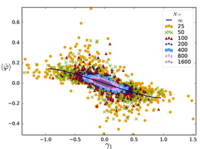
Experiments show that stretching induces spatial ordering of the cells of an epithelium from a Xenopus embryo. Using a vertex-based model, the authors demonstrate how an applied tension organizes the stress field of cells in a stretched layer and how mechanical properties of the tissue can be determined. This formulation extends previous approaches, and furthers our understanding of mechanical influences on biological tissues.

Gas-induced friction and diffusion of rigid rotors

Lukas Martinetz, Klaus Hornberger, and Benjamin A. Stickler

Phys. Rev. E 97, 052112 (2018) - Published 11 May, 2018

This paper presents a comprehensive classical theory of coupled translational and rotational dynamics of convex rigid bodies in rarified gases. The theory provides a detailed understanding of how a nanoparticle is affected by interactions with background gases and has applications ranging from optomechanics and the motion of nanoparticles in high vacuum to interstellar dust and dusty plasmas.

Landau theory of the short-time dynamical phase transitions of the Kardar-Parisi-Zhang interface

Naftali R. Smith, Alex Kamenev, and Baruch Meerson

Phys. Rev. E 97, 042130 (2018) - Published 25 April, 2018

The Kardar-Parisi-Zhang equation describes an important class of stochastic growth processes. The authors use the optimal fluctuation method to study extremal statistics of the interface height in this equation. The resulting detailed characterization of the system’s behavior makes contact with available exact results.

From sticky-hard-sphere to Lennard-Jones-type clusters

Lukas Trombach, Robert S. Hoy, David J. Wales, and Peter Schwerdtfeger

Phys. Rev. E 97, 043309 (2018) - Published 24 April, 2018

This paper examines the connection between the morphology of sticky-hard-sphere clusters and the energy landscape of soft potentials. The authors address this question for variants of the well-known Lennard-Jones model up to clusters of 13 particles, and study how the results depend on the softness, as characterized by the exponents in the potential.

Detachment dynamics of colloidal spheres with adhesive interactions

J. Bergenholtz

Phys. Rev. E 97, 042610 (2018) - Published 23 April, 2018

Detachment processes play an important role in the dynamics of colloids. This work demonstrates that including repeated attachment and detachment events gives predictions for a colloidal particle’s escape probability that are significantly different from those in first-passage-time descriptions. The author finds an analytical solution for detachment dynamics that should prove useful for a variety of applications.

Neural network approach to time-dependent dividing surfaces in classical reaction dynamics

Philippe Schraft, Andrej Junginger, Matthias Feldmaier, Robin Bardakcioglu, Jörg Main, Günter Wunner, and Rigoberto Hernandez

Phys. Rev. E 97, 042309 (2018) - Published 19 April, 2018

The authors of this paper use a neural network to construct a time-dependent dividing surface between reactant and product states in chemical reactions. The neural network is trained on a set of calculated points so that its output provides the position of the dividing surface. The approach is demonstrated for two simple models and has the potential to simplify the calculation of reaction rates in more complicated reactions.

Glass transition of soft colloids

Adrian-Marie Philippe, Domenico Truzzolillo, Julian Galvan-Myoshi, Philippe Dieudonné-George, Véronique Trappe, Ludovic Berthier, and Luca Cipelletti

Phys. Rev. E 97, 040601(R) (2018) - Published 11 April, 2018

The authors study the glass transition of soft colloids with computer simulations and experimental measurements. In contrast to previous work, they find that the behavior of the relaxation time is independent of particle softness, interaction type, and particle deformability, for a large range of parameters.

Effect of shock waves on the statistics and scaling in compressible isotropic turbulence

Jianchun Wang, Minping Wan, Song Chen, Chenyue Xie, and Shiyi Chen

Phys. Rev. E 97, 043108 (2018) - Published 11 April, 2018

This paper examines the spectra of the velocity and several thermodynamic variables in compressible turbulence in the presence of large-scale shock waves. The authors perform simulations of turbulence driven by solenoidal and compressible forces for a range of Mach numbers, and are able to extract different scaling behaviors. In addition, they propose heuristic ways to account for the observations.

Quantifying fluctuations in reversible enzymatic cycles and clocks

Harmen Wierenga, Pieter Rein ten Wolde, and Nils B. Becker

Phys. Rev. E 97, 042404 (2018) - Published 4 April, 2018

Fluctuations are a fundamental feature of biochemical reactions, and this paper presents a unified framework to describe such fluctuations in biochemical reaction cycles. The authors show first that the standard alternatives to quantify randomness in these processes are essentially equivalent and then proceed to characterize the statistical properties of the cycle period.

Catch bonding in the forced dissociation of a polymer endpoint

Cyril Vrusch and Cornelis Storm

Phys. Rev. E 97, 042405 (2018) - Published 4 April, 2018

Catch bonding is a phenomenon where the mean lifetime of a bond increases when subjected to a pulling force, as has been observed experimentally in protein binding. The authors successfully reproduce this feature using a simplified model in which a particle confined in a symmetric potential is pulled with a nonlinear force; this resembles more closely real polymer and protein interactions.

Normal stresses in semiflexible polymer hydrogels

M. Vahabi, Bart E. Vos, Henri C. G. de Cagny, Daniel Bonn, Gijsje H. Koenderink, and F. C. MacKintosh

Phys. Rev. E 97, 032418 (2018) - Published 28 March, 2018

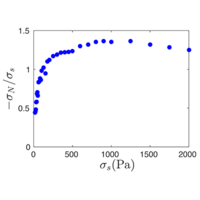
The authors extend and refine their model for the stress behavior of biopolymer gels. The microscopic model predicts time-dependent stresses and transient behavior which agree well with experimental measurements, including a behavior under shear that is opposite to that of most synthetic gels.

Barriers to front propagation in laminar, three-dimensional fluid flows

Minh Doan, J. J. Simons, Katherine Lilienthal, Tom Solomon, and Kevin A. Mitchell

Phys. Rev. E 97, 033111 (2018) - Published 26 March, 2018

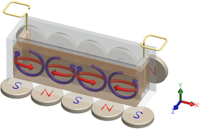
This paper presents an experimental study of front propagation in three-dimensional flows, showing evidence of one-way barriers that hinder the motion of the reaction fronts. In order to explain their results, the authors extend the burning-invariant-manifold theory to three dimensions, which enables them to capture the main features of the experimental results.

How nonuniform contact profiles of T cell receptors modulate thymic selection outcomes

Hanrong Chen, Arup K. Chakraborty, and Mehran Kardar

Phys. Rev. E 97, 032413 (2018) - Published 22 March, 2018

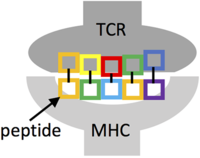
T cells undergo a selection process so that, as part of the immune system, they recognize foreign antigens, yet tolerate self-peptides. The authors show that the outcome of the selection process not only depends on the amino-acid sequence of the T cell, but also on its physical structure which determines the strength of each amino-acid contact.

Transition to collective oscillations in finite Kuramoto ensembles

Franziska Peter and Arkady Pikovsky

Phys. Rev. E 97, 032310 (2018) - Published 20 March, 2018

This paper addresses the issue of collective modes in a finite ensemble of oscillators in the Kuramoto model. The authors use the minimum of the order-parameter amplitude as the characteristic parameter for the existence of a collective mode and study how it is influenced by the statistical properties of the ensemble. Interestingly, the results continue to hold in the thermodynamic limit of an infinite ensemble.

Chemical event chain model of coupled genetic oscillators

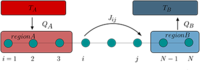
David J. Jörg, Luis G. Morelli, and Frank Jülicher

Phys. Rev. E 97, 032409 (2018) - Published 19 March, 2018

The dynamics of oscillators in biological systems can involve chains of events with many noisy steps. In this work the authors investigate how precision and synchronization can be increased by coupling two such genetic oscillators. Their findings may shed light on the operating regime of cellular genetic oscillator systems in which precise timing is vital, such as circadian clocks.

Heat transport in oscillator chains with long-range interactions coupled to thermal reservoirs

Stefano Iubini, Pierfrancesco Di Cintio, Stefano Lepri, Roberto Livi, and Lapo Casetti

Phys. Rev. E 97, 032102 (2018) - Published 5 March, 2018

The authors investigate heat propagation in one-dimensional chains of long-range interacting oscillators connected to thermal baths. They study two different models and find that for nonadditive interactions, heat transport shows a mean-field-like behavior irrespective of the particular details of the interactions.

Impact of hydrodynamic interactions on protein folding rates depends on temperature

Fabio C. Zegarra, Dirar Homouz, Yossi Eliaz, Andrei G. Gasic, and Margaret S. Cheung

Phys. Rev. E 97, 032402 (2018) - Published 5 March, 2018

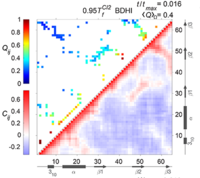
This paper examines the influence of hydrodynamic interactions on protein folding. The authors take two model proteins and perform Brownian dynamics simulations with a coarse-grained approach. Their results suggest that the long-range hydrodynamic interactions favor protein folding below the folding temperature, but retard it above that temperature

Sinking during earthquakes: Critical acceleration criteria control drained soil liquefaction

C. Clément, R. Toussaint, M. Stojanova, and E. Aharonov

Phys. Rev. E 97, 022905 (2018) - Published 21 February, 2018

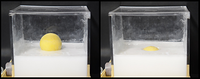
Experimental studies and simulations of a simple model demonstrate how liquefaction of granular media depends on the presence of water, the friction properties and density of the media, and acceleration of the imposed oscillation. The authors suggest modifications of their model that could give additional insights into how soil liquefaction may be triggered during an earthquake.

Sign In to Your Journals Account

Filter

Section

Filter

Article Lookup

Enter a citation