Highlights

Pattern localization to a domain edge

Manon C. Wigbers, Fridtjof Brauns, Tobias Hermann, and Erwin Frey

Phys. Rev. E 101, 022414 (2020) - Published 18 February, 2020

This paper uses a reaction–diffusion model to explain the formation of protein patterns in heterogeneous conditions, for example inside cells. The authors propose an explanation of how proteins collect at domain edges in the environment based on a local mass redistribution that does not occur in homogeneous systems.

Identifying knot types of polymer conformations by machine learning

Olafs Vandans, Kaiyuan Yang, Zhongtao Wu, and Liang Dai

Phys. Rev. E 101, 022502 (2020) - Published 11 February, 2020

Identifying if two knots are similar is an open problem that cuts across several disciplines from mathematics to physical sciences; the main challenge is that the knot type is a global property that cannot be determined by looking only locally. In this paper, the authors apply supervised learning techniques to the knot recognition problem in polymers, showing what artificial neural networks can do to address it.

Translational nucleosome positioning: A computational study

J. Neipel, G. Brandani, and H. Schiessel

Phys. Rev. E 101, 022405 (2020) - Published 10 February, 2020

How to predict the positions of nucleosomes on DNA is an important problem. The authors show that a simple coarse-grained model of DNA is unable to account for all aspects of the positioning, and they propose a model that assumes the elasticity of DNA changes when it is part of the nucleosome. The new approach shows excellent agreement with previously published experimental work.

Lattice Boltzmann model for weakly compressible flows

Praveen Kumar Kolluru, Mohammad Atif, Manjusha Namburi, and Santosh Ansumali

Phys. Rev. E 101, 013309 (2020) - Published 22 January, 2020

The authors propose an energy-conserving multispeed lattice Boltzmann model relevant for acoustic phenomena and weakly compressible flows. By providing simulations of several test cases they demonstrate that the model gives impressive results, including for turbulent flows, even in the presence of objects.

Adsorption anomalies in a two-dimensional model of cluster-forming systems

E. Bildanau, J. Pękalski, V. Vikhrenko, and A. Ciach

Phys. Rev. E 101, 012801 (2020) - Published 17 January, 2020

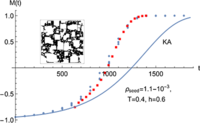
Monte Carlo simulations are used to study a two-dimensional lattice model of particles interacting through short-range attraction and long-range repulsion. Adsorption of particles on a boundary line and the distribution of particle clusters near the boundary were investigated while varying several parameters. The authors find a rich variety of patterns that are qualitatively different from those in liquids with simpler interactions.

Charge oscillations in ionic liquids: A microscopic cluster model

Yael Avni, Ram M. Adar, and David Andelman

Phys. Rev. E 101, 010601(R) (2020) - Published 9 January, 2020

The microscopic model of ionic liquids presented in this work reproduces many features previously observed in experiments and simulations. The effective mean-field theory obtained from this model shows that ionic pairs lead to short-range charge oscillations near an interface and that more complex clusters can lead to long-ranged oscillations.

Mechanics-based model for the cooking-induced deformation of spaghetti

Nathaniel N. Goldberg and Oliver M. O'Reilly

Phys. Rev. E 101, 013001 (2020) - Published 2 January, 2020

A strand of spaghetti changes shape as it is cooked. This paper proposes a theory that includes a time-dependent curvature, and models the evolution of the system based on previous observations. The authors compare their results with tabletop experiments and find good agreement.

Lorentzian-geometry-based analysis of airplane boarding policies highlights “slow passengers first” as better

Sveinung Erland, Jevgenijs Kaupužs, Vidar Frette, Rami Pugatch, and Eitan Bachmat

Phys. Rev. E 100, 062313 (2019) - Published 27 December, 2019

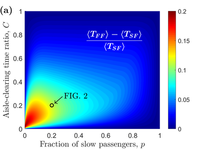
This paper tackles the problem of airplane boarding by making use of geodesics in an appropriate spacetime. The authors find that boarding slower passengers first reduces the total boarding time, as faster passengers catch up with them and can sit down simultaneously. The results are strictly correct in the limit of infinitely many passengers, but appear to hold for a realistic number of individuals.

Hard convex lens-shaped particles: Characterization of dense disordered packings

Giorgio Cinacchi and Salvatore Torquato

Phys. Rev. E 100, 062902 (2019) - Published 24 December, 2019

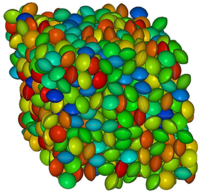
Simulations of hard lens-shaped particles can be used to explore their packing properties. Starting from a loosely packed state, the particles are compressed until isostaticity is reached. The authors find that the maximally packed state is denser and more disordered than its hard-sphere counterpart, and also free of loose rattler particles.

Percolation on branching simplicial and cell complexes and its relation to interdependent percolation

Ginestra Bianconi, Ivan Kryven, and Robert M. Ziff

Phys. Rev. E 100, 062311 (2019) - Published 20 December, 2019

The authors explore percolation transitions on certain two-dimensional generalized networks whose boundaries scale like their volume. They find several intermediate transitions that show a discontinuity in the fractal exponent of the giant component, and in the percolation probability.

Temperature control of nematicon trajectories

Gaetano Assanto, Cassandra Khan, Armando Piccardi, and Noel F. Smyth

Phys. Rev. E 100, 062702 (2019) - Published 13 December, 2019

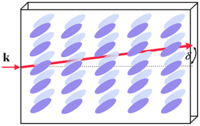
When a light beam propagates through a nematic liquid crystal, it heats the material and the resulting change in temperature in turn affects the propagation of the light. The authors propose a theory that reduces the mathematical complexity using several physical assumptions, and gives remarkable agreement with experimental data.

Acceptance rate is a thermodynamic function in local Monte Carlo algorithms

Evgeni Burovski, Wolfhard Janke, Maria Guskova, and Lev Shchur

Phys. Rev. E 100, 063303 (2019) - Published 10 December, 2019

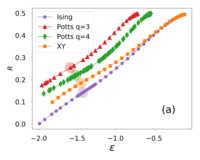
Monte Carlo simulations are one of the most widely used computational methods in physics. The authors find that, for a specific model and update scheme, the acceptance rate of Monte Carlo moves depends linearly on the energy. They explore several lattice models and update mechanisms and show how the acceptance rate behaves in the vicinity of the systems’ critical temperatures, and that it can be viewed as a thermodynamic function.

From early nucleation past the percolation threshold: Status of the Kolmogorov-Avrami theory on a cold Ising lattice

Vitaly A. Shneidman

Phys. Rev. E 100, 061301(R) (2019) - Published 6 December, 2019

This work tests the Kolmogorov-Johnson-Mehl-Avrami theory of crystallization kinetics in Ising systems for regimes that are accessible with current computer simulations. The author shows the conditions under which the theory is able to describe the simulation results, and where it fails.

Direct evaluation of dynamical large-deviation rate functions using a variational ansatz

Daniel Jacobson and Stephen Whitelam

Phys. Rev. E 100, 052139 (2019) - Published 25 November, 2019

Large-deviation rate functions play a role in dynamical systems similar to that of the free energy in equilibrium. The authors develop a method related to umbrella sampling that allows dynamical rate functions to be calculated in a manner similar to the calculation of free energies.

Phase behavior of blocky charge lattice polymers: Crystals, liquids, sheets, filaments, and clusters

Nicholas A. S. Robichaud, Ivan Saika-Voivod, and Stefan Wallin

Phys. Rev. E 100, 052404 (2019) - Published 15 November, 2019

Certain proteins condense into a liquidlike state instead of folding into a stable configuration. Using a lattice model, the authors simulate a variety of polymers and find different condensed phases. The results indicate that the formation of the liquidlike state will depend sensitively on the amino sequence of the protein.

Uniform distortions and generalized elasticity of liquid crystals

Epifanio G. Virga

Phys. Rev. E 100, 052701 (2019) - Published 15 November, 2019

This paper presents a generalization of the elastic theory of anisotropic materials having nematic symmetry. The author shows that two families of heliconical distortions with opposite twists account for all uniform distortions of the nematic director that can fill three-dimensional space. An expression describing the twist-bend nematic phase is provided based on this generalized elastic theory.

Confinement effects on the dynamics of a rigid particle in a nanochannel

Alberto Gubbiotti, Mauro Chinappi, and Carlo Massimo Casciola

Phys. Rev. E 100, 053307 (2019) - Published 12 November, 2019

How does a single nanoparticle move in a confined geometry comparable to its size? This question is of central importance now that we are able to realize nanodevices. In this work the authors overcome the limitations of previous theoretical models by simulating the motion of a rigid body under confinement using a statistical framework that takes into account thermal fluctuations.

Transition to bound states for bacteria swimming near surfaces

Debasish Das and Eric Lauga

Phys. Rev. E 100, 043117 (2019) - Published 31 October, 2019

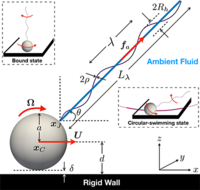
The plethora of swimming techniques developed by bacteria suggest that how they swim depends on their environment, size, and shape. This study provides interesting insights into this problem. The authors theoretically and numerically investigate the transition from swimming to a surface-bound state observed in unusual gigantic bacteria.

Quantum duets working as autonomous thermal motors

Michael Drewsen and Alberto Imparato

Phys. Rev. E 100, 042138 (2019) - Published 30 October, 2019

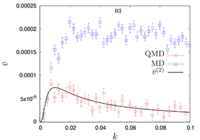
An autonomous thermal motor can be modeled by two quantum Brownian particles, each driven by heat reservoirs and moving in a periodic potential. The authors’ simulations with a quantum molecular dynamics algorithm agree well with calculations for the center of mass velocity of the system. The model could potentially be realized with two laser-cooled atomic ions.

Persistent exclusion processes: Inertia, drift, mixing, and correlation

Stephen Zhang, Aaron Chong, and Barry D. Hughes

Phys. Rev. E 100, 042415 (2019) - Published 30 October, 2019

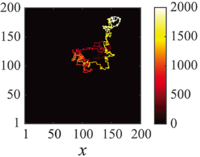
This work examines a model for a population of interacting walkers with motion persistence, in a mean-field approximation. The authors examine variations of the model and find that results are generally well described by systems of nonlinear diffusion equations. Their investigations indicate that the presence of persistence may be inferred by examining the pair correlation function.

Sign In to Your Journals Account

Filter

Section

Filter

Article Lookup

Enter a citation