Recent Articles

Ab initio study of magnetic phase transition and electronic properties of CeFe2 under high pressure

Yiyuan Wang and Ji Feng

Phys. Rev. B 110, 144414 (2024) - Published 10 October, 2024

Near-room-temperature ferrimagnetism and half-metallicity in disordered Ca1.5La0.5MnRuO6

A. G. Silva, R. B. Pontes, M. Boldrin, H. V. S. Pessoni, L. S. I. Veiga, J. R. Jesus, H. Fabrelli, A. R. C. Gonzaga, E. M. Bittar, and L. Bufaiçal

Phys. Rev. B 110, 144415 (2024) - Published 10 October, 2024

Recursive algorithm for generating high-temperature expansions for spin systems and the chiral nonlinear susceptibility

Andreas Rückriegel, Dmytro Tarasevych, Jan Krieg, and Peter Kopietz

Phys. Rev. B 110, 144416 (2024) - Published 10 October, 2024

Peculiar RKKY behavior involving electron transfer effect in sp3 semi-ionic F-doped graphene metal

Shuilin Li, Hongzhe Pan, Jiawei Liu, Ziying Li, and Nujiang Tang

Phys. Rev. B 110, 144417 (2024) - Published 10 October, 2024

Quantum spin liquids in weak Mott insulators with spin-orbit coupling

Asimpunya Mitra, Daniel J. Schultz, and Yong Baek Kim

Phys. Rev. B 110, 144418 (2024) - Published 10 October, 2024

Competition between d-wave and d+is-wave superconductivity in the Hubbard model on a checkerboard lattice

Yue Pan, Runyu Ma, Chao Chen, Zixuan Jia, and Tianxing Ma

Phys. Rev. B 110, 144509 (2024) - Published 10 October, 2024

Electric field tunable nonlinear Hall terahertz detector in the dual quantum spin Hall insulator TaIrTe4

Junwen Lai, Jie Zhan, Peitao Liu, Xing-Qiu Chen, and Yan Sun

Phys. Rev. B 110, 155122 (2024) - Published 10 October, 2024

Boundary-dominated photonic Chern insulators with hyperbolic lattice geometry

Haoyu Qin, Weixuan Zhang, and Xiangdong Zhang

Phys. Rev. B 110, 155123 (2024) - Published 10 October, 2024

Exchange interactions in the rare-earth magnets A2PrO3 (A=alkali metals)

Seong-Hoon Jang and Yukitoshi Motome

Phys. Rev. B 110, 155124 (2024) - Published 10 October, 2024

Anomalous Hall effect in two-dimensional vanadium tetrahalogen with altermagnetic phase

Hao Jin, Zhibin Tan, Zhirui Gong, and Jian Wang

Phys. Rev. B 110, 155125 (2024) - Published 10 October, 2024

Full-potential screened spherical wave based muffin-tin orbital method for density functional theory

Aixia Zhang, Qingyun Zhang, Yu Zhang, Zhiyi Chen, Yong Wu, and Youqi Ke

Phys. Rev. B 110, 155126 (2024) - Published 10 October, 2024

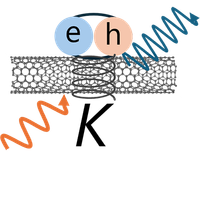
Intrinsic process for upconversion photoluminescence via K-momentum–phonon coupling in carbon nanotubes

Daichi Kozawa, Shun Fujii, and Yuichiro K. Kato

Phys. Rev. B 110, 155418 (2024) - Published 10 October, 2024

Carbon nanotubes exhibit efficient upconversion photoluminescence, which has been thought to arise from extrinsic effects such as defects. By using single nanotube spectroscopy on defect-free, air-suspended carbon nanotubes, the authors demonstrate here that upconversion readily occurs through an intrinsic process. Sidebands in the upconversion photoluminescence excitation spectra are assigned to K-momentum phonon modes, explaining the mechanism of upconversion. With efficient upconversion, large energy gain, and near-unity radiative quantum efficiency, these pristine nanotubes offer a promising platform for exploring optothermal effects.

Moiré flat bands and antiferroelectric domains in lattice relaxed twisted bilayer hexagonal boron nitride under perpendicular electric fields

Fengping Li, Dongkyu Lee, Nicolas Leconte, Srivani Javvaji, Young Duck Kim, and Jeil Jung

Phys. Rev. B 110, 155419 (2024) - Published 10 October, 2024

Light-modulated Andreev effects in graphene-based superconducting junctions

Miao Yu, Deliang Cao, Hong Wang, Yafang Xu, Fenghua Qi, Xingfei Zhou, and Guojun Jin

Phys. Rev. B 110, 155420 (2024) - Published 10 October, 2024

Three-component fractional quantum Hall effect in topological flat bands

Tian-Sheng Zeng

Phys. Rev. B 110, 165126 (2024) - Published 10 October, 2024

Sign structure of the t−t′−J model and its physical consequences

Xin Lu, Jia-Xin Zhang, Shou-Shu Gong, D. N. Sheng, and Zheng-Yu Weng

Phys. Rev. B 110, 165127 (2024) - Published 10 October, 2024

Topological Kondo semimetal and insulator in AB-stacked heterobilayer transition metal dichalcogenides

Daniele Guerci, Kevin P. Lucht, Valentin Crépel, Jennifer Cano, J. H. Pixley, and Andrew Millis

Phys. Rev. B 110, 165128 (2024) - Published 10 October, 2024

The “Topological Kondo Insulator” is a long-sought phase of matter, in which two physically distinct systems, localized magnetic moments and mobile (conducting) electrons, combine via the many body process known as the Kondo effect to form a nonmagnetic insulator with gapless topological surface states and a quantized spin Hall conductance. Guerci and collaborators predict here that this state can be realized in the currently intensively studied transition metal dichalcogenide bilayer systems, opening the door to extensive studies of Kondo insulator physics.

Anisotropic optical conductivity of the n-doped type-II three-dimensional Dirac semimetal PtTe2

Q. N. Li, Y. M. Xiao, W. Xu, F. M. Peeters, and M. V. Milošević

Phys. Rev. B 110, 165203 (2024) - Published 10 October, 2024

Impurity scattering and Friedel oscillations in altermagnets

Wang Chen, Xiaoying Zhou, Dong Zhang, Ying-Qiang Xu, and Wen-Kai Lou

Phys. Rev. B 110, 165413 (2024) - Published 10 October, 2024

Controlling orbital magnetism of band electron systems via bath engineering

Subrata Chakraborty and So Takei

Phys. Rev. B 110, L140405 (2024) - Published 10 October, 2024
A complete theory of the orbital magnetic susceptibility of an isolated multiband electron system was developed in 2015. Here, the authors study whether one can control this orbital susceptibility by opening the electron system to a fermionic bath. They show that, as the system-bath coupling is increased, a properly engineered bath can enhance the diamagnetic susceptibility of the system and even change its orbital paramagnetic response into a diamagnetic one. The work also discusses how a Van Hove singularity in the bath density of states can be exploited to generate a giant enhancement of the orbital magnetic response. These results are counterintuitive, relative to the common belief, that bath-induced decoherence merely leads to the quenching of the orbital magnetic susceptibility.

Sign In to Your Journals Account

Filter

Recent Issues

Vol. 114, Iss. 24
15 October 2026
Vol. 114, Iss. 23
15 October 2026
Vol. 114, Iss. 22
15 October 2026
Vol. 114, Iss. 21
1 October 2026
Category
Article Type
Section

Filter

Article Lookup

Enter a citation