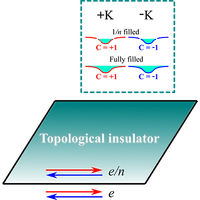
We study low-temperature phases and edge-state conductance of an interacting composite Abelian helical edge state made of a regular helical liquid carrying charge and a (fractionalized) helical liquid carrying charge . A systematic framework is developed for these composite Abelian helical edge states with , incorporating symmetry-allowed interaction and disorder. For , the system is made of two regular helical Luttinger liquids. For , the composite edge state consists of a regular helical Luttinger liquid and a fractional topological insulator (the Abelian topological order) edge state arising from half-filled conjugated Chern bands. The composite edge state with is pertinent to the recent twisted experiment at , suggesting a possible fractional topological insulator with an edge-state conductance . For , we consider a regular helical Luttinger liquid and a pair of time-reversal Laughlin fractional quantum Hall edge states. Using bosonization, we identify relevant perturbations and construct generic phase diagrams in the presence of weak Rashba spin-orbit coupling. In addition to a phase of free bosons, we find a time-reversal symmetry-breaking localized insulator, two perfect positive drag phases (due to different mechanisms), a perfect negative drag phase (for ), a time-reversal symmetric Anderson localization (only for ), and a disorder-dominated metallic phase analogous to the disordered fractional quantum Hall edges (only for ). We further compute the two-terminal edge-state conductance, the primary experimental characterization for the (fractional) topological insulator. Remarkably, the negative drag phase gives rise to an unusual edge-state conductance , which is not directly associated with the filling factor. We further investigate the effect of an applied in-plane magnetic field. For , the applied magnetic field can result in a phase with localization only in the regular helical liquid channel, and the edge-state conductance is , providing another testable signature. Our work establishes a systematic understanding of the composite Abelian helical edge, paving the way for future experimental and theoretical studies.