Recent Articles

Characterizing dynamical behavior in topological open systems with boundary dissipation

Zhen-Yu Zheng, Xueliang Wang, and Shu Chen

Phys. Rev. B 111, 214304 (2025) - Published 12 June, 2025

Solvable embedding mechanism for one-dimensional spinless and Majorana fermions in higher-dimensional spin-12 magnets

Sumiran Pujari

Phys. Rev. B 111, 214421 (2025) - Published 12 June, 2025

Quasiperiodically modulated honeycomb lattices and their magnetic properties

Akihisa Koga and Toranosuke Matsubara

Phys. Rev. B 111, 214422 (2025) - Published 12 June, 2025

Erratum: Transport theory and spin-transfer physics in d-wave altermagnets [Phys. Rev. B 111, 064422 (2025)]

Ricardo Zarzuela, Rodrigo Jaeschke-Ubiergo, Olena Gomonay, Libor Šmejkal, and Jairo Sinova

Phys. Rev. B 111, 219901 (2025) - Published 12 June, 2025

Dipole-quadrupole coupling in triplet exciton-polaron quenching in a phosphorescent OLED emission layer

Clint van Hoesel, Reinder Coehoorn, and Peter Bobbert

Phys. Rev. B 111, 224204 (2025) - Published 12 June, 2025

From quantum chemical calculations, triplet-polaron quenching in phosphorescent Ir(ppy)2acac:m-MTDATA host–guest films, such as those used in OLEDs, is shown to be governed not only by dipole–dipole Förster transfer, as is often assumed, but also by quadrupolar interactions. At typical emitter-host separations, quadrupolar contributions even dominate. This work quantifies these contributions by generalizing Förster spectral overlap method to dipole-quadrupole coupling, based on near-field quadrupolar absorption. The study resolves a discrepancy between Förster radii found from spectral overlap calculations and device experiments.

Out-of-equilibrium dynamics across the first-order quantum transitions of one-dimensional quantum Ising models

Andrea Pelissetto, Davide Rossini, and Ettore Vicari

Phys. Rev. B 111, 224306 (2025) - Published 12 June, 2025

Neutron diffraction study of the crystal and magnetic structures of antiferromagnetic manganese deuteride at high temperatures and high pressures

Akihiko Machida, Hiroyuki Saitoh, Katsutoshi Aoki, Kazuki Komatsu, Takanori Hattori, Asami Sano-Furukawa, Kenichi Funakoshi, Shinichi Machida, Toyoto Sato, and Shin-ichi Orimo

Phys. Rev. B 111, 224413 (2025) - Published 12 June, 2025

Impurity states in altermagnetic superconductors

Andrea Maiani and Rubén Seoane Souto

Phys. Rev. B 111, 224506 (2025) - Published 12 June, 2025

Altermagnetic superconductors have been predicted as a new class of materials with potential for novel phases of matter, but have not been demonstrated so far. The authors show here that a single nonmagnetic impurity induces spin-polarized bound states with distinctive “cross-shaped” spatial patterns that follow the hidden Néel order. The orientation of these states leads to spin-selective coupling between impurities. The predicted signatures—spatial extent and energy splitting as a function of magnetic field—are observable via scanning tunneling microscopy, offering a route to identify altermagnetic superconductivity and control atomic-scale quantum tunneling.

Electronic structures and pseudogap nature of the strongly correlated Kondo semimetals and insulators CeNiSn and CeRhX(X=As, Sb)

J.-S. Kang, Seungho Seong, J. D. Denlinger, T. Takabatake, Y. Ōnuki, Kyoo Kim, and B. I. Min

Phys. Rev. B 111, 235123 (2025) - Published 12 June, 2025

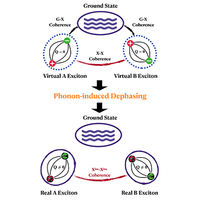
Long-lived coherence between incoherent excitons revealed by time-resolved angle-resolved photoemission spectroscopy: An exact solution

Zhenlin Zhang, Wei Hu, Enrico Perfetto, and Gianluca Stefanucci

Phys. Rev. B 111, 235124 (2025) - Published 12 June, 2025

The authors study here exciton dynamics in an exactly solvable two-band semiconductor model, including light-matter, electron-electron, and electron-phonon interactions. They identify a long-lived coherence between incoherent excitons that persists despite phonon-induced dephasing. This coherence manifests as quantum beats in time-resolved angle-resolved photoemission spectroscopy spectra, revealing dynamics distinct from previously known excitonic coherences.

Evaluation of zero-threshold optical gain in quantum dots based on size-controlled electron doping

Chen Liao, Haoran Yang, Luping Tang, Weihua Shi, and Shaoling Sun

Phys. Rev. B 111, 235302 (2025) - Published 12 June, 2025

Layer-resolved quantum transport in twisted bilayer graphene: Counterflow and machine learning predictions

Matheus H. Gobbo Kuhn, L. A. Silva, and D. A. Bahamon

Phys. Rev. B 111, 235425 (2025) - Published 12 June, 2025

Mott states proximitized to a relativistic electron gas in epitaxial graphene

Chitran Ghosal, Siheon Ryee, Zamin Mamiyev, Maria-Elisabeth Federl, Niklas Witt, Tim Wehling, and Christoph Tegenkamp

Phys. Rev. B 111, 235426 (2025) - Published 12 June, 2025

Multiple layer Hall states in the topological magnet V2WS4 family

Xuqi Li, Hong Xu, Yu Zhang, and Shifei Qi

Phys. Rev. B 111, 235427 (2025) - Published 12 June, 2025

High superconducting transition temperature in bilayer blue phosphorus by metal intercalation

Ruiqi Ku, Liujiang Zhou, Jian-Guo Si, Bao-Tian Wang, Weiqi Li, and Luo Yan

Phys. Rev. B 111, 235429 (2025) - Published 12 June, 2025

Valley gapless semiconductor: Models and applications

Kok Wai Lee, Pei-Hao Fu, Jun-Feng Liu, Ching Hua Lee, and Yee Sin Ang

Phys. Rev. B 111, 235430 (2025) - Published 12 June, 2025

Image of helical local moment magnetic order in the STM spectrum

Alireza Akbari and Peter Thalmeier

Phys. Rev. B 111, 245129 (2025) - Published 12 June, 2025

Chiral vortex-line liquid of three-dimensional interacting Bose systems with moat dispersion

Bahar Jafari-Zadeh, Chenan Wei, and Tigran A. Sedrakyan

Phys. Rev. B 111, 245130 (2025) - Published 12 June, 2025

The chiral vortex-line liquid (CVLL) is a newly predicted quantum phase in three-dimensional Bose systems with “moat” dispersion, where energy minima create continuous surfaces in momentum space. By generalizing Chern-Simons flux attachment to 3D-combining planar Chern-Simons phases with Jordan-Wigner strings along the vortex lines, the CVLL emerges as a noncondensed topologically ordered liquid that exhibits broken time-reversal symmetry, vortex-line excitations, and gapless surface states. Monte Carlo simulations confirm that, at low densities, the CVLL energetically outcompetes conventional condensates, making it a ground-state candidate for frustrated magnets, excitonic insulators, ultracold atoms, superfluid helium, and heavy-ion collision physics.

Intrinsic spin Nernst effect in topological Dirac and magnetic Weyl semimetals

Taiki Matsushita, Akihiro Ozawa, Yasufumi Araki, Junji Fujimoto, and Masatoshi Sato

Phys. Rev. B 111, 245131 (2025) - Published 12 June, 2025

Shear-resistant topology in the quasi-one-dimensional van der Waals material Bi4Br4

Jonathan K. Hofmann, Hoyeon Jeon, Saban M. Hus, Yuqi Zhang, Mingqian Zheng, Tobias Wichmann, An-Ping Li, Jin-Jian Zhou, Zhiwei Wang, Yugui Yao, Bert Voigtländer, F. Stefan Tautz, and Felix Lüpke

Phys. Rev. B 111, 245415 (2025) - Published 12 June, 2025

Sign In to Your Journals Account

Filter

Recent Issues

Vol. 114, Iss. 24
15 October 2026
Vol. 114, Iss. 23
15 October 2026
Vol. 114, Iss. 22
15 October 2026
Vol. 114, Iss. 21
1 October 2026
Category
Article Type
Section

Filter

Article Lookup

Enter a citation