Recent Articles

Determination of ground states of one-dimensional quantum systems using the cluster iTEBD method

Tao Yang, Rui Wang, Z. Y. Xie, and Baigeng Wang

Phys. Rev. B 112, 085142 (2025) - Published 25 August, 2025

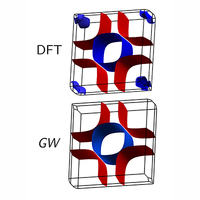
Pressure and strain effects on the ab initio GW electronic structure of La3Ni2O7

Jean-Baptiste de Vaulx, Quintin N. Meier, Pierre Toulemonde, Andrés Cano, and Valerio Olevano

Phys. Rev. B 112, 085143 (2025) - Published 25 August, 2025

The bilayer compound La3Ni2O7 under high pressure has long held the superconducting Tc record among the nickelates, triggering a considerable amount of experimental and theoretical work to understand its main electronic properties. This work presents an ab initio analysis of these properties within the G0W0 approximation for different pressures and under epitaxial strain, showing features consistent with ARPES data as well as interesting effects. Among these, a strong renormalization of the rare-earth band and a slight deviation from conventional Fermi-liquid behavior stand out.

Stability of Floquet sidebands and quantum coherence in one-dimensional strongly interacting spinless fermions

Karun Gadge and Salvatore R. Manmana

Phys. Rev. B 112, 085144 (2025) - Published 25 August, 2025

Photoinduced dc Hall current in few-layer black phosphorus with a gate-tunable Floquet gap

Taehun Kim, Hansol Kim, Dongeun Kim, and Hongki Min

Phys. Rev. B 112, 085145 (2025) - Published 25 August, 2025

Effect of disorder on the strain-tuned charge density wave multicriticality in PdxErTe3

Anisha G. Singh, Maja D. Bachmann, Alan Fang, Aharon Kapitulnik, Steven A. Kivelson, Ian R. Fisher, Paul Thompson, Stephan Rosenkranz, Raymond Osborn, Matthew Krogstad, Jong Woo Kim, and Philip J. Ryan

Phys. Rev. B 112, 085146 (2025) - Published 25 August, 2025

Symmetry is a central concept in condensed matter physics. Similarly, disorder is pervasive in real materials and can have important effects on a wide range of physical properties. Here, the authors explore how disorder affects a strain-tuned bicritical point associated with the meeting of two non-symmetry-related continuous phase transitions in an orthorhombic material. They find evidence for an emergent pseudo-tetragonal symmetry proximate to the bicritical point, which, despite negligible changes in the structural orthorhombicity, occurs for a smaller value of the critical strain and extends over a wider range of tuning parameters than for the pristine material.

Influence of nitrogen doping and annealing on the silicon vacancy in 4H−SiC

Samuel G. Carter, Infiter Tathfif, Charity Burgess, Brenda VanMil, Suryakanti Debata, and Pratibha Dev

Phys. Rev. B 112, 085209 (2025) - Published 25 August, 2025

Evolution of flat bands in a two-dimensional fused pentagon network

Tomonari Mizoguchi, Mina Maruyama, Yasuhiro Hatsugai, and Susumu Okada

Phys. Rev. B 112, 085421 (2025) - Published 25 August, 2025

Initialization of neutral and charged exciton spin states in a telecom-emitting quantum dot

Giora Peniakov, Johannes M. Michl, Mohamed Helal, Raphael Joos, Michael Jetter, Simone L. Portalupi, Peter Michler, Sven Höfling, and Tobias Huber-Loyola

Phys. Rev. B 112, 085422 (2025) - Published 25 August, 2025

It is an ongoing effort to utilize semiconductor quantum dots as quantum light sources directly in the telecom wavelength range. Here, the authors contribute to this effort by establishing a p-shell excitation method for such quantum dots, enabling “writing” of the confined matter spin qubit state via the exciting laser’s polarization. In addition, they report a record-high coherence time for a confined hole, opening up new possibilities for implementing advanced quantum light protocols.

Analytic framework for self-dual criticality in Zk gauge theory with matter

Zhengyan Darius Shi and Arkya Chatterjee

Phys. Rev. B 112, L081111 (2025) - Published 25 August, 2025

Anomalous non-Hermitian skin effect of chiral boundary states

Tian-Rui Liu, Tao Liu, and Meng Xiao

Phys. Rev. B 112, L081112 (2025) - Published 25 August, 2025

Anisotropy at twin interfaces in RT12 (R=rare earth; T=transition metal) magnets

Christopher E. Patrick

Phys. Rev. B 112, 054446 (2025) - Published 22 August, 2025

High-temperature superconductivity in Th-B-H systems via nonclathrate design

Zengguang Zhou, Wenwen Cui, Shicong Ding, Weishuo Xu, Jian Hao, Jingming Shi, Artur P. Durajski, Hanyu Liu, and Yinwei Li

Phys. Rev. B 112, 054513 (2025) - Published 22 August, 2025

Anderson localization of light by impurities in a solid transparent matrix

S. E. Skipetrov and I. M. Sokolov

Phys. Rev. B 112, 064206 (2025) - Published 22 August, 2025

Temperature-dependent study of the spin dynamics of coupled Y3Fe5O12/Gd3Fe5O12/Pt trilayers

Felix Fuhrmann, Sven Becker, Akashdeep Akashdeep, Gerhard Jakob, Qianqian Lan, Nan Wang, Rafal E. Dunin-Borkowski, Romain Lebrun, Mathias Weiler, and Mathias Kläui

Phys. Rev. B 112, 064432 (2025) - Published 22 August, 2025

The authors unravel here the coupled spin dynamics in Y3Fe5O12/Gd3Fe5O12/Pt trilayers by combining broadband ferromagnetic resonance and spin pumping measurements, supported by micromagnetic simulations. Their work demonstrates strong interlayer coupling, revealing that the GdIG layer governs spin current generation, near its compensation temperature. The system’s highly tunable spin current and coherent dynamics establish a robust platform for investigating magnonic transport and designing complex spintronic devices, such as all-insulating magnon spin valves, across broad temperature and field regimes.

Many-body perturbation theory for moiré systems

Liangtao Peng, Giovanni Vignale, and Shaffique Adam

Phys. Rev. B 112, 075146 (2025) - Published 22 August, 2025

Moiré materials exhibit a rich spectrum of correlated phases, most notably superconductivity and insulating behavior driven by interactions. Existing theories often rely on mean-field approximations, which miss important correlation effects. Here, the authors build a many-body perturbation theory tailored to moiré systems, using Green’s functions to go beyond mean-field. Their approach captures symmetry-breaking states, finite-temperature transitions, and self-consistent corrections to electronic properties. This framework opens a new route to better understand how interactions shape the rich physics of moiré materials.

Fermi surface as a quantum critical manifold: Gaplessness, order parameter, and scaling in d dimensions

Gennady Y. Chitov

Phys. Rev. B 112, 075147 (2025) - Published 22 August, 2025

Spin fractionalization at the edge of quantum Hall fluids induced by bulk quasiparticles

Alexander Fagerlund, Alberto Nardin, Leonardo Mazza, and Eddy Ardonne

Phys. Rev. B 112, 075148 (2025) - Published 22 August, 2025

Key role of orbital splitting in two-dimensional Janus transition metal dichalcogenides: From stability to ferrovalley material design

Lei Li, Ji-Chun Lian, Zi-Xuan Yang, Tao Huang, Jun-Qi Xu, X. S. Wang, Gui-Fang Huang, Wangyu Hu, Wei-Qing Huang, and Xidong Duan

Phys. Rev. B 112, 075423 (2025) - Published 22 August, 2025

First-principle-based Floquet engineering of solids in the velocity gauge

Vishal Tiwari and Ignacio Franco

Phys. Rev. B 112, 085139 (2025) - Published 22 August, 2025

Double rotatory power reversal, continuous Kerr angle, and enhanced reflectance in bi-isotropic media with anomalous Hall current

Alex Q. Costa, Pedro D. S. Silva, and Manoel M. Ferreira, Jr.

Phys. Rev. B 112, 085140 (2025) - Published 22 August, 2025

Sign In to Your Journals Account

Filter

Recent Issues

Vol. 114, Iss. 24
15 October 2026
Vol. 114, Iss. 23
15 October 2026
Vol. 114, Iss. 22
15 October 2026
Vol. 114, Iss. 21
1 October 2026
Category
Article Type
Section

Filter

Article Lookup

Enter a citation