Recent Articles

Efficient optimization of variational tensor-network approach to three-dimensional statistical systems

Xia-Ze Xu, Tong-Yu Lin, and Guang-Ming Zhang

Phys. Rev. B 112, 134403 (2025) - Published 2 October, 2025

Measuring the magnetic anisotropy of the spin Hall effect and spin relaxation length in nickel and permalloy via electrical spin injection

Eoin Dolan, Jone Mencos, Williams Savero Torres, Maxen Cosset-Chéneau, Jean-Philippe Attané, Laurent Vila, Luis E. Hueso, and Fèlix Casanova

Phys. Rev. B 112, 134404 (2025) - Published 2 October, 2025

Gapfull and gapless one-dimensional topological superconductivity in spin-orbit-coupled bilayer graphene

Daniel Skliannyi, Yuval Oreg, and Ady Stern

Phys. Rev. B 112, 134504 (2025) - Published 2 October, 2025

Consistent surface and bulk magnetic properties of MnBi6Te10 observed by x-ray absorption spectroscopy

A. Tcakaev, V. B. Zabolotnyy, R. J. Green, L. T. Corredor, M. Valvidares, P. Gargiani, E. Weschke, L. C. Folkers, T. R. F. Peixoto, F. Reinert, M. W. Haverkort, A. Isaeva, and V. Hinkov

Phys. Rev. B 112, 144406 (2025) - Published 2 October, 2025

How similar are the surface and bulk in a magnetic topological insulator? The authors combine here surface- and bulk-sensitive x-ray experimental techniques (XAS, XMCD, XMLD) with a novel Fourier-based method to remove complicated backgrounds, and ab initio multiplet ligand field theory (MLFT) modeling of the spectra. This combination shows that MnBi6Te10 exhibits nearly identical surface and bulk electronic and magnetic properties, with a single parameter set reproducing all the spectra. The introduced framework delivers background-resilient quantification of core-level spectra in layered magnets and provides constraints for models of exchange gaps in topological surface states.

Femtosecond versus nanosecond magnetization dynamics in ultrathin ferromagnetic bilayers

Anulekha De, Christopher Seibel, Sanjay Ashok, Paul Herrgen, Akira Lentfert, Laura Scheuer, Georg von Freymann, Philipp Pirro, Baerbel Rethfeld, and Martin Aeschlimann

Phys. Rev. B 112, 144407 (2025) - Published 2 October, 2025

Spin-dependent anisotropy of lattice thermal conductivity in the altermagnetic semiconductor MnTe

Ying Liu, Yupeng Zhi, Siyu Yang, Qinxi Liu, Jijun Zhao, and Xue Jiang

Phys. Rev. B 112, 144408 (2025) - Published 2 October, 2025

Noninvasive temperature measurement of magnetic hyperthermia investigated through optical properties

Hai Hoang Thi Thanh, Damien Jamon, Chloé Landreau, James Hainsworth, Adriana Morana, Laure Bsawmaii, Emmanuel Marin, Sophie Neveu, Florent Bourquard, Patrick Ganster, Nicolas Moulin, and François Royer

Phys. Rev. B 112, 155107 (2025) - Published 2 October, 2025

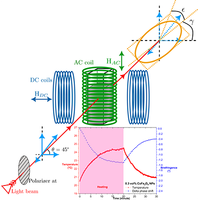
The authors report here an in situ method for probing the temperature during hyperthermia experiment, through the real-time monitoring of optical properties of magnetic nanoparticles. A setup allows inducing magnetic hyperthermia using an alternating magnetic field while simultaneously measuring the magneto-induced birefringence and optical absorption. As the temperature increases, the birefringence and absorption of magnetic nanoparticles decrease and vice versa. These findings offer a noninvasive and nondestructive method for probing temperature, and in particular provide a way to measure local temperature.

Dynamics in the presence of local symmetry-breaking impurities

Yahui Li, Pablo Sala, Frank Pollmann, Sanjay Moudgalya, and Olexei Motrunich

Phys. Rev. B 112, 155108 (2025) - Published 2 October, 2025

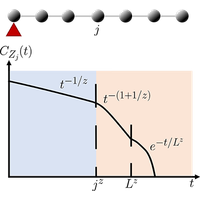
While symmetric systems are ubiquitously studied in physics, imperfections inevitably occur. This work introduces a general framework to study how symmetry-breaking impurities influence the relaxation dynamics of quantum many-body systems. The authors analytically show that the remnants of the original symmetries can persist for long times, leading to slow relaxation in correlation functions with a larger power-law decay exponent or long prethermal plateaus. The methods apply to both conventional symmetries, such as charge conservation, and unconventional ones like Hilbert space fragmentation.

Resonant inelastic x-ray scattering investigation of Hund's and spin-orbit coupling in 5d2 double perovskites

Felix I. Frontini, Christopher J. S. Heath, Bo Yuan, Corey M. Thompson, John Greedan, Adam J. Hauser, F. Y. Yang, Mark P. M. Dean, Mary H. Upton, Diego M. Casa, and Young-June Kim

Phys. Rev. B 112, 165103 (2025) - Published 2 October, 2025

The interplay of spin-orbit coupling and electronic correlation in multiorbital crystalline systems has a profound impact on their magnetic and electronic properties. Unfortunately, these energy scales are similar in 5d systems and are difficult to disentangle even with knowledge of the electronic energy levels. Here, the authors remove this ambiguity by comparing L2 and L3 edge resonant inelastic x-ray scattering measurements of 5d2 double perovskites and using dipole selection rules to determine the energy scales of spin-orbit and Hund’s coupling.

Metallic collinear antiferromagnets with mirror-symmetric and asymmetric spin splittings

Vladimir A. Zyuzin

Phys. Rev. B 112, 165104 (2025) - Published 2 October, 2025

Supercavity mode enhanced near-field radiative heat transfer between Mie resonators

Chen Ni, Asim Ur Rahman, Tianle Chen, Xinran Li, Rui Chen, and Yungui Ma

Phys. Rev. B 112, 165301 (2025) - Published 2 October, 2025

Three-Majorana cotunneling interferometer for non-Abelian braiding and topological quantum gate implementation

Zhen Chen, Yijia Wu, and X. C. Xie

Phys. Rev. B 112, 165402 (2025) - Published 2 October, 2025

Interaction effects on electronic Floquet spectra: Excitonic effects

Teng Xiao, Tsan Huang, Changhua Bao, and Zhiyuan Sun

Phys. Rev. B 112, L161106 (2025) - Published 2 October, 2025

Quantifying non-Hermiticity using single- and many-particle quantum properties

Soumik Bandyopadhyay, Philipp Hauke, and Sudipto Singha Roy

Phys. Rev. B 112, 134201 (2025) - Published 1 October, 2025

Large enhancement of the intrinsic spin Hall conductivity in W-N compounds

Quynh Anh T. Nguyen, Do Duc Cuong, Min Hyeok Lee, Minkyu Park, Young Keun Kim, and Sonny H. Rhim

Phys. Rev. B 112, 134401 (2025) - Published 1 October, 2025

Near complete laser-induced modulation of the ferromagnetic-antiferromagnetic phase fraction in FeRh films

Alexis Pecheux, Robin Salvatore, Laura Thevenard, Jon Ander Arregi, Vojtěch Uhlíř, Morgan Almanza, Danièle Fournier, Catherine Gourdon, and Martino LoBue

Phys. Rev. B 112, 134402 (2025) - Published 1 October, 2025

Multiple Majorana bound states and their resilience against disorder in planar Josephson junctions

Pankaj Sharma and Narayan Mohanta

Phys. Rev. B 112, 134501 (2025) - Published 1 October, 2025

Ductile Al7MgH2 superconductors with Tc up to 64 K at ambient pressure

Chong Tian, Juan Du, Hong-xia Zhong, Yao-hui Zhu, Xinqiang Wang, and Jun-jie Shi

Phys. Rev. B 112, 134502 (2025) - Published 1 October, 2025

Superconducting properties of Fibonacci chains with enhanced superconducting pairing at the boundaries

Quanyong Zhu, Guo-Qiao Zha, A. A. Shanenko, and Yajiang Chen

Phys. Rev. B 112, 134503 (2025) - Published 1 October, 2025

Renormalization group analysis of the many-body localization transition in the random-field XXZ chain

Jacopo Niedda, Giacomo Bracci Testasecca, Giuseppe Magnifico, Federico Balducci, Carlo Vanoni, and Antonello Scardicchio

Phys. Rev. B 112, 144201 (2025) - Published 1 October, 2025

Sign In to Your Journals Account

Filter

Recent Issues

Vol. 114, Iss. 24
15 October 2026
Vol. 114, Iss. 23
15 October 2026
Vol. 114, Iss. 22
15 October 2026
Vol. 114, Iss. 21
1 October 2026
Category
Article Type
Section

Filter

Article Lookup

Enter a citation